
Mohammad Eslami and Ibrahim al-Marashi – Middle East Eye July 3, 2025
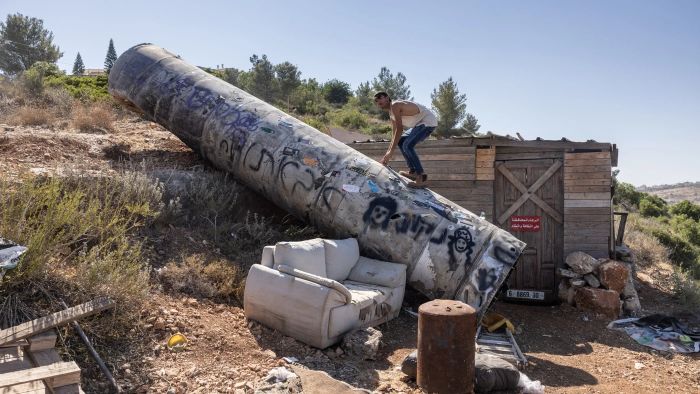
A man climbs on the remains of an Iranian missile in the Israeli settlement of Neria near Ramallah, in the occupied West Bank, on 29 June 2025, following the 12-day war between Israel and Iran
An uneasy US-brokered ceasefire between Israel and Iran has ended a 12-day exchange of strikes, with Israeli Prime Minister Benjamin Netanyahu declaring victory. It marked one of the shortest wars of the 21st century.
Yet Iran, too, has claimed victory, much like it did at the end of the Iran-Iraq War from 1980 to 1988, the longest conventional war of the 20th century, when then-Iraqi President Saddam Hussein also declared victory.
In both cases, Iran was the target of attack and framed the conflicts as “imposed wars” (jang-e tahmili), arguing that they were launched with a “green light” from the United States.
Also in both cases, Iran paired its declaration of victory with a posture of strategic patience (sabr-e rahbordi) – a doctrine of restraint aimed at shifting the balance over time.
After the Iran-Iraq War, it waited, letting time and circumstance play to its advantage. It was ultimately the US, not Iran, that dismantled Saddam’s weapons of mass destruction during the 1991 Gulf War and later overthrew him entirely in 2003.
From Tehran’s perspective, the same strategic patience principle is being applied again today.
The current ceasefire, while publicly welcomed, is widely seen – especially in Iran’s political and military circles – as a tactical pause rather than a sustainable peace.
Strategic pause
For Iran, the ceasefire with Israel serves a clear strategic purpose.
In line with its long-standing approach of strategic patience, time is a resource. Iran will recalibrate its nuclear strategy, expand regional alliances, and test the limits of international resolve.
During this period, Iranian planners are expected to re-examine their deterrence doctrines, potentially including asymmetric naval capabilities and cyber operations, while crafting a long-term retaliatory posture.
Time provides Tehran with critical breathing room to: first, restructure its leadership; second, replenish its arms; and third, plan an international diplomatic offensive.
In June 1981, the Islamic Republican Party was bombed, killing its secretary-general, Mohammad Beheshti and 74 high-ranking officials. That same month, Iran lost one of its most influential military commanders, Mostafa Chamran, on the front lines with Iraq.
In August 1981, Iran’s newly elected president, Mohammad-Ali Rajai and Prime Minister Mohammad-Javad Bahonar were assassinated in a bombing at the prime minister’s office in Tehran.
The attack was carried out by the Mujahideen-e Khalq (MEK). This armed opposition group had turned against the Islamic Republic and allied itself with Saddam’s regime during the Iran-Iraq War.
The bomb was planted by Masoud Keshmiri, an MEK operative who had infiltrated the government posing as a security official. The explosion killed eight high-ranking officials, including the president, prime minister, the chief of national police, senior military advisers, and members of the Supreme National Security Council, making it one of the deadliest acts of internal sabotage in the early years of the war.
Nevertheless, despite the loss, Iran was still able to launch a counter-attack that expelled all Iraqi forces from Iranian soil.
Rebuilding and rearming
On the morning of Friday, 13 June 2025, Israel launched its most extensive military operation against Iran to date.
Its strikes went far beyond nuclear and missile facilities, targeting senior military commanders and scientists. Among those assassinated were Major General Mohammad Bagheri, Iranian Revolutionary Guard Corps commander Hossein Salami, and aerospace chief Amir Ali Hajizadeh, along with several nuclear scientists and military officials.
Yet Iran was still able to mount missile attacks against Israel, overwhelming its vaunted anti-missile defence system.
Iran can now shift its focus towards rebuilding and rearming.
—
The war depleted Iran’s short- and medium-range missile stockpiles and damaged its missile-launching infrastructure, much of which was targeted in the initial waves of Israeli and US strikes.
In this new phase of calm, Iran is expected to prioritise the replenishment and modernisation of its missile arsenal, including newer classes such as the Fattah and Kheibar Shekan hypersonic missiles, while bolstering its air defences to anticipate any future surprise attacks.
One of the most critical lessons Iran has drawn from this recent war is that victory in a modern conflict is not achievable without a capable and advanced air force.
While Iran’s reliance on missile and drone-based deterrence showcased some tactical strengths, it also exposed a critical vulnerability: such systems alone are fragile when confronted with advanced aerial and electronic warfare capabilities.
To address this strategic gap, Iran is now expected to urgently pursue the acquisition of Russia’s S-400 air defence systems and Su-35 fighter jets.
Simultaneously, Chinese combat aircraft, such as the J-10 and the fifth-generation J-20, which demonstrated their capabilities in the recent India-Pakistan standoff, are being seriously considered.
Beyond these platforms, Iranian military planners have acknowledged another significant deficiency: the lack of airborne early warning systems.
Even the most advanced ground-based air defence becomes severely limited without Airborne Warning and Control Systems (Awacs), which are essential for real-time detection and coordination. Thus, the acquisition of Awacs aircraft from China or Russia has become an urgent priority in Tehran’s defence modernisation agenda.
Beyond the battlefield
Iran is also laying the groundwork for a legal and diplomatic counteroffensive.
Iranian officials have already announced their intention to submit a comprehensive complaint to the International Court of Justice, holding both Israel and the US responsible for initiating an undeclared war and violating Iranian sovereignty by targeting nuclear facilities protected under international law.
Until this legal process reaches a stage of formal recognition and judgment, Tehran has made it clear that it will not return to the nuclear negotiation table.
This pivot away from negotiations is not a sign of retreat, but a calculated manoeuvre. Meanwhile, another crucial variable remains hidden from international view: Iran’s president has signed a law suspending cooperation with the International Atomic Energy Agency under Director-General Rafael Grossi, citing biased oversight and political pressure.
Prior to the war, and unbeknownst to most intelligence services, Tehran had reportedly transferred large quantities of enriched uranium from Fordow and Natanz to undisclosed secure locations.
These reserves remain untouched by US and Israeli strikes, as no radiation was reported in Iran – indicating the stockpile was most likely undamaged. Iran could also choose not to disclose the whereabouts of these uranium stockpiles, using them as a strategic deterrence lever in future confrontations or negotiations.
In light of all these factors, the current ceasefire is not a resolution – it is a chapter in a much larger, unfinished story.
Iran’s actions, both during and after the war, underscore a coherent and disciplined doctrine: absorb the blow, retaliate with calibrated precision, and use time as a tool of power. Strategic patience, for Tehran, is not passive restraint; it is a form of long-term psychological and political warfare.
Whether the ceasefire holds or shatters under the weight of unresolved tensions will depend not just on missiles or negotiations, but on which side better understands the value of time.
Mohammad Eslami is an Assistant Professor of International Relations at the University of Minho, a visiting fellow of International Security at Dublin City University, Ireland, and a Max Weber Fellow of International Security at European University Institute, Florence, Italy. He was also a fellow of Arms Control Negotiation Academy led by Davis Center for Russian and Eurasian Studies of Harvard University. His research primarily focuses on the proliferation of conventional and unconventional weapons in the Middle East region.
Ibrahim al-Marashi is associate professor of Middle East history at California State University San Marcos. His publications include Iraq’s Armed Forces: An Analytical History (2008), The Modern History of Iraq (2017), and A Concise History of the Middle East (forthcoming).
the big picture
what you must understand is irans fight is also our fight
irans resistance to jewish control
is important for us in as much
as we pay 5000 per second to rothschilds banks
for our national debt
if israel is destroyed their murderous grip on out country is diminished
we need to fight for our freedom
excatly as adolf hitler did for the people of his country and gaddhafi and saddham hussein did
There’s so much toxic Nazi language in this article.
‘Iran testing international resolve’.
It, he, heshe, bot, AI-bot, whatever, this came from the MI6/Langley writing pool.
I am not making excuses for Iranian folly, but agreeing to this pause, because IT IS NOT A CEASEFIRE, is a massive mistake.
Iranian religious doctrine says that when your enemy says stop, you also stop. Joolandia begs for a pause, because they were massively beaten. Only on days 11 & 12 did Iran start using its bigger and faster missiles. Israel was about to have it’s big Joo nose pushed to the back of its cranium. lol Yes it’s funny.
Bibi: ‘let’s pause, so I can warm up my nukes, or get Donald Hitler to do it for me’.
Aside from the fact that Nazi Joos respect no laws, not even the laws of God, a ceasefire is a legal commitment to negotiate, to predetermined goals. These must be set before the ceasefire starts.
For instance, there’s a possible Joolandia ceasefire with Hamas, but there are details still to be agreed. One of those details is that the IDF baby killers withdraw from certain positions in Gaza. I’ll have more luck on the lottery.
There’s no legal ceasefire between Iran and Joolandia. Putin offered to mediate, but Donald Hitler rejected his offer, but maybe he’ll filp flop, it’s his medication. I suspect Donald Hitler has some form of blood cancer, hence his puffyness, and super strong makeup.
Nazi Amerika knew Iran had moved their nuke materials and centrifuges, so used smaller bombs in Iran, and Iran didn’t shoot down any B2s, because Russia said, ‘What’s the point’, but the diehard Nazis broke cover, saying massive fail, which DH didn’t like, so now we’re back to bombing.
The problem is, where, becauase the Nazis are clueless. How many nukes do we use? Of course, this has nothing to do with nukes. The Nazi Joos won’t be happy, until Iran is back in the stone age, and it’s not going to happen. Iran has some big friends.
As Putin gave North Korea advanced ICBMs and nuke warheads, why not do the same deal with Iran? Maybe this is going on right now because like North Korea, Iran is, or has left the IAEA, and will probably leave the NPTreaty.
Talk about the Nazis kicking themselves in the bollox. lol
There might be a long pause, but the war won’t be a long war when it restarts.
Who will spend the debt rebuilding Joolandia, when it’s going to be rubblised in round 2?
Sure, Iran can fight a long war, but Joolandia can’t. They are a small illegal state with one international airport, and two ports. You can bet that Russia and China will provide all the targeting info that Iran needs.
I have been reading “the Giant with Feet of Clay” by Juergen Graf, the giant in question being the book that was the most important Holocaust book for a period of 25 years. People lacking Graf’s ability to read 1100 pages carefully never found out that Raul Hilberg’s book on the subject had no substance, the point being that what is true for Holocaust books is true for modern Israel–it stands on feet of clay, and cannot exist without a Lie Industry, (including films like Swindler’s Fist by Spewelberg)
Divert the white man from his own war/predicament (i.e, the invasion of the West by millions of wogs; white woman mulatto-mongrel makers & the genocide of whites in Ukraine by anti-white Eurasian Russia) onto Jew & wog conflicts/issues (Israel/Palestine/Iran) far away.
Nico X was always right.his many disciples too
‘Liar’ owned the truth.hence the inversion.’in times of universal deceit, telling the truth is a revolutionary act”.
No comments on the rocket?
why is this carl jones jew nutjob allowed duplicate posts??
Xmuz
true the liar and nico x (and their supporters) were the best posters on here..one is banned , don’t know what happened to the other
Rixon:
Jews are passing off some old discarded concrete pipe with decades old graffiti on it as an “Iranian rocket”…lol
77th brigade asshole carl jones is still pedling his nonsense
its about time he was kicked off the comments
Agreed @Mr. Crowley,
If that fat pipe had been piece of a missile, it would have shown all kinds of dents and scratches, and more importantly, it would have caused some obvious damage at the landing site—obviously a kike trash heap, dirty and disordered as can be due to kikes’ inability to do any man’s labor and clean it up.
Settler kikes are living inside their own assh0les and enjoying it.
“Iranian officials have already announced their intention to submit a comprehensive complaint to the International Court of Justice” …. HAhahahaha yeah, try the jewdiciary, that’ll surely, ummm, do f*ck all. Satanic entities such as Jewry, Israhell, and the Jewnited States don’t give a standing piss about the limp dick “international court” when they are on the receiving end.
…then we have multiple pseudonyms of Nico talking about how great Nico is/was… If we made a drinking game out of how many Nico pseudos comment about himself on a piece, we’d all be piss drunk in short order.
lobro
excellent