
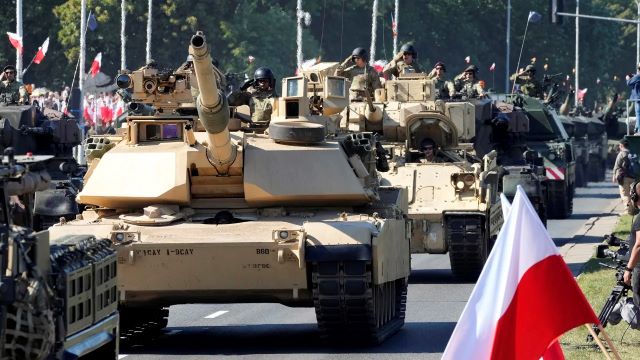
Polish military parade 2023
Wojciech Kość – Politico May 27, 2025
Since Poland unveiled its goal to train every adult male for war, being a Polish passport-holder has taken on a different character.
Hollywood A-lister status is no exception.
“There’s really nothing to be afraid of!” Polish Prime Minister Donald Tusk teased U.S. actor Jesse Eisenberg in a social media video. The 41-year-old Eisenberg was awarded Polish citizenship earlier this month for his role in a “A Real Pain,” an Oscar-nominated drama about estranged Jewish cousins reuniting for a Holocaust tour through the country.
Days after Eisenberg became a citizen, Tusk revealed plans for a dramatic military expansion.
“We’ll give you such a training that the new James Bond role? It’s yours!” Tusk said. The Polish PM underlined that the training is voluntary.
Poland spent almost two centuries as a colony of Moscow and retains a deep-seated wariness of the country. Russia’s full-scale invasion of Ukraine in 2022 has kicked that worry into overdrive.
Warsaw is now NATO’s biggest defense spender at 4.7 percent of GDP, has the EU’s largest army, and is spending billions of euros on jets, rockets, tanks, artillery and more.
Now the frontline state is getting its population ready for war.
Were a full-scale conflict to erupt, Poland doesn’t have the strategic depth of some other European countries, Chief of the General Staff of the Polish Armed Forces General Wiesław Kukuła told POLITICO.
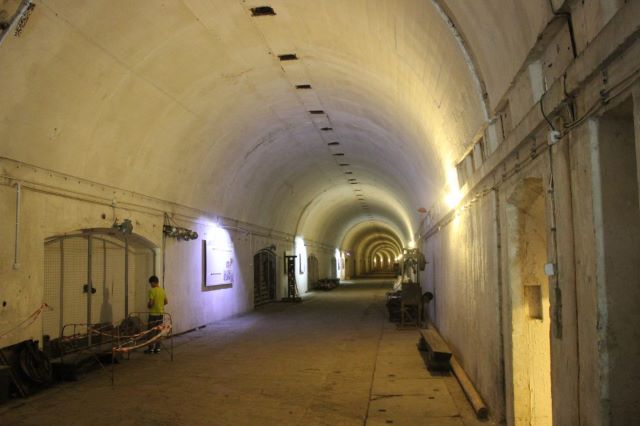
The government has also ordered that bomb shelters in Warsaw be refurbished and resupplied. Click to enlarge
“We are neighbors with the Russian Federation and its ally Belarus, so we don’t have a buffer between us and them, and we have only a limited time to prepare and respond,” Kukuła said.
Instead of relying on space to hold off the Russians, Poland is planning to more than double its military to half a million troops and to train millions of reservists, Tusk told parliament earlier in March.
“By the end of the year, we want to have a model ready so that every adult male in Poland is trained for war, and so that this reserve is adequate for possible threats,” Tusk said in parliament, adding that women can also sign up.
The training will be voluntary, he said, seeking to offset concerns of a return to the country’s hugely unpopular conscription policy, which ended in 2008.
For Poland, a high-income country with some of the strongest economic growth rates in the EU, the switch to battle-readiness will mark a shift in mindset — and many of its citizens are eager to get started.
“I really want to go through training, and if it comes to it, fueled by hatred for [Russian President Vladimir] Putin, I want to defend my home, shoot at them, and make their lives hell,” said Marek, a 37-year-old media producer from Warsaw, granted permission to use a pseudonym to speak candidly.
“I want to defend everything I’ve worked for, everything I’ve built. In this country I’ve earned my home, my own place, my safe space, and no Russian bastard is going to take that from me. They can fuck off back where they came from.”
Modus operandi

Polish soldiers hold positions during live fire excercises in Cincu, Romania. Click to enlarge
The details are still being hammered out by the military, which is expected to propose a plan by the end of March, Kukuła said. Legislative work is expected to start soon after.
Authorities plan to roll out short-term military training programs aimed at civilians with no prior experience, the Rzeczpospolita newspaper reported. These crash courses, lasting just a few days, will introduce participants to the fundamentals of civil defense, first aid and select military skills.
For those with prior military training, the government is offering targeted refresher courses designed to sharpen specialized skills, including firearms proficiency, combat medicine and land navigation.
Civilians looking for more comprehensive preparation can enroll in a month-long training program, available in both in-person and online formats.
“The first [goal of the training program] is to improve the availability and quality of reservists,” Kukuła said. “Currently, the army has a large number of reservists, but their average age is already around 45. If conflict and pressure on Poland persist for an extended period, well-trained reservist resources will be essential to ensure they can operate alongside professional soldiers and the Territorial Defense Forces.”
The initial plan is to train 100,000 people by the end of 2026, he said.
“The second goal is even more important — we must prepare society for the effects of a crisis, even if not everyone undergoes military training,” he said.
But time might not be on Poland’s side, some senior military figures warn.
“[The] Russians are building a massive army in the rear. If peace is not reached and the split within NATO continues, Russia will attack the Baltic states,” former Deputy Chief of the General Staff of the Polish Armed Forces General Leon Komornicki said. “This could happen at the end of this year or the beginning of next. An invasion is part of their plan.”
Jarosław Kraszewski, former commander of Poland’s missile, rocket and artillery land forces, told Radio Zet that Tusk’s plan was a case of too little, too late.
“Training 100,000 people a year? Too few. We should bring back [the] draft,” the general said. “We have switched to a consumerist lifestyle, the joys of democracy, and traveling around the world without any problems, but we have forgotten that each of us should have basic knowledge in this area.”
Wartime mentality
Polls suggest the idea has some popular backing — but it’s far from overwhelming.
Over half of Poles support the initiative, while 39 percent said they’d be willing to participate, according to one survey. Another poll found that around two-thirds of Poles would remain in the country if war broke out, while a third would try to flee.
“If war were to come to us — which I consider unlikely but not impossible — then contrary to what Donald Tusk says today, conscription would be reinstated, and men, with few exceptions, would be banned from leaving the country,” said Patrycja Wieczorkiewicz, a journalist at the left-wing publication Krytyka Polityczna.
“I cannot imagine fleeing in such a situation … leaving behind my friends, colleagues and others,” she said.
But she said her motive isn’t patriotism. “This would not be a fight for Poland, but against a fascist-imperialist aggressor who kills, rapes and tortures. Based on what Tusk said so far, the program will be extensive, including truck driving courses, so I believe there will be something suitable for me too,” Wieczorkiewicz said.
But not everyone is prepared to go to war to defend the country.
A recent report by the Gazeta Wyborcza newspaper quoted Polish urbanites who doubted their country has offered them enough to leave them feeling obliged to pay it back.
“I am a patriot, I love my country, but that does not mean I have to die for it. I would be of no use in a war — except as cannon fodder,” a student told the newspaper. “My attachment to this country is defined by the taxes I pay and the fact that [it] offers me no real chance of starting a family in decent conditions,” the student said, alluding to Poland’s sky-high housing prices and the most expensive mortgage rates in Europe.
The government must go the extra mile to ensure sufficient interest in the program, military expert Marek Kozubel said.
“Financial incentives will be crucial, along with an effective marketing campaign highlighting the benefits of enrolling in training programs. These should include skills that are also useful in professional life, such as advanced knowledge for mechanics or drone operation,” Kozubel said.
The training will strive to offer Poles skills “useful in both wartime and peacetime, such as cybersecurity or medical training,” according to Kukuła. “These skills may be beneficial in the job market as well.”
Incentives being considered include financial compensation or tax breaks for participants and their employers, the general added. “We want the Polish state to make it clear that we respect those who contribute to our defense.”
“No one will be turned away,” Defense Minister Władysław Kosiniak-Kamysz told Polish Radio. “Not everyone will become a soldier, if only due to age, but they can receive training in civil defense, first aid and crisis response.”
The military training for adults appears to be just part of a larger system the Tusk government is trying to build, expecting the worst from Russia.
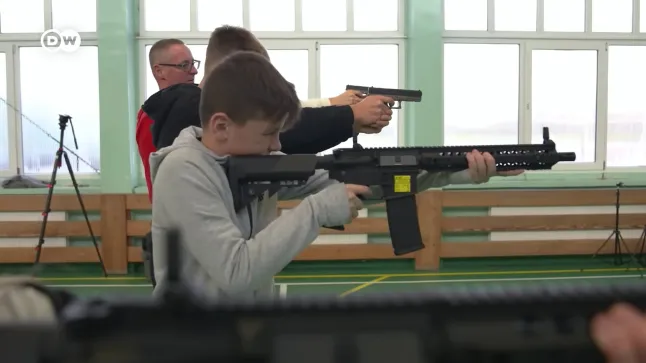
Polish school children undergo firearms training. Click to enlarge
A school program called “education with the army” is being expanded, and gym lessons will also feature a civil defense component, possibly starting in September.
“If we are prepared, and if Russia knows we are, this will be a significant deterrent,” Kukuła said. “In my opinion, it will be strong enough that Russia, knowing this, won’t even start a conflict.”
All we need now is for the Bwitish Eshstabwishment to stick its big Juice Nose in
– maybe Charlie could even issue a Woyal Pwoclamation! –
vowing to “stand by” those DUMB Polaks until the last THICK Brit has been “processed” in the “meat grinder”….
with, meanwhile, the Mass-Migration Turd Whirled Takeover of Britain being ramped-up to warp-speed to replace those White THICK Brits wiped-out on the Russian Front…
😒
Still too many whites on planet for mongrel moschiach to arrive. Coming soon: Waste Whitey III. We got Holodomor II rolling in Ukraine thanks to our Chabad agents Putin & Zelensky pretending to be ‘enemies’ as they slaughter millions of dumb whites. Shalom.
poles never get enough of warmongering . they
hate russians deeply . hate is a cancer .
How does Poland imagine it will have the money to continue the war it wants to be a part of? The US is broke and not only is Trump not trying to fix it but his crazy policies are smashing it harder–all while the EU said nothing after the US and maybe Norway ended its cheap energy and killed off its industry. The US and Europe are done, we just don’t know where the bottom is yet. Poland may be starting something it never needed to, because the costs of it to continue are unlikely to be met. And once it starts it’s in until the end, and while it can’t be certain Russia will survive this war intact it can be guaranteed Poland won’t.
8 billion wogs on the planet now. Less than 500 million whites left. Time to start Waste Whitey III soon & put the kibosh on the white man.
They’re all in it together. NATO has been preparing for war against Russia for a long time.
Shimon Peres boasted that the jews owned most of Poland so…
Poland, huh? Terrifying. *cough cough* Well, they say every dog has its day…except Poland is a flea-infested organ grinder monkey…
The shit talking Donald Tusk should have his teeth bashed out with bricks, stripped naked, his kneecaps shattered, get violently sodomized by a mob of randy Russians soaked in vodka and viagra, then his head forced up the ass of a pig while the wide end of a flaming cricket bat gets stuffed up his ass.