
Hannah Ellis-Peterson, Shah Meer Baloch in Islamabad and Aakash Hassan – The Guardian May 8, 2025
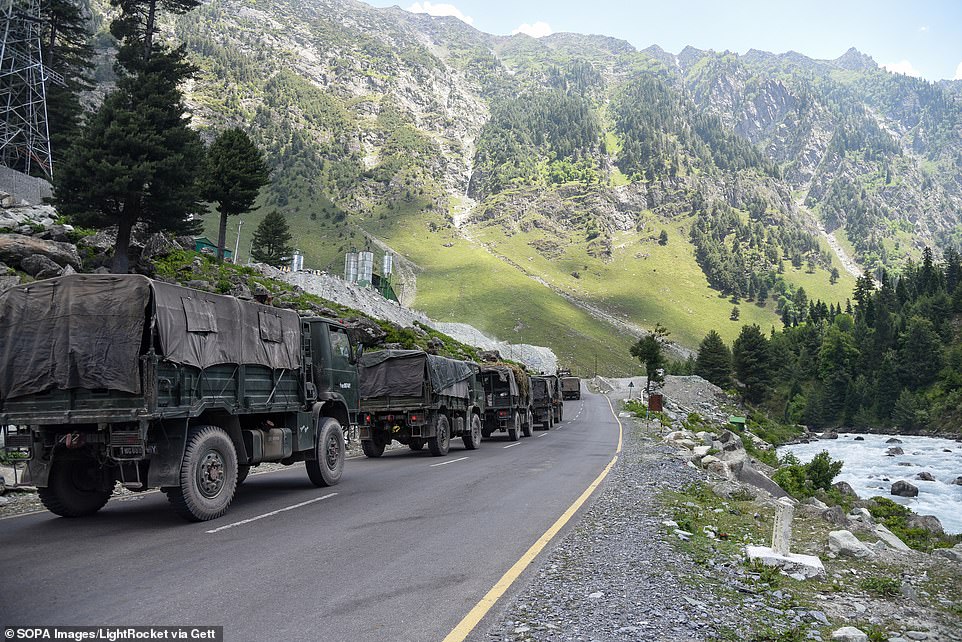
Indian Army convoy moves along the national Highway leading to Ladakh. Click to enlarge
Pakistan has warned that it will “avenge” the death of 31 people killed in overnight missile attacks by the Indian air force, raising fears of an escalating conflict between the two nuclear-armed countries.
In a late night address to the nation late on Wednesday, Pakistan’s prime minister, Shehbaz Sharif, said: “We make this pledge, that we will avenge each drop of the blood of these martyrs.”
His comments came after Pakistan’s government accused India of “igniting an inferno” with strikes on nine sites in Pakistan-administered Kashmir and the Pakistani province of Punjab and authorised its military to take “corresponding” retaliatory action against India.
India said the strikes were a direct retaliation for an attack in Indian-administered Kashmir late last month, in which militants killed 25 Hindu tourists and their guide. India had accused Pakistan of direct involvement in the attacks, through Islamist militant organisations it has long been accused of backing
In an interview with the Guardian in Islamabad, Pakistan’s deputy prime minister, Ishaq Dar – who is also the foreign minister – said the country would go to “any extent” to defend its dignity. “We reserve the right to authorise the armed forces to take any proper actions in response – and those will be measured, proportionate and responsible,” said Dar.
He refused to be drawn into a timeline on any reprisal attacks but said the plans would be led by the country’s army chief Gen Asim Munir, who would consult with the coalition government. “What measures we can take when and where – I think it’s too premature to be discussed at this stage,” said Dar. “There is no minimum or maximum response time.”
Dar was adamant that until now, Pakistan had exercised “patience and maximum restraint” in the face of India’s accusations and attacks. “Yes, there is a huge economic loss attached to any full-fledged war. But when the question [is] of sovereignty, integrity of the country, territorial integrity, dignity of the nation, then there is no price,” he said.
Dar also expressed his frustration at the international community, which has so far been reluctant to get involved in the latest dispute between India and Pakistan, beyond urging restraint. Calls by Pakistan for assistance in carrying out an independent investigation into the Kashmir attacks had gone unanswered, he said.
Under previous presidents, the US was highly proactive in helping to de-escalate conflicts between India and Pakistan, often averting all-out war. However, Dar noted that the Trump administration had been reluctant to take on the same mediation role. “Yes, in the past US presidents have played an active role. But each administration has its own style of working,” he said.
He added: “It is also the responsibility of the global community because any consequences and negative economic impacts of any such war will not be limited to India-Pakistan. It will cross international boundaries eventually.”
After India’s airstrikes on Wednesday, which killed 31 people, including several children, and injured dozens more, it jubilantly claimed victory over Pakistan.
The Indian army said the strikes had targeted terrorists and terrorist training camps for two Islamist militant groups, Lashkar-e-Taiba and Jaish-e-Mohammed, which have long been accused of freely operating out of Pakistan and have been implicated in some of India’s deadliest terror attacks.
“We killed only those who killed our innocents,” said India’s defence minister, Rajnath Singh, while the home affairs minister, Amit Shah, said the government was “resolved to give a befitting response to any attack on India and its people”.
The Indian army described the missile strikes as “not escalatory, proportionate and responsible”.
Pakistan said that the “unprovoked and unjustified attacks martyred innocent men, women and children”, and denied the existence of any terrorist camps or infrastructure in the areas struck by India. This was reiterated by Dar, who said there were “no terrorist outfits” in the areas struck by India.
For the first time since the India-Pakistan war in 1971, Indian missiles struck inside Punjab, Pakistan’s most politically and militarily important province, killing at least 16 people there
At a meeting of the national security council on Wednesday, Sharif’s government gave Pakistan’s military authorisation to take action to defend the country’s sovereignty “at a time, place, and manner of its choosing”.
At a session of parliament on Wednesday, Bilawal Bhutto Zardari, co-chair of the Pakistan People’s party, which rules as part of the coalition government, reaffirmed the country’s right to defend itself and said that Pakistan’s answer to India’s attacks “has yet to come”.
“Pakistan has the right to respond to this attack however it wants,” he said.
Kashmir, in the foothills of the Himalayas, has been disputed since the partition of India and the formation of Pakistan in 1947. Both India and Pakistan claim it in full, but each administers a section of the territory, separated by one of the world’s most heavily militarised borders: the “line of control” based on a ceasefire border established after the 1947-48 war. China administers another part in the east.
India and Pakistan have gone to war three times over Kashmir, most recently in 1999.
There were indicators that India had also suffered losses in Wednesday’s attacks, which were carried out by military aircraft and drones from within India’s own airspace. Pakistan claimed that about 80 Indian jets had taken part in the strikes, and said it had “exercised restraint” by shooting down just five.
The Indian government remained tight-lipped about all aircraft reportedly shot down, but debris of at least three planes was reported in areas across Indian-administered Kashmir and India’s Punjab state.
In the Indian-Kashmir village of Wuyan, Adnan Ahmad, 25, reported hearing a loud crash at about 1.40am. “When I rushed to window I saw an aircraft in flames falling down,” he said. “There was another aircraft moving above the falling aircraft. The aircraft landed near a school building, hitting trees. There were multiple explosions from the fallen wreckage for around an hour.”
From the early hours of the morning, there was heavy firing between Indian and Pakistani forces across the line of control. According to officials in Indian-administered Kashmir, at least 12 civilians on the Indian side had been killed since Wednesday morning. Pakistan reported that at least five people had been killed from shelling on their side of the line.
Parvez Khan, the chief medical officer of Poonch, one of the border areas that suffered the worst damage in the cross-border shelling, said 42 people were being treated for injuries.
“Two of my relatives were seriously wounded when a mortar shell hit their home this morning,” said Safeer Abdullah, a Poonch resident who expressed anger over rising India-Pakistan tensions.
“We’ve endured this violence for generations; our ancestors suffered, and now we do too. Every hour here feels like it could be our last. The shelling has been so intense that no one within 150km of the border can sleep or eat properly.”
As the firing continued throughout the day, thousands of residents living near the line of control on the Indian side of the border were forced to evacuate to safer areas. They described living in terror amid what they called a “rain of artillery fire” that damaged homes, a Sikh temple, agricultural fields and vehicles.
Another resident, Abdullah Khan, said he had been confined to a basement with six of his family members since the overnight attack. “Mortar shells have been landing around us since last night. While many have managed to flee to safer areas, we haven’t found an opportunity to escape,” he said.
On Wednesday, the US, UK, China, Iran and UAE all called for a swift de-escalation of the conflict. The British prime minister, Keir Starmer, said the UK was “engaging urgently with both countries … encouraging dialogue, de-escalation and the protection of civilians”.
Donald Trump called for India and Pakistan to halt their fighting, saying: “I want to see them stop. We get along with both countries very well, good relationships with both, and I want to see it stop.”
Larry Johnson, who I believe is still working for the CIA, directly, or indirectly suggests Western intelligence could be involved in terror attacks in India.
If we go back to that period, it was discussed on here, and I said, half the Pakistani military worked for the CIA, and even so, the other half of Pakistan could rise up, and take control of Pakistans nukes, so the US had plans to drop troops into Pakistan and take control of the nukes.
Then LJ mentions Chechnya, and Russias subsequent successful operation to suppress the breakaway, and LJ suggests Western intel was at play. Of course, being CIA, he needs to be careful, because this was also discussed on this site and I said that MI6 was behind the uprising in Chechnya and had even corrupted Russian soldiers to aid the uprising. We know this, because of the Beslan school seige, where Russian soldiers allowed the Chechnays terrorists to escape.
Then we had Benazir Bhutto who lived in the UK, or maybe Paris (memory?), was clearly encouraged to return to Pakistan and run for power, but she survived an MI6 assassination attempt, and she knew who was behind this. Days later she appeared on Al Zazzera’s Across this/the World, hosted by MI6 Divad Frost (Nixon interviews). Benazir Bhutto disclosed the real Bin Laden killer, and this was live in newsrooms across the world, but Frost blanked this staggering revelation as if she’d said nothing, and not a single presstitute in the entire official fake news system, batted an eye lid! Bhutto knew she was dead ewe walking, and days later, MI6 had her assassinated.
LJ does report on the disclosures made by the Pakistani foreign minister, that Pakistan does what it’s told to do by MI6 and the CIA. You can read LJs article on his site.
The point is this, who benefits from a war between a Pakistan that’s about to collapse, and an India which is slowly becoming a failed state? Donald Hitler might demand they stop, but this isn’t what the Nazi deep states in Nazi UK and Nazi Amerika wants. Destabilising this region, has a destabilising effect on both Russia and China, and this benefits bankrupts, because in times of major instability, money rushes into the US dollar, or, more specifically, into US treasuries/bonds, worthless US paper, and at the same time, US financials have been instructed, on pains of death, to buy US debt.
Donald Hitler’s much vaunted cut backs and MIC cuts, have been reversed, and some.
If this conflict breaks out into a major war, all Nazi states benefit, including Joolandia, who spends an inordinate amount of time bullying India, or cutting deep sea cables that have cut india off in the past.
Yes more hard evidence of Nazi evil. This is why Putin needs to do humanity a big favour and nuke the UK. I could talk about Imran Khan, but he’s still alive.
Interesting.
It will be a surprise to wonder….
who the starmer admi’ decides to side with, (If/when it all kicks off) they’ll be OBLIGED to pick a side, So the RAF know which people to boom boom. decisions decisions,
My brass is on India ! because it’s all about brass..
Front row seats selling fast ! to see how long the porkies can keep ‘them’ apart in our provincial towns, resplendent in their summer non-combat gear. maintaining the softly -softly approach, they may find it challenging.
Being a “citizen” of the jew-k, I can’t say I care if islama-pakis slaughter indiana-pedos. Having seen the enclaves and tasted the sweet nectar of their loving embrace, I hope they wipe each other off the face of the earth.
The Pakis should look on ‘The Bright Side:
Even if thy have to part with Kashmir… they’ll ALWAYS have BritStan!
Ain’t that right.. Sadick Kunt??
Well, it is true that it’s difficult and and also unneccesary to take sides in this war. However it seems that India blocked the flow of the river Indus which is the only sourse of water for Pakistan, both drinking water and agricultural water. By doing this India broke an old treaty existing between these two countries, the treaty which prohibited doing such a thing. Of course, it could be spinned any way – that because of the war and this and that…but the fact is that the actual source of the river Indus is…in China.
And China is an unofficial ally of Pakistan… And to build a damb and divert the flow ow water Chinese could do it very quickly if they decide to.