
Mike Whitney – The Unz Review May 6, 2025
On Thursday, President Donald Trump delivered a fiery statement on his Truth Social website. He said:
ALERT: All purchases of Iranian Oil, or Petrochemical products, must stop, NOW! Any Country or person who buys ANY AMOUNT of OIL or PETROCHEMICALS from Iran will be subject to, immediately, Secondary Sanctions. They will not be allowed to do business with the United States of America in any way, shape, or form. Thank you for your attention to this matter, PRESIDENT DONALD J. TRUMP @realDonaldTrump
Most people who read Trump’s statement assumed that the president was planning to tighten economic sanctions on Iran. But that misses the point entirely. The real target is China because China imports 85-90% of Iran’s oil output, roughly 1.5 million barrels per day (bpd). What Trump is saying in blunt terms, is that, if China continues to purchase oil from Iran “they will not be allowed to do business with the United States of America in any way, shape, or form.” In other words, Trump is doubling down on his tariffs policy (which is 145% on Chinese goods) and imposing a complete embargo. Trump was apparently hoping that this new threat would force Beijing to the negotiation table where they would make the concessions that he seeks.

But the Chinese are not giving an inch, in fact, Beijing is more resolute than ever. China’s Foreign Minister has said repeatedly that Beijing will not bow to Trump’s bullying, nor will they negotiate until all the unilateral tariffs are removed. The western media has deliberately misled its readers on this point by making it seem like there’s “wiggle-room” on the Chinese side. But there is no wiggle room. Either Trump lifts his tariffs or there will be no talks. And if there are no talks, there will be no trade. End of story.
China believes it has the moral high-ground on this issue because it is defending the rules of international trade which cannot be changed by executive fiat or the arbitrary actions of an impulsive autocrat who thinks the system should be reconfigured to suit his interests. Chinese leaders have made it quite clear that they are not going to budge on an issue which they consider to be a matter of principle.
The Era of Bullying is Over.
Not bowing to bullying, not compromising on justice. #China‘s principled response to U.S. #tariffs has won global solidarity, from small businesses to emerging economies. By striking back, China defends shared values and a fairer world.#opinion pic.twitter.com/vj5rxk5Mv3
— T-House (@thouse_opinions) May 4, 2025
What that means in practical terms, is that Trump is going to be forced to cave in. And he is going to be forced to cave in sooner than many Americans realize. Activity at U.S. ports on the West Coast, has slowed significantly as of early May, and the absence of imports will become increasingly noticeable as May drags on. Take a look:
According to Gene Seroka, Executive Director of the Port of Los Angeles, predicted a 35% decrease in cargo arrivals for the week following April 29, 2025, compared to the same period in 2024….
For the week of May 4–10, 2025, only 17 vessels carrying 85,486 twenty-foot equivalent units (TEUs) were scheduled to arrive, a 28.6% drop from the prior week and 10.5% lower than the previous year.
Approximately 45% of the port’s business comes from China, and many large importers, including major retailers, have paused or halted shipments from China due to tariffs as high as 145% on Chinese goods….
Port of Long Beach is also experiencing a steep decline in freight vessel traffic from China. For the week of May 4–10, 2025, only 12 vessels were scheduled to arrive, down from 22 the week of April 20–26… China accounted for 61% of Long Beach’s containerized imports in 2024, making it highly vulnerable to the trade disruptions….
Broader Trends:
Nationwide, ocean container bookings from China to the U.S. have fallen 20% year-over-year, with some reports indicating a 60% drop in bookings over the past three weeks since tariffs intensified.
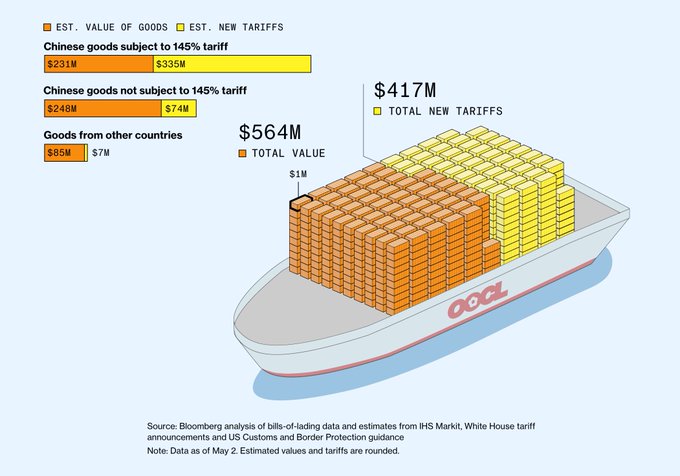
What we are seeing now is a slow-motion trainwreck that was entirely avoidable, and which will severely damage the US economy. Many experts now think we could see a near 50% year-over-year drop in West Coast port activity accompanied by critical supply chain breakdowns similar to those that would occur during a World War. The dearth of imports will affect everything from unemployed dockworkers and truckers, to wholesalers and retailers, to Mom and Pop stores across the country. The knock-on effect will result in higher prices, mass layoffs, slower growth and volatile, chaotic markets. For the first time in living memory, Americans will experience real shortages, panic buying and empty shelves, reminders of the self-inflicted wound brought on by poor leadership.
At the same time, China is unlikely to feel much pain at all. Keep in mind, China not only has a current account surplus of $422 billion (Economist Brad Setser argues that China’s “true” surplus may be $300 billion larger), nominal GDP of $18.1 trillion, with gross domestic savings at $8 trillion in 2023, and household savings at $19-20 trillion 2024… The Chinese government also has $3.1 trillion foreign exchange reserves. ($784.3 billion of which are US Treasuries)
In contrast, the United States is $36 trillion in debt, with credit card debt soaring to $1.2 trillion, (according to the Federal Reserve Bank of New York), U.S. student loan debt currently topping $1.75 trillion, and a majority of American families that claim to be unable to cover even a $500 emergency. (without procuring a loan.)
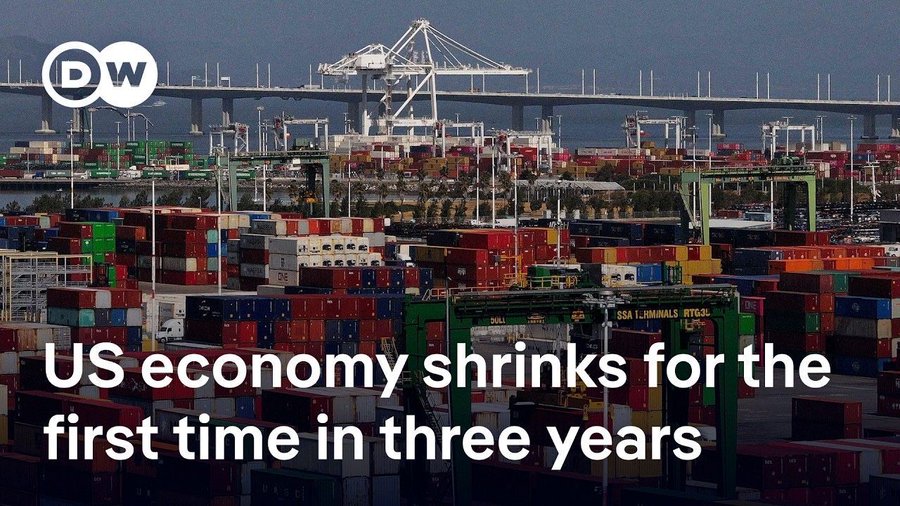
In short, China is flush with cash while the US is drowning in an ocean of red ink. Secretary of the Treasury Scott Bessent would like you to believe that America’s lack of funds put it at an advantage in its competition with China. But that is not the case. China’s massive savings enable the government to heavily invest in projects that keep the economy expanding during financial crises, trade wars or recessions. So, while Trump continues to lay-off more government employees and slash federal expenditures, (which slows growth) China is diverting its surplus into fiscal stimulus that will keep workers employed and the economy growing. Check out this excerpt from an article at the Global Times:
China’s stepped-up fiscal policies are emerging as a pillar in its efforts to stabilize the economy, offering much-needed support to sectors under financial strain and helping the world’s second-largest economy weather persistent global uncertainty.
In 2025, the country pledged to intensify counter-cyclical adjustments, raising the deficit-to-GDP ratio to 4 percent and setting the government deficit at 5.66 trillion yuan (about 786 billion U.S. dollars), both at their highest levels in recent years.
While vowing a more proactive fiscal policy, China plans to issue 1.3 trillion yuan in ultra-long special treasury bonds, up from 1 trillion yuan in 2024, alongside 4.4 trillion yuan in local government special-purpose bonds.
Data points to an accelerated roll-out of bond issuance. In the first quarter alone, the total issuance of government treasury bonds surpassed 3.3 trillion yuan, while local government bond issuance exceeded 2.8 trillion yuan, an over 80 percent increase from the same period last year.
These funds are swiftly being channeled into efforts to boost consumer demand, accelerate infrastructure investment, and subsidize people in difficulties. Economists said this front-loaded fiscal drive reinforces short-term stability and leaves ample leeway for further issuance of ultra-long treasury bonds and capital support measures for banks later in the year.
So far, the efforts have been translating into robust domestic demand…. Retail sales of consumer goods, a key barometer of economic strength, rose 4.6 percent year on year in January-March, with the figure in March recording the strongest single-month growth since 2024…..
Ramped-up financial support has also been directed toward local governments, enabling them to advance major infrastructure projects vital for sustaining investment momentum.…
“In the first quarter, our project received 1.497 billion yuan in local government special-purpose bonds, which has been instrumental in keeping construction on track,” said the project manager.
Aside from more expansionary fiscal spending, local governments have been granted more flexibility in channeling their special-purpose bonds toward project categories, an effort to enhance investment efficiency and regional responsiveness.
Results suggest that the policy shift has gained traction…. Infrastructure investment jumped 5.8 percent year on year… the bond supply may exceed expectations in the second quarter, as the government looks to offset external challenges through fiscal expansion. “The faster pace of issuance enhances counter-cyclical adjustment and creates space for future policy maneuvering,” Feng noted. China’s financial salvo gains speed to shore up economic growth, Global Times
What’s ironic, is that China grasps the economic theories of John Maynard Keynes better than anyone in the Trump administration. In Keynes masterpiece, The General Theory, the British economist pointed out that that recessions occur due to insufficient aggregate demand that can be offset by government fiscal stimulus. (which makes up for the loss of private investment and personal consumption) Stimulus injects money into the economy, which encourages further consumption, and keeps the economy growing during slumps, financial crises or trade wars. Once the crisis has passed or the recession ends, the government can withdraw its stimulus and balance its accounts.
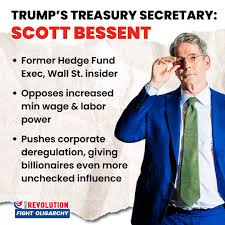
We shouldn’t expect a similar response from the neoliberal economists in Trump administration who view every crisis as an opportunity to implement their far-right, “shock doctrine” theories about shrinking government, lowering taxes, and further strengthening the western oligarchy. And we shouldn’t confuse Trump’s blather about economic nationalism (America First) as being the driving force behind the China tariffs. The real driver is Wall Street as we will explain in a minute. But first, a word about Trump’s Treasury Secretary Scott Bessent, Wall Street’s man in the White House. This is from Wikipedia:
Scott Bessent is a former hedge fund manager who was formerly a partner at Soros Fund Management (SFM) and founded Key Square Group, a global macro investment firm….. In September 1992, he was a leading member of the group that profited by $1 billion on Black Wednesday, the British Pound sterling crisis. He made another $1.2 billion profit for SFM in 2013 betting against the Japanese yen. After he left the Soros Fund in 2015, he established Key Square Group, a hedge fund….
In 2000, Bessent hosted a fundraiser for Al Gore at his home in East Hampton, New York. That year, he also donated $1,000 to John McCain. In 2007, he donated $2,300 to Barack Obama and in 2013, he donated $25,000 to Hillary Clinton’s campaign. At that time, he was described as a Democrat who supported liberal causes….
In 2016, after the election of Donald Trump, Bessent donated $1 million to Trump’s 2017 presidential inaugural committee. In 2023 and 2024, he donated more than $1 million to Trump’s 2024 presidential campaign…. Bessent has advocated pushing for concessions from U.S. trading partners to restrict their economic relationships with China in order to isolate China and gain leverage over it in potential trade talks.
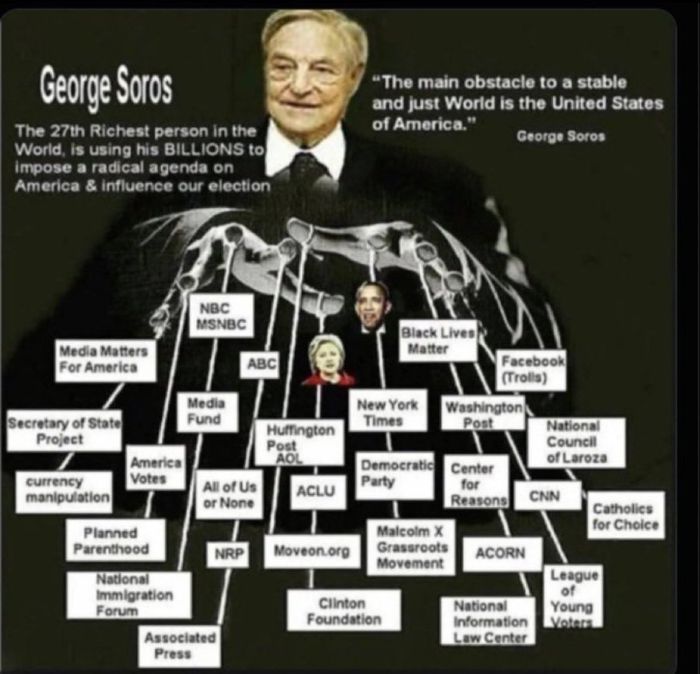
So, Bessent worked for globalist billionaire George Soros, contributed to whatever political party might end up in power, and made his bones as a high-flying hedge fund manager.
Are we supposed to believe that a man like Bessent—who is obviously a creature of Wall Street—has launched a trade war on China to bring jobs back to the United States and rebuild the anemic US manufacturing sector?
No, that is not his real objective. Bessent is Wall Street’s man in the White House. His job is to do everything in his power to remove the obstacles that block the banksters from access to China’s massive savings and financial markets. Thus, the goal of the Trump tariffs is not reindustrialization. It’s ‘open markets’. Here’s more from Grok:
Bessent’s push for China to open its markets includes liberalizing its financial and capital markets, which directly involves Wall Street banks. Here’s how they fit into his vision, based on his April 2025 statements and broader trade policy:
Access to China’s Financial Sector:
Bessent’s Demand: China should remove restrictions on foreign financial institutions, allowing U.S. banks to operate freely in its $18.6 trillion economy, particularly in banking, asset management, and securities. Bessent argues this would integrate China into global finance, reducing trade imbalances by fostering a “fair deal” (April 23, 2025, Institute of International Finance). (Note—So, providing access to China’s financial markets would reduce trade imbalances?? In other words, no need for rebuilding manufacturing in the US, just let the banksters ‘do their thing’ and everything will be hunky-dory.)
Wall Street’s Role: Banks like JPMorgan, Goldman Sachs, and Morgan Stanley seek greater market share in China’s $55 trillion financial sector (2024, including banking and securities). Currently, foreign banks hold only 1.3% of China’s banking assets ($59 trillion) and face caps on ownership (e.g., 51% in securities until 2020 reforms)….(Note—“Hand over the $55 trillion and nobody gets hurt.” Where have we heard that before?)
Benefit: Opening markets would allow Wall Street to compete with Chinese banks, tapping into China’s $19-20 trillion household savings. (Note—“Wall Street wants access to your personal savings, too.”)
Scott Bessent, as U.S. Treasury Secretary in April 2025, demands that China “open their markets” to address trade imbalances, reduce export overcapacity, boost domestic consumption, and liberalize trade and capital markets….. Wall Street banks—major U.S. financial institutions like JPMorgan Chase, Goldman Sachs, Morgan Stanley, and Citigroup—play a significant but complex role in Bessent’s demands. They stand to benefit from China’s market opening, particularly in financial services and capital markets, but their involvement also raises concerns about financial extraction and geopolitical tensions… (Note- Well, duh!)
Bessent’s Demand: China should relax capital controls, allowing freer flows of foreign investment and yuan convertibility, integrating its $3.1 trillion foreign exchange reserves and $12 trillion bond market into global finance. Bessent sees this as part of “restoring equilibrium” to global markets. (Note—China is being asked to trust its national savings with the crooks who blew up the financial system in 2008 costing the world over $50 trillion.)
Bessent’s Demand: China’s market opening is a condition for de-escalating the trade war... Financial market access is a key U.S. demand in talks(Q3 2025 target, per Reuters). (Note—There it is in black and white; ‘You either do what we say, or we blow your brains out. Can you see what’s going on here??)
Bessent’s Demand: China’s state-driven model, with $7.894 trillion savings and $422 billion surplus…. Bessent wants China to “graduate” from developing-nation status at the World Bank, opening markets to reduce its financial dominance. Grok
So, Bessent is ordering China to abandon its state-owned economic model (which is the primary reason for its success) to ensure that the world’s wealth remains in the hands of the world’s richest Capitalists. In other words, Bessent is candidly admitting that he is leading the effort to obliterate the most successful “economic development model” in history simply because it is not under the control of voracious western oligarchs. It’s not only an admission that the tariffs are a smokescreen aimed at concealing the administration’s real motives (access to China’s financial markets). It is also an admission that the western model is no longer competitive because the (Chinese)state recycles profits into more productive outlets while western oligarchs divert profits into stock buybacks, dividends, derivatives-trading and other forms of unproductive activity. One system creates an optimistic future for all of humanity while the other generates crushing poverty, political instability, and war.
There’s no doubt which system is better.
LOL…
The Yankee economy is made in China, that’s why Tricky Dicky went there, well that and because the big Money ‘financialists’ told him to…
So off he trundled with Hank the troll Kissinger…after he’d taken his meds and the world off the gold standard… which of course has now mysteriously disappeared..
Now we have the the pseudo science economics, explicating the desired where and very unwhys..
Yes, the Yankee economy is being detonated, by the people that run it, ready for the move to China* (hint: they are already there)…they will probably use Melon Husks govern-mente chump bots to target the american populus with chinky drones and endless netflix pabulum while cackling insanely… a sort of noahide censure…
*The old empire is always collapsed before the move to the new one, because even if it is no longer supplying surplus value to the hollow men, it may be lol, problematic.. which is why you have all this theatre…you have to apply the laws of inversion to ascertain the correct coordinates.. of course America is continental so it’s not going to be as easy as the denouement of pirate rock…so I should imagine some sort of totatlit-aryan stay behind militarised junta to mitigate threat…probably a black one… which would explain a lot..
‘going forward’…to charlie chan land..where obviously a fake war will do to the yankees what they did to Hitler..
Today at around 3pm Nazi UK time, Donald Hitler will announce a comprehensive UK trade deal where he states on his Truth Social, this will ‘CEMENT’ ties with Nazi UK.
What this really means is that Nazi Amerika is literally taking over the UK. Sure, the UK Nazis will attempt to make policy, but that policy will be totally on Nazi Amerikan terms.
We already know that barriers to toxic US food will be dropped and food standards diluted. How this will impact on EU trade isn’t clear, but from what I understand, it’s going to have a massive impact. Any UK products that contain US gunk, or even suspected of, will probably be blocked from the EU.
Effectively, Donald Hitler’s tariffs have made the UK Nazis hand over the keys.
Before this trade deal, your vote was irrelevant, because Nazi UK was a one party Nazi state, but now you’re going to be ruled as a 52st, 53rd, or whatever, Amerikan state.
Will thicko sheeple even know what’s transpired, doubtful.
In other news, Nazi UKraine and MI6 were clearly given a very stern warning about the consequences of any attacks on Russian parades today, but that doesn’t mean MI6 won’t get the RAF to strike St Petersburg and Moscow.
A good point from David DuByne in a recent Bitchute video is that this will have damaging effects on the stock price value of US companies, not just because goods won’t be bought and sold in normal trade, but because such a drop in market activity means businesses can no longer demonstrate their true value. If they’re not trading and showing profit, loss and costs then investors cannot truly gauge their worth.
A lot of money could be pulled from Wall Street. There’s no point investing in a company whose value can’t be known while these tariffs continue. Pulling the money out to invest it in non-western markets makes the most sense because the UK and EU might cut their own throats when Trump tells them to.
Satan makes a counterfeit God world and China makes a counterfeit Aryan world. They are an irritating shadow
FACT #1 – In the 1970’s the major owners of the central banks (the “money power”) and big business through their puppets Kissinger and Nixon opened trade with communist China, which some people just happen to think was a prodigy nation of that same cabal ever since Mao came on the scene in that nation.
FACT #2 – Once trade was opened with China in 1979, the same cabal and their agents the MOTU (Masters of the Universe) of Wall Street sought to get very, very rich based the low-cost (LC) labor of China, with huge outsourcing and joint ventures with the Chinese government, using the unprotected Western markets to flog their LC goods.
FACT #3 – “Coincidentally” the same cabal believed the foreseeable debt from the resulting trade imbalances and loss of manufacturing in the West would be balanced with the agreement to trade in US dollars, maintaining control of the money supply, while maintaining the US as the leading arms manufacturer and supplier on the globe, and with whiles of the MOTU in flipping large debt instruments for large profits, in much the same way they rebuilt Europe with the Marshall Plan after WWII.
FACT #4 – “Coincidentally” the same money-power cabal was the center of not just of “internationalism” through such insanity as the “spread of communism” (a threat which they fueled and also capitalized upon), but mainly that form of internationalism which was more respectable coming from their control of money, credit, debt, trade, industrial development, multinational corporations, major resources and markets on a global basis, which largely was dependent on the prowess of the US military and the practice of debt rigging every nation the cabal could entrap their their coercive lending practices.
FACT #5 – “Coincidentally” the same money power cabal upon opening trade with China took giant strides to establish a centralized globalist government (self described as the “New World Order”), with a vision to centralize and consolidate control over virtually everything on the planet, such that by 1992 not only was the “communist” threat no longer useful to them, but also in that year they managed to have 178 of the 179 nations on the globe world endorse in Rio their sweeping UN Agenda 21 plans for the their “planned” centralized controls through the 21st century. Of course, they had been very busy in the proceeding two decades debt rigging those nations along with ensuring all of their puppets were installed in places of power and influence.
FACT #6 – The resulting “globalist” movement became the official policy of every cabal debt-rigged nation and especially those in the West, which were systematically being transformed mainly through the open-society policies. DEI, and “free trade” from being the free “creditor” nations of the past into the highly cabal-controlled “debtor” nation of today. None of this could have been done without the deliberate industrial waking up of China.
FACT #7 – The economic success of China was built not just on the hard work of the Chinese people but mainly on the huge outsourcing operations from the West together with their ability to exploit unprotected Western markets through their LC labor. This process predictably resulted not just in China becoming wealthy and a major power, but for the actual heart of the globalist movement (the money-power cabal and the MOTU traders and corporations) also to become enormously wealthy.
FACT #8 – “Coincidentally” the NWO globalists who actually “made” China into the power which it has become, and despite its totalitarian government and its xenophobic culture, they in fact chose that nation as the “model nation” for their WEF NWO.
FACT #9 – All of the so-called major “conspiracy theories” such as the global-warming & climate change hoaxes, the 9-11 false flag, the 2007 economic crash, the wars and forced migrations, and the Covid plandemic, are now fact, and each one of them were actual NWO “globalist” conspiracies intended to usher mainly the Western nations into the centralized UN Agenda controls. Without that lead and example in their nation-busting and population culling efforts in the West, they had no authority to impose the same polices on the rest of the world. All of the debt rigging, economic degrowth, nation busting, “open society” border crashing, culture cancelling, rights denying, zero equity, and ownership usurpations has come directly from that same cabal source. It has all been aimed mainly at the West, and to make their agendas succeed they have mounted one engineered crisis on us after another.
FACT #9 – Guess what? The cabal and their catspaw MOTU of Wall Street Fecked Up. China, India, Russia and other nations have no intention of becoming vassals of the NWO globalist order. Also, the people of the West have been waking up to how their cultures, fertility, futures, and wealth have been pillaged and destroyed by the same cabal.
FACT #10 – If any Western nation, people, or culture wants to survive and prosper economically, culturally, and demographically, and to take back control of their lives and destinies, the people have to wake up and unite to denude the cabal and their agents of their powers, end all of the massive deceptions, and obtain & provide full disclosure and transparency to the people on every major issue.
FACT #11 – Trump is an instrument of the US deep state which is the main instrument the cabal has used in the globe to user in the NWO. Populism is being manipulated now by the cabal with “multipolar” globalism, to enable the superpower nations to absorb more and more lesser nations into their respective spheres. The decision of the powers appears to be to back off of the more centralized quest for a unipolar globalist NWO. The US deep state has not changed its spots or its owners.
FACT #12 – Trump is a prodigy of the cabal and the MOTU just as much as was Biden. He showed his true colors along with the help of the US deep state in their election interference in the recent federal elections in Australia and Canada to ensure the NWO globalist regimes remained in power, and the that the rival political parties lost their election bids. These rival parties “coincidentally” wanted to strengthen their nations & follow Trump’s nation-first example, and they were set to win before that interference.
Whitney you pathetic Far Left retard!! That is LAST WEEKS NEWS MORON!!
They should put a heavy tax on pink frilly bondage trousers
that would mess up that little stupid tart