
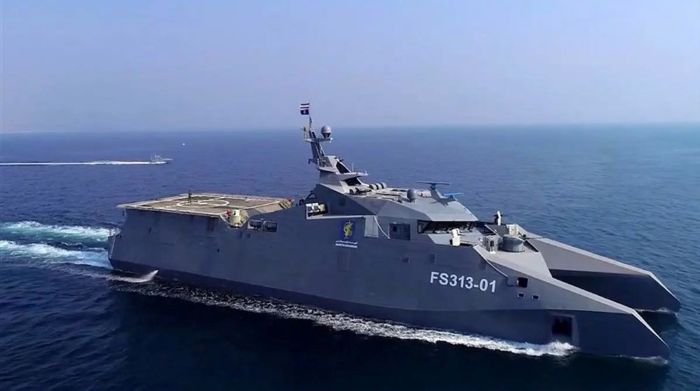
IRGC Navy’s Shahid Soleimani
Press TV – April 30, 2025
The Islamic Revolution Guards Corps (IRGC) has built a missile boat with a speed of 116 knots (215 km), the IRGC Navy chief says, lauding Iran’s cutting-edge military achievements used to safeguard the Persian Gulf.
Rear Admiral Alireza Tangsiri made the announcement on Wednesday, on the occasion of the Persian Gulf National Day, which usually falls on April 30.
The day marks the anniversary of the expulsion of the Portuguese Navy from the Strait of Hormuz in 1622.
“We have built a missile boat that has a speed of 116 knots, which is equivalent to 215 kilometers per hour on land, and it has passed all technical and specialized tests,” Tangsiri said.
Stressing that the IRGC Navy builds its own vessels, missiles, drones, and submersibles, Tangsiri said, “We work day and night to ensure the security of the Persian Gulf.”
Pointing to the capabilities of the force, the commander said, “We recall that before the [1979] Revolution we could not even build a small fishing boat; an American company built them for us. But now we have built the Shahid (Martyr) Soleimani vessel with the most advanced technology, which can navigate the oceans for 5000 nautical miles non-stop.”
The Persian Gulf — spanning some 251,000 square kilometers — is bounded by the Arvand River in the north, which forms the frontier between Iran and Iraq, and the Strait of Hormuz in the south, linking the Persian Gulf to the Sea of Oman and the Indian Ocean.
The strategic inland sea is an international trade route connecting West Asia to Africa, India, and China.
It has been referred to by historians and ancient texts as “the Persian Gulf” since the Achaemenid Empire was established in what is now modern-day Iran.
Persian Gulf enjoys ‘inherent importance’
Elsewhere in his remarks, the commander of the IRGC Navy said the Persian Gulf has an inherent importance, and the deepest coasts as well as the best and most suitable international waterways are located on the Iranian side.
“The Persian Gulf holds a very important economic position. Oil and gas exports in this region are very high, such that 40% of the region’s gas and 62% of its oil are exported from the Persian Gulf, which indicates the importance and economic position of the Persian Gulf,” Tangsiri said.
“The position of the Persian Gulf is very important in terms of security, and we have repeatedly sent messages of peace and friendship from the Islamic Republic to the countries of the region, and we have repeatedly said that we are seeking peace, friendship, and brotherhood.”
Touching on the daily passage of vessels through the Strait of Hormuz, the commander said, “Today, we are proud to have established the security of the Strait of Hormuz and the daily passage of more than 80 ships in this region, all of which indicates the significance of this crucial and strategic region.”
Tangsiri underscored the security of the Persian Gulf region and said the presence of extra-regional forces would be disruptive given their “sinister” plots.
“Insecurity in the strategic Strait of Hormuz has international dimensions and impacts on the economy, and is therefore extremely important and strategic. What matters to us in the Persian Gulf is peace, security, brotherhood, and friendship. We believe that the presence of foreigners in the Persian Gulf will disrupt security,” he said.
“A region that is strategic and economic is very important to us and neighboring countries, and certainly the enemies are pursuing two sinister goals: one is their illegitimate presence in the region, and the other is the sale of weapons in the strategic Persian Gulf region.”
Tangsiri underlined, “We are seeking security, but be absolutely sure that those who come to this region from thousands of miles away are not after security in this region.”
COLLAPSE OF LBGT AGENDA
According to a Wall Street Journal report, companies are reassessing their LGBTQ sponsorships under mounting morality pressure and economic concerns.
LBGT leaders have confirmed that the simultaneous withdrawal of several corporate sponsors this year is unprecedented. reports: PepsiCo, Nissan, Citi, and PricewaterhouseCoopers have also opted not to renew their corporate sponsorships this year, according to the outlet. However, a few companies are not withdrawing entirely, the article adds, with some maintaining a paid presence through branded booths or supporting smaller homosexual events.
Nissan’s move was part of a broader review of marketing and sales spending, a company spokesman told the WSJ. Other LBGT events such as those in St. Louis and San Francisco are reportedly losing key sponsors like alcoholic beverage companies Anheuser-Busch InBev and Diageo, though the latter will continue smaller sponsorship through its Smirnoff brand.
The main cause for concern is the persuasion of children to undergo sex change operations, children going through this often have deep regrets around the age of 20
Critics have also drawn attention to the LBGT Adult/child sex agenda
Wow..
They’ll be bloody good at the next Olympics in the water skiing comp.
or at least they should be….
🙂
Even ‘Jet Spray’ speed boat rides from Margate harbour wall in the early 60’s weren’t that fast..
Mablethorpe council should get one in… to help increase day tripper numbers.