
David Averre and Kumail Jaffer – Daily Mail April 28, 2025
Pakistan’s defence minister has claimed that India is preparing to launch a military incursion into Pakistani territory, raising fears of a war between the nuclear-armed neighbours amid escalating tensions in Kashmir.
Fresh fighting erupted last week in Kashmir – a territory that has been disputed between India and Pakistan since the British partition of India in 1947 – after gunmen killed 26 people near the town of Pahalgam in the worst attack on civilians for a quarter of a century.
The shooting, which Indian authorities believe was carried out by Pakistani assailants, prompted a flurry of military and diplomatic action as both sides moved to militarise along the ‘Line of Contact’ (LoC) that separates Indian- and Pakistani-administered Kashmir.
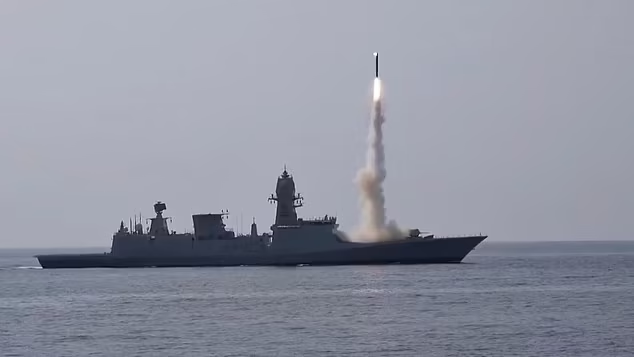
India launched naval drills, test-fired several long-range missile systems and suspended a key treaty that ensures India supplies Pakistan with water from the Indus River, a provision that is crucial for Pakistan’s water supply and agricultural economy.
Pakistan in turn deployed its air force to close its airspace to Indian airlines and has mobilised its army with footage appearing to show artillery batteries and armoured vehicles on their way to the LoC in anticipation of a major conflict.
Both sides have exchanged small arms fire across the LoC for the past four days, according to government and military officials.
Pakistani Defence Minister Khawaja Muhammad Asif today told Reuters in an interview at his office in Islamabad: ‘We have reinforced our forces because (an incursion) is something which is imminent now. In that situation some strategic decisions have to be taken, so those decisions have been taken.’
He added that India’s rhetoric was ramping up and that Pakistan’s military had briefed the government on the possibility of an Indian attack, though he gave no details as to why he thought an incursion by India’s forces was in the offing.
Asifs statement came after Pakistan’s railway minister, Hanif Abbasi, dramatically declared at the weekend that his nation’s nuclear arsenal of more than 130 missiles were ‘not kept as models’ and were reserved ‘only for India’.
‘These ballistic missiles, all of them are targeted at you,’ he concluded in a chilling warning.
The brutal attack that stoked tensions in Kashmir unfolded on April 22 in the Indian-administered region of Jammu and Kashmir.
The majority of the dead were Hindu tourists from India, with reports from witnesses and survivors claiming the gunmen, who remain at large, were ordering civilians to recite Islamic prayers and shooting those who were unable to do so.
A Pakistani militant group known as The Resistance Front (TRF) claimed responsibility in the wake of the attack, only to rescind the statement days later and blame the initial claim on a communications breach.
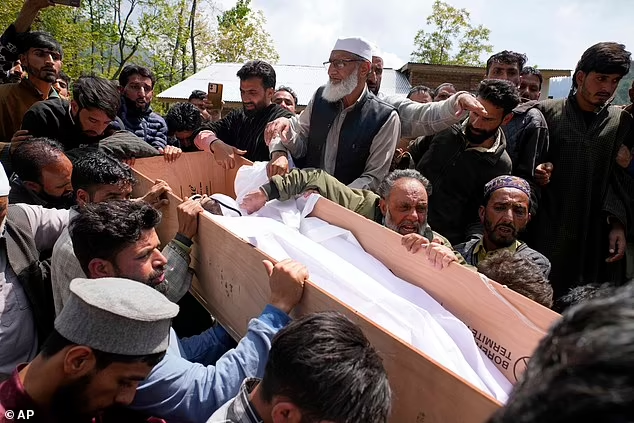
The body of Adil Hussain Shah, who was killed in the April 22 shooting, is carried for burial
India accused Pakistan of supporting ‘cross-border terrorism’ as authorities concluded the gunmen were Islamic militants and identified two of the three suspected shooters as Pakistani.
But authorities in Islamabad have denied any involvement, calling attempts to link Pakistan to the attack ‘frivolous’ and vowing to respond to Indian action.
An all-out conflict between the two nuclear-armed nations could prove devastating for the 15-million-strong population of the disputed territory.
India’s defence forces have conducted several military exercises across the country since the attack, though many of them were reported to be military preparedness drills.
Security forces have detained around 500 people for questioning after searching nearly 1,000 houses and forests around the site of the attacks in their hunt for the militants and further evidence, a local police official said this morning.
Several houses belonging to Muslim families living in Indian Kashmir were demolished in the course of the operation, prompting regional political leaders to ensure the innocent are not harmed in the government’s actions against terrorism.
‘It’s time to… avoid any misplaced action that alienates people. Punish the guilty, show them no mercy but don’t let innocent people become collateral damage,’ Omar Abdullah, the chief minister of Jammu and Kashmir said on X on Saturday.
Another former chief minister made an appeal to the Indian government ‘to take care that innocent people are not made to feel the brunt as alienation aids terrorists’ goals of division and fear.’
But the Indian government is pressing ahead with a raft of measures in response to the shooting.
Prime Minister Narendra Modi issued a stern warning that New Delhi would ‘identify, track and punish every terrorist and their backers’ and vowed to hunt the shooters ‘to the ends of the Earth’.
Last week, India’s Ministry of External Affairs declared it was suspending visa services for Pakistanis.
‘In continuation of the decisions made by the Cabinet Committee on Security in the wake of the Pahalgam terror attack, the Government of India has decided to suspend visa services to Pakistani nationals with immediate effect.
‘All existing valid visas issued by India to Pakistani nationals stand revoked with effect from 27 April 2025.
‘Medical visas issued to Pakistani nationals will be valid only till 29 April 2025.
‘All Pakistani nationals currently in India must leave India before the expiry of visas, as now amended.
‘Indian nationals are strongly advised to avoid travelling to Pakistan. Those Indian nationals currently in Pakistan are also advised to return to India at the earliest.’
India also suspended the World Bank-mediated Indus Waters Treaty of 1960 that ensures water for 80% of Pakistani farms, saying it would last until ‘Pakistan credibly and irrevocably abjures its support for cross-border terrorism.’
The treaty split the Indus River and its tributaries between the nuclear-armed rivals.
Government officials and experts on both sides say India cannot stop water flows immediately, because the treaty has allowed it to only build hydropower plants without significant storage or dams on the three rivers allocated to Pakistan.
But things could start changing in a few months.
‘We will ensure no drop of the Indus River’s water reaches Pakistan,’ India’s water resources minister, Chandrakant Raghunath Paatil, said on X.
Pakistan responded to the moves by suspending all visas issued to Indian nationals under an exemption scheme with immediate effect and closing its airspace to Indian flights.
A statement from Pakistan Prime Minister Shehbaz Sharif’s office said: ‘Any attempt to stop or divert the flow of water belonging to Pakistan as per the Indus Waters Treaty, and the usurpation of the rights of lower riparian will be considered as an Act of War and responded with full force.’
Khalid Hussain Baath, chairman of a national farmers’ union in Pakistan, said India’s move came at a time when there is both a water shortage and low predicted rainfall.
‘This is a true war,’ he added.
The two nations have clashed over Kashmir since 1947, when Britain, which controlled India, split the nation into two, creating an independent India and Pakistan.
The partition of the two nations established Pakistan as a Muslim-majority nation, while India was created as a Hindu-majority nation.
Britain’s decision, passed by parliament in July 1947, also gave Kashmir, as well as Jammu, the opportunity to decide which nation to join.
Kashmir’s monarch, the maharaja, initially decided that his nation should go it alone, claiming that it had been under the yoke of empires for centuries and had been ignored and under-developed.
But ultimately, the then-ruler of Kashmir agreed his nation should join India, in exchange for the former colony providing material support against Pakistan, which later triggered the Indo-Pakistani War of 1947-48.
Years of conflict led to rebels in Kashmir waging an insurgency that began in 1989, seeking independence or a merger with Pakistan.
Meanwhile, China – which also has territorial claims in Kashmir – has urged both India and Pakistan to exercise restraint following last week’s shooting.
Foreign Ministry spokesman Guo Jiakun told reporters in a briefing Monday morning that Beijing welcomes ‘all measures that will help cool down the situation’.
I’d never contemplated that the next ‘Civil War’ in the Yuk-Kay would be between….
Bradford v Oldham, Keighley v Burnley, Rochdale v ‘Uddersfield.
(make your own regional confrontations.)
I assume the pO -lice will be non-existent at the illegal Hindu or Muzzy controlled check points on the main arterial roads. (Kerching !! Dick Turpin would be green with envy.) They’ll hopefully be besieged in their ‘Alamo’ stations. There’ll be no help coming…
From anyone.
Our neighbours will be the biggest problem , stealing everything we’re trying to grow to survive.
‘They’ the Jimmy Grant invaders..own ALL the petrol stations & most of the ‘fast food’ outlets already.
What ! What are we going to do.
Suffer, that’s what.
I’m rather conflicted here as I’d like to see India and Pakistan thoroughly incinerate each other, but I also know that a major conflict in that toilet bowl will only send more hordes of deranged street-shiting mongrels pouring to the already overly-saturated West.
If this goes off big time these good people of India & Pakistan that live in Britain won’t be capable of controlling themselves. Then large areas here will become chaotic with battle lines drawn all over some of our major cities.
Srila Prabhupada once said a nuclear war would devastate parts of the world. It would start with a nuclear exchange between India and Pakistan and involve the main nuclear powers.
I would not wonder if the Kashmir tourist conflict
would involve an israeli/CIA false flag (like Mumbay once).
According to Revilo Oliver, India lost its White Man intellect around 300 AD, and (to me), Islam looks like a conscious attempt to eliminate intellect, beauty, truth and art (except geometric patterns)