
AFP South China Morning Post – April 15, 2025
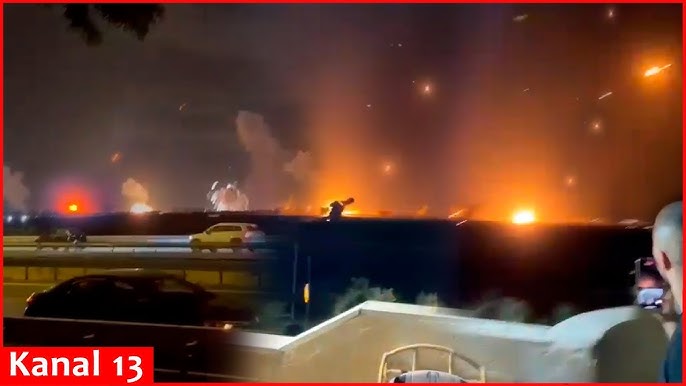
Iranian missiles strike Israel’s Nevatim airbase in Oct 2024
Iran’s Islamic Revolutionary Guard Corps said on Tuesday the country’s military capabilities were off limits, ahead of a second round of talks with the United States on its nuclear programme.
“National security and defence and military power are among the red lines of the Islamic Republic of Iran, which cannot be discussed or negotiated under any circumstances,” Guards spokesman Ali Mohammad Naini said, quoted by state broadcaster IRIB.
Iran and the US will hold another round of talks in Muscat on Saturday, a week after top officials met in the Omani capital for the highest-level discussions since the 2015 nuclear deal collapsed.
President Donald Trump, who withdrew the US from the 2015 deal during his first term, has reinstated his “maximum pressure” campaign against Iran since returning to office in January.
In March, he sent a letter to Iran’s supreme leader Ayatollah Ali Khamenei calling for nuclear talks and warning of possible military action if Tehran refused.
Trump addressed reporters on Monday regarding Iran, saying “I’ll solve that problem” and “that’s almost an easy one”.
The US leader also threatened to attack Iran’s nuclear facilities and called Iranian authorities “radicals” who should not possess nuclear weapons.
Khamenei on Tuesday voiced satisfaction with recent talks with the US, expressing confidence in the Islamic republic’s position but casting doubt on US intentions.
The talks were “well carried out in the first steps. Of course, we are very pessimistic about the other side, but we are optimistic about our own capabilities,” state TV quoted Khamenei as saying.
Iran has repeatedly denied seeking an atomic bomb, insisting its nuclear programme is for peaceful purposes, especially the provision of energy.
Late on Sunday, Iran’s official IRNA news agency said the country’s regional influence and its missile capabilities were among its “red lines” in the talks.
Tehran supports the “axis of resistance” – a network of militant groups opposed to Israel, including Yemen’s Houthi rebels, the Hezbollah armed group in Lebanon, the Palestinian Islamist group Hamas in the Gaza Strip and Shiite militia groups in Iraq.
Last Saturday, Iran’s Foreign Minister Abbas Araghchi met US Middle East envoy Steve Witkoff in Oman for “indirect” talks, according to Iranian officials and media.
The talks were the highest-level Iran-US nuclear negotiations since the collapse of the 2015 accord, formally known as the Joint Comprehensive Plan of Action.
The accord offered Iran relief from international sanctions in return for curbs on its nuclear programme.
Both Tehran and Washington, enemies who have had no diplomatic relations since shortly after Iran’s 1979 Islamic Revolution, have called the latest round of negotiations “constructive”.
Araghchi’s office has said he will travel to Moscow at the end of this week for talks with Russia, a close ally of Iran and party to the 2015 nuclear deal.
Moscow welcomed the Iran-US talks as it pushed for a diplomatic solution and warned any military confrontation would be a “global catastrophe”.
If we take this as red, then Donald Hitler has dug himself a very deep hole.
I hear the Hooties are claiming the USS Harry S. Truman is no longer operational. There was a time when the Nazis felt so invincible that they would have embedded presstitutes onboard one of the carrier group vessels. Today, things are so bad we hear and see nothing from the Nazi side, apart from stock images and video. These days not even the crew can leak what’s really going on, and while I don’t know this for a fact, I doubt the crews on this carrier strike group are allowed contact with their families. It’s never been so tight.
If this carrier is a dead duck, just consider the moral on board. Even if we don’t know, the Russians, Chinese, and many other elites will know.
Trump addressed reporters on Monday regarding Iran, saying “I’ll solve that problem” and “that’s almost an easy one”. — In true diplomatic style — Trumpstein style !!! What a fool.