
Boyko Nikolov – Bulgarian Military April 4, 2025
In a development that has sent ripples through military and geopolitical circles, satellite imagery recently captured by open-source intelligence enthusiast @MT_Anderson revealed the presence of a U.S. Navy destroyer, believed to be the USS Wayne E. Meyer [DDG-108], near Diego Garcia, a remote but strategically vital island in the Indian Ocean.
This sighting comes amid heightened tensions following Iran’s threats to target the island with long-range ballistic missiles and drones if the United States uses it as a staging ground for strikes against Iranian territory. The images, shared on X, show the warship approximately 650 kilometers northeast of the base, raising questions about America’s military posture in the region and the potential for escalation with Iran.
The USS Wayne E. Meyer, an Arleigh Burke-class destroyer equipped with the advanced Aegis combat system, is a formidable asset capable of both air defense and ballistic missile interception, signaling a possible U.S. response to Iran’s provocative rhetoric. As the situation unfolds, the presence of this destroyer underscores Diego Garcia’s critical role in U.S. strategy and the broader chess game playing out across the Indian Ocean.
update: Diego Garcia
Looks like the could be deploying additional air defense capabilities near Diego GarciaSpotted on Sentinel 2, 4 April 2025, ~650 km NE of the base, an Arleigh Burke destroyer (transiting solo) appears to be en route (pretty confident in the ID) https://t.co/56dvEtnTT0 pic.twitter.com/Ba3ifpzQDe
— MT Anderson (@MT_Anderson) April 4, 2025
The USS Wayne E. Meyer is no ordinary warship. Commissioned in 2009 and named after Rear Adm. Wayne E. Meyer, a key figure in the development of the Aegis system, this destroyer represents the cutting edge of naval technology.
As a Flight IIA variant, it measures 509 feet in length, displaces around 9,200 tons, and is powered by four General Electric LM2500-30 gas turbines, allowing it to reach speeds exceeding 30 knots. Its crew of approximately 300 personnel operates a suite of sophisticated systems, but the heart of its capability lies in the Aegis Baseline 9.2.1 [BMD 5.1] configuration.
This system integrates powerful radar, including the SPY-1D[V], with an array of weapons such as the SM-3 and SM-6 missiles, enabling it to track and engage multiple targets simultaneously—whether they be aircraft, cruise missiles, or ballistic threats. With 96 vertical launch system [VLS] cells, the ship can deploy a mix of interceptors, anti-ship missiles, and Tomahawk land-attack missiles, making it a versatile platform for both defense and offense.
Interesting, following recent threats by Iran, that they would target Diego Garcia in the Indian Ocean with long-range ballistic missiles and drones if the United States used the island to launch strikes against Iran; @MT_Anderson has now spotted an Arleigh Burke-Class… https://t.co/TZ3BhAV6T4
— OSINTdefender (@sentdefender) April 4, 2025
Its presence near Diego Garcia suggests a mission focused on protecting the island’s airspace and potentially countering Iran’s missile capabilities, though the Pentagon has not officially confirmed its deployment or purpose.
Diego Garcia itself is more than just a dot on the map. Located in the Chagos Archipelago, this small atoll—roughly 12 square miles—has been a linchpin of U.S. military power projection since the Cold War. Its history is as complex as its strategic value. Originally inhabited by the Chagossians, a Creole-speaking population descended from African slaves and Indian laborers, the island underwent a dramatic transformation in the late 1960s and early 1970s.
Under a secretive agreement between the United States and the United Kingdom, the entire population—over 1,500 people—was forcibly removed between 1968 and 1973 to make way for a military base. The U.S. leased the island from Britain, which retains sovereignty over the Chagos Archipelago as part of the British Indian Ocean Territory, in exchange for a discount on Polaris missile systems.
Since then, Diego Garcia has grown into a heavily fortified outpost, complete with a deep-water lagoon for naval vessels, a 12,000-foot runway for heavy bombers, and advanced intelligence-gathering facilities. Its isolation—over 1,000 miles from the nearest significant landmass—offers a secure staging ground, far from the reach of most conventional threats, yet close enough to project power into the Middle East, South Asia, and beyond.
That isolation, however, has not shielded Diego Garcia from becoming a target in the current standoff with Iran. Tehran’s threats, reported by outlets like Israel Hayom on March 30, 2025, stem from fears that the U.S. could use the base to launch strikes against Iranian targets, much as it did during the Gulf War and the early stages of the wars in Afghanistan and Iraq.
Iran’s state media claimed the country possesses the “necessary weapons” for such an attack, specifically citing the Khorramshahr missile, a medium-range ballistic missile with a reported range of up to 2,000 kilometers [about 1,240 miles], and the Shahed-136B, a kamikaze drone with a claimed range of 4,000 kilometers [approximately 2,485 miles].
—
At roughly 3,800 kilometers [2,360 miles] from Iran’s western border, Diego Garcia lies beyond the reach of most of Iran’s conventional ballistic missiles, but the Shahed-136B’s extended range—if accurate—could theoretically pose a threat. The Iranian military has also conducted high-profile drills, including joint naval exercises with Russia and China in the Persian Gulf, to showcase its growing capabilities and signal resolve.
Yet, Iran’s rhetoric may be more about posturing than practicality. Analysts suggest that targeting Diego Garcia would stretch Tehran’s logistical and technological limits. The Khorramshahr, first unveiled in 2017, is a liquid-fueled missile derived from North Korean designs, capable of carrying a 1,800-kilogram warhead. While it has been tested successfully, its accuracy and reliability over long distances remain uncertain.
The Shahed-136B, an evolution of the drones used effectively against Saudi oil facilities in 2019, is a low-cost, expendable weapon designed for saturation attacks. However, launching a coordinated strike across thousands of miles of open ocean would require precise navigation, mid-flight refueling or staging platforms, and the ability to evade U.S. defenses—capabilities Iran has yet to demonstrate on this scale.
—
For comparison, Russia’s Kinzhal hypersonic missile, with a range of up to 2,000 kilometers, and China’s DF-26, dubbed the “carrier killer” with a range of 4,000 kilometers, represent more advanced threats, but even those systems would struggle to hit a target as remote as Diego Garcia without significant support infrastructure.
The USS Wayne E. Meyer’s Aegis system, meanwhile, is tailor-made to counter such threats. Developed in the 1980s and continually upgraded, Aegis is a networked combat system that links radar, missile launchers, and command centers into a seamless whole.
The SPY-1D[V] radar can detect targets at ranges exceeding 300 kilometers, tracking over 100 simultaneously, while the SM-3 missile, designed specifically for ballistic missile defense, has a range of up to 2,500 kilometers and can intercept threats in the exoatmosphere.
During a 2019 test, an Arleigh Burke-class destroyer successfully shot down a simulated intercontinental ballistic missile, proving the system’s ability to handle high-speed, long-range targets. Against drones like the Shahed-136B, the ship could deploy SM-6 missiles or its Phalanx close-in weapon system, a rapid-fire 20mm Gatling gun that serves as a last line of defense. This layered approach makes the destroyer a floating fortress, capable of protecting not just itself but the entire Diego Garcia installation.
Still, the matchup isn’t as one-sided as it might seem. Iran has honed an asymmetric strategy, relying on low-cost, mass-produced weapons to overwhelm sophisticated defenses. The 2019 attack on Saudi Arabia’s Abqaiq and Khurais oil facilities, attributed to Iran-backed forces, saw a swarm of drones and cruise missiles bypass advanced air defenses, causing significant damage.
The assault involved at least 18 drones and seven cruise missiles, striking with precision from multiple directions. If Iran were to attempt a similar tactic against Diego Garcia, the Aegis system’s ability to handle dozens of incoming threats simultaneously would be put to the test.
—
Experts note that while the system excels against ballistic missiles, its effectiveness against a large-scale drone swarm—potentially numbering in the hundreds—remains less certain. The U.S. Navy has been adapting, and integrating laser weapons and electronic countermeasures into its arsenal, but these upgrades are still in early deployment phases across the fleet.
Beyond the immediate U.S.-Iran dynamic, Diego Garcia’s role highlights the Indian Ocean’s emergence as a critical theater in global power struggles. Historically a maritime highway for trade, the region is now a contested space where superpowers jockey for influence.
China, with its expanding naval presence and string of ports under the Belt and Road Initiative, views the U.S. base as a check on its ambitions. India, just 1,800 kilometers north of Diego Garcia, relies on the ocean for 70% of its energy imports and has bolstered its own naval patrols in response to growing tensions. Australia, a key U.S. ally, has increased its military cooperation with Washington, including joint exercises in the region.
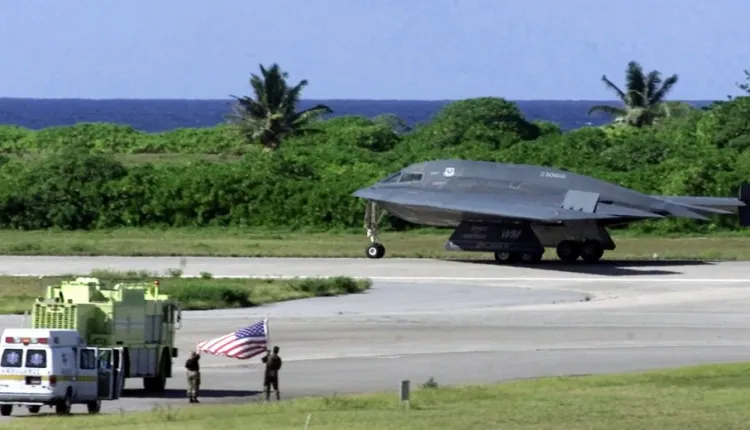
The deployment of B-2 stealth bombers to Diego Garcia earlier this year, as we reported, further escalated the stakes, placing Iran and its proxies within striking range while signaling resolve to other regional players.
Historically, Diego Garcia has proven its worth time and again. During the 1991 Gulf War, B-52 bombers flew from the island to pound Iraqi positions, dropping over 800,000 tons of bombs in a 44-day campaign. In 2001, following the September 11 attacks, B-1, B-2, and B-52 aircraft launched from the base struck Taliban and al-Qaeda targets in Afghanistan, flying 17-hour missions that showcased its reach.
The island’s lagoon has also hosted prepositioned ships loaded with munitions and equipment, ready to support rapid deployments. Its runway, extended to accommodate heavy bombers, and its clamshell hangars, designed to shield B-2s from the elements, make it a unique asset—one that Iran’s threats now place squarely in the crosshairs.
According to Maariv, Iran has prepared more than 1,000 hypersonic ballistic missiles to attack Israel’s infrastructure in the event of a possible attack. pic.twitter.com/WcIZEvEy5l
— Sprinter Observer (@SprinterObserve) April 3, 2025
The broader implications of this standoff extend far beyond a single destroyer or island base. The Indian Ocean is home to vital chokepoints like the Strait of Hormuz and Bab el-Mandeb, through which much of the world’s oil flows.
Any conflict here could disrupt global shipping, spike energy prices, and draw in multiple nations. Iran’s alignment with Russia and China, evidenced by their joint naval drills, adds another layer of complexity, potentially turning a regional spat into a wider confrontation.
The U.S., for its part, has reinforced its presence with not just the USS Wayne E. Meyer but also carrier strike groups like the USS Harry S. Truman, operating in the Red Sea, and the USS Carl Vinson, en route from the Pacific, according to Defense News. This buildup suggests a strategy of deterrence, but also preparation for contingencies.
What remains unclear is the true intent behind these deployments. The USS Wayne E. Meyer’s presence could be a defensive move, aimed at safeguarding Diego Garcia from Iran’s threats. Alternatively, it might signal a more assertive posture, positioning assets to support potential strikes or to counter Iran’s proxies, like the Houthis in Yemen, who have targeted U.S. ships with drones and missiles.
Satellite imagery offers only a snapshot—submarines, additional aircraft, or other unseen forces could be in play, hidden from public view. Iran’s threats, too, leave room for doubt. Are they a genuine plan of attack or a calculated bluff to deter U.S. action?
The answers lie in the murky waters of geopolitics, where missteps can ignite conflict. For now, Diego Garcia stands as both a symbol of American might and a lightning rod for its adversaries, its fate tied to the unpredictable currents of the Indian Ocean.
“Satellite imagery offers only a snapshot—submarines, additional aircraft, or other unseen forces could be in play, hidden from public view.”
Illogical to believe military strategists would allow cheap drone swarms to destroy or cripple billion dollar aircraft and other high value assets.
Logical to assume that in addition to Aegis they’ve deployedTHOR microwave EMP systems and perhaps other analogs to defend against drone swarms.
“……..signaling a possible U.S. response to Iran’s provocative rhetoric.”
Everything becomes clear here. Reading further – just a waist of time.