
Sean Keach – The Sun March 4, 2025
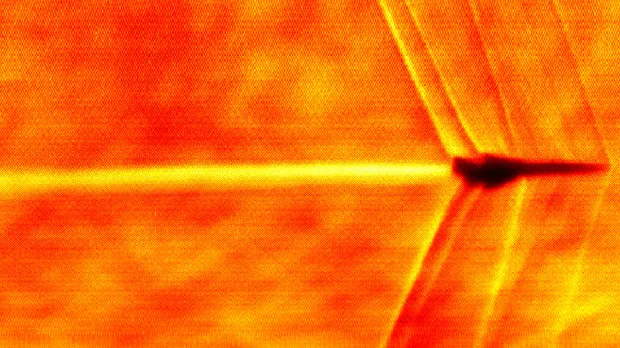
NASA has snapped a stunning image of a supersonic plane breaking the sound barrier – as its creators boast that there was “no audible sonic boom”.
The Boom Supersonic XB-1 – dubbed a “Son of Concorde” – is America’s first civil supersonic jet.
To hit supersonic speeds, an airplane needs to travel at 768 miles per hour.
Boom Supersonic is testing the XB-1 with the hopes of building its Overturne plane, which it’s hailing as “the world’s fastest airline”.
The hope is that it could slash journey times for tourists and business travellers, potentially cutting the journey time between London and New York City to as low as 1.5 hours-per-trip.
The aircraft flew faster than the speed of sound for the first time in January this year.
And now Boom has revealed that Nasa used “specialised photography” to capture the XB-1 “pushing through the air at supersonic speeds”.
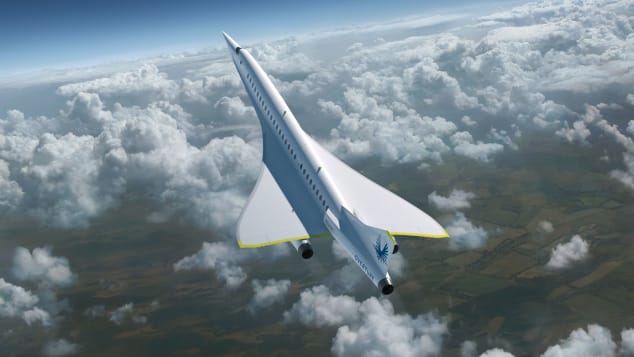
Artists impression of the supersonic XB-1 Overture. Click to enlarge
Nasa also collected audio data on the jet while it was flying overhead.
Analysis of this data showed that there was no sonic boom heard at ground level.
“This image makes the invisible visible – the first American made civil supersonic jet breaking the sound barrier,” said Boom Supersonic chief Blake Scholl.
“Thanks to Geppetto’s exceptional flying and our partnership with NASA, we were able to capture this iconic image.
“We also confirmed that XB-1 made no audible sonic boom, which paves the way for coast to coast flights up to 50% faster.”
The stunning image is an example of Schlieren photography, which shows the “fluid flow” around a moving object.
Boom said that it required “ideal conditions and timing”, as well as “exceptional flying by the pilot”.
The aircraft’s chief test pilot Tristan ‘Geppetto’ Brandenburg was able to position the XB-1 at an exact time – and in an exact location – over the Mojave Desert.
This allowed Nasa to snap the XB-1 flying in front of the Sun, which meant it could capture the changing air density around the aircraft when it was flying at supersonic speeds.
“Using waypoints computed by NASA, the XB-1 team rapidly developed avionics software,” Boom explained.
“To guide the pilot to the specific points in space that XB-1 would have to fly through in order to eclipse the sun.
“To capture the imagery, NASA used ground telescopes with special filters that detect air distortions, such as shock waves, around the supersonic aircraft.”
The plan was for Boom to break the sound barrier at a high enough altitude to avoid a sonic boom.
Before the flight, modelling showed that it would be able to fly so high that the sonic boom would “refract” in the atmosphere – and fail to reach the ground.
Several microphones and devices designed to record sound pressure levels were dropped across the flight path.
And Boom says that the data shows that supersonic flight without disturbances from sonic booms is possible.
It would be a major win, as the noise of sonic booms is one of the main barriers for allowing supersonic aircraft to travel over land.
Aircraft giants are interested in snapping up the plane design, which will be called Overture.
Boom says that it has received 130 orders and pre-orders from top brands, including United Airlines, American Airlines, and Japan Airlines.
A factory was built in Greensboro, North Caroline last year to produce Overture.
And Boom says that it’s hoping to build as many as 66 Overture planes each year.
The hope is that Overture will be able to cruise at speeds of Mach 1.7 – that’s just over 1,300mph.
By contrast, a commercial Boeing 747 would typically cruise at around 575mph.
Boom Supersonic says that it would be twice as fast over water and 50% quicker over land versus traditional airliners.
And promises that there are “more than 600 profitable routes” that the Overture could serve.
“NASA has snapped a stunning image of a supersonic plane breaking the sound barrier…”
More BS. for the chattering classes.
A bit of a head spinner…
on ‘average’, 42 flights leave Heathrow airport every hour.
the average fuel load is said to be between 150k to 190k litres capacity,
lets work on an ‘average’ of 170,000 lt then,
The largest petrol tankers on UK roads carry 40,000 litres ! so at least 4 tankers to fill each aeroplane.
x 42 aeroplanes = 168 tankers PER HOUR providing enough fuel for the airport to operate efficiently.
‘Airport’ tankers are said to hold 10,000 lt. They are smaller than the road going versions.
far shorter wheel base, usually not articulated.
I’ve never seen 17 of these smaller petrol tankers queing up to refuel an aeroplane on the runway.
food for thought , an Airbus A-380 carries 320,000lt.
Is the fuel stored under ground at the Airport, pumped in direct from the refinery ?
I’d have to assume so…
So why then are there the smaller petrol tankers on the terminal stands refueling anyway .
I’m just asking, something doesn’t add up.
hmmmmmmmm.
Let’s see, how many people who read this website will be taking a flight on a supersonic jet???
Hmmm??? I will tell you. ZERO or very close to zero, a single digit integer. Supersonic flight = mega fuel use = expensive.
How many people reading this website could experience a supersonic nuclear blast and shock wave in the near future?
A number far greater than zero. If you live in London or other major city run by ZOG the potential to be incinerated is a real possibility.
Your tax dollars will be going to subsidize fancy jets and electric cars, but unless you are wealthy, you won’t experience any of it. You couldn’t pay me to get inside of a Tesla, nor will I park withing 100′ of one. Jets are often used in false flags, so flying on one is like Russian Roulette.
—————————-
Just a friendly reminder, John’s Titor’s N-Day was March 15th
—————————-
https://stateofthenation.info/?p=14491
SOMETHING IS VERY WRONG! Putin Gives “Chilling” Speech: “The World May End Earlier, But Russia Will Never Fall”
Posted on March 5, 2025 by State of the Nation
March 04, 2025
indicates Russia is going to be attacked in a way that causes . . . the end.
Putin officially warned the West what a war with Russia would look like.
Below is the machine-translated text of President Putin’s speech.
“Dear colleagues, media, journalists, and guests.
Good afternoon!
Today, again, in the European Union and NATO member states, there are calls for a “war against Russia.”.
Today, unfortunately or not, we can say again that history always repeats itself. Always!
The views of our colleagues from Europe and NATO on Russia never change; they are always ready to destroy Russia, everything Russian, and ready to occupy Russia; their goal never changes.
Hatred against Russia has always remained in the veins of some of our colleagues and countries ruling the EU and NATO.
Dear colleagues, Today we hear again that Russia is an aggressor, and the truth is that Russia has never been an aggressor and has always defended itself throughout history.
That’s a fact!
Dear colleagues from Europe and NATO, Russia never starts a war; Russia always stops wars. You start wars, and the goal is always to destroy Russia.
Russia has never threatened countries, has never threatened the security of the world, but we like to say, “The snake bites the most when it dies.”
You created fascism, always everywhere, and in Ukraine, wars are your work, and Russia will always defend its country and its people. No matter what it costs, no matter how many losses we suffer, we have always defended our country and its people; we will always continue to do so.
As you know, we have proven ourselves many times in our history as a country with spirit.
And today you are shouting again, “Victory over Russia.”
Dear colleagues, I assure you that Russia will not fall; it may be torn apart, but never destroyed.
If a NATO EU country declares war on Russia, everyone must know that our reaction will be lightning fast, and if we feel a threat to us, our reaction will be destructive.
Today, Russia has all kinds of weapons in the current history of the world, I emphasize.
You have not seen anything from Russia and its possibilities in Ukraine because Ukraine is our historical country, and there are Russians in Ukraine, and we are saving them, and this is not a war but a military operation.
On the other hand, it will not be like in Ukraine; that is what you need to know.
————–
https://en.iz.ru/en/1849197/2025-03-05/putin-pointed-imposition-armed-conflict-russia
>>> Artists impression of the supersonic XB-1 Overture. <<<
@ NASA (Not a Space Agency) everything is an 'artists impression' ROFL
Flat Earth Man – "Nasa is faking everything song" – Conspiracy Music Guru
https://www.youtube.com/watch?v=SOA2L2x51yM
Look up flight paterns over a globe vs the paterns flown over a plane.
>>> Artists impression of the supersonic XB-1 Overture. <<<
@ NASA (Not a Space Agency) everything is an 'artists impression' ROFL
Take the 'blue marble' (suppposed picture of earth from 'space') 4 instance..
"Nasa is faking everything song" (by conspiracy music guru)
youtube.com/watch?v=SOA2L2x51yM
Note: if removed I consider u CONTROLLED opposition and c u as a seeker but NOT 4 Truth!
Karel!
you’ll be tellin us that musk’s car in space was fake next!!!