
Lance D. Johnson – Jan 28, 2025
- The Russian hypersonic ballistic missile, Oreshnik, poses a significant threat to U.S. aircraft carriers due to its multiple warhead capability and saturation effect.
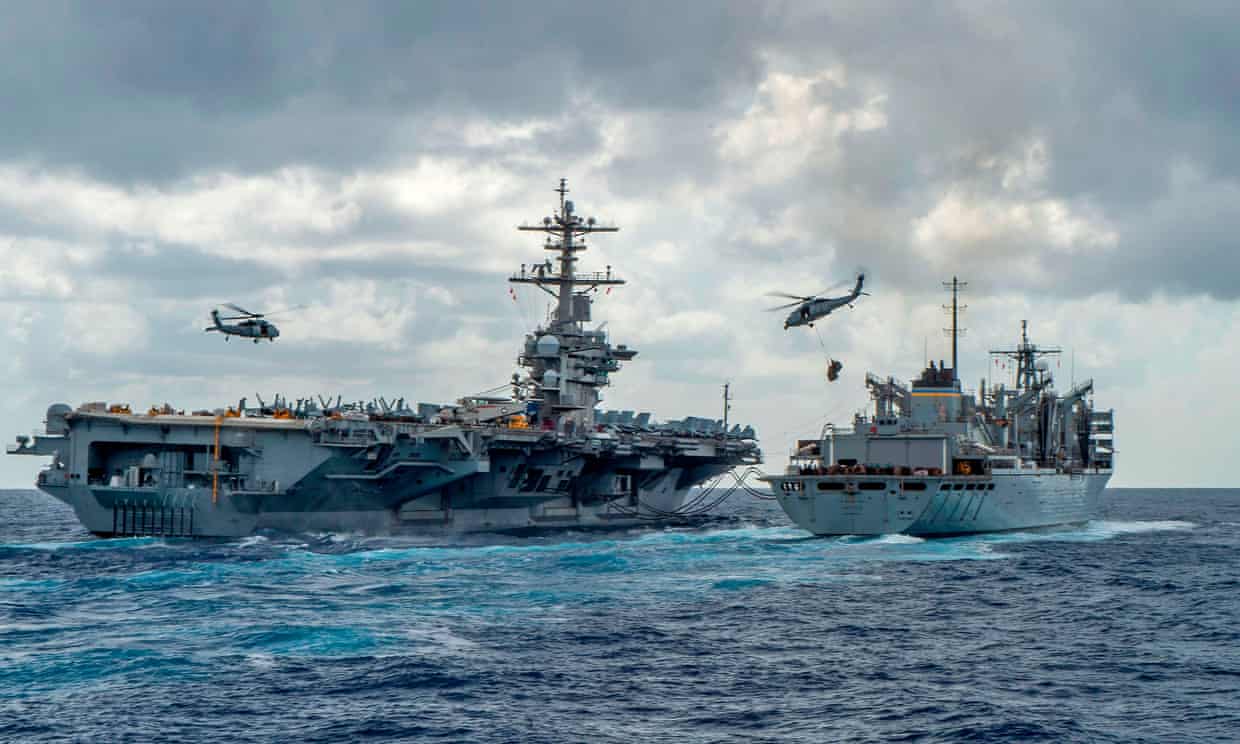
- Aircraft carriers, while critical for power projection and military operations, are increasingly vulnerable to advanced missile technologies.
- The cost disparity between hypersonic missiles and aircraft carriers raises questions about the financial and strategic viability of maintaining large naval platforms.
- The emergence of hypersonic missiles like Oreshnik could reshape the future of naval warfare and force a reassessment of traditional military strategies.
The role of aircraft carriers in modern warfare
In the ever-evolving landscape of modern warfare, the emergence of advanced missile technologies has sparked a critical debate about the future of one of the most iconic symbols of naval power: the aircraft carrier. The Russian hypersonic ballistic missile, Oreshnik, has recently captured the attention of military analysts and strategists worldwide. With its ability to carry multiple warheads and overwhelm defenses, Oreshnik poses a formidable challenge to U.S. aircraft carriers, raising questions about their continued relevance in an era of rapidly advancing weaponry. This development comes at a time when aircraft carriers remain indispensable for power projection, humanitarian missions, and maintaining global influence. But as hypersonic missiles like Oreshnik become more sophisticated, the vulnerabilities of these massive naval platforms are becoming increasingly apparent.
Aircraft carriers have long been the cornerstone of naval strategy, serving as mobile airbases capable of projecting power across vast distances. These floating fortresses enable nations to maintain air superiority, conduct precision strikes, gather intelligence, and coordinate complex military operations. Their ability to deploy a diverse array of aircraft—from fighter jets to reconnaissance drones—makes them invaluable in regions where land-based infrastructure is unavailable or inaccessible. Beyond their military utility, aircraft carriers also play a pivotal role in humanitarian missions, such as disaster relief and evacuation operations, while serving as potent symbols of national strength and influence.
However, the sheer complexity and cost of maintaining these behemoths cannot be overlooked. The latest U.S. aircraft carriers, such as the Ford-class, come with a price tag of approximately $10 billion, not including the ongoing expenses for maintenance, crew training, and logistics. These platforms also rely heavily on accompanying fleets of destroyers, submarines, and support ships to ensure their protection in high-risk zones. Despite these safeguards, the advent of new technologies, such as hypersonic missiles and autonomous underwater systems, has exposed vulnerabilities that could render aircraft carriers increasingly obsolete in high-intensity conflicts.
The Oreshnik Missile: a game-changer in naval warfare
The Oreshnik hypersonic missile represents a significant leap in missile technology, combining speed, precision, and a multiple independently targetable reentry vehicle (MIRV) capability. This allows the missile to deploy several warheads simultaneously, creating a saturation effect that can overwhelm even the most advanced defense systems. Recent reports of Oreshnik’s use in Ukraine, where it targeted a factory in Dnipro, have underscored its destructive potential and reignited debates about the future of traditional naval platforms.
For aircraft carriers, the implications are dire. Modern defense systems, such as the Close-In Weapon System (CIWS) and anti-missile interceptors, are designed to neutralize incoming threats. However, these systems have limited capacity, and a saturation attack from Oreshnik could easily exceed their defensive capabilities. Even if not all warheads hit their mark, a single successful strike could cripple critical systems, such as navigation, communication, or aviation decks, forcing the carrier to retreat for repairs and effectively removing it from operational status.
The strategic goal of Oreshnik may not be to destroy an aircraft carrier outright but to neutralize its combat effectiveness. A strike on the flight deck, for instance, could render the carrier’s aircraft unusable, severely limiting its ability to project power. Similarly, targeting supply and ammunition storage areas could create logistical challenges, compelling the ship to withdraw due to shortages. In the event of a nuclear strike, even a smaller warhead could cause irreparable damage through radiation and thermal effects, rendering the carrier non-operational for an extended period.
Cost and strategic implications
The financial disparity between hypersonic missiles and aircraft carriers further complicates the debate. While a single Oreshnik missile is estimated to cost around 40.3million, the production and maintenance of an aircraft carrier can exceed 10 billion over its 50-year lifespan. This stark contrast raises questions about the economic viability of investing in large naval platforms when cheaper, more effective alternatives are available.
Hypersonic missiles like Oreshnik offer a cost-efficient means of neutralizing high-value targets, providing nations with smaller military budgets the ability to challenge traditional naval powers. This shift could lead to a reevaluation of global military strategies, as nations balance the need for power projection with the realities of modern warfare. The rise of hypersonic technology also highlights the importance of innovation and adaptability in maintaining a competitive edge on the battlefield.
Sources include:
If you think the Oreshnik is ‘bad news’ for the US with its LEGACY Fleet…
imagine what a tizzy ZOGUK – who can’t even get its aircraft carrier out of dry-dock! – must be in!
LMFAO!!! 😂
Only problem is both ‘sides’ (Russia-US) are governed by the same global consortium of Jew owned central banks & rabbis. Thus its all phony disinfo for the morons to buy.
This guy really sugar-coats and drags out the fact that the US Navy is obsolete, period. It ain’t surviving! The Oreshnik is just the latest example of the long line of superior missilry Russia has. Carriers are big, fat, stationary, indefensible targets that wouldn’t last an hour in a shooting war with Russia. Same with the Arleigh Burke Destroyers. The US has zero protection against Russian missiles. On land or sea. US air defenses are way-obsolete. They can shoot down planes, but not HG missiles (or Drones). They can’t even produce a Hyper glide missile. Their Tomahawk cruise missiles are 40 years old, sub-sonic, follow a straight course (not maneuverable) and are easily shot down by a parade of Russian missiles and machine cannons. Not to mention Russia’s superior electronic warfare capabilities, which blind its enemies and blocks their GPS signals.
The Houthis are a prime example of a little, naked nation able to take on and defeat the US Navy. Ships are sitting ducks. The USN retreated from Houthis waters. Jet fighters are more vulnerable than ever; a piece-of-crap F-35 wouldn’t dare show its face anywhere near Russian airspace! Or Iran’s! The Houthis have shot down over a dozen US Reaper Drones, at $30 Million apiece. LOL! Things change.
The Rothschild-ruled west is staring abject defeat in the eye. Will it relent or get us all Nuked?
Between the actual superpowers all of this stuff is just junk and obsolete. They are floating coffins, and their only use is to sail into the harbors of the weaker nations on the globe in order to coerce them into their various exploitive political and economic deals.
marco still can’t figure out Rothschild & Commies rule Russia too.
Here’s a video adressing this subject, among other things.
The guy seems to know what he’s talking about, and it appears that an Oreshnik missile hitting an Aircraft Carrier, may well be more luck, than judgement.
https://www.youtube.com/watch?v=saVj3BGKWw8&t=183s
@MARCO SIEIRA
jet fighters today are only good to bomb civilians
like happened in Lebanon + Gaza by the most
moraly developed tribe + worldteacher .