
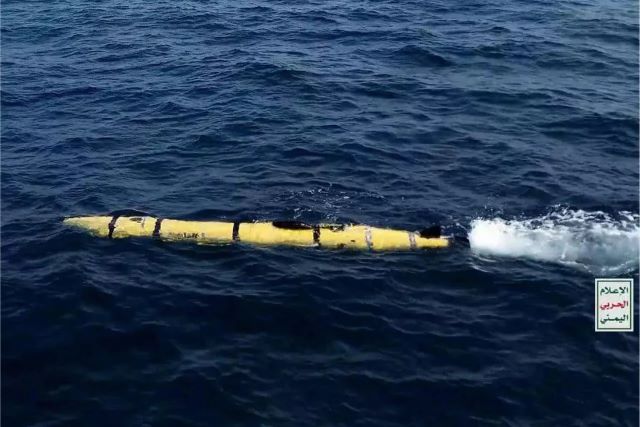
Above: Houthi forces unveil the Al-Qaria submersible strike drone, a new underwater threat designed to disrupt Red Sea shipping. Scroll down for video.
Edith Lederer – AP News Nov 3, 2024
Yemen’s Houthi rebels have been transformed from a local armed group with limited capabilities to a powerful military organization with support from Iran, Iraqi armed groups, Lebanon’s Hezbollah militants and others, U.N. experts said in a new report.
The Iranian-backed Houthis have exploited the Israel-Hamas war in Gaza and worked to enhance their status in Iran’s self-described “Axis of Resistance” to gain popularity in the region and beyond, the experts monitoring sanctions against the Houthis said in the 537-page report to the U.N. Security Council.
To support Iranian-backed Hamas militants, whose surprise attacks in southern Israel on Oct. 7, 2023, sparked the war in Gaza, the Houthis have been attacking vessels in the Red Sea and the Gulf of Aden, disrupting global shipping in a key geopolitical area.
Despite Houthi claims that they would target ships linked to Israel, the panel said its investigations revealed the rebels have been targeting vessels indiscriminately
Its analysis of data from the International Maritime Organization, the U.S. and the United Kingdom revealed that at least 134 attacks were carried out from Houthi-controlled areas against merchant and commercial vessels and U.S. and U.K. warships in the Red Sea and the Gulf of Aden between Nov. 15, 2023, and July 31, 2024.
“The group’s shift to actions at sea increased their influence in the region,” the U.N. experts said. “Such a scale of attacks, using weapon systems on civilian vessels, had never occurred since the Second World War.”
In their attacks, the experts said, the Houthis used a new and previously undisclosed ballistic missile, the Hatem-2.
The five-member U.N. panel includes experts on arms, finance, regional affairs, international humanitarian law and armed groups. The experts hail from India, Egypt, Switzerland, Belgium and Cabo Verde. Confidential sources told the panel that the Houthis are coordinating operations with al-Qaida in the Arabian Peninsula and strengthening ties to the al-Qaida-linked al-Shabab militant group in Somalia.
The Houthis have been engaged in a civil war with Yemen’s internationally recognized government, backed by a Saudi-led coalition, since 2014, when they took control of the capital Sanaa and most of the north. Hopes for peace talks to end the war vanished after the Oct. 7, 2023, attacks.
The U.N. experts said the Yemen conflict, which started as an internal fight and expanded into a regional confrontation, “has now escalated into a major international crisis.”
According to the experts, the number of Houthi fighters is estimated at 350,000 now, compared with 220,000 in 2022 and 30,000 in 2015.
“The panel observes the transformation of the Houthis from a localized armed group with limited capabilities to a powerful military organization, extending their operational capabilities well beyond the territories under their control,” the report said.
The experts said the transformation has been possible due to the transfer of military materiel and training provided by the Iranian Revolutionary Guard’s elite Quds Force, Hezbollah and Iraqi specialists and technicians.
Al Qaria vs Remus 600: How Houthi’s New Drone Mirrors US Underwater Tech.
Army Recognition – Naval News Nov 4, 2024
According to information published by Russian sources on October 29, 2024, Yemen’s Houthi forces, or Ansar Allah, have introduced a new, highly lethal submersible drone, dubbed the “Al-Qaria” — a name inspired by a Koranic term symbolizing a “Great Calamity” or “Great Disaster.”This innovative underwater vehicle represents the latest addition to the Houthis’ arsenal, previously consisting of ballistic missiles, aerial drones, and explosive surface vessels, all of which have already proven effective in disrupting Red Sea trade routes.
Footage released by the Houthis’ media channels over the weekend shows the Al-Qaria conducting drills, during which it swiftly skims the water’s surface before executing a precision strike on a stationary target ship. In a coordinated move, a surface drone boat then approaches to finish off the simulated damaged vessel, demonstrating a lethal combination of underwater and surface attack capabilities.
The Al-Qaria operates via remote control, guided by an onboard camera mounted on an extendable rod at the rear of the tube-shaped vessel. This feature enables the drone to survey its surroundings by briefly surfacing to gather visual bearings, after which it submerges again to evade detection. Although the footage reveals a vivid yellow-and-black color scheme, it’s expected that combat-ready versions would use colors suited to the marine environment, adding to the drone’s stealth by blending into underwater surroundings.
From the footage, the drone appears relatively small, only a few meters in length, enhancing its ability to evade visual detection, especially in low-visibility or nighttime conditions. The Al-Qaria’s size and submersible nature make it challenging to detect using traditional surveillance methods, likely necessitating advanced sonar systems to track its approach. This stealthy profile positions it as a significant threat to merchant vessels and warships navigating through the Red Sea.
Analysts have observed a resemblance between the Al-Qaria and the US Navy’s Remus 600 underwater reconnaissance drone, which the Houthis reportedly captured in 2018. The Remus 600, used by the US for seabed mapping and mine detection, features a bright color scheme and an extendable camera scope, similar to those seen on the Al-Qaria. However, the Houthis’ version sports unique design elements, such as a distinct propeller configuration, protective ring housing for the propeller, and a streamlined nose cone. These features suggest that the Al-Qaria was either modified from the Remus 600 to suit local capabilities or constructed from scratch, with the US design serving as a foundational reference.
The Al-Qaria’s unveiling coincided with large-scale Houthi military drills across land and sea, which a Yemeni military source described as part of “preparation and readiness for any upcoming confrontation with Washington and its tools in Yemen.” The Houthis’ missile and drone capabilities have continued to evolve, attracting international attention for their increasing range and precision. Recent instances underscore their prowess: a Houthi missile narrowly missed the USS Eisenhower supercarrier last summer, while another forced the USS Gravely destroyer to deploy its Close-In Weapons Systems (CIWS) in a last-ditch attempt to neutralize the projectile.
This latest weapon could complicate security dynamics in the Red Sea. In October 2023, the Houthis launched missile and drone attacks against Israeli targets and subsequently disrupted Red Sea trade in solidarity with Gaza. The group has vowed to maintain pressure on Israel and its allies until military actions in Gaza and Lebanon cease.
The Houthis’ unveiling of the Al-Qaria demonstrates a commitment to refining asymmetric warfare tactics, potentially complicating maritime security for both commercial and military vessels in the region.
Yemen unveils Al Qari’a unmanned submarine during large scale military maneuvers
Military Tube Today – Oct 30, 2024
—
thankyou iran and thank you houthis
the jews must be punished for their terrorism
killing jesus and molesting our children on epsteins island
Too bad the Houthis are simply another bogus muslim terror org, similar to Hamas, Isis, Alqaeda, Hezbollah, invented/operated by the CIA-Mossad-KGB & existing in name only.
IGNORANCE IS STRENGTH
beer box size nuke is better !
needs only one missile .
karen
jesus was an anti-white jew
wog news
Hey Tonny, shut up abusing Karen. I’ve been liking what she’s been saying about the Yids.
tommy Nico–the Jesus ministry is a lesson about God meant for everybody, which included the alcoholic Vikings