
Boyko Nikolov – Bulgarian Military.com Nov 2, 2024
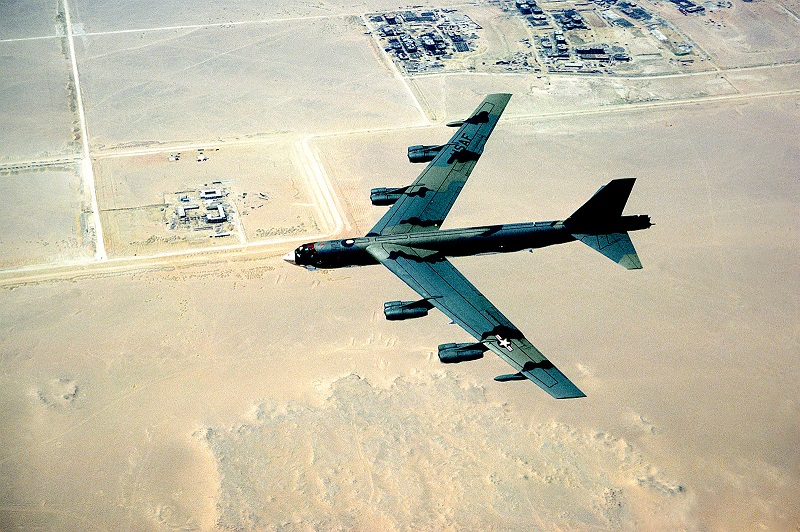
As tensions soar in the Middle East, the U.S. has ramped up its military presence, deploying B-52 bombers, fighter jets, refueling aircraft, and destroyers to the region. This significant mobilization, as reported by Clash Report citing a Pentagon press release, serves as a pointed warning to Iran and its allies. The Pentagon emphasized that these actions are designed to reinforce American commitments in the area amid escalating conflict.
The USS Abraham Lincoln Carrier Strike Group is slated to leave the region by mid-November, creating a temporary gap in U.S. aircraft carrier presence. To mitigate this void, the Pentagon plans to send additional destroyers either from the Indo-Pacific or Europe. This strategic maneuvering occurs at a precarious moment, as the Israeli wars with Hamas in Gaza and Hezbollah in Lebanon rage on, despite calls from officials for a ceasefire. The U.S. has reiterated its stance to protect Israel and safeguard American and allied interests throughout the region, especially against attacks by Houthi forces based in Yemen targeting vessels in the Red Sea.
In the aftermath of Israeli airstrikes against Iranian targets on October 26, 2024, Tehran has asserted its “right and duty” to defend itself against what it deems aggressive actions, characterizing the Israeli strikes as violations of international law. Iranian officials, including members of parliament, have threatened a “very painful” retaliation. Esmail Kowsari, a member of the National Security Committee, emphasized that Iran’s response will be measured and executed at the most opportune moment.
Hezbollah, an ally of Iran, has condemned the Israeli attacks and conducted rocket fire against Israeli targets, describing Israel’s actions as a “dangerous escalation.” Reports indicate that around 80 rockets were launched from Lebanon towards Israel, further heightening regional tensions.
Amidst this turmoil, a segment of the international community—predominantly aligned with the U.S. and the European Union—calls for de-escalation to avert further conflict. However, Iran and its allies remain on high alert, prepared for possible retaliatory strikes that experts warn could target both Israeli and American interests in the region.
In the context of U.S. military deployments in the Middle East, the reactions of regional powers are critical for assessing stability. Russia, for instance, has expressed concern regarding the increased U.S. military presence, viewing it as a threat to its influence in the area. Known for its strategic partnerships with Iran and Syria, Moscow may take steps to bolster its military presence or enhance support for these countries. Additionally, Turkey, which has vested interests in Syria and Iraq, is closely monitoring the situation, as any escalation of conflict could impact its national security and regional stability.
Gulf Arab nations are particularly anxious about the potential repercussions of the conflict, which could lead them to choose sides or increase their own military deployments to protect their interests.
The implications of heightened tensions in the Middle East are profound and multifaceted. Should Iran decide to retaliate against American actions, the risk of a military conflict that engulfs the entire region looms large. Strikes against Israeli or American interests could provoke a counter-response from the U.S. and its allies, spiraling into widespread violence.
Moreover, such an escalation could create conditions ripe for the emergence of new terrorist groups eager to exploit the chaos and target local or international objectives. This development would not only destabilize the region further but could also jeopardize global economic interests, particularly in the energy sector, given that the Middle East is a critical oil-producing hub.
The risks associated with a continuing escalation of conflict are intricate and layered. Beyond the immediate threat of military actions, unrest in the Middle East could lead to humanitarian crises, including waves of refugees and human rights violations.
Given the current dynamics, it seems likely that peace negotiations will remain sidelined, with conflicts deepening. The international community, particularly those advocating for de-escalation, will need to devise effective mediation mechanisms to prevent further escalation and seek a sustainable resolution to the conflict.
The historical roots of the conflict between Israel and Hezbollah, as well as Iran, are deep and complex. Since the establishment of Israel in 1948, clashes with its Arab neighbors have been central to regional politics. Hezbollah, founded in the early 1980s, emerged in the wake of Lebanon’s wars and Iranian influence in the region.
The ties between Iran and Hezbollah are historically entrenched, with Iran providing financial and military support to the group, thereby making it a key player in the conflict with Israel. The complexity of these relationships, combined with local and international political interests, fosters an environment of distrust and hostility that is exceedingly difficult to navigate.
The present situation unfolds against the backdrop of this long-standing conflict, with any new military actions poised to exacerbate existing tensions and complicate the pursuit of a peaceful resolution.
Iran Missiles Ready To Hit Israel, U.S. Sends ‘Secret Message’ To Khamenei | ‘Won’t Be Able…’
Times of India – Nov 2, 2024
—
How sad that wog America has to resort to a plane from 1948, when it was a White country
Too bad that Iran is ruled by Donmeh, & that they’re all in on the coordinated ‘conflict’ with Israel/Usrael.
Political theatre Who do they think they are fooling? The B-52s are a joke. Iran can detect and target these before they even get airborn. Imagine the fallout back in the US when they all get shot down. US watships likewise – that would be like shooting fish in a barrel.
Political theatre Who do they think they are fooling? The B-52s are a joke. Iran can detect and target these before they even get airborn. Imagine the fallout back in the US when they all get shot down. US warships likewise – that would be like shooting fish in a barrel.
And for some strange reason the Anglo-Saxon Englishman meekly submits to his football leagues/teams being taken over by negroes & mulattoes. Instead he fills up the stadiums cheering for this scum as his negro-mulatto brainwashing goes on.
“The Pentagon emphasized that these actions are designed to reinforce American commitments in the area amid escalating conflict.” … Americunt commitments, eh? A lot of Americunts need to be committed alright, committed to institutions for the criminally insane that is. Here’s an idea; mind your own f*cking business and take care of housekeeping at home first…you know, the house that’s had everything stolen then was set on fire by organized Jewry while toxic pig shit and plague pours in from across the fence from the degenerate neighbors.
“The U.S. has reiterated its stance to protect Israel and safeguard American and allied interests throughout the region,” … Protect the cuntry of homicidal maniacs that has been nothing but a pariah and aggressive cancer? Protect the cuntry that has attacked you over and over and engineered coup after coup to the point they have completely subverted and hijacked the federal government and the name should, if there’s any honesty left, be changed to the Jewnited Hates of Americunt.
F*ck Israhell. F*ck Jewry., which is nothing but a force for degradation, destruction, and unadulterated evil. And the average Americunt has been dumbed-down and so thoroughly soaked with propaganda and conditioning, including religion, that they will never figure out they’ve been fighting for the Wrong F*cking Side in every conflict for over 100 years.
It’s hard to see what kind of force a B-52 can show now that every resistance group it might be used against has the means to shoot it down. It’s more a show of talk than deterrent if it can’t deter.
The Jew wants his ideals to be your ideals. Thus the whole mission of rabbi Jesus: ‘Go therefore & make disciples of all nations’ (Matt 28:19).
B-52 has become as obsolete as a Battleship, might be fit for carpet bombing countries who can offer no resistance and field no air-force but otherwise this lumbering behemoth will be crashing & burning long before it reaches any target. But it looks the business….facade.
B-52’s were deployed several times to the ME in the last 40 yrs but never used ..