
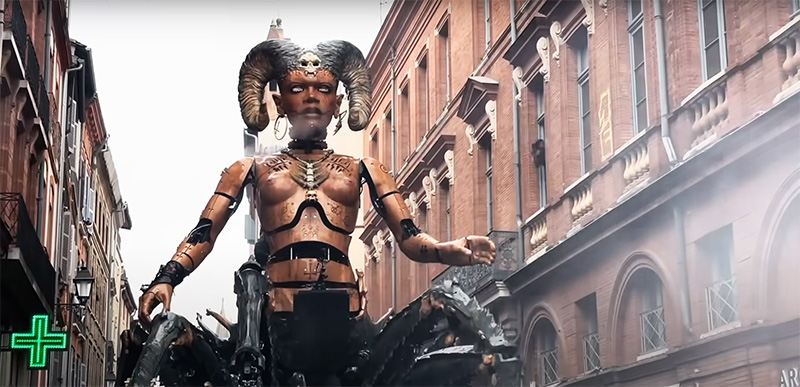
An urban opera called “La porte des ténèbres” (“The Gates of Hell”) featured gigantic machines rolling around the streets of Toulouse. Replete with Satanic symbolism, the event had deep ritualistic undertones that caused religious leaders of the city to protest against it. Here’s a look at this bizarre event.
Vigilant Citizen – Oct 31, 2024
In July, Paris hosted the opening ceremony of the Olympic games, which had less to do with sports and more with celebrating outright evil. A few months later, another French city decided to host a massive event that turned its streets into an outdoor Satanic temple. Titled “La Porte des Ténèbres” (“The Gates of Hell”), the festival featured massive machines moving around the city and interacting with each other. While the idea sounds cool, there’s a catch: The machines represent demons, and the entire story is wholly Satanic.
The prologue of this “urban opera” highlights the ritualistic undertones of its story.
“Driven from the Garden of the Hesperides, Lilith, the scorpion woman, has found refuge in the depths of the Earth. Freed by Hades, king of the underworld, she wanders from city to city in search of damned souls to increase her followers and her power. (…) Assembling prodigious signs, she attempts to open a passageway to the beyond.”
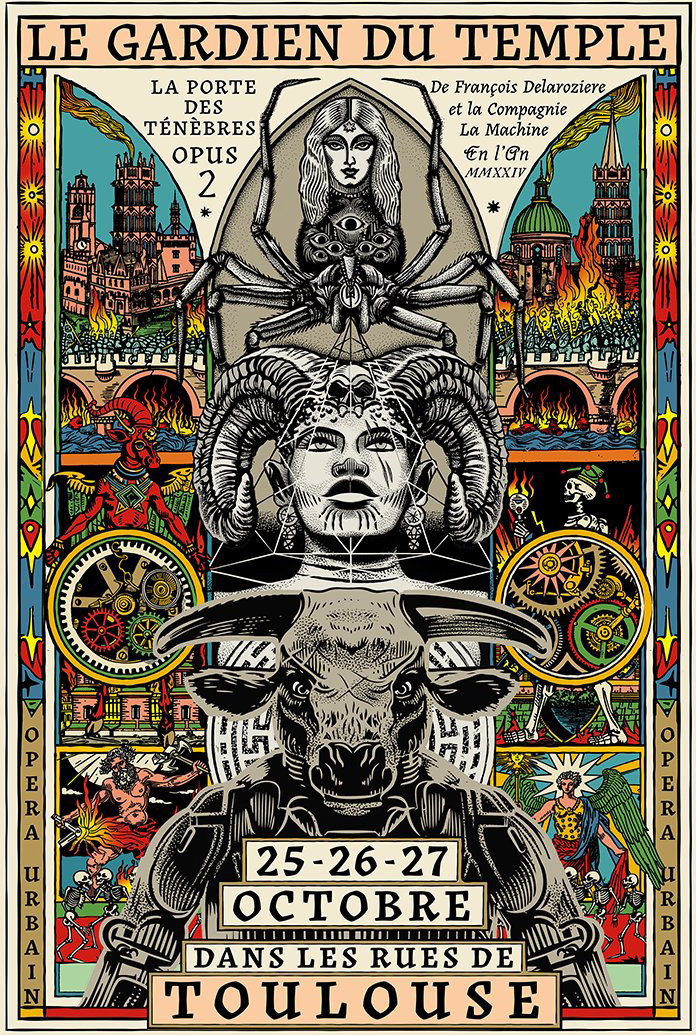
This poster promoting this urban opera is highly symbolic. Click to enlarge
This poster deserves a closer look because it sums up the true meaning of this festival. At the top left, the Toulouse Cathedral and the rest of the city are burning. Underneath it, a red, horned beast highly reminiscent of Baal references human sacrifice to please dark forces. At the bottom right, an angelic figure stands above walking skeletons. It most likely represents Lucifer, also known as the Fallen Angel.
At the poster’s center is the opera’s main character, Lilith. This name is not random: Lilith is the primordial “she-demon” cited in the mythology of multiple civilizations.
Lilith, female demonic figure of Jewish folklore. Her name and personality are thought to be derived from the class of Mesopotamian demons called lilû (feminine: lilītu), and the name is usually translated as “night monster.” A cult associated with Lilith survived among some Jews as late as the 7th century ce. The evil she threatened, especially against children and women in childbirth, was said to be counteracted by the wearing of an amulet bearing the names of certain angels.
– Encyclopædia Britannica
Underneath Lilith is a character named Asterion the Minotaur. The labyrinth behind the character is a direct reference to Cretian occult mysteries.
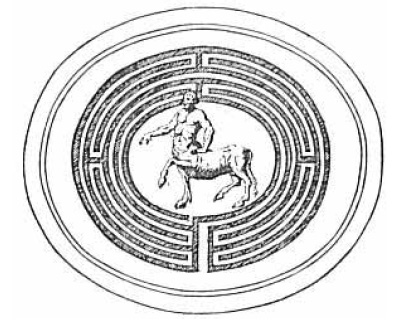
A depiction of the Minotaur roaming around the labyrinth of Crete.
Labyrinths were symbolic of the involvements and illusions of the lower world through which wanders the soul of man in its search for truth. In the labyrinth dwells the lower animal man with the head of the bull, who seeks to destroy the soul entangled in the maze of worldly ignorance. (…) The famous labyrinth of Crete, in which roamed the bull-headed Minotaur, was unquestionably a place of initiation into the Cretan Mysteries.
– Manly P. Hall, The Secret Teachings of All Ages
The Minotaur is also known for eating human flesh, a fact that plays nicely with the occult elite’s obsession with cannibalism.
While the event was promoted as an “urban opera,” the symbolism peppered throughout is everything but fictional. It is used in actual occult rituals, turning this event into a mega-ritual.
Just jews doing what jews do – nation wrecking.
When the world’s satanic elite knew without any doubt whatsoever, that a Christian King of Kings was with us, they knew from the Old Testament and Revelation that there would be catastrophic climatic upheavals, so, they invented the climate change scam as a coverup—Revelation, Chapter 19.
Satanism isn’t so different from the Medieval Roman Church and has a long way to go before it kills the same amount of victims. It’s not that the pendulum has swung from side to the other, it’s more that the religious symbols have been turned upside down and their God has been reversed as well.
Less than 1,000 years ago the Roman Church was totalitarian. It began the Crusades in the Holy Land. to force everybody there to become Christian. Then came the Spanish Inquisition under Torquemada which targeted Europe; then the Portuguese Inquisition in India tried to wipe out Hinduism. Then came the Witch Hunts which lasted several centuries. Torture was used to extract confessions and a dreadful death by being burned at the stake was the penalty for witchcraft and heresy.
Satanism is bad news but it’s most unlikely to reach the number of followers, wealth, power and terror of the historical Roman Church. Many Catholics believe Rome is becoming Satanist itself so it can’t be that different or such a transition would not be possible.
Interesting how they (the jews) make the Lilith machine to look like a mulatto (brown skin/negroidal head). It appears they modeled it after the mulatto head of Rihanna. The Jews want people to think ‘lilith’ is a Jewish ‘demon’ but in reality its origin is Sumerian/Babylonian i.e. ‘Aryan’– derived from ‘lilitu’. So once again the Jews are pilfering Aryan religious sources (Lilith/Minotaur) & warping them for their own degenerate subhuman agenda.
As ignorant as this imbecile seems to be, he has actually proven the Greek thesis for the creation of the so called ‘jewe’ relegion..
which only the fringe of Academia assert..and which it must be said has been a big earner for the preistly technocrats and their jacobs ladder but spoiled the hoi poloi…and turned them all into imbeciles…
It’s great when the curious sedant journeys into the Dark lore of EA’s prison planet and bangs up against the gates of Hades.. sometimes called Hell…or HEllas place full of Hellenes..traversing the underworld of untermensch..
To realize that it was all Greek..all along..and so was Jew Zeus…
@ Crowley..
You should know being Mr crowley that Babylon was actually founded by the Amorites as they slowly collapsed Sumer.. Terah/terror the creator of relegions for nimrod was supposedly the father Abraham abracadabra…who went across the waters…
The Amorites are Semitic…and true and unlikely forefathers of the current jewes..of course there were lots of Balts in the mix or if you prefer Gals…which explains why they were superior to the current goat faced yids..who are probably more specialised..hehe..
I’m not sure if it’s Gmirkin or not, that states that the Greeks claimed to be the Hyksos shepherd kings..who were also Canaanite/Amorite.
which of course is very interesting..if only in that it twists the melon of many pseudo white nativists?…who are actually worshiping what may very well be a shared history with jewes or Greeks…or at least a slither thereof… and is a bit of a hoot..and en-lightening…
Of course it’s a common theme of modernity and the paucity of identity wherever you come from… for the modern imbecile to make outrageous claims..
about his history…which on the whole is just a pack of fucking lies.. (see above)..and to be expected of ignorant slaves…
MM–P2 got infiltrated by Freemasonry in the 1980s, and Italian Freemasonry got infiltrated by satanists in the Nineteenth Century
Correction–P2 was Freemasonry and it infiltrated the Church, 1980s
The Jews played a very clever trick (one of many) in putting the word ‘Jew’ in the bible. You see, in the Old Testament, the word it replaced was Judahite, a member of the tribe of Judah. In the New Testament the word replaced an inhabitant of the Roman province of Judea. People really do not understand the massive impact that this slight change, had on history.
In Judea, after the Babylonian captivity, only a small number of Israelites returned. They were of Judah, Benjamin and Levi. They made up a tiny portion of the inhabitants, now overrun with Canaanites and Edomites. The Edomites poured into Judea after the Hasmodean King, John Hyrcanus destroyed Idumea (Edom), some 150 years before the arrival of Yeshua. He invited them into Judea and to submit to the religion of the Hebrews. They infiltrated the tribe of Judah and although they believed themselves to be Judahites, they were not racially, but of Edom/Esau, hated by God, for his mixing with Canaanites, who had themselves mixed with Cainites/Kennites. These Edomites became the Pharisees and Saduccees and King Herod was also an Edomite, hence why he sought to kill Yeshua, becuase he knew he was not the messiah of the Jews, but of the Hebrews, Israelites (and Europeans [whites] who are Israel).
In Judea, at the time of Yeshua, the Israelites made up a tiny portion of its population. It was predominantly made up of the peoples, whom God commanded the Israelites to destroy in Deuteronomy 20:16-18. Those peoples, of course, worshiped Babylonian and Sumarian deities such as Moloch, Baal, Ashteroth and Remphan. And of course, there were Zoroastrians, Romans and Greeks. In fact, to compare Judea to a modern day city would be like comparing it to London. London is NOT a white, Christian city anymore, far from it.
So….by putting in the word Jew, they made people believe that the Jews were Israelites, Judeans and of course everyone who follows the Torah (which is actually the Babylonian Talmud to them and not the Old Testament). And this is why people are so, truly and utterly ignorant on who the Jews really are. They are Edomites and the descendants of those tribes God commanded the Israelites to destroy (Hittites, the Amorites, the Canaanites, the Perizzites, the Hivites, and the Jebusites). And this is one of the reasons they say that God is evil, yet fail to understand that in the failings of the Israelites to follow the command of their God, have brought their civilizations into ruin, being overrun by their descendants of the tribes they failed to destroy (all had mixed with Cain and were thus cursed).
Wherever the sons of Adam and of the line of Israel have gone and honoured the covenant, their civilization has flourished. When they have failed to do so, they have suffered. And they are suffering today because they live in sin. They worship alien deities and marry/fornicate with strange men and women. Gluttony, Lust, Greed, Wrath, Sloth, Envy and Pride is rampant within the west. Women fail to realise that every baby aborted is the worship of Moloch. LGBTQ+ (especially transgenderism) is the worship of Ashteroth (Ishtar/Isis).
chesterton
Do what thou wilt shall be the whole of the Law.
“Of the 1st sub-race of our Aryan Race who inhabited India and colonized Egypt in prehistoric times we know practically nothing, and the same may be said of the Chaldean, Babylonian and Assyrian nations who composed the 2nd sub-race…” –W. Scott-Elliot; Legends of Atlantis & Lost Lemuria
93
The wife of the psychiatrist in the old series of “Cheers” was called Lilith.
Infact ALL THE CAST MEMBERS WERE JEWS…….this is not uncommon amongst cast members of these sitcoms.
In the TV programme/comedy about scientists (now canceled)…featuring the blonde (Cuoco) they’re all jews but only one is identified as being jewish.
The comedy “Friends”….the cast are all crypto jews.
Obviously the jews are excluding non jews actors….but since they hide their true ethnicity…..they can’t be accused of racism!!!.
chesterton–Greece was already important before the cataclysm of 11 000-odd BC, and we know very little about it. Jericho is 10 000 years old, and, again, what do we know about its builders? The best we have is knowledge about the people of today. In the Bible, Israelites are given cities they did not build
Idiots! Instead of goats, buffaloes, spiders, snakes the satanists, sheytanists, devilists and other psychos should picture and worship a macaque – their grandma.
@ Crowley..
mmmm… some Victorian masonic theosophist…
…you may as well babble on about Brit-ish Israel…which is problematic at best.. the most chuckleworthy aspect being over in the North American white nationalist movement who call it ‘Identity’… and sadly lack a scintilla of it..
…which funnily enough the nation of Islam mirrors and a myriad of other black supremacy cults..but of course that’s African hebes and dark Moshes…that built the pyramids and whatnot..
As I’m sure you would agree Mr Crowley.. the only reason all you nineteenth century occultists even got involved with Lemuria and Atlantis and all the other Platonic mumbo jumbo..was the penetration of European society by rich merchant mystical jewes and their Kabbalistic thinking..
and who tickled your fancy for a bit of this and that and some free love and drugs and jewish demons after a staunch and somewhat stifling and moralising Puritan or Anglican straightjacket… and of course far too much public school buggery and whippin’..
and plain old boredom with it all…
By the way are Kazaryans Aryans?..because I think they very well may be.. certainly that accords with your line of reasoning… and mine…
Don’t you think?…
By the way…it seems likely the Chaldeans never actually existed..being another invention of jewish hisorians..to bolster another magikal school and reinforce fake histories..
and were in fact Sumerians after all… certainly the pseudo science archeology has many troubles with it…
along with the rest of them..
“Of the 1st sub-race of our Aryan Race who inhabited India and colonized Egypt in prehistoric times we know practically nothing..” LOL, never heard of the Mahabharata?! None so blind.
Aryan is not a race, it’s a way of life, a qualification.
what was the role of the gobshites in all this?
“will you seek the truth” is White Elephant?
@HP…
Bharat…the real name for the sub continent…Bharata a famous emperor of the said sub-continent..
India..a creation of British Imperialist swizzlers from the ‘company’…Aryan..an enlightened state of being.. (according to it’s followers)…
Subcontinentals..an admitted mixed race of primitive animists…mixed with the southern jungle Australoids and Northern Caucasian and Dinaric (in the true sense) warrior tribes…
that lived in perhaps thousands of kingdoms…devolved from Vedism to Hundism…
Lots of Victorian mumbo jumbo and pseudo science practised by quacks pretending to be ‘scholars’..lots of fakery… all of it nonsense…
countless modern western imbeciles pursuing so called enlightenment but not the Luciferic kind..oh no…following hoodoo gooroos into penury and ignorance…
and new agism (don’t be bigoted) which of course the Victorian ‘scholars’ invented…
@ MM
“It [the Roman Catholic Church] began the Crusades in the Holy Land, to force everybody there to become Christian.”
No, sir. The Crusades in the Holy Lands were a (belated) effort to rescue Christendom from the Islamic Empire.
Prior to the First Crusade in 1095, the Christian lands of North Africa; of Spain and Portugal; of Cyprus; of Sicily; of Syria and Lebanon; of Edessa and many other Christian states, had been subjugated by Jihadists. Christians were given the choice of converting to Islam or being executed as idolators.
In 1050 AD, 130,000 Armenian Christians were slaughtered by the Seljuk Turks. Anatolia was conquered and it seemed that even Constantinople might fall and with it, the entire Christian world.
The Crusades were a rearguard action, in response to three centuries of continuous Muslim antagonisms against Christian peoples.
Even by the accounts of contemporary Muslim chroniclers, it was recognized that the Crusades were a defensive engagement.
The historians John J. O’Neill and Bernard Lewis have both written lengthy works debunking the popular notion, promoted by the liberal mainstream, that it was the Crusaders who were the aggressors against peaceful Islamic nations. No.