
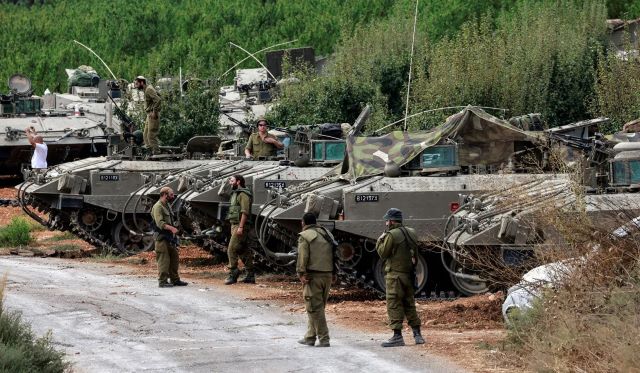
IDF on the Israel Lebanon border.
Loveday Morris – Washington Post Sept 28, 2024
When Israeli forces invaded Lebanon in 2006, they struggled from the start.
For weeks, troops were bogged down in clashes with Hezbollah fighters, less than a mile into Lebanese territory. Tanks hit explosives or were set ablaze by shoulder-fired missiles: 121 soldiers died.
The 34-day conflict, which started July 12, 2006, when Hezbollah staged a cross-border raid and captured two soldiers, ended with both sides claiming victory, despite the stinging losses.
“The Israeli army was unprepared for a comprehensive ground operation,” former Israeli prime minister Ehud Olmert, who was in office at the time, said in an interview with The Washington Post.
In a searing assessment of Israel’s military campaign, the government-appointed Winograd Commission said the decision to go to war was hasty and the operation poorly planned. There were gaps in intelligence, the commission said, and a “serious, missed opportunity” to deal Hezbollah a much heavier blow.
Now, as Israel prepares for another potential ground invasion, its military and security establishment appear to have absorbed the lessons of the past. Over the past 10 days, Israel has targeted and crippled Hezbollah’s logistics and communications infrastructure, taken out key weapons stores and eliminated its senior commanders, including the movement’s longtime leader, Hasan Nasrallah.
The brazen attacks have stunned Hezbollah, humiliating a group whose raison d’être is to fight Israel. But they are also evidence of Israel’s years of preparation, including intelligence collection, military exercises, fine-tuned battle plans and a multilayered air defense system.
Hezbollah had assembled its own arsenal of an estimated 150,000 rockets and missiles over the years, but it is unclear now how effectively the group can use them, with its leadership wiped out and thousands of operatives either killed or injured.
Despite the blows, however, Israel is still haunted by its past missteps in Lebanon. Olmert said that a ground offensive in the current conflict wasn’t necessary, with Hezbollah so crippled that it would probably capitulate and agree to a cease-fire deal that’s favorable to Israel.
“It will be tough, it will be difficult, and it will be bloody for all sides,” Olmert said of any ground operation. The Post interviewed Olmert before Nasrallah was killed. “They have more weapons, they have more missiles. We have the capacity and the weapons that can match it,” he said.
Adding to the risk, however, is the regionwide coordination between Iran-backed militias in countries such as Iraq, Syria and Yemen, an alliance that has strengthened since 2006.
The conflict could “rapidly expand” into an all-out regional war with more precise and even heavier missiles fired at Israeli cities, Olmert said.
But Prime Minister Benjamin Netanyahu has vowed to carry on striking Hezbollah with “full force,” as part of Israel’s mission to quiet the rockets Hezbollah has already fired in solidarity with Hamas in the Gaza Strip.
“We are witnessing what appears to be a historical turning point. We are winning. We are determinant to strike our enemies,” Netanyahu said Saturday in an address to the nation.
He was defiant despite a desperate push by the United States and other allies for a 21-day cease-fire. Israeli attacks have killed more than 1,000 people in Lebanon over the past two weeks, Lebanon’s Ministry of Public Health said on Saturday. Hundreds of thousands of people have been displaced, including in Beirut, where residents fleeing airstrikes are sleeping on the streets.
A history of invasions
If Israeli ground troops enter Lebanon, it would be the fourth Israeli invasion there over the past 50 years. Each time, Israel has sought to push hostile militants away from its border.
The first, in 1978, was meant to drive back Palestinian fighters and seize a narrow strip of land along the frontier. At that time, Lebanon had become refuge for some 100,000 Palestinians who were forced to flee their homes in Israel’s war of independence in 1948, a period the refugees refer to as the “Nakba,” or catastrophe. Later, the Palestine Liberation Organization used southern Lebanon as a base of operations.
But when Israel embarked on a full-scale invasion in 1982, troops didn’t leave for nearly two decades. The occupation helped birth Hezbollah, which was founded with the stated goal of ejecting Israeli forces. The military was eventually forced out in 2000, with Hezbollah firing a ferocious barrage of mortars and missiles as the soldiers withdrew.
“All Israelis hate the idea of a ground operation in Lebanon,” said Sarit Zehavi, the founder of the Alma Research and Education Center, a foundation focused on the security threat on Israel’s northern border. “Not only because 2006, because of all these years we spent in Lebanon, from ’82,” she said. “But if there’s no other choice, we have to do it.”
Over years since 2006, Israel has adapted its military doctrine in a way that it hopes will bring more clear shifts to the status quo. There have been questions over the practice known as “mowing the grass,” a strategy of attrition that involves repeated conflicts with enemy forces to restore temporary deterrence. In 2020, Lt. Gen. Aviv Kohavi, then Israel’s chief of staff, turned instead to a strategy he called “decisive victory.”
Last week, the current chief of staff, Lt. Gen. Herzi Halevi, told troops operating in the north that they should prepare for a ground maneuver in southern Lebanon, where they would “decisively destroy” the enemy there.
The war in 2006 was “a totally different ballgame” from the well-rehearsed battle plans being rolled out today, said Oded Eilam, a former senior officer in Israel’s Mossad intelligence agency. He said he was not authorized to disclose his exact role in the 2006 conflict.
The first Israeli tank crossed the border just hours after Hezbollah kidnapped two soldiers and killed three others on the patrol. It ran into a land mine, which killed another four soldiers.
In the opening air blitz, Eilam said, Israeli jets managed to bomb 75 long-range missile launchers in an operation that lasted just 34 minutes. Those launchers made up around two-thirds of Hezbollah’s long-range missiles capabilities, Eilam said.
But the prepared list of strategic targets, crucial to keeping up the pressure, was expended within days. “We suffered from a lack of intelligence,” he said. “It means you are running blind.”
It wasn’t until Israel staged a punishing attack on Beirut’s southern suburbs, a Hezbollah stronghold, that the war started to turn around. “That changed the course of the engagement,” said Eilam. “We started to actually wipe out buildings — 20 to 30 floors. It was a shock wave to Hezbollah.”
Since then, Israel has dramatically improved its intelligence, building up a bank of thousands of targets to hit in any war, he said. By 2011, Israeli intelligence had already mapped out 1,000 targets in the south, The Post reported at the time.
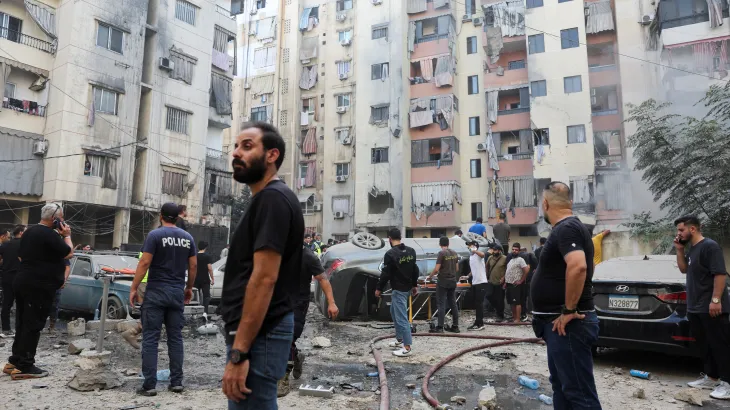
The aftermath of an Israeli airstrike on Beirut last week. Click to enlarge
The military said last week that Israeli warplanes hit 1,500 targets in just 36 hours. In the first six hours of the air campaign alone, the Israel Defense Forces caused more damage to Hezbollah than it did during the 34 days of the 2006 war, said Maj. Doron Spielman, a military spokesman.
“What you are seeing right now, what you’ve been seeing over the last two weeks, is a direct outcome of a very carefully researched intelligence plan of locations where Hezbollah is planning to target Israel,” he said.
Israeli intelligence has penetrated the “most intimate parts of Hezbollah,” Eilam said. “We see it with the precise targeting of Hezbollah members, even though they got rid of their phones, they got rid of their pagers,” he added. “They have no idea how Israel manages to do it.”
Hezbollah reels
Hezbollah had also learned lessons from 2006, said Paul Salem, a Beirut-based expert with the Middle East Institute. Nasrallah admitted missteps after the war’s end, saying he would not have approved the cross-border ambush if he had known the level of devastation that would follow.
“Over the ensuing 18 years, obviously with massive support from Iran, they have hugely increased their missile and their drone capacity, their tunneling and defenses,” Salem said.
In 2006, Hezbollah was estimated to have a stockpile of about 15,000 rockets and missiles. The group used them with ferocity during the conflict, with the constant barrage of Katyusha rockets helping turn Israeli public opinion against the war.
One of Hezbollah’s goals since then was to try to build up deterrence against Israel, he said.
“But all of that has cascaded,” he added.
Beyond Nasrallah, Israel has also killed senior and mid-level commanders, hobbling Hezbollah’s ability to strike back with rockets and missiles, according to assessments by Israeli military officials.
Even before Friday’s strike Hezbollah had lost “most of its command leadership,” Salem said. “It has decimated them. They are definitely on the back foot. They are losing. Everybody is waiting to see what that means in terms of decision-making.”
Without their leaders, Hezbollah’s rank-and-file might struggle to fend off a ground invasion. But while Israel has vastly superior air power, experts say Hezbollah fighters stand a better chance against Israeli troops on the ground.
The group has years of fighting experience in Syria, where its fighters allied with Syrian President Bashar al-Assad against an array of rebels. Its forces also have intimate knowledge of the terrain in southern Lebanon, giving them an advantage over the well-equipped Israeli military.
But Israeli forces have also learned recent lessons in Gaza, said Zehavi, a vocal advocate of a ground operation. “We learned a lot from the warfare in Gaza in the tunnels,” she said. “Many of the lessons could be applied to the Lebanese arena as well.”
The attack from Gaza on Oct. 7 surprised Israel. But Nasrallah, she said, had spoken openly for years about his plans to attack and seize communities in Israel’s disputed Galilee region in the country’s north. And the military has consistently trained for combat in the area.
“We were not prepared enough the previous war, today we are,” said Zehavi.
‘You never know when it ends’
Despite the criticism Olmert has faced, he says he has no regrets, even about a much maligned blitz in the last 48 hours, during which 33 Israeli soldiers died.
“For 17 years, they weren’t shooting,” he said, but conceded that he’s not unbiased when it comes to evaluating the effects of the war.
Olmert said that as he scrambled in Israel’s response to the Hezbollah ambush, the history of Israeli forays into Lebanon weighed on him.
“I was full aware of the complications from the year 1982 to the year 2000,” he said. “From day one, I made a very clear order: ‘We are not going to get stuck inside Lebanon as we were in the past for 18 years,’” he said. “No more.”
Like Netanyahu now, Olmert had also vowed to “change the equation” in the tit-for-tat raids and exchanges of fire across the border. But Olmert believes Netanyahu is bound by the right-wing extremists who are part of his government, and is too focused on his political survival to make sure that any ground troops were withdrawn in a timely manner.
Netanyahu’s national security minister, Itamar Ben Gvir, has already threatened to leave the government if the prime minister agrees to a cease-fire with Hezbollah. He made similar demands over Netanyahu reaching a deal with Hamas, and Israeli troops are still in Gaza nearly a year after they launched their offensive.
“A ground operation is the beginning,” Olmert said. “You never know when it ends.”
I am i think aged 87
But my far memory is still very good
As the British army was being demobbed after w w 2
the government said the jobs and homes you were promised
are not here, but for 10 pounds we will fund your trip to australia
where there is better chances of employment
Many Brits made the trip, but the Austalians were hostile and said we want
the jobs for our own folk, and rightly so
The Government then said
we are bringing in shiploads of black folk from the west indies
to fill the jobs gap, the term ” protected occupations ” meant jobs just kept open for the black migrants.
A group of ex service men started the National Front, a political party who had immense public support, and very against the government racism
The government moved the goal posts and said the hostility was because they were black, this was not true as many blacks belonged to the National Front
one of their main speakers was a very popular and very busty black girl
another was a Sikh and several Hindus
The smearing of the National Front was the major hate crime of the decade
you could not pick up a news paper without reading this
I have new allegiances, starting again
Nutenyahu is constantly saying he will bring in the US forces
to bomb surrounding countries
The US forces are full of nancy boys, who go into combat in full make up
film of this went viral last year
TV subliminals have converted normal men into poofters
there are so many female hormones in food and drinking water that fish in the sea are changing sex.
US soldiers would rather nob each other than fight
a wise man said ” they are just burger eating surrender monkeys “
The (((Washington Post))) ??? And we believe what it prints of course 🙂 As for Nutinyahoo, what a sick joke.
according to their past experiences they
will probably prefere the tactical nuke option .
LEBANESE UNDERSTAND : IT WAS NO
FERTILIZER + NOT GUILT OF YOUR GOVERNMENT !
According to Hezbollah they have no vacant positions in their chain of command ..
Hezbollah + Iran should use this next invasion as an opportunity to complete wipe out the IDF armor. Then concentrate on destroying the IDF air force.
“Over the past 10 days, Israel has targeted and crippled Hezbollah’s logistics and communications infrastructure, taken out key weapons stores and eliminated its senior commanders, including the movement’s longtime leader, Hasan Nasrallah.”
If you know war is coming, how is it your weapons depots are not more dispersed and hidden? How could any resistance leader not be hidden better when Israel repeatedly assassinates the top leaders? Sleep in a different location each night. Never be a a known address. Never sleep with your cell phone. Duh.
@YUKON JACK
one weapons depot IDF has already nuked in
lebanon sunday . its on telegram !
@YUKON JACK
please watch Mexicos jewess Scheinbaum of Khazarian mafia
with her NWO leftist agenda for both states Mexico + USA
in conjunction with Rothschilds Soros . read news of :
jimstone.is or voterig.com or jimstonereloaded.com
There is a reason Israel could not beat Hezbollah in 2006 and won’t now either by taking over Lebanon. The Bible…in any Bible with a map of ancient Israel the map shows and the Bible says that NO TRIBE of Israel will take up a border ACROSS THE LITANI RIVER (then called Leontine River), which means God will not allow Israel to take over any land north of the Litani River. So alll that “Nile to Euphrates” nonsense is just that–nonsense, and screw the Talmud!
All these writers on war and blood have never been in a war zone.they have no clue how it works in the war theatre.they have never seen or felt warm blood. i doubt whether they have experienced any danger? They are too scared even to ride through the getto, without security.they lack the critical thinking of a learned person.are these today’s hournalists?seems like every body and his dog is a hournalist.and their mothers too. Take their word,you die
A waste of text.i should have seen its name, loveday Morris, probably a shemale jew… these are your sources of information.information the alt. takes and runs away with .opinining on lies sold to them.after regurgitation, they come back for more feeds.like cows,grazing on whatever pellet or cube their owner provides.fir their well-being of course. The biggest conspiracy theorists are the mainstream media.they create the most outlandish narratives.narratives unquestionably accepted by alt.they only fight over trivia and minutiae.keeping the following strapped in their pen of lies.