
Introduction – Aug 7, 2024
One crucial point needs to be mentioned here. Although Iran has S-300 missile systems it doesn’t have crews trained to operate the more advanced S-400.
Moreover, a few days is not enough time to properly train crews to operate the system.
So if Iran wants to use the air defence system anytime soon, Russia will have to provide trained crews to operate them. Ed.
Iran receives first deliveries of S-400s from Russia’s Almaz-Antey
Boyko Nikolov – BulgarianMilitary.com Aug 6, 2024
The New York Times, as cited by The Times of Israel on August 5, reported that Iranian officials claim Russia has started delivering advanced air defense and radar systems to Iran following Tehran’s request to the Kremlin.
Local Iranian media have corroborated Tehran’s request, and two officials, including a member of Iran’s Revolutionary Guard Corps, have confirmed to The Times that these deliveries are underway. According to these Iranian sources, the equipment in question is likely the Russian S-400 anti-aircraft missile system, crafted by the Almaz-Antey concern. However, it should be noted that BulgarianMilitary.com has not independently verified that it is indeed the S-400 being supplied to Tehran by Moscow.
The Times article did not specify the exact equipment requested by Iran or what has been delivered so far. Iran does already possess Russian S-300 air defense systems, although Russia has since developed the more advanced S-400 system.
The events took place amid rising tensions in the Middle East, anticipating a potential Iranian retaliation against Israel following the alleged assassination of Hamas political leader Ismail Haniyeh in Tehran on July 31.
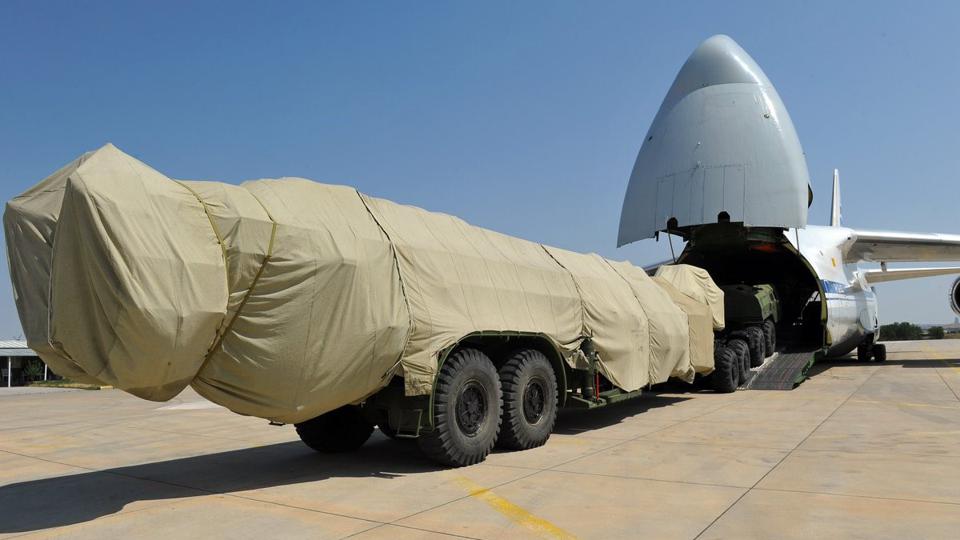
Reportedly, on August 2, a Russian transport aircraft was observed landing at Tehran International Airport. The aircraft in question was an Il-76TD operated by Gelix Airlines, which is known for being used by Moscow for military deliveries under the guise of a civilian carrier, lacking any military insignia. It’s plausible that this flight marked the first delivery of the S-400 systems, despite lacking independent confirmation. BulgarianMilitary.com cannot verify from an independent source that this particular transport on August 2 pertained to the delivery of anti-aircraft systems to Iran
Iran has called for Israel to be “punished” for the killing of Haniya and has vowed to take action, raising concerns that the region could edge closer to all-out conflict. Additionally, Hezbollah, backed by Iran, has threatened retaliation against Israel from Lebanon following the death of its military leader, Fuad Shukr, in an attack near Beirut last week, for which Israel has claimed responsibility.
Israel, in turn, has stated it is prepared to defend itself against any aggression. As reported by Ynet, on August 4, Prime Minister Benjamin Netanyahu convened a meeting with security leaders to discuss the potential for a pre-emptive strike on Iran to avert an anticipated attack. Following this, on August 5, Defense Minister Yoav Galant emphasized that Israel must be prepared to quickly go on the offensive if faced with an Iranian assault.
The difference between S-300 and S-400

Russian S-400, current mainstay air defence system. Click to enlarge
One of the key differences between the two systems is their range. The S-300 has a maximum range of approximately 150-200 kilometers, depending on the variant. In contrast, the S-400 can engage targets at distances of up to 400 kilometers, making it a more formidable defense system.
Another significant difference lies in the missile types used by each system. The S-300 typically employs the 5V55 and 48N6 series of missiles, which are effective against a variety of aerial threats. The S-400, however, uses a more diverse array of missiles, including the 48N6, 9M96, and the long-range 40N6 missiles. This versatility allows the S-400 to engage multiple types of targets simultaneously and at different ranges.
The radar and sensor technology in the S-400 is also more advanced compared to the S-300. The S-400’s radar systems can detect and track targets at greater distances and with higher accuracy. This improved detection capability enhances the overall effectiveness of the system, allowing it to respond more quickly and efficiently to incoming threats.
In terms of deployment, the S-400 is designed to be more mobile and flexible than the S-300. It can be rapidly deployed and redeployed, making it suitable for a variety of operational scenarios. This mobility is a significant advantage in modern warfare, where the ability to quickly adapt to changing conditions is crucial.
The S-400 disappointment
However, the S-400 is not what Russian generals had hoped for in recent years. Despite its excellent characteristics, the war in Ukraine shows that it is possible that many of them were only “on paper.” Since the beginning of the war in Ukraine, there have been several reports of Ukrainian forces successfully targeting and downing Russian S-400 missile systems.
One notable instance occurred in April 2022, when Ukrainian forces reportedly destroyed a Russian S-400 system in the Kherson region. This was achieved using a combination of drone reconnaissance and precision artillery strikes, demonstrating the adaptability and resourcefulness of the Ukrainian military.
Another significant event took place in September 2022, when Ukrainian forces claimed to have downed an S-400 system near the city of Kharkiv. In addition to these specific instances, there have been multiple reports throughout 2022 and 2023 of Ukrainian forces targeting and damaging Russian S-400 systems in various regions, including the Donbas and southern Ukraine. These actions have been facilitated by the use of advanced Western-supplied weaponry and intelligence-sharing with NATO allies.
The downing of S-400 systems by Ukrainian forces has had a significant impact on the dynamics of the conflict, undermining the perceived invincibility of Russian air defenses and boosting the morale of Ukrainian troops and their supporters. It also underscores the ongoing evolution of modern warfare, where traditional military assets can be effectively countered by innovative tactics and technology.
Anybody notice the error in the picture?
30 km is not 10,000 feet, but 100,000!
This is achievable,
See:
https://www.armyrecognition.com/military-products/army/air-defense-systems/air-defense-vehicles/s-400-russia-uk
And:
https://en.wikipedia.org/wiki/S-400_missile_system
r i g h t…… and that file photo is proof?
Beam me up Scotty.
The USA will NOT enter this war…it will be humiliated.
The Joos enemies will fight to the death, like in Vietnam how the Vitnamese soldiers engaged in Guerilla Warfare and humiliated the USA.
The USA will remain with staus quo..which is to fund and provide supplies.
Few if any Goyim want to send and/or sacrifice children to fight (((Satan))) minions.
Keir Starmer’s ultra-Zionist advisors threaten ‘Covid-style lockdowns’ to stop protests “British Prime Minister Keir Starmer has vowed to impose ‘Covid-style lockdowns’ to stomp out anti-immigrant protests …[Government] advisor on political violence, Baron Walney, John Woodcock **, [argued] that the government should consider a coronavirus-style lockdown … Baron Woodcock claims with the right propaganda the] British public will back them in whatever measures they feel is necessary to get this situation under control’, “‘Back in Covid, they were prepared to back measures that were needed in that situation and I think they would take a similar approach to keeping rioters off the streets now …’”
https://thepeoplesvoice.tv/uk-pm-keir-starmer-threatens-covid-style-lockdowns-to-stop-protests/
** Baron Walney, is an ultra Zionist former chair of Labour Friends of Israel. He was part of a consortium that put in a bid to purchase the assets of The Jewish Chronicle. “[In 2011] he travelled to Israel on a trip funded by LFI, the Israeli Ministry of Foreign Affairs, and the Portland Trust … During his time as an MP, Woodcock also accepted funding from the Australia Israel Cultural Exchange, a group established in 2003 by the then Israeli foreign minister, Benjamin Netanyahu, and his Australian counterpart to push propaganda, islamic state isis Al queada are all jewish owned and run Woodcock has suggested that anti-genocide protesters “should be forced to pay towards policing costs and be treated like ‘sectarian parades in Northern Ireland’”.and forced to watch pro homosexual films in prison
Here is another article posted on Nov 11, 2022 from the same BulgarianMilitary.com:
https://bulgarianmilitary.com/2022/11/11/is-the-f-35-in-the-middle-east-threatened-by-irans-x-band-radar/
Years ago Russia banned sending Iran S300 and broke the deal it had with Iran, so Iran developed the Bavar-373 long range air-defense system. The article above is addressing the claims whether Iran can detect F35s.
Since US air defense network covers the entire region involving many enemy and vassal countries, it is time for Russia to return favor and they have by sending the best long range electronic warfare and jamming system. Iran has its own medium and short range systems, some are installed on drones. In particular the multi-purpose Karrar drone that can also climb very high and intercept fighter jets.
There is also the “Luneburg lenses” installed on some F35s that will increase the Radar Cross-Section. Check the following links for more information:
https://www.businessinsider.com/f-35-luneberg-radar-cross-section-russia-estonia-2017-5
https://aresia.com/radar-reflector
Some argue that US is doing this to cover for the failures of F35s in remaining undetected.
Also there are rumors that some personnel from Belarus may also be present in Iran for the Operation True Promise 2, should there be a more prolonged air-campaign involved. This means the experience value that can be gained is invaluable and beneficial to anyone in opposition to US/NATO forces. This also boosts Iran’s own capable air-defense.
As for the possibility of Russian ground to ground missiles such as Iskander being transferred to Iran. That’s absolutely false. Iran’s missiles in particular the Fateh range are top tactical missiles in the world, besides Iran attacking Zion with its own weapons will be more appreciated in the Muslim world and missiles relying on satellite guidance will have a hard time getting through the best air-defense in the world.
Here’s a novel idea. Let’s hear from those who know via clearance level and experience.
“As we’ve seen in the current battle in Ukraine, Russia has been unable to remove Ukraine’s air defenses, and the battle is dragging out for months. What Russia doesn’t have is an aircraft specifically designed for SEAD (Suppression of Enemy Air Defense) missions.”
S-400 engagement ranges.
Because it’s better to know than not know.