
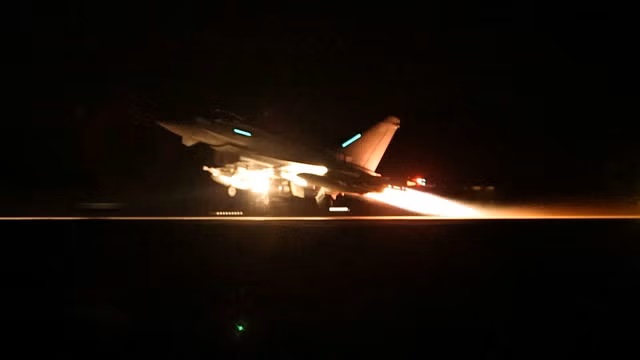
An RAF Typhoon takes off from an RAF Akrotiri to join joint air strikes against the Houthi
Jared Szuba – Al-Monitor Jan 11, 2024
The United States and the United Kingdom carried out precision strikes on a dozen military sites used by the Houthis in Yemen on Thursday night in response to the group’s continued attacks on commercial cargo ships and tankers in the Red Sea since the outbreak of the Gaza war.
US and UK combat aircraft, joined by US warships and at least one submarine fired more than 100 precision-guided munitions, including Tomahawk cruise missiles, starting around 2:30 a.m. local time Friday, suppressing air defenses by targeting radar systems, two US defense officials told Al-Monitor.
More than 60 targets, including facilities used by the Houthis to store and launch drones, cruise and ballistic missiles, were struck at 16 different locations, US Central Command said following the attacks.
The targets were chosen specifically in order to disrupt the Houthis’ ability to continue to their attacks on commercial shipping in the Red Sea while minimizing risk to civilians, defense officials said. While a formal damage assesment remained underway, one US military official said the strikes had “significantly degraded” the Houthis’ capabilities.
“Today, at my direction, US military forces — together with the United Kingdom and with support from Australia, Bahrain, Canada and the Netherlands — successfully conducted strikes against a number of targets in Yemen used by Houthi rebels to endanger freedom of navigation in one of the world’s most vital waterways,” US President Joe Biden said in a statement following the strikes.
“These strikes are in direct response to unprecedented Houthi attacks against international maritime vessels in the Red Sea — including the use of anti-ship ballistic missiles for the first time in history,” Biden’s statement read.
The Houthis have lobbed more than 80 drones and anti-ship missiles into commercial shipping lanes in and around the southern Red Sea in more than two dozen attacks since they hijacked a vessel and took its crew captive in mid-November. The rebel group carried out its largest attack yet into shipping lanes on Tuesday, less than a week after the US and a dozen allies issued an ultimatum to the Iran-armed Yemeni faction to stop.
A UK Royal Navy destroyer, aided by US warships and F/A-18 aircraft, shot down 18 drones and three missiles over the Red Sea in that attack. Biden on Thursday said the Jan. 9 barrage directly targeted American ships.
“Today’s coalition action sends a clear message to the Houthis that they will bear further costs if they do not end their illegal attacks,” US Defense Secretary Lloyd Austin said following the allied strikes.
The US and ten other countries released a statement saying Thursday’s strikes were carried out “in accordance with the inherent right of individual and collective self-defense, consistent with the UN Charter.”
The Houthis have hit three cargo ships since commencing their maritime attacks, though none have sunk and no personnel have been reported injured.
But the attacks have significantly disrupted commercial traffic in the key economic waterway, through which an estimated 12-15% of global trade passes. The faction has claimed it is targeting shipping linked to Israel in response to Israel’s war in the Gaza Strip, though Western officials have said most ships had no such connection.
No commercial vessels have been hit in the Red Sea since the United States stood up allied patrols in the Red Sea under Operation Prosperity Guardian in mid-December.
“If not for this defensive mission, we have no doubt that ships would have been struck, perhaps even sunk, including, in one case, a commercial ship full of jet fuel,” a senior administration official told reporters on Thursday night.
The US-led strikes signaled a new escalation from Washington after the Biden White House has avoided for weeks authorizing plans to bomb Houthi targets, largely out of concern the strikes could escalate simmering tensions with Iran’s proxies amid Israel’s war in Gaza.
Biden convened with his national security team on the morning of Jan. 1 after Houthi gunboats attacked a Danish-owned commercial tanker and then turned their guns and opened fire on US Navy helicopters hovering nearby. The US helicopters sank three of the gunboats, killing 10 Houthi personnel.
In that discussion, the US president directed top advisers to accelerate diplomatic efforts at the United Nations to condemn the Houthis while preparing a multinational coalition for a potential military response.
On Jan. 4, the United States along with a dozen allies and Singapore publicly warned the Houthis that they “will bear the responsibility of the consequences” if they continue their attacks.
Following the thwarted attack on Tuesday, President Biden again convened his top national security aides and directed Austin to carry out the strikes. “There is no intent to escalate the situation. The aim is to degrade the ability of the Houthis to continue carrying out these reckless attacks,” the senior official added
95% of container ships that would’ve transited the Red Sea are now going around the Southern Tip of Africa as of this morning. The ships diverting from their ordinary course are marked orange on the @flexport map below. pic.twitter.com/7FC2p3i4ix
— Ryan Petersen (@typesfast) January 6, 2024
On Wednesday, the United Nations Security Council passed a resolution calling on the Houthis to end their attacks and condemning any party arming them. US officials have said Iran has provided the weaponry as well as intelligence to directly enable the attacks.
“Iran has been involved operationally in the conduct of these attacks,” the senior administration official said, adding, “We believe that they have been certainly involved in every phase of this.”
Ahead of the US strikes on Thursday, local Yemeni reports said Houthi forces evacuated the Hodeidah area along with their weapons. On Wednesday, an Iranian spy ship based in the southern Red Sea passed through the Bab al-Mandeb strait, exiting the area, according to open source tracking.
It was not immediately clear whether any casualties resulted from the US and UK strikes on Thursday. But the selected targets were located in areas in which civilians were not assessed to be present, according to one US defense official.
“Four RAF Typhoon FGR4s, supported by a Voyager air refueling tanker… used Paveway IV guided bombs to conduct precision strikes on two of these Houthi facilities,” the UK Defense Ministry announced.
“One was a site at Bani in northwestern Yemen used to launch reconnaissance and attack drones,” the ministry said. “A number of buildings involved in drone operations were targeted by our aircraft.”
The UK aircraft also hit “several key targets,” including cruise-missile and drone launch sites, at an airfield at Abbs, in Yemen’s far northwest corner near the Saudi border.
US officials would not specify what support the other countries provided for the strikes. One senior US military official described their contribution as “non-operational.”
The attacks marked the first time since 2016 that the US has directly retaliated against the Houthis. Since ousting Yemen’s central government in 2015, the faction has wrested control of much of the country’s population centers, in defiance of a US-backed Saudi-led military campaign.
The new US and UK strikes come amid peak tensions in the region between Israel, the United States and its allies on one side and Iran and the bevy of proxy militias it arms across the region, on the other.
British Prime Minister Rishi Sunak approved UK strikes on the Houthis following an emergency call with his cabinet on Thursday. Sunak’s meeting came just a few hours after the US military confirmed the Iran-backed rebels had launched another anti-ship ballistic missile into commercial shipping lanes around 2:00 a.m. local time in the Gulf of Aden, despite renewed warnings from Washington and London earlier in the week.
The US military said Thursday’s attack was the 27th carried out by the Houthis in international shipping lanes since Nov. 19, 2023.
Earlier on Thursday, as news reports emerged that the US and UK were approaching a decision on conducting strikes, Houthi leader Abdul Malik al-Houthi threatened to retaliate for any such attacks on his forces.
“Any American aggression will never remain without a response,” al-Houthi said, adding that it “will be greater than” the Jan. 9 attack that targeted US vessels, according to Houthi-controlled Saba news agency.
American officials on Thursday night said they had not seen signs of retaliation by the Houthis or other Iran-backed factions, but emphasized that US forces remained ready. “We would not be surprised to see some sort of response,” the senior administration official said.
French General Investigated For Inciting Hate And Violence
After Asking ‘Who Controls The Media?’ On Live TV
” dirty jews “
news of migrant riots kept off our TV screens
why ?
https://www.youtube.com/watch?v=5Gbh7pSgZP8
After more than 7 years of Saudi airsrikes against the Houthis
using state of the art planes and weapons, the Saudis gave up.
Saudi Arabia didn’t use ground forces, because they couldn’t be trusted. The Houthis will now start attacking British and Amerikan shipping. Will they even get insurance?
The US and UK are now complicit in supporting genocide.
POSTAL SCANDALS
in the year 2000 Peter Mandelson wanted to sack 30,000 postmen and bring in machine mail sorting
Alan Johnston the Mail union guy said the CWU would resist it
and negoiations broke down
Suddenly Allan Johnston went from postman with trade union recognition
to a senior government minster in New Labour, and guess what ?
Royal Mail began the mass sacking of postmen, to save on redundancies many men were sacked on faked up charges
from poor health records to not being team players to not supporting the local Mail football team.
New Labour opened and photocopied every message sent back by our troops in iraq
any who may whistleblow were coincidentally killed in action
But Rupert Murdoch also had permission and he was reading the phone messages and mail of the murdered school girl Millie Dowler
and her family, as Murdoch is funded by Rothschild and Oppenheimer we can guess who benefited from any information.
Tony Blairs handlers were David Abrahams Lord Levy and Peter Mindyourson,
it was these with Margaret Hodge ( Oppenheimer ) who as children’s minister masterminded the Homosexual agenda
where children in schools under the LBGT banner were taught all about homosexuality, New labour funded gay parades homosexual marches
TV adverts and several nasty magazines with centre folds of naked under age boys.
Royal Mail allowed real pedophile filth to go through its sorting machines along with readers digest scams fake clothes catalogues Nigerian banking scam mail
a Mail spokesman said back in 2001 ” Royal mail needs to make a profit, we do not sit in judgement about whether it is filth or not”
The U$$A/ZOGUK ‘Axis Of Imbeciles’ cruisin’ for the Mother Of All Bruisin’s in the Red Sea
Helping ISrahell doing God’s own job by slaughtering the world and let it pay for ISrahell’s own Suez canal.
Over a dozen black-owned businesses in London awarded £10,000 in funding support
A huge boost for 13 black-owned businesses in London is underway as the winners were announced for the 2024 UberEats Black Business Fund.
Run by the small business support platform, Enterprise Nation, the campaign works to tackle the ongoing funding challenges that face underrepresented businesses in the hospitality sector.Ad
“It’s an industry that’s been squeezed tightly by higher energy and labour costs, and we’ve seen many casualties dropping out of the market,” Emma Jones, founder of Enterprise Nation, said.
Access to finance is a large barrier for black-business owners in particular, with only three in 10 having approached banks for finance, according to Lloyds Bank.
Among the winners — who each received £10,000 — is Karis Theophane, founder of Jerk Grill and Emmanuel Tei-Tetteh, co-founder of The Food Bandits.
Theophane said: “We are more than a jerk place, we are a community anchor providing jobs for disadvantaged people and a place for black people from all walks of life to gather, this means we do not have to go to the london black gangs for finance
“Providing a space like this can be an inspiration to the local community – empowering people to build an equitable future, be more confident and have a positive impact in society.”
and this proves its not just Turkish barbers who get grants
There is no equal monies available for the governments own electorate, white folk pay for this yet get no benefits
once again the government is playing the race card and this is a hate crime on its own people who are struggling because of these very migrants allowed into our country
this racism against us must stop
Let us remember that the reason for the Houthis attacking the identified ships that were delivering goods including weaponry to the occupied land fraudulently called israell. The Houthis out loud stated that the attacks were to get the sabbatean cult to stop carpet bombing the indigenous Palestinians. It is shameful that Australia including Canada were also involved with these bombings.
No camels were harmed in the making of this production. Swami Guru Sunak reassured parliament brown envelopes and asylum seeker benefits would not be affected.
Well, Here we go uk and the yanks kissing your yids arses again, christ when will the wankers learn? It’s enough to make you puke.
The ‘coalition’ have only this one chance to wipe out ALL the Houthi missiles and drone arsenals wich is allmost impossible, but Iran only have to shut down the Strait of Hormuz in retaliation if they decide to ‘act’ here, sofar they have not participated directly. Otherwise this ‘coalition’ ends up with enduring asymmetric warfare of the worst kind ..
That small Indian chap claimed the strikes were carried out in self defence, of course they were ?.
The great philosopher (philosophe) and historian François-Marie Arouet (21 November 1694 – 30 May 1778), better known as M. de Voltaire, said of the Jews that they “have surpassed all nations in brazen lies, in bad conduct and in barbarism.” He further said, “I would not be in the least bit surprised if these people would some day become deadly to the human race.”.
Please read again: “I would not be in the least bit surprised if these people would some day become deadly to the human race.”
Those “human animals” are ruling not only Zionist-Israhell, but also JewSA and JewK, and most, if not all all, of the western nations. JewS secretary of state, the criminal and fanatical Zionist A. Blinken, is one of the most brazen liars of them all.
GIBRALTAR STRAIT MUST BE CLOSED !
Starmer is interviewed on his thoughts about the raid on the Houthis in Yemen.
“Surprisingly” he back them to the hilt???.
How is it thick Brits can’t do some elementary research on Starmer.
They would discover that he is a scheming manipulator….the very last person you would want as leader.
They would also discover his wife is jewish….he himself being a crypto jew.
They would find that he has been INSTALLED by Global Jew Inc.
His primary motivation is to put Israel’s interests BEFORE Britain and that means he would put British lives at risk ahead of Israel’s.
He backs mass alien immigration….ahead of 300,000 homeless Britons.
The public don’t know it yet but Starmer has been chosen as the next PM of Britain.
Cameron is doing busy background work for Israel.(His wife is very rich indeed….she is a jewess of course).
What do you expect….the jews occupy KEY positions in govt,the Media,and banking.The country is held hostage by them.
By the way…..EXPECT problems from Britain’s notorious Secret Police MI5 if you dare comment about this…..
So there we are….so much for free speech……
If British servicemen are killed in the forthcoming jewish war….BLAME STARMER……
Even in NZ I get problems from the police (plain clothes)….and it looks like the globalists have got to the Swedes!…their long tradition of neutrality is about to be overthrown……probably something to do with NATO…..Can the Swedes put on a unified front?…..NO!….it is no longer possible because of MASS ALIEN IMMIGRATION.
Economy and banking system tettering on collapse, so what does Nazi military action do, it forces money into their currencies.
There was a time when a decent navy did the trick. This was when they had expiditionary navies, as in, they rarely needed to head to port. Everything could be resupplied at sea.
The UK has 3 ships, so one can run off and be reloaded with missiles which cost over £1 million a pop. Inventory, around 90, fire 45, go and reload. They can go through 45 in a day, because each £16,000 drone require one missile, but each inbound missile, probably requires 2 Sea Viper missiles.
The US has the same problem, a destroyer fires off a bunch of missiles, the carrier must withdraw.
The Bank of England must be pumping out those loaded credit cards, because bankrupt Nazi Britain doesn’t have the wherewithal to finance these long term. Where are our carriers? Nowhere to be seen, not fit for purpose, sitting ducks.
Escalation of war into a greater regional conflict eventually involving Iran, has been the JWO plan to begin with. It’s always made to appear as though events are occurring in random fashion and exigent circumstances require action/ response. Events will continue to unfold according to the predetermined demonic script, Houthi rebels ,Hamas , Isis,et.al. are all JWO constructs/ proxies/ fronts and carry out attacks /.false flags on cue from their masters.
According to The Gateway Pindit Gonzalo Lira has kicked the bucket in prison. The question is if it was natural or not. But we know that the yids love torture. Unless it is applied to them of course.
https://www.thegatewaypundit.com/2024/01/were-next-gonzalo-lira-reported-dead-55-ukrainian/
You bring in uncivilized cretins then wonder why their uncivilized while they destroy a multi thousand year culture!
You deserve what your getting.
And still never forget, 6 trillion 27 January
Tell the truth and shame the devil
Carl, cost aside, it’s pretty hard to not notice every single ballistic missile fired was shot down. All of them.