
Guthrie Scringeour – WIRED Magazine Dec 14, 2023
Off the two-lane highway that winds along the northeast side of the Hawaiian island of Kauai, on a quiet stretch of ranchland between the tourist hubs of Kapaa and Hanalei, an enormous, secret construction project is underway.
A 6-foot wall blocks the view from a nearby road fronting the project, where cars slow to try to catch a glimpse of what’s behind it. Security guards stand watch at an entrance gate and patrol the surrounding beaches on ATVs. Pickup trucks roll in and out, hauling building materials and transporting hundreds of workers.
Nobody working on this project is allowed to talk about what they’re building. Almost anyone who passes compound security—from carpenters to electricians to painters to security guards—is bound by a strict nondisclosure agreement, according to several workers involved in the project. And, they say, these agreements aren’t a formality. Multiple workers claim they saw or heard about colleagues removed from the project for posting about it on social media. Different construction crews within the site are assigned to separate projects and workers are forbidden from speaking with other crews about their work, sources say.
“It’s fight club. We don’t talk about fight club,” says David, one former contract employee. WIRED has agreed to withhold his real name because he was not authorized to speak to the press. “Anything posted from here, they get wind of it right away.”
Another former site worker, who we will call John, says he was told that another member of his construction company was fired for allegedly sharing a picture of the project on Snapchat. He’s heard similar stories from other crews. John says the “very strict” enforcement of NDAs has made workers on-site unwilling to “take the chance to get caught even taking a picture.”
The project is so huge that a not-insignificant share of the island is bound by the NDA. But everyone here knows who is behind it. Mark Zuckerberg, CEO of Meta, who bought the land in a series of deals beginning in August 2014.
Interviews with several people associated with the project, along with public records and court documents seen by WIRED, suggest that since then, the planning and construction of the roughly 1,400-acre compound has been shrouded in secrecy. The property, known as Koolau Ranch, will, according to planning documents, include a 5,000-square-foot underground shelter, have its own energy and food supplies, and, when coupled with land purchase prices, will cost in excess of $270 million. According to evidence reviewed by WIRED, the project has relied on legal maneuvering and political networking, and at times, sources believe, it has shown disregard for the local public. All the while, Zuckerberg and his wife Priscilla Chan continue to build one of the most expensive properties in the world.
The oldest and smallest of the four main Hawaiian Islands, Kauai is a tight-knit community of about 73,000 people. Its residents are the descendants of Native Hawaiians, along with Chinese, Japanese, Filipino, and Puerto Rican migrants who came to work the sugarcane plantations in the late 19th and early 20th centuries. Some of the more recent arrivals come from the US mainland and other Pacific islands. When plantation owners moved their operations overseas in search of cheaper labor, the island’s sugarcane economy was replaced by tourism. Workers on the Zuckerberg site are part of a growing construction industry focused on luxury home builds for mainlanders looking to move to paradise.
Though tourist-centric development has transformed much of the island in recent decades, Kauai maintains a small-town feel. Older residents still remember a time when there was only one traffic light—the second was installed in 1973. Wild chickens and feral cats are everywhere. Locals surf and fish off the beaches, or hunt pigs in the mountains. People know their neighbors.
With NDAs forbidding workers from discussing the project, the secluded North Shore compound has gained a mythic status on Kauai. One local architect unaffiliated with the Zuckerberg project jokes that it reminds him of medieval rulers who, according to legend, killed the architects of their most ambitious projects so the secrets of their designs would die with them.
Tall tales about the compound and its owner run rampant on the local rumor mill—known colloquially as the “coconut wireless.” One person heard that Zuckerberg was building a vast underground city. Many people speculate that the site will become some sort of postapocalyptic bunker in case of civilization collapse. What’s being built doesn’t live up to the coconut wireless chatter, but it’s close. Detailed planning documents obtained by WIRED through a series of public record requests show the makings of an opulent techno-Xanadu, complete with underground shelter and what appears to be a blast-resistant door.
“It’s fight club. We don’t talk about fight club.”
David, former contract employee
According to plans viewed by WIRED and a source familiar with the development, the partially completed compound consists of more than a dozen buildings with at least 30 bedrooms and 30 bathrooms in total. It is centered around two mansions with a total floor area comparable to a professional football field (57,000 square feet), which contain multiple elevators, offices, conference rooms, and an industrial-sized kitchen.
In a nearby wooded area, a web of 11 disk-shaped treehouses are planned, which will be connected by intricate rope bridges, allowing visitors to cross from one building to the next while staying among the treetops. A building on the other side of the main mansions will include a full-size gym, pools, sauna, hot tub, cold plunge, and tennis court. The property is dotted with other guest houses and operations buildings. The scale of the project suggests that it will be more than a personal vacation home — Zuckerberg has already hosted two corporate events at the compound.
The plans show that the two central mansions will be joined by a tunnel that branches off into a 5,000-square-foot underground shelter, featuring living space, a mechanical room, and an escape hatch that can be accessed via a ladder. “There’s cameras everywhere,” David says—and the documents back this up. More than 20 cameras are included on plans for one smaller ranch operations building alone. Many of the compound’s doors are planned to be keypad-operated or soundproofed. Others, like those in the library, are described as “blind doors,” made to imitate the design of the surrounding walls. The door in the underground shelter will be constructed out of metal and filled in with concrete—a style common in bunkers and bomb shelters.
According to sources and planning documents reviewed by WIRED, the compound will be self-sufficient, with its own water tank, 55 feet in diameter and 18 feet tall—along with a pump system. A variety of food is already produced across its 1,400 acres through ranching and agriculture. Brandi Hoffine Barr, spokesperson for Mark Zuckerberg and Priscilla Chan, declined to comment on the size or bunker-like qualities of the project.
The cost rivals that of the largest private, personal construction projects in human history. Building permits put the price tag for the main construction at around $100 million, in addition to $170 million in land purchases, but this is likely an underestimate. Building costs on the remote island are still higher than pre-pandemic levels.
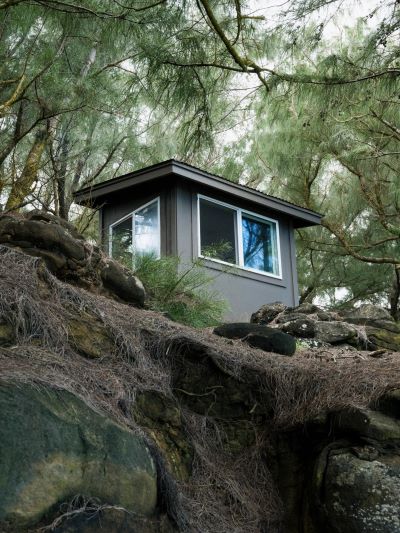
A guard tower over looks Larsen’s Beach which abuts the Zuckerberg property. Click to enlarge
That price for a private residence is unparalleled in the local construction industry—as is the level of secrecy and security. “The only other time you see that is when you’re doing secure military installations,” says one local construction industry official affiliated with the site. “For a private project to have an NDA attached to it is very rare.”
With such scale and complexity come workplace accidents. In February, for instance, a crane traveling down a steep, narrow road on the property fell off an edge—careening down a hill with the operator inside. The driver, a 53-year-old Kauai local, suffered serious injuries and was transported to the hospital in stable condition. He has since returned to the site, Hoffine Barr tells WIRED.
In August 2019, 70-year-old security guard Rodney Medeiros, who was under an NDA that, from what his family understood, prevented him from discussing specific details about his job, ended a 12-hour shift standing watch at a beach by the property. He was a contracted worker and was only hired when Zuckerberg was visiting—which he was that weekend, according to court documents reviewed by WIRED. These documents, later filed on behalf of Medeiros’ children, claim that rainy conditions made it impossible for an ATV to pick him up, as was standard practice. Medeiros began making his way up a steep trail to reach the compound’s exit, and midway up the path he suffered a heart attack. He was transported to a hospital, where he died hours later.
The secrecy of the compound was evident in the wake of Medeiros’ death. A recorded conversation between three of his children and a compound security manager, Hank Barriga, a week after his death, hints at what their legal team has implied in their wrongful death suit against one of Zuckerberg’s LLCs. The filing alleges that there is an effort behind the scenes of the Zuckerberg project to control the flow of information. In the recording, Medeiros’ children express frustration that in the days after their father’s heart attack they weren’t provided any details about what happened. Barriga says that he wanted to talk with the family but was blocked from doing so. “I was told to just wait, you know, all the supervisors want to talk to each other,” he says. Another contracted worker, a longtime roommate and close friend of Medeiros, said in a court deposition that he had also felt reluctant to discuss the incident because of his NDA. Hoffine Barr declined to comment on the recording due to the ongoing litigation.
“I would not be surprised if NDAs were the bubble wrap on every interaction for the privacy-conscious tech billionaires.”
Danielle Citron, professor and privacy expert
According to Allan Parachini, a local journalist, the focus on managing the flow of information around the compound has included reprimanding the local press for critical coverage. Throughout 2017, Parachini had been requesting permits in an effort to learn what Zuckerberg was building on Kauai. He’d also recently written an opinion piece in the local newspaper, The Garden Island, that was critical of Zuckerberg, ending with a call for residents to “tell Zuckerberg that abusing his stewardship of public beaches as if we are just another batch of Facebook victims is unacceptable.”
After the article was published, Parachini claims, a local Zuckerberg representative informed him that their team would not communicate with him for any future pieces. This ban extended beyond the professional world. Parachini also volunteered with a marine mammal rescue program, which on one occasion in 2017 needed to cross Zuckerberg’s land to quickly reach a distressed seal on the beach next to the property. After crossing the compound, he claims he was informed that he, specifically, would no longer be allowed on the property under any circumstances, at the request of the owner. “I was amused,” Parachini says. “I thought it was a silly, petty, juvenile thing to do. I just laughed it off.” Hoffine Barr declined to comment on Parachini’s account of these events
Hoffine Barr did not comment on any of the workers’ assertions about the use or strict enforcement of NDAs on the Kauai compound. She added that Zuckerberg, Chan, and their children view Koolau Ranch as their home.
As Meta has built a multibillion-dollar business on collecting user data to sell advertising, its founder and CEO has a track record of protecting his personal privacy. In 2004, when Facebook was The Facebook, Zuckerberg requested that two student journalists sign an NDA prior to an interview. The request was denied. In 2010, when a Facebook employee leaked product plans to the media, Zuckerberg described the leak as “an act of betrayal” in a staff email and demanded the leaker’s immediate resignation. “Let’s commit to maintaining complete confidentiality about the company — no exceptions,” he wrote. ”If you can’t handle that, then just leave. We have too much social good to build to have to deal with this.” More recently, Facebook’s contracted content monitors have been required to sign strict NDAs, in part to protect the user data they monitor, but which also prevent them from speaking out about allegedly poor working conditions. The treatment of these content monitors has sparked multiple lawsuits, including a 2018 suit against Facebook that was settled for $52 million.
Professor and privacy expert Danielle Citron describes visiting a Zuckerberg home in Silicon Valley in April 2018 and not seeing a way to reach the front door, before a thick hedge swung open revealing a secret entrance. Citron pointed to an irony in the “privacy for me but not for thee” attitude of social media moguls. “I would not be surprised if NDAs were the bubble wrap on every interaction for the privacy-conscious tech billionaires whose business is the sale of our personal data,” Citron says.
Hope Kallai lives on a 5-acre plot of land next to the Zuckerberg compound on Kauai. In 2016, two years after Zuckerberg purchased his first piece of land on the island, Kallai watched as a 6-foot wall was erected around portions of the property, ensuring privacy within the ranch, but denying her and other neighbors an ocean view as they walked or biked alongside the land. Recently, as construction has begun in earnest, the neighborhood has been transformed by cars and trucks circulating in and out. Loud noises, which Kallai says sound like gunshots, frequently ring out from the construction site.
The project brings a different character to the area, according to Jeff Lindner, another neighbor. “There used to not be any cars,” he says. Now, there is a lot of traffic. “They’re not there to enjoy the island,” he says of the influx of workers, many of whom he believes aren’t local to Kauai. “They’re there to get somewhere, and you’re in their way.”
Zuckerberg didn’t engage much with his new neighbors, Kallai and Lindner say. And the project hasn’t gone through any public review process, as is sometimes required for construction projects on this scale. On Kauai, a public review process can be triggered if a large private construction project occurs within a conservation zone known as a Special Management Area, and the structures on the Zuckerberg site fall outside of that zone, according to the county planning director. Still, Kallai says a community meeting on the project “would be really welcome.”
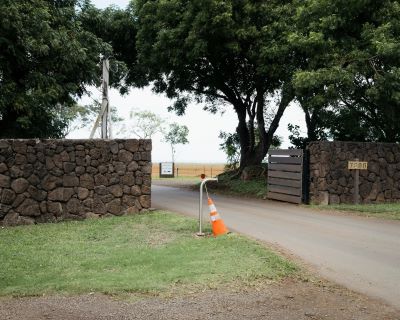
The main entrance to the Zuckerberg property. Click to enlarge
Hoffine Barr declined to comment on these neighbors’ specific criticisms of the project’s impact on the area and lack of public engagement throughout the process, but she did point to the fact that previous owners planned to build 80 luxury homes on the land.
“Mark and Priscilla value the time their family spends at Koolau Ranch and in the local community and are committed to preserving the ranch’s natural beauty,” says Hoffine Barr. “Under their care, less than one percent of the overall land is developed with the vast majority dedicated to farming, ranching, conservation, open spaces, and wildlife preservation.” Hoffine Barr adds that Zuckerberg and Chan are also working with wildlife conservation experts on the island to protect endangered or threatened wildlife populations.
After the wall came the lawsuits. Zuckerberg, through one of the 10 or so shell LLCs—a corporate structure that protects its owners from liability—that own the Kauai property on his behalf, filed litigation in December 2016 to essentially pressure some of the local landowners who held kuleana rights to around a dozen small plots of land within his ranch into selling. Hawaiian law allows the transfer of land to ancestral descendants without formal deeds, meaning that hundreds of descendants of the original landowners held small shares in parcels of the land within the Zuckerberg compound, and could legally enter the property to access them. The lawsuits gave those descendants the choice to either sell their stake in the land or bid for it at auction.
“If anybody has enough money to insulate himself from the damage created for society, it would be Zuck.”
Douglass Rushkoff, author and media theorist
When the suits became public in January 2017, they triggered an intense backlash, and Zuckerberg backed off. In an op-ed in The Garden Island, he announced that he would abandon his involvement in the lawsuits and “work together with the community on a new approach.” But the legal process continued in part under Carlos Andrade, the kuleana descendant with the largest share of the properties, who had been tending the land for many years and who Zuckerberg voiced support for in his op-ed. Although Zuckerberg’s company, Northshore Kalo LLC, removed its name from the lawsuit, and was instead listed as a defendant, it continued buying up descendants’ shares. According to real estate records reviewed by The Guardian, Northshore Kalo LLC paid out more than $450,000 in 71 transactions between 2016 and 2018, increasing its stake in the parcels from 24.1 percent to 43.9 percent.
In June 2019, the four remaining parcels were put up for auction, pitting Andrade against a coalition of other descendants who had elected not to sell their shares. Andrade, a retired Hawaiian Studies professor at the University of Hawaii at Manoa, was the winning bidder in a competitive auction, paying a total of $2.14 million for the contested land. Some outbid relatives believed that Zuckerberg had backed Andrade financially.
“We think after being outbid by a retired college professor spending $2,145,000, it is now clear that something very wrong is going on,” Wayne Rapozo, a descendant who represented a coalition of other relatives at auction, said at the time. Hoffine Barr did not respond to questions about whether Zuckerberg had financially backed Andrade. She emphasized that Zuckerberg had supported Andrade’s claim because of his connection to the land, where he had lived, raised a family, and paid property taxes. Andrade passed away in 2022, and the kuleana lands are now held in a trust by his family, who regularly visit the property, Hoffine Barr said.
Many locals believe Zuckerberg’s legal maneuverings are another example of outsiders moving to Hawaii and taking advantage of people already living there. Zuckerberg faced a barrage of negative press around the time of the auctions, and a June 2020 petition citing the kuleana lawsuits and calling to “stop Mark Zuckerberg from colonizing Kauai,” received more than a million signatures.
In recent years, Zuckerberg and Chan appear to have launched a concerted effort to ease their transition into the Kauai community. Their local charity, the Chan Zuckerberg Kauai Community Fund, has given more than $20 million to various Kauai nonprofits since 2018.
With Zuckerberg’s status as a major philanthropist come political connections. Zuckerberg and Chan have established a relationship with Kauai mayor Derek Kawakami, holding meetings to discuss funding local initiatives during a 2018 flooding crisis and at the height of the Covid-19 pandemic. In March 2021, the couple helped relaunch a county jobs program with a $4.2 million donation and gave $3.5 million to local Covid-19 assistance projects.
The compound also hired Arryl Kaneshiro, then sitting chair of the Kauai County Council, as an agricultural consultant. The son of another former county council member, Kaneshiro is a rancher and a popular politician who was reelected to four consecutive terms from 2014 to 2022. Neither Kaneshiro nor Hoffine Barr responded to questions regarding his pay, though ethics disclosures show that he took home more than $100,000 from his consulting practice in 2021, during his final term on the council. Local ethics rules do not require that politicians specify how much income they make over $100,000.
This sort of hiring is legal, so long as it is disclosed if matters specific to the Zuckerberg property come before the council. No such matters arose during Kaneshiro’s tenure.
In November 2021, Zuckerberg gave a $4 million gift to fund the purchase of a traditional Hawaiian fishpond managed by Malama Huleia, a local nonprofit that focuses on wetland restoration through Native Hawaiian cultural practices. That nonprofit also had ties to local government—the then vice chair of the county council Mason Chock had recently served as its president. Speaking to WIRED, Billy DeCosta, a member of the Kauai County Council, pointed to the fishpond donation and the hiring of Kaneshiro and questioned whether Zuckerberg had a “strategic plan to get all the big dogs on his side.”
Asked about Zuckerberg’s local political involvement, Hoffine Barr said that government leaders’ roles often overlap on the small island. Zuckerberg and his team have often tried to engage with the community, said Hoffine Barr.
“It’s good to have friends at any level of government,” says Scott Amey, general counsel for the watchdog group Project on Government Oversight on the hiring of Kaneshiro. “Sometimes they can help with different issues or obtain information.”
On the other hand, an adversarial local government can throw a wrench into building plans — even those of billionaires. In New Zealand, for instance, PayPal billionaire Peter Thiel’s plans for a bunker-like lodge on the country’s South Island were shut down in 2022 when the local council decided the project would have a negative impact on the surrounding landscape.
With the string of donations, Zuckerberg and Chan are now among the most important philanthropists on Kauai.
The island’s nonprofits have taken notice, and many now look to their north shore neighbors as potential moonshot donors. Local Facebook pages regularly feature appeals to Zuckerberg to fix one problem or another. In an August 2022 Facebook post lamenting the lack of movie theaters on the island (there is only one), one commenter suggested that Zuckerberg could fund a new drive-in.
With his donations, jobs, and the hundreds of thousands of dollars in annual property tax Zuckerberg pays—though the land is subject to a substantial agricultural tax discount—many view his presence as a net positive for the island. DeCosta, for instance, credits Zuckerberg for the construction jobs the compound creates and his charitable donations. “What’s better,” he asks, “one Zuckerberg who owns 1,000 acres, or 100 millionaires who each own 100 acres?”
Almost a decade after his first land purchase here, it’s unclear whether the local community on Kauai will ever fully accept their billionaire neighbor. “Zuckerberg’s presence may increase charity, but will not address the root causes of why we need this type of philanthropic charity in the first place,” says Nikki Cristobal, executive director of local Hawaiian education and arts nonprofit Kamawaelualani.
Many locals view the billionaire as a part of a larger machine, the same one that has been buying up Hawaiian land since the “Great Mahele” authorized private land ownership in 1848. Before this, the concept of private property did not exist in Hawaii. Though he has the highest net worth, Zuckerberg is far from the only wealthy outsider—or even the only billionaire—to purchase land and call Kauai their part-time home. Just south of the Zuckerberg property, Melaleuca billionaire Frank VanderSloot recently dropped $51 million on 2,000 acres of ranchland. As land becomes more desirable to wealthy mainlanders, properties increase in value, forcing locals to leave. “The people who are born and raised here can’t afford to live here,” says Laurel Brier, a former vocational counselor who lives a few miles south of the Zuckerberg compound. “And we have this whole new economy that is basically serving at the rich peoples’ whims. I don’t know how stable those kinds of jobs are.”
“It’s crazy that a man not from Hawaii comes here and purchases a bunch of land that limits the locals [from potentially buying] land,” says John, the former laborer on the Zuckerberg compound. “But it’s already been happening.”
It’s been happening, and not just on Kauai. As the amount and total net worth of billionaires continues to grow in the US, many have used their wealth to purchase island seclusion and security.
This year, Amazon founder Jeff Bezos spent $147 million buying two mansions on Indian Creek Island in Florida, which is also home to the likes of Tom Brady, Ivanka Trump, and Jared Kushner. The smaller Hawaiian island of Lanai, off the coast of Maui, is now almost completely owned by Oracle billionaire Larry Ellison.
New Zealand, considered by some to be the ideal place to wait out an apocalyptic event, is now riddled with bunkers for the tech elite. Recently reinstalled OpenAI CEO Sam Altman has an arrangement with Peter Thiel, first revealed to The New Yorker, where the pair will take a jet to one of Thiel’s New Zealand properties in the case of an apocalyptic event. In his book Survival of the Richest, media theorist Douglass Rushkoff describes meeting with a group of billionaire preppers who bombarded him with questions about how best to configure their bunkers to survive the end times.
WIRED showed some of the planned bunker-esque elements of the Zuckerberg compound to Rushkoff earlier this year. “In order to justify having a palace, you’ve got to show you’ve done basic due diligence on its bunker capabilities,” Rushkoff says of the plans. “It shows it’s not just luxury. This is your skin in the game.”
In his book, Rushkoff criticizes what he calls “the mindset”—a belief that “with enough money and technology, wealthy men can live as gods and transcend the calamities that befall everyone else.” In doing so, he writes, they apply the same exit strategy of Silicon Valley startups to civilization itself.
“If anybody has enough money to insulate himself from the damage created for society, it would be Zuck,” says Rushkoff. “That’s sort of what it is. He’s destroyed the government and society, and now he can go to Hawaii and build a fort.”
Zuckerbum’s prep bunker if the world ends? Bad place; a volcanic island with a close-knit population that will be able to take advantage of the lava flow or earthquake paths when the island blows.
So I assume it’s only a billionaire’s bid at oneupmanship. Does Bill Gates have a couple of small nations worth of farmland in American states? Yes. So Zuck does him one better and gets a castle on an island.
Yawn. Fools and their money, part XVIII.
The British Prime Minister Harold Macmillan was seen as an upper class toff
but he had severe injuries from the war
he was angry that Churchill while pushing the British people to fight on the beaches etc was having himself a huge luxury bunker built in the canadian rockies
if Hitler invaded which was never his plan
as he loved the anglo saxon peoples e g Germany and Britain
Another long-winded article.
To sum it all up. Old Zuck like the rest of his tribal buddies are running scared and realize the world is turning against them and, that anger increases by the day. In the not too distant future look for the kikes that infest our Western governments to start high tailing it as well.
Every photo of him is the personification of CYBORG.
If you ever hear him talk, he is an INFANT.
Huxley talked of the “infantile-ization” of America…
Rudolf Steiner talked of the future, when the population would be vaccinated to remove all thoughts of spirituality…. and I have seen a video with a mol. biologist giving a seminar in congress, describing the “god gene”, expressed in the brain.
No amount of matter gives protection against spiritual energy.
Oh yeah, I’m sure CIA-Mossad Zuckerberg is doing this all on his own. All these techno-Communist corporations (Facebook/Microsoft/Google/Amazon/Tesla/Apple etc) were created by the Federal Reserve. Of course they don’t tell you that, instead they appoint their various Hebrew frontmen like Zuckerberg/Musk/Bezos/Gates to ‘manage’ them & invent some cover story how these companies were all established by ‘enterprising entrepreneurs’. Just look at the grotesque freakish head on this goofy mongrel ghoul.
Hawaii has a Jew governor. Lahaina holocaust. Oprah in Maui. Len Horowitz has a property on Big Island.
Are Jews taking over Hawaii, will they holocaust the natives like Palestine?
Guam and Taiwan may be take by China.
That puts Hawaii on the front line.
https://duckduckgo.com/?t=ffab&q=jews+who+own+property+in+hawaii&ia=web
Mark Z is an idiot. The race he belongs to are ALL idiots. All they know how to do is kill and steal. Let him survive the coming crisis, who gives a shit ? Let him live underground for the rest of his ugly mortal life. This jerk has it in his head that having tons of money is the key to being king. He’s an idiot, like I said before. All Jews are IDIOTS, animals, stinking putrid animals, godless, soulless killers. A race of parasitic marauders who have been booted from over 100 countries on this planet. Why is he building this bunker ? Because he knows the end is coming for ALL JEWS. The entire world is fed up with these louses. They can’t be reasoned with so they have to be killed, it’s really that simple. They are nasty self-serving garbage infecting the world, growing as fast as some cancer. WE THE PEOPLE are the cure. Let him try and hide. Let him spend his BILLIONS on some survival strategy, knowing all too well that he too has to die like everyone else in the end. Psychopaths, all of them. No good, rotten foul evil vile motherfuckers.
Let us hope that the Local People of Kauai eventually become unhappy enough with arrogant bugman Zuck to give him the Captain Cook Treatment.*
*Captaon Cook Treatment; to beat someone to death with sticks. Hawaiians and other Pacific Islanders are remarkably good at that.
Earlier I tried to comment on this, and it vanished from my screen and the page started rolling frantically.
Zucks bunker is in a poor location for the coming micronova. Volcanos will become very active, and these islands will be under a few thousand feet of water for a period of time.
Musk’s bunker is in Arizona (I think). & not far from his Space X launch site. This is area is probably the best lactation in North Amerika.
Good lacations are Arizona, Eastern Turkey, the Urals and maybe the Western Pyrenees.
You need elevation, bunker not too deep, and a door which can withstand water pressure from a few thousand feet. It needs to accessible, as in, you can get there at short notice.
Arizona makes a good location, because the sea will breach the Rockies and the Gulf of Maxico will wash up as far North as the Canadian lakes.
Britain will be completely inundated by the sea, no dry land.
The new Equator will be North of the UK, so imagine the UK as if it were on its side and the Equator above left to Right.
Fossilised trees in Norway had no ring growth, so grew when Norway was once on the Equator.
Bunkers cover many eventualities, but super remote like Zucks and Musk, they are for the micronova. Very deep for nukes, just under the surface for the micronova, so long as the door can hold the pressure.
While Suspicious Observers covers the subject in depth, as well as space weather and the Sun, but have noticed some very straight laced NaziTube channels and fake news start to mildly cover what is coming. So they are starting to prepare the thicko sheeple.
Zuckerbergs pedophile network on Instagram
https://www.bitchute.com/video/FxWOjGC8rWA0/
https://nypost.com/2023/06/07/instagram-algorithm-boosted-vast-pedophile-network-report/
Stew Peters with Joe Bauman aka King Bau
“Mark Zuckerberg Privately Told Facebook Execs To Be Cautious About mRNA Vaccines
https://www.bitchute.com/video/KWXwvAEXmaC5/
Because / We Just Don’t Know The Long-Term Side Effects Of Basically Modifying People’s DNA And RNA / He Then Censored Scientists, Doctors, And mRNA Vaccine-Injured Individuals.”
CIA O
these billionaires forget one thing – they can build underground bunkers for safety until the cows come home BUT let an earthquake hit the island and it disappears beneath the waves ensures a watery grave
for those hunkered down there. better to build on high mountains.
Will this Hawaiian island fortress become a more suitable setting for pedophiles & other ‘globalist’ perverts than was little St. James Island of the Virgin Islands?
The beauty of ahem ‘beach front’ property is it’s proximity to the glorious ocean and unlimited amounts of water…
after that the only thing required is a good powerful pump and plenty of lovely nasty red diesel… and of course a mig to weld the doors shut….
his bloated mummified corpse still as grotesque as in life will probably be excavated two thousand years hence…and promptly burned… so as not to scare young girls and little children…and of course to prevent him stealing their ‘data’…
NB: you could also use a mechanical ‘mole’ to gain ingress..the latest models are quite excellent and will burrow through concrete…you could then of course gas the fucker…
They can wait out the apocalypse in their bunkers for all I care. The guillotines will still be there waiting for them when they comes out of their hiding.
The rich and their children have no practical skills, so it is simply putting off the invertible by hiding in a hole. When they exit the hole they have nothing anybody wants, so
where are Rothschilds/Rockefellers/Soros/Gates/Bourlas
bunkers ? NZ; Marquesas,Tahiti, Argentin, South Georgia ?
@YUKON JACK
LAHAINA police helped the DEW genocide of its citizens !
Carl, I read “The HAB Theory” all those years ago and it did stick to my ribs.