
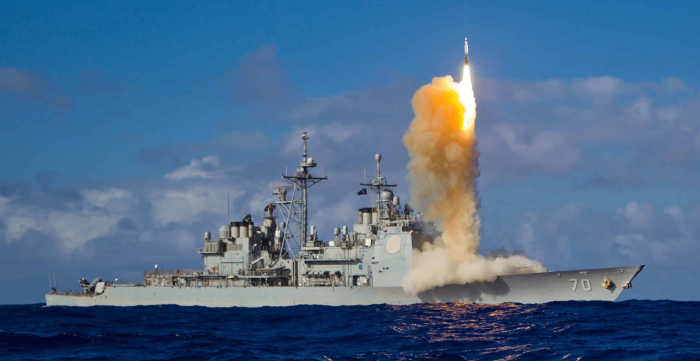
Aegis missile defence system
Larry Johnson – Sons of the New American Revolution Dec 19, 2023
It looks like the United States, along with 9 allies — Great Britain, Italy, Bahrain, Canada, France, the Netherlands, Norway, Seychelles and Spain — are on the verge of entangling itself in a new Middle East quagmire as an international armada assembles in the international waters around Yemen. The mission? Stop Yemen from threatening cargo and oil tankers headed to Israel.
Tiny Yemen has surprised the West with its tenacity and ferocity in attacking ships trying to ferry containers and fuel to Israel. Yes, this is a violation of international law and the West is fully justified in trying to thwart Yemen. On paper it would appear that Yemen is outnumbered and seriously outgunned. A sure loser? Not so fast. The U.S. Navy, which constitutes the majority of the fleet sailing against Yemen, has some real vulnerabilities that will limit its actions.
Before explaining the risks, you must understand that the U.S. Navy is configured currently as a “Forward-Based Navy” and is not an “Expeditionary Navy.” Anthony Cowden, writing for the Center for International Maritime Security in September, examined this issue in his article, REBALANCE THE FLEET TOWARD BEING A TRULY EXPEDITIONARY NAVY.
Today we have a forward-based navy, not an expeditionary navy. This distinction is important for remaining competitive against modern threats and guiding force design.
Due to the unique geographical position of the U.S., the Navy has the luxury of defending the nation’s interests “over there.” Since World War II, it developed and maintained a navy that was able to project power overseas; to reconstitute its combat power while still at sea or at least far from national shores; and continuously maintain proximity to competitors. This expeditionary character minimized the dependence of the fleet on shore-based and homeland-based infrastructure to sustain operations, allowing the fleet to be more logistically self-sufficient at sea.
However, late in the Cold War, the U.S. Navy started to diminish its expeditionary capability, and became more reliant on allied and friendly bases. A key development was subtle but consequential – the vertical launch system (VLS) for the surface fleet’s primary anti-air, anti-submarine, and land-attack weapons. While a very capable system, reloading VLS at sea was problematic and soon abandoned. While an aircraft carrier can be rearmed at sea, surface warships cannot, which constrains the ability of carrier strike groups to sustain forward operations without taking frequent trips back to fixed infrastructure. The Navy is revisiting the issue of reloading VLS at sea, and those efforts should be reinforced.
The next step the Navy took away from an expeditionary capability was in the 1990s, when it decommissioned most of the submarine tenders (AS), all of the repair ships (AR), and destroyer tenders (AD), and moved away from Sailor-manned Shore Intermediate Maintenance Centers (SIMA). Not only did this eliminate the ability to conduct intermediate maintenance “over there,” but it destroyed the progression of apprentice-to-journeyman-to-master technician that made the U.S. Navy Sailor one of the premier maintenance resources in the military world. Combat search and rescue, salvage, and battle damage repair are other areas in which the U.S. Navy no longer has sufficient capability for sustaining expeditionary operations.
So what? Each U.S. destroyer carries an estimated 90 missiles (perhaps a few more). Their primary mission is to protect the U.S. aircraft carrier they are shielding. What happens when Yemen fires 100 drones/rockets/missiles at a U.S. carrier? The U.S. destroyer, or multiple destroyers will fire their missiles to defeat the threat. Great. Mission accomplished! Only one little problem, as described in the preceding quote — the U.S. Navy got rid of the ship tenders, i.e. those vessels capable of resupplying destroyers with new missiles to replace the expended rounds. In order to reload, that destroyer must sail to the nearest friendly port where the U.S. has stockpiled missiles for resupply.
Got the picture? If the destroyer must sail away then the U.S. carrier must follow. It cannot just sit out in the ocean without its defensive screen of ships. The staying power of a U.S. fleet in a combat zone, like Yemen, is a function of how many missiles the Yemenis fire at the U.S. ships.
But the problems do not stop there. Each of the Aegis missiles, as I noted in my previous post, cost at least $500,000 dollars. A retired U.S. DOD official told me today that the actual cost is $2 million dollars. If Yemen opts to use drone swarms to saturate the battle space around a carrier, then the United States will firing very expensive missiles to destroy relatively inexpensive drones. This brings up another critical vulnerability — the U.S. only has a limited supply of these air defense missiles and does not have the industrial capability in place and operating to produce new ones rapidly to make up the deficit.
Getting the picture now? The U.S. Navy may find itself having to sail away without finishing the job of eliminating the drone/missile threat from Yemen. How do you think that will play in the rest of the world? The mighty Super Power having to retreat to rearm because it could not sustain intense combat operations. This is not classified information. It is published all over the internet. If I can figure this out then I am certain that U.S. adversaries, not just Yemen, realize they have a way to give the U.S. a very bloody nose in terms of damaged prestige.
What happens if Yemen is able to sink one or two U.S. Navy ships? Then the shit really hits the fan. The United States does not have a magical supply of missiles squirreled away to deal with this contingency. The U.S. ships would have to sail away to rearm after picking up the survivors from a sundered ship.
Then there is the problem of finding the mobile missile platforms in Yemen. Remember the problems the United States had in Iraq in 1991 trying to find and destroy SCUD missile launch systems? While ISR systems are better today, there is still no guarantee of being able to locate and destroy in a timely manner. The Yemenis have more than 8 years experience dealing with U.S. ISR and U.S. drone attacks. On November 9th the Yemenis shot down a MQ-9 Reaper drone. That baby costs a little more than $30 million dollars.

An armed U.S. Predator drone. Click to enlarge
Here is the bottomline. The United States flotilla, along with its allies, can do some damage to Yemen but are unlikely to achieve a decisive victory. Yemen, for its part, can inflict some serious damage to some of the ships — maybe even sink one or two — and by doing so, score a moral victory that will fuel doubts about America’s naval capabilities and staying power. Perhaps this explains why the U.S. has been so slow to respond to the attacks launched by Yemen.
—
Support us financially
If you like what I am writing I would welcome financial support in defraying the costs of this blog. You can donate here:
the US navy is said to be full of sickos after having the jew-jab not only that
but so many have been programed to be homosexuals they no longer represent a fighting force
Great analysis here. $2,000,000 missiles taking out $12,000 dollar drones. They had the same problem in UKraine.
The Nazi MIC demands more and more money for more and more expensive and complex weapons. Servicing an F35 every two sorties, when similar Russian aircraft can fly 6 or more sorties.
These Aegis missiles are run by Aegis software. It’s a pile of shit. Russia can jam it any time they want. Don’t be susprised if this ability hasn’t been given to Yemen, Hezbollah, Iran, North Korea, and China.
There’s a very high chance Nazi ships could be damaged or even sunk, and Royal Navy rust buckets would be the most prised kill.
The type of RN destroyer being despatched to Yemen, was once declared able to defeat the entire Argentinian navy and airforce, on its one. So we can assume the Nazis are brimming with confidence, before a fall
Looks like the US Navy – like some lumbering steroid-pumped meat-head that’s seen “better days” – is setting up to get the Mother Of All A$$ Kickings off a swarm of Yemeni street-fighters..
THUS ends POX Americana…
Why is Yemen attacking ships?
Saudi with help from Israel & US have in an International war crime Holocausted Yemen people while bombing Yemen back to the Stone Age.
Currently US is helping Israel, Rothschild’s private fiefdom located in occupied Palestine populated with Non Semitic Red Russian Turkmen Mongolian Khazarians who’s anscesters were never in the Middle East but mass converted to the Babylonian Talmud inspired End of Times Death Cult, is continuing a 75 year Holocaust of the Indigenous Semitic Palestinian Descendants of Biblical Judians.
If Saudi, Israel & US had not in international war crimes made war on Yemen, If Red Russian Khazarians were not making war on Palestinians, Yemen would not be attacking ships.
Then the US Navy could redeploy to the Souther Border with Mexico where a huge illegal invasion of American states is ongoing by 3ed world criminals whop hate Americans.
Yahwey is going to be evicted from the heavenly realms in a matter of moments in their sense of time, and will come through into this dimension and grab the earth in an embrace Ba’al’s children will not remember, as they will be dead.
It’s like a woman in labor, pain coming faster and faster, until Ba’al’s end and Yahwey’s taking power, with the deaths of 1/3rd of the world.
Anytime now!
Another act in the dog & pony show diversionary theatre extravaganza of Goys Must Go directed by the production team of Shlomo and the Satanic Tribe of Homicidal Maniacs. Just wait for the rousing intermission, when slobbering hook-nosed degenerate Rabbis will walk through the crowd of slack-jawed gawkers, screaming “FFFUUUUUCCCCKKKK YYYYOOOOOOUUUUU!” in their faces while pimp-slapping them with rubber dongs and simultaneously pissing on their legs and finger-f*cking their children. What a hoot. Expect them to sweep the Oscars.