
James Callery and AFP – The Daily Mail Aug 7, 2023
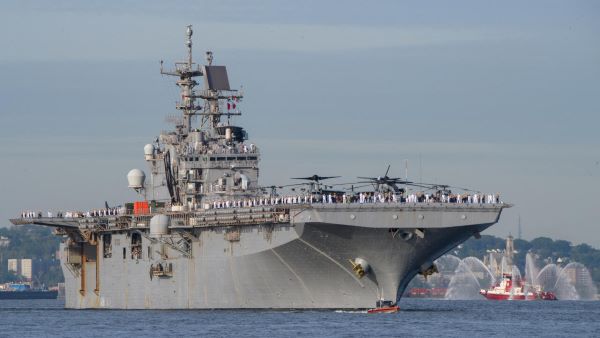
More than 3,000 United States military personnel have arrived in the Red Sea aboard two warships, part of a beefed up response from Washington after tanker seizures by Iran, the US Navy said on Monday.
The deployment adds to a growing US military buildup in tense Gulf waterways vital to the global oil trade and led Tehran on Monday to accuse the US of inflaming regional instability.
The US military says Iran has either seized or attempted to take control of nearly 20 internationally flagged ships in the region over the past two years.
The US sailors and Marines entered the Red Sea on Sunday after transiting through the Suez Canal in a pre-announced deployment, the US Navy’s Fifth Fleet said in a statement.
They arrived on board the USS Bataan and USS Carter Hall warships, providing ‘greater flexibility and maritime capability’ to the Fifth Fleet, the statement from the Bahrain-based command added.
The deployment adds to efforts ‘to deter destabilising activity and de-escalate regional tensions caused by Iran’s harassment and seizures of merchant vessels,’ Fifth Fleet spokesman Commander Tim Hawkins told AFP.
USS Bataan is an amphibious assault ship which can carry fixed-wing and rotary aircraft as well as landing craft. The USS Carter Hall, a dock landing ship, transports Marines, their gear, and lands them ashore.
In a Monday press conference, Iran’s foreign ministry spokesman Nasser Kanani said US deployments are only serving Washington’s interests.
‘The US government’s military presence in the region has never created security. Their interests in this region have always compelled them to fuel instability and insecurity,’ he told reporters.
‘We are deeply convinced that the countries of the Persian Gulf are capable of ensuring their own security.’
The latest deployment comes after Washington said its forces blocked two attempts by Iran to seize commercial tankers in international waters off Oman on July 5.
The maritime services in Iran said one of the two tankers, the Bahamian-flagged Richmond Voyager, had collided with an Iranian vessel, seriously injuring five crew members, according to state news agency IRNA.
In April and early May, Iran seized two oil tankers within a week in regional waters.
Those incidents came after Israel and the United States blamed Iran in November for what they said was a drone strike against a tanker operated by an Israeli-owned firm carrying gas oil off the coast of Oman.
The US announced last month that it would deploy a destroyer, F-35 and F-16 warplanes, along with the Amphibious Readiness Group/Marine Expeditionary Unit, to the Middle East to deter Iran from seizing ships in the Gulf.
Last week, a US official told AFP that Washington is also preparing to put Marines and Navy personnel aboard commercial tankers transiting the Gulf as an added layer of defence.
Washington’s stepped-up military response comes at a time of deepening engagement between the region and China, which brokered a shock detente between Gulf rivals Saudi Arabia and Iran in March.
Tehran’s relations with other Arab Gulf states are also growing. The president of the United Arab Emirates and Kuwait’s foreign minister were both offered invitations to visit the Islamic Republic last week.
‘Security will remain a friction point in US-Gulf relations even if the threat posed by Iranian attacks against shipping eases in the short term,’ said Torbjorn Soltvedt of the risk intelligence firm Verisk Maplecroft.
‘The perception that the US isn’t doing enough to deter Iranian attacks against international shipping will persist,’ he told AFP.
‘The need for a new approach is evident’.
Useful target practice for the new Iranian weapons 🙂
Naval power, per se, is greatly diminished, as high speed, and supersonic missile technology is already in place. The US’s enormous navy, which at one time, could move to a war theatre with little or no threat from an enemy, and support a land war, just can’t do this any more. The great Eurasian land mass is now beyond any naval threat. In the hypothetical scenario, that NATO should attack Russia, the vulnerability of the naval supply line from the USA is beyond doubt. Russia’s supply line has no such problem. This same principle applies to any war between China and the US, where a sea landing by the US navy would be a disaster. However the US navy’s influence over Australia NZ and all the Americas remains, where the missiles will not be a threat.
Iran + arab nations can look for themself .
yankees you are out ! and leave Europa !
we dont need your CIA/Mossad brainpiss medias !
USSA FAGGOT FORCES have arrived, watch out world, gay faggots and transgender chicks with dicks are going to protect the oil lanes from them Iranians.
The Muslim world fears the most faggot navy in the world. You sure don’t want to be the captured POW, our anal pounders have special methods to get you to talk!
Go USA!
Our administration is stealing their oil. What did you expect them to do?
The rogue terrorist Jewnited States has less-than-zero credibility at this point, so the Iranians have some fresh new targets on which to try out their new cruise missiles…
matrix melodrama