
Mike Whitney – The Unz Review July 12, 2023
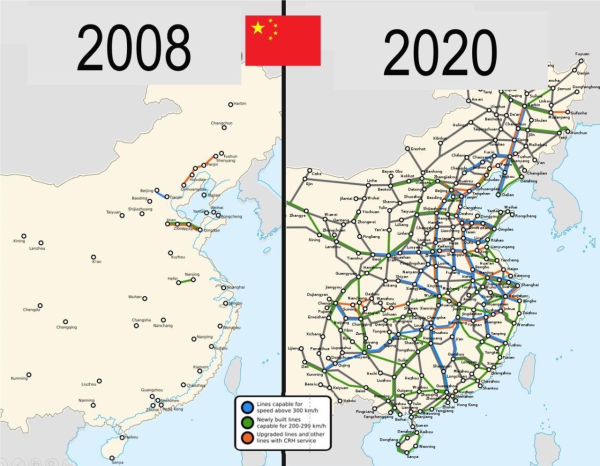
Look carefully at the chart above. What do you see?
You see the development of a high-speed rail system that is unrivaled anywhere on earth. You see the actualization of plan to connect all parts of the country with modern-day infrastructure that reduces shipping costs, improves mobility and increases profitability. You see a vision of the 21st century in which state-directed capital links rural populations with urban centers lifting standards of living across the board. You see an expression of a new economic model that has lifted 800 million people out of poverty while paving the way for global economic integration. You see an industrial juggernaut expanding in all directions while laying the groundwork for a new century of economic integration, accelerated development and shared prosperity.
Is there a high-speed rail system in the United States that is comparable to what we see in China today?
No, there isn’t. So far, less than 50 miles of high-speed rail has been built in the United States. (“Amtrak’s Acela, which reaches 150 mph over 49.9 miles of track, is the US’s only high-speed rail service.”) As everyone knows, America’s transportation grid is obsolete and in a shambles.
But, why? Why is the United States so far behind China in the development of critical infrastructure?
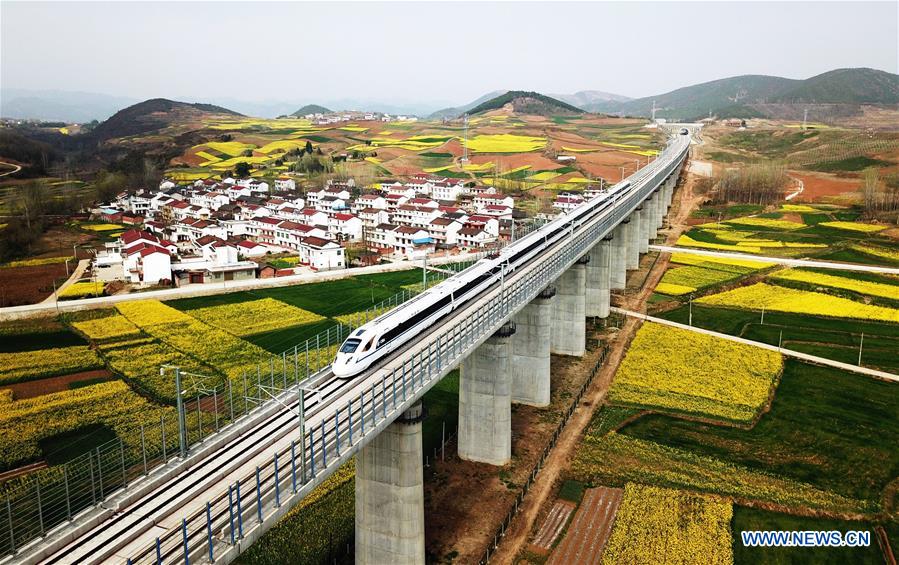
It’s because China’s state-led model is vastly superior to America’s “carpetbagger” model. In China, the government is directly involved in the operation of the economy, which means that it subsidizes those industries that enhance growth and spur development. In contrast, American capitalism is a savage free-for-all in which private owners are able to divert great sums of money into unproductive stock buybacks and other scams that do nothing to create jobs or strengthen the economy. Since 2009 US corporations have spent more than $7 trillion on stock buybacks which is an activity that boosts payouts to rich shareholders but fails to produce anything of material value. Had that capital been invested in critical infrastructure, every city in America would be linked to a gigantic webbing of high-speed rail extending from “sea to shining sea”. But that hasn’t happened, because the western model incentivizes the extraction of capital for personal enrichment rather than the development of projects that serve the common good. In China, we see how fast transformative changes can take place when a nation’s wealth is used to eradicate poverty, raise standards of living, construct state-of-the-art infrastructure, and lay the groundwork for a new century.
Here’s more from a report by the Congressional Research Service on “China’s Economic Rise…”
Since opening up to foreign trade and investment and implementing free-market reforms in 1979, China has been among the world’s fastest-growing economies, with real annual gross domestic product (GDP) growth averaging 9.5% through 2018, a pace described by the World Bank as “the fastest sustained expansion by a major economy in history.” Such growth has enabled China, on average, to double its GDP every eight years and helped raise an estimated 800 million people out of poverty. China has become the world’s largest economy (on a purchasing power parity basis), manufacturer, merchandise trader, and holder of foreign exchange reserves…. China is the largest U.S. merchandise trading partner, biggest source of imports, and the largest foreign holder of U.S. Treasury securities, which help fund the federal debt and keep U.S. interest rates low.
… China’s Economic Rise: History, Trends, Challenges, and Implications for the United States, Congressional Research Service
Here’s more from an article at the Center for Strategic and International Studies titled Confronting the Challenge of Chinese State Capitalism:
China now has more companies on the Fortune Global 500 list than does the United States… with nearly 75 percent of these being state-owned enterprises (SOEs). Three of the world’s five largest companies are Chinese (Sinopec Group, State Grid, and China National Petroleum). China’s largest SOEs hold dominant market positions in many of the most critical and strategic industries, from energy to shipping to rare earths. According to Freeman Chair calculations, the combined assets for China’s 96 largest SOEs total more than $63 trillion, an amount equivalent to nearly 80 percent of global GDP. Confronting the Challenge of Chinese State Capitalism, Center for Strategic and International Studies
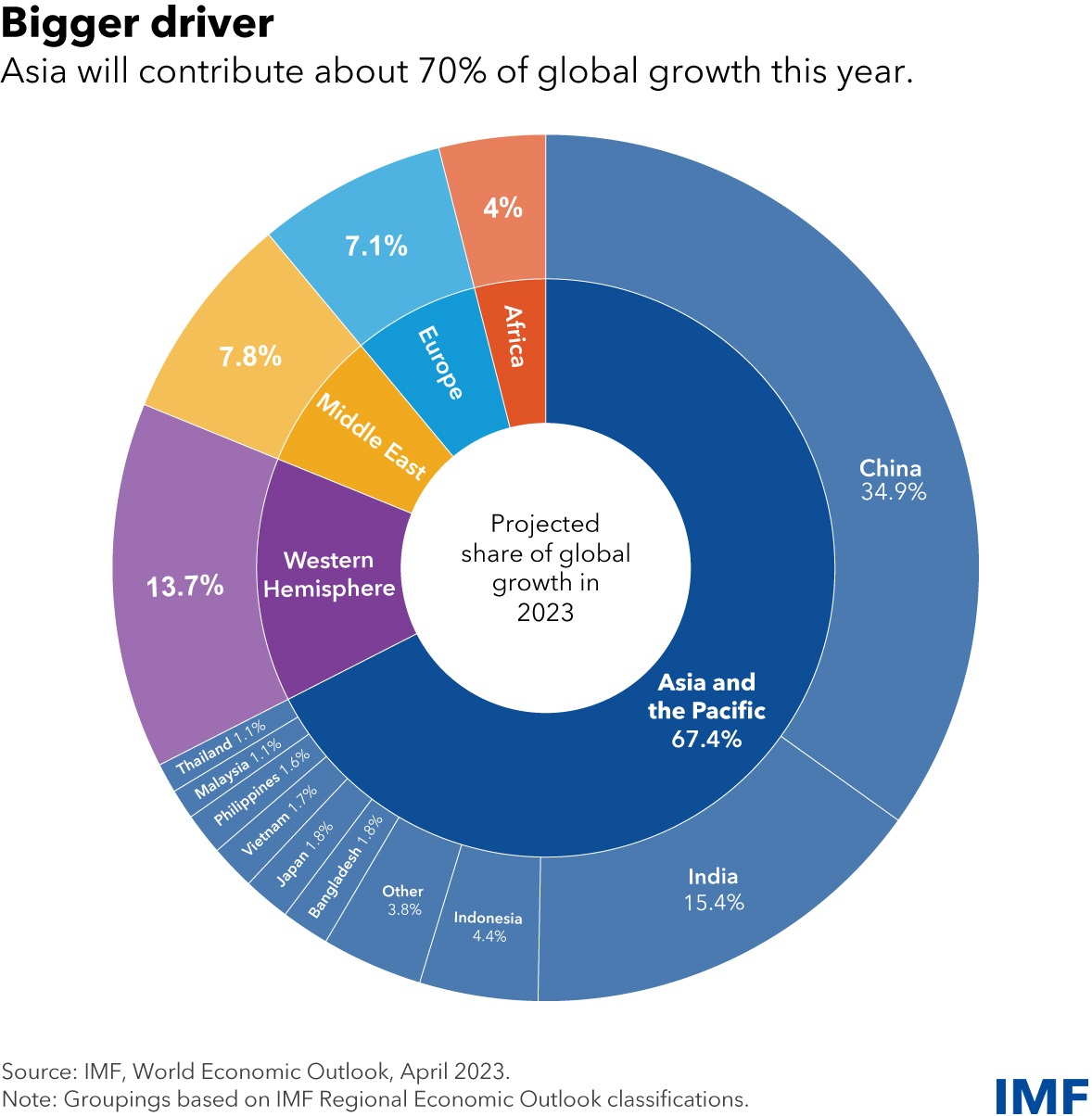
And here’s one more from a report by the IMF titled “Asia Poised to Drive Global Economic Growth, Boosted by China’s Reopening”:
China and India together are forecast to generate about half of global growth this year. Asia and the Pacific is a relative bright spot amid the more somber context of the global economy’s rocky recovery.
As the Chart of the Week shows, the region will contribute about 70 percent of global growth this year—a much greater share than in recent years.” Asia Poised to Drive Global Economic Growth, Boosted by China’s Reopening, IMF
Click to enlarge
In short, the Chinese state-led model is rapidly overtaking the US in virtually every area of industry and commerce, and its success is largely attributable to the fact that the government is free to align its reinvestment strategy with its vision of the future. That allows the state to ignore the short-term profitability of its various projects provided they lay the groundwork for a stronger and more expansive economy in the years ahead. Chinese reformer Chen Yun called this phenom the “birdcage economy”, which means the economy can “fly freely” within the confines of the broader political system. In other words, the Chinese leadership sees the economy as an instrument for achieving their collective vision for the future.
China’s success is only partially due to its control over essential industries, like banking and petroleum. Keep in mind, “the share of State-Owned Enterprises (SOEs) in the total number of companies in the country has dropped to just 5%, though their share of total output remains at 26%.” And even though the state sector has shrunk dramatically in the last two decades, Chinese President Xi Jinping has implemented a three-year action plan aimed at increasing competitiveness of the SOE’s by transforming them into “market entities” run by “mixed-ownership.” Simply put, China remains committed to the path of liberalization despite sharp criticism in the West.
It’s also worth noting that the so-called Chinese Miracle never would have taken place had China implemented the programs that were recommended by the so-called “western experts”. Had China imposed the radical reforms (like “shock therapy”) that Russia did following the dissolution of the Soviet Union in 1991, then they would have experienced the same disastrous outcome. Fortunately, Chinese policymakers ignored the advice of the western economists and developed their own gradual reform agenda that produced success beyond anyone’s wildest dreams. The story is summarized in a video on You Tube titled “How China (Actually) Got Rich”. I have transcribed part of the text below. Any mistakes are mine:
The single most stunning economic story of the last few decades has been the rise of China. From 1980 to 2020, China’s economy grew more than 75-fold…. It was the largest and most rapid improvement in material conditions in modern history…. China had been one of the poorest countries on earth but now it is an economic powerhouse… Economists predict it will overtake the US as the largest economy in the world by the end of the decade. People call it The Chinese Miracle. Some people describe this miracle as a straightforward story of the “free market”. They say “it’s a simple story. China was poor (but) then the economy was freed from the grip of the state. Now China is rich.” But this is misleading. China’s rise was NOT a triumph of the free market. ...
Since the 1980s, free market policies have swept the globe. Many countries have undergone far-ranging transformations. Liberalizing prices, privatizing entire industries, and opening up to free trade. But many of the economies that were subjected to the market overnight have since stagnated or decayed. None of them have had a growth record like the one seen in China. African countries experienced brutal economic shrinkage. Latin American countries experienced 25 years of stagnation. If we compare China to Russia, the other giant of Communism in the 20th Century, the contrast is even more staggering.
Under state socialism, Russia was an industrial superpower while China was still largely an agricultural economy. Yet during the same period that Chinese reforms led to incredible economic growth, Russia’s reform led to a brutal collapse. Both China and Russia had been economies that were largely ordered through state commands. ….Russia followed the recommendations of the most “scientific economics” at the time, a policy of so-called “shock therapy” As a basic principle, the idea was that the old planned economy had to be destroyed, to make space for the market to emerge…. Russia was expected to emerge as a full-fledged economy overnight. …When Boris Yeltsin took power he eliminated all price controls, privatized state-owned companies and assets, and immediately opened up Russia to global trade. The result was a catastrophe. The Russian economy was already in disarray, but shock therapy was a fatal blow. (Western economists) predicted some short-term pain, but what they didn’t see coming was how severe and destructive the effects would be. Consumer prices spiraled out of control, Hyperinflation took hold, GDP fell by 40%.
The shock therapy slump in Russia was deeper and longer than the Great Depression by a large margin. It was a disaster for ordinary Russians…. Alcoholism, childhood malnutrition and crime went through the roof. Life expectancy for Russian men fell by 7 years, more than any industrial country has ever experienced in peacetime. Russia did not get a free market overnight. Instead, it went from a stagnating economy to a hollowed-out wreck run by oligarchs. If just getting rid of price-controls and government employment didn’t create prosperity but did destroy the economy and kill huge numbers of people, then clearly, the rapid transition to “free markets” was not the solution. …
Throughout the 1980s, China considered implementing the same type of sudden reforms that Russia pursued. The idea of starting from a clean slate was attractive, and shock therapy was widely promoted by (respected) economists… But in the end, China decided to not implement shock therapy. …Instead of knocking over the entire (economy) at once, China reformed itself in a gradual and experimental way. Market activities were tolerated or actively-promoted in non-essential parts of the economy. China implemented a policy of dual track pricing…. China was learning from.. the world’s most developed nations, countries like the US, UK, Japan and South Korea. Each of these managed and planned the development of their own economies. and markets, protecting early-stage industries and controlling investment.
Western free market economists thought this system would be a disaster …. But China’s leaders did not listen, and while Russia collapsed after following the “shock therapy” program, China saw remarkable success. The state kept control over the backbone of the industrial economy, as well as the ownership over the land,. As China grew into the new dynamics of its economy, state institutions were not degraded to fossils from the past, but were often the drivers at the frontier of new industries, protecting and guaranteeing their own growth. China today is not a free market economy in any sense of the word. It is a state-led market economy. The government effectively owns all land, and China leverages state ownership through market competition to steer the economy. The shock therapy approach advocated around the world was a failure. While Russia collapsed after its sudden transition, China’s gradual reforms allowed it to survive. And that made all the difference.” How China (Actually) Got Rich”, You Tube.
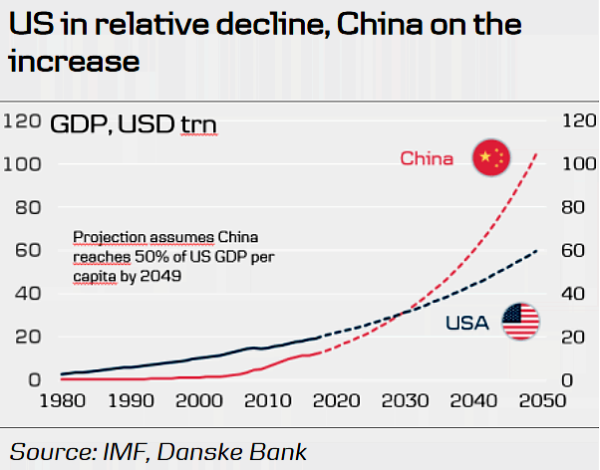
The fact that China’s SOEs are shielded from foreign competition and receive government subsidies, has angered foreign corporations who think China has an unfair advantage and is not playing by the rules. That is certainly fair criticism, but it’s also true that Washington’s unilateral sanctions—which have now been imposed on roughly one-third of all the countries in the world—are also a clear violation of WTO rules. In any event, China’s approach to the market under Xi has been ambivalent at best. And while “the state sector’s share of industrial output dropped from 81% in 1980 to 15% in 2005”, (in the spirit of reform) Xi has also ensured that the CCP has greater influence in corporate management and corporate decision-making. Naturally, none of this has gone-over well with US and EU businesses titans who firmly believe that corporate stakeholders should rule the roost. (as they do in the West.)
The larger issue, however, is not that China subsidizes its SOEs or even that China is set to become the biggest economy in the world within the next decade. That’s not the problem. The real problem is that China has not assimilated into the Washington-led “rules-based order” as was originally anticipated. The fact is, Chinese leaders are strongly patriotic and have no intention of becoming a vassal-state in Uncle Sam’s global empire. This is an important point that political analyst Alfred McCoy sheds light on in an article at Counterpunch:
China’s increasing control over Eurasia clearly represents a fundamental change in that continent’s geopolitics. Convinced that Beijing would play the global game by U.S. rules, Washington’s foreign policy establishment made a major strategic miscalculation in 2001 by admitting it to the World Trade Organization (WTO). “Across the ideological spectrum, we in the U.S. foreign policy community,” confessed two former members of the Obama administration, “shared the underlying belief that U.S. power and hegemony could readily mold China to the United States’ liking… All sides of the policy debate erred.” In little more than a decade after it joined the WTO, Beijing’s annual exports to the U.S. grew nearly five-fold and its foreign currency reserves soared from just $200 billion to an unprecedented $4 trillion by 2013. The Rise of China and the Fall of the US, Counterpunch
Clearly, US foreign policy mandarins made a catastrophic error-in-judgement regarding China, but now there’s no way to undo the damage. China will not only emerge as the world’s largest economy, it will also control its own destiny unlike western nations that have been subsumed into the oligarch-led system (WEF) that decides everything from climate policy to mandatory vaccination, and from transgender bathrooms to war in Ukraine. These policies are all set by oligarchs who control the politicians, the media, and the sprawling deep state. Again, the issue with China is not size or money; it’s about control. China presently controls its own future independent of the “rules-based order” which makes it a threat to that same system.
If we look again at the first chart (above), we can understand why Washington rushed into its proxy-war with Russia. After all, if China was able to spread its high-speed rail network across all of China in just 12 years, what will the next 12 years bring? That’s what worries Washington.
China’s emergence as regional hegemon on the Asian continent is a near-certainty at this point. Who can stop it?
Not Washington. The US and NATO are presently bogged down in Ukraine even though Ukraine was supposed to be a launching pad for spreading US military bases across Central Asia and (eventually) encircling, isolating and containing China. That was the plan, but the plan looks less likely every day. And remember the importance that national security advisor Zbigniew Brzezinski placed on Eurasia in his classic The Grand Chessboard nearly 3 decades ago. He said:
“Eurasia is the globe’s largest continent and is geopolitically axial. A power that dominates Eurasia would control two of the world’s three most advanced and economically productive regions. ….About 75 per cent of the world’s people live in Eurasia, and most of the world’s physical wealth is there as well, both in its enterprises and underneath its soil. Eurasia accounts for 60 per cent of the world’s GNP and about three-fourths of the world’s known energy resources.” (The Grand Chessboard: American Primacy And Its Geostrategic Imperatives, Zbigniew Brzezinski, p.31)
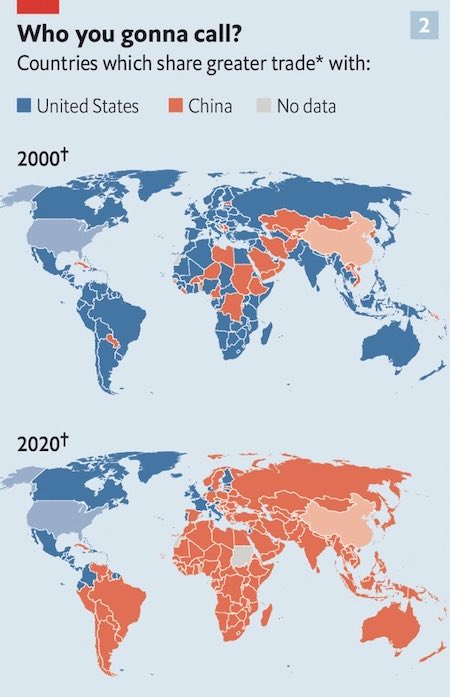
The consensus opinion among foreign policy mucky-mucks is that the United States must become the dominant player in Central Asia if it hopes to maintain its current lofty position in the global order. Former Undersecretary of Defense Paul Wolfowitz went so far as to say that Washington’s “top priority” must be “to prevent the re-emergence of a new rival, either on the territory of the former Soviet Union or elsewhere, that poses a threat on the order of that posed formerly by the Soviet Union.” Wolfowitz’s sentiments are still reiterated in all of recent US national security documents including the National Security Strategy and National Defense Strategy. The pundits all agree on one thing and one thing alone; that the US must prevail in its plan to control Central Asia.
But how likely is that now? How likely is it that Russia will be forced out of Ukraine and prevented from opposing the US in Eurasia? How likely is it that China’s Belt and Road Initiative will not expand across Asia and into Europe, the Middle East, Africa and even Latin America? Check out this brief excerpt on China’s Belt and Road plan:
China is building the world’s greatest economic development and construction project ever undertaken: The New Silk Road. The project aims at no less than a revolutionary change in the economic map of the world…The ambitious vision is to resurrect the ancient Silk Road as a modern transit, trade, and economic corridor that runs from Shanghai to Berlin. The ‘Road’ will traverse China, Mongolia, Russia, Belarus, Poland, and Germany, extending more than 8,000 miles, creating an economic zone that extends over one third the circumference of the earth.
The plan envisions building high-speed railroads, roads and highways, energy transmission and distributions networks, and fiber optic networks. Cities and ports along the route will be targeted for economic development.
An equally essential part of the plan is a sea-based “Maritime Silk Road” (MSR) component, as ambitious as its land-based project, linking China with the Persian Gulf and the Mediterranean Sea through Central Asia and the Indian Ocean. When completed, like the ancient Silk Road, it will connect three continents: Asia, Europe, and Africa. (and, now, Latin America) The chain of infrastructure projects will create the world’s largest economic corridor, covering a population of 4.4 billion and an economic output of $21 trillion…
For the world at large, its decisions about the Road are nothing less than momentous. The massive project holds the potential for a new renaissance in commerce, industry, discovery, thought, invention, and culture that could well rival the original Silk Road. It is also becoming clearer by the day that geopolitical conflicts over the project could lead to a new cold war between East and West for dominance in Eurasia. The outcome is far from certain. (“New Silk Road Could Change Global Economics Forever”, Robert Berke, Oil Price)
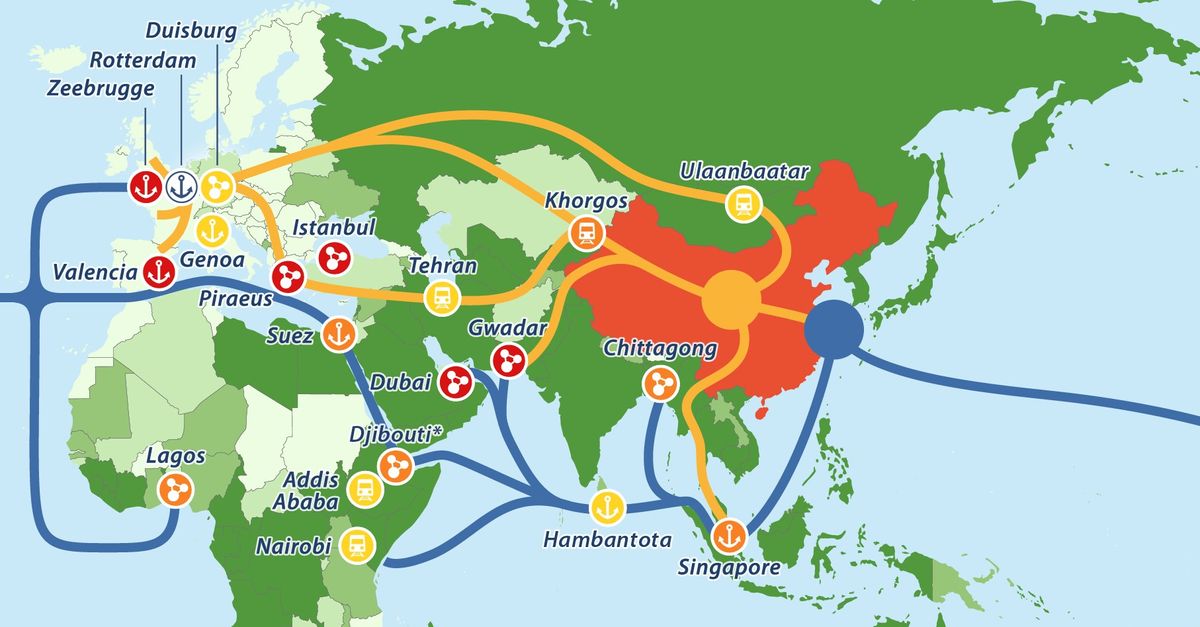
Click to enlarge
The Future Is China
Xi Jinping’s “signature infrastructure project” is reshaping trade relations across Central Asia and around the world. The BRI will eventually include more than 150 countries and a myriad of international organizations. It is, without question, the largest infrastructure and investment project in history which will include 65% of the world’s population and 40% of global GDP. The improvements to road, rail and sea routes will vastly increase connectivity, lower shipping costs, boost productivity, and enhance widespread prosperity. The Belt and Road is China’s attempt to replace the crumbling post-WW2 “rules-based” order with a system that respects the sovereignty of nations, rejects unilateralism, and relies on market-based principles to affect a more equitable distribution of wealth.
The BRI is China’s blueprint for a New World Order. It is the face of 21st century capitalism and it is bound to shift the locus of global power eastward to Beijing which is set to become the de facto center of world.
I only read part of.
This is what China wants to do with Belt & Road, or Silk Road 2.
Of course, it won’t be so dense, but the infrastructure will go from China/SEAsia, all the way to Europe.
UKraine and Belarus are vital to these plans.
Nazi Britain and Amerika never wanted to seriously develope the world like China does. Just like Britain and Amerika used designed poverty all through the 20th century for cheap labour, the 21st century sees immigration do this and create GDP, because their model started to fall apart in the 1970s, and this accelerated again from the late 90s, and again in 2008.
The BRICS and upto 90 countries are walking away from the NWO Satanic Nazi sect.
I had a conversation with someone the other day where they stated that global warming is china’s fault because of all the pollution they create, and that britain was the light of hope because of “net zero”. I pointed out to him that all the crap made in china is made for people like him in britain, and it’s only made there because your fascist overlords can make more profit by exploiting the chinese peasants than they would exploting the british slime. You can imagine the confusion on poor little britisher’s face.
The writer of this article seems to think that making money and covering the world in factories and railways shows that one country is better than another. Personally, I’d rather live in a green third world than a concrete slab like britain.
NWO is a western construct a wish to dominate the world.
China doesn’t want to dominate the world it wants a new connectivity order where all countries involved are on equal terms. Sovereignty(a dirty word in the west it has got that bad) will reign supreme not China. BRI is the only growth policy on offer going into the future.
Neoliberalism and its institutions will be left behind while new institutions have been birthed and already growing at a rapid rate.
Eurasia, the world island the Heartland Volga to the Yangtze was always the prize going back to Halford Makinder in the early 1900s. Who controls the world island controls the world he said. China and Russia don’t want to control Eurasia but the west does and no way Russia and China are going to let that happen. Give Eurasia over to a bunch of globohomo foreign fags. Not on your life Eurasia is for Eurasians. Eurangloland will be reduced to destabilizing and terrorising the connectivity infrastructure like Nord Stream which will not work it only backfires like we’ve seen recently. The west can scream and shout all it likes it isn’t going to change the fact that the great connectivity projects are going to grow from strength to strength.
Win win.
Greedy western employers and governments sent industry and jobs to China so China could make goods for first world world markets paid for in third world wages so they could stop paying their own citizens first world wages. And they wonder how China became first world and the west a third world shithole?
How do Klaus Schwab and his band of merry men feel about this? I mean, ol’ Klaus wants to kill off 95% of the world’s population and throw the remainder into total slavery and non-ownership of anything at all. He’s obviously anti-progress, he’s the candidate on the feudal express train headed to a town near you. In a present world of rule by potentates, we see the antithesis of Chinese growth and widespread alliances. Of course, the Chinese are similar to Klaus because they are not hung up on personal freedoms.
Whitney asks…
“But, why? Why is the United States so far behind China in the development of critical infrastructure”..
Well Mikey..there’s Stiltskinkissinger and Maurice Strong.. and of course…
..coff coff…financialization of the Western Economies..and the move to Asian slavery…
and of course..the old hoary chestnut…’Favoured Nation Status’… created like the USSR to ‘serve’ the ‘plan’… and suitably ahem..funded….
As Social laboratory..
T’was always the thus.. lt’s hilarious the way these fools expect you to accept all of this as some sort of organic natural process an outgrowth of ‘sensible’ fiscal policy.. caused by the foolishness and greed of Western elitism.. and to cheer it on..
when of course what it all really is… lS ‘Western’ policy.. that being.. those who own the ‘West’ and who are now moving East..having bled the host dry..
NB:..”and who are now moving East”…going home… having circumnavigated the hehe ‘Globe’ (although that’s impossible)..
and Conkered the whirled….
Meanwhile in Blighty – a fraction the size Of China! –
after decades of (((privatisition))) where the rail “service” has been stripped to the bone..
they can’t even get the “bum-to-bum” commuter train from Basingstoke to ‘The Belly Of The Beast’ to run on time!
😂😅🤣
Attention all Chinese in other parts of the world! China is doing great now, come back to China. Leave America, Europe, Australia, France, Germany, N. Zealand and Canada immediately. It’s much better here in China. You will love it! Your Engrish is improving and you have a good life selling liquor to Africans in Detroit, or running a Dollar Store in Toronto? Your daughter got into med school and your son got a schorraship to Yare? You are a benefit to the West? Forget about it, come back to China and you will be the cream of the crop. You will integrate wonderfully back into Chinese society.
Ha! I spent years in China and it’s a crowded, polluted, noisy, sweaty, dreary, slave colony. It’s been about twenty years since my brother or myself worked there but there is no way they transformed that place into a desirable home. Life is cheap as in you are dispensable, government is everything, money is their god, entertainment is excruciating, you do exactly what you are told to do, or else. There was nothing like unemployment insurance, old age pensions, medicare or sunny skies unless you went to a place like Sanya. The way they mistreat animals is frightening, you rarely see a home with a garden. The women are very plain to say the least and boy do they want your money. ‘I want money, I want money, you better give me money’. But please go back to China.
Here is another chart that explains why Ukraine is contested.
https://themillenniumreport.com/wp-content/uploads/2014/08/UKRAINEgasMAP.jpg
The one main gas pipeline bypassing the Ukraine choke point was blown by Blinken and Biden.
Why did China choose to back Russia over USA? One Belt and Road Initiative, note both Tehran and Moscow are major hubs for China:
https://cdn.static-economist.com/sites/default/files/images/print-edition/20170805_WBC987.png
China can supply Russia with infinite arms and manpower, including North Koreans eager to fight and kill globohomo faggot forces.
These was no Chinese Miracle. The way the Chinese were able to lift 800 million people out of poverty was by shoving 200 million Americans into poverty. Thanks (((Usual Suspects))).
This article shows exactly why Whitney and Unz are not to be trusted, and are most likely controlled opposition of the international banskters.
The so-called “miracle” of modern-day China is the prodigy not of the long-term planning of their communist government, but that of the Western-based international banking cartel, often called the “money power”. The design and dream of both Western capitalists and their Rothschild-Rockefeller overlords was to regiment the Chinese masses into the world’s largest low-cost labor force. With the abject failure from its inception of the USSR being a showcase for any political, social or economic success, and actually being largely dependent on Western bankster handouts, the Western betrayal of Chiang Kai‐shek and the endorsement and support for Mao by the international banking cartel back in 1948 was no accident.
The political cleansing operations and regimentation of the Chinese people to serve their totalitarian masters, were carried out in typical ruthless communist fashion all through the 1950’s and 1960’s with funds channelled to sustain that regime coming through Russia and other sources but ultimately from the Western money power, and especially under the direction of both the Rothschild and Rockefeller dynasties, which spawned the international communist movement and revolutions, and which have also been the main driving force of corporate monopolies and cartels gobbling all successful ventures into their controls.
Russia never had the population nor the industrious of a people who could live on so little but do so much work as China. You would have to be blind not to see the economic potential of China in the 1920’s. Even under Mao from 1948 on, the same money power behind the globalist communist movement remained firmly ensconced in China. That power came partly from British and European trade ventures of the past, but mainly from the huge profits made from the opium trade imposed on the Chinese people in the 1800’s. Also, the pecking order of all crime organizations in China as in the West are subject to the same money power cartel.
Following right on the heels of the so-called “Cultural Revolution” where millions of anti-communist “reactionaries” were eliminated, in 1971 the Rothschild agent provocateur, Henry Kissinger, met with top Chinese officials (probably Mao as well) for “Reproachment”, and to set the sage for the visit of Nixon in following year.
Communist China never had a pot to piss in on its own under before open trade with the West, but the promise of huge profits to be made to the “here-and-now” investors of the West, based on the fact of its low-cost labor and totalitarian controls over the entire workforce, was enough to send billions and billions into China in the 1970’s, and to officially open trade in 1979. The huge outsourcing of capital, machinery, technology, know-how, entire industries and millions of jobs, came entirely from our nations. The “money power” of the West was in control of everything and still is. Characteristically, as that same “money power” debt-rigged most resource-rich third-world nations with there “economic hitmen and jackals” in order to own and control them, they did the same thing to every developed Western nation through trade with China.
The deal the Rothschild US agents made with the Mao regime was that with the joint ventures the Chinese central government would maintain in control and the nation would be greatly developed and enriched based on unrestrained access to Western markets to sell their low-cost goods. Never has there been such treachery and betrayal by governments of their own people as in the past 40 years. From the opening of trade with China all of the huge trade deficits were entirely foreseen with any projections with the outsourcings taking place and the exploitation of our markets together with absolutely no efforts to balance the deficits, and they were foreseen in particular by the principal money-power investors. The huge trade deficits and losses led also to galloping deficit financing, which to the internationalist money-power moguls and especially to the international communist movement, such debt-rigging was a very good thing for their plans of a world government and top-down, totalitarian controls of virtually everything. The leading Western nations had to be as financially and centrally “controlled” as the third-world ones.
That every Western creditor nation would be turned into a debtor nation in just 20 years mainly from the huge outsourcings to China was not only foreseen by the banksters in the 1970’s. It was “planned”.
Ultimately, it is not the centralised government, corporate controls, or even the Western banksters, which ultimately made China Whitney’s showcase nation of rapid-transportation and low-cost manufacturing. It is us. We and our civilization have been the sacrificial lamb. The golden goose which laid the Chinese egg remains Western civilization. The egg may be a long-term golden one, but without Western markets it is most likely to be short lived.
Long-term planning for any nation ought to be done by the government of that nation but ONLY by a government OF the people, BY the people and FOR the people, AND NOT THROUGH BRAINWASHING, MASS DECEPTIONS, PERCEPTION MANAGEMENT, FEAR MONGERING, ELECTION RIGGING, ISSUE RIGGING, MEDIA RIGGING, VOTE RIGGING, DEBT RIGGING, OR ANY KIND OF RIGGING BY THE INTERNATIONAL MONEY-POWER OR BY ANYONE ELSE. The plutocrats running things have usurped from the people through through their dishonest and divisive means their wealth and power. They are presently trying to institutionalize their same evil control systems on a global scale.
This globalist top-down order is same “money power” running virtually everything, and China is just one more of their puppet nations. During Covid we very directly experienced their hideous and totalitarian powers exercised against us. For the past 100 years this same money power has been systematically destroying the personal good will, incentive, motivation, strength, integrity, and trust between people everywhere in their efforts to impose their highly planned totalitarian centralized corporate and communist controls over virtually everything we do, and even over who we actually are.
@Bob Smith,
Yes, I have had much contact with the Chinese through work, and I find them a repulsive people. Although, if I were to choose between the various third world primitive hordes invading the U.S. and Canada i.e. Africans, South Asians, Afghans, Somalis, etc etc … I would take them. At least they work hard, and are not criminals and thugs (at least a vast majority are not).
They a very strange people, and despite the backwardness of middle easterners, at least one can relate to and understand them. The Chinese act and behave very differently, and it’s impossible to be close friends with them i.e. as in to relate with a Chinaman the way one relates to someone of one’s own heritage.
It’s somewhat sad because I used to enjoy reading Carl Jones’ replies as they were insightful but now there isn’t a post that goes by without some reference to nazis, which the minute I see his posts I just ignore them.
Anyway….
China is, what it is, for one reason and one reason only – Jewish bankers.
Communism, obviously, was orchestrated by the Jew bankers in China and that was when they took control of it, lock stock and barrel. And yes, if you think they DON’T still control China you’re daft. China’s massive economy is because of their manufacturing and slave labour. If the west stopped buying Chinese good, that they stolen off of the west, or should I say the west was sold out to China, it would collapse overnight.
Sir Bertrand Russell spoke of how the Chinese were the ideal people to lead humanity into the future, because they are, to quote George Carlin: “good, obedient, workers”. They are a slave people, just like the Africans. They don’t ask questions and just do.
So, they sold all technology and manufacturing to China, building it up to the size it is today (as seen in the maps in the article), allowed them to do whatever they wanted to regarding the Kyoto agreement for pollution (they don’t give a sh*t about man made climate change and do whatever they want to). And China also rapes the seas. These people eat anything and everything. Heck, I even saw a video where they catch loads of jellyfish then process them into food.
China exemplifies Rothschild & Jew control of a country, with automatons who work themselves to death for a pittance.
The Han gradually got rid of the other tribes, so there is racial homogeneity as in an ant nest, and the ants are well-disposed to work for each other
Yes, true. BUT there is only ONE team – and US, China, Russia, they’re all part of it. They just have different roles to play. US as the old power walking into the sunset; China as the world’s new factory; and Russia as the bogeyman. All of this benefits the same class of people.
The West is more about slowing down progress a lot more than maxing it out for the good of all of their ‘consumers’.
This is an interesting channel:
https://www.youtube.com/@ADVChina
(Two westerners married to Chinse women who travel around China on motorbikes and talk about the country. Their coverage of “ghost cities” is particularly interesting. It seems many Chinese are indebted to the bank by being “invested” in substandard non-occupied real estate.)
White Elephant: well, I can’t account for your personal prejudices and fashion blinkers…
The Chinese have more or less, cut off Israel’s balls. China, and to a lesser extent, has destroyed all of Israels regional plans..
So sure, the Chinese suck Jewish cock.. That’s your prejudice. The Chinese won’t let failed state Israel screw up their global economic plans, and that includes a very prosperous Iran.
I tell the truth as well as I see it. I’m far more insightful than anyone else on here. It’s not my fault that you can’t keep up.