
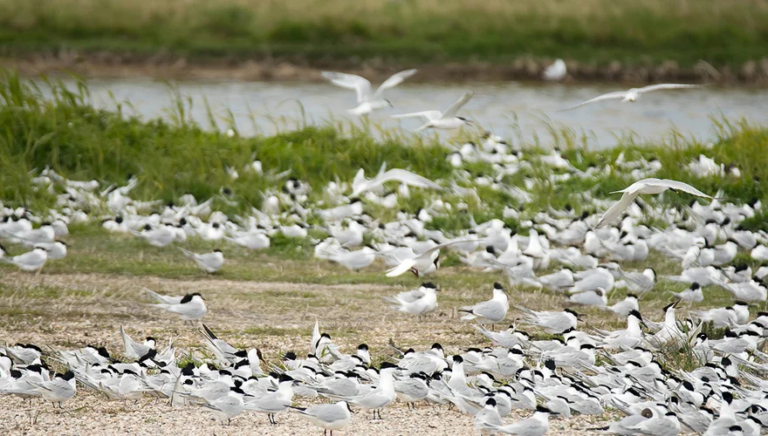
Low-radiation reserve on Texel Island, early June 2023
Arthur Firstenburg – Cell Phone Task Force
All over the Earth, birds — symbols of freedom and joy — have been disappearing, and unless we stop killing them, they will never more enliven our skies and imaginations. They are terns, seagulls, avocets, gannets, skuas, guillemots, puffins, oystercatchers, ducks, geese, godwits, pheasants, magpies, sanderlings, storks, cranes, pelicans, herons, swans, loons, sparrows, pigeons, red-winged blackbirds, owls, cormorants, grebes, dunlins, crows, ravens, bald eagles, hawks, falcons, vultures, all of them vanishing from the landscapes of our homes, forests, sea coasts and minds. It rarely makes the news, and a world grown accustomed to ever-dwindling resources and diminishing life has not been paying attention. The warning of a Silent Spring, sounded sixty years ago like a trumpet’s blare, has shrunken from a year-round emergency to the almost-meaningless ritual of Earth Day, celebrated just once a year.
But last spring, during May and June, the world was awakened to shocking tales and heart-rending photographs of dead seabirds littering their breeding grounds all over the Northern Hemisphere, nowhere so vividly as in the De Petten Nature Reserve on the island of Texel in the Netherlands, where the corpses of Sandwich terns littered the ground as if they had fallen dead out of the sky in mid-flight:
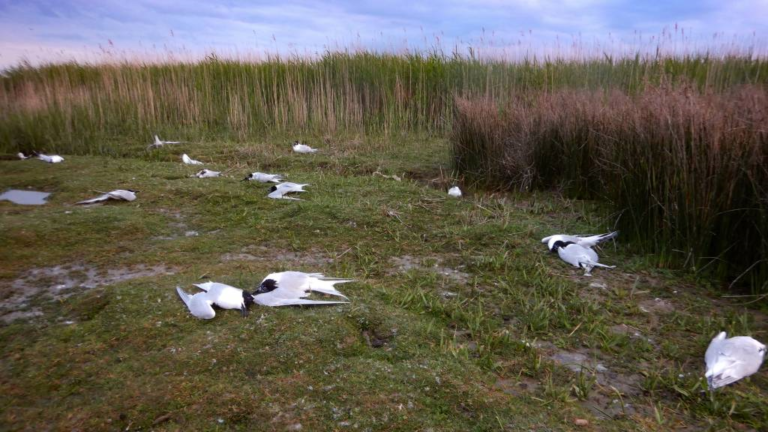
Texel Island, early June 2022. Birds appear to fallen from the sky, literally. Click to enlarge
Ornithologists and bird conservation organizations, reflexively, said to themselves and the world, “This must be bird flu,” and they dressed in hazmat suits and masks as they wandered among the avian graveyards with their specimen collectors and testing equipment, while ignoring obvious signs to the contrary. Bird flu, they pronounced, is so contagious and deadly that it travels round the world in days, spreads like water between species, and kills entire colonies in weeks. While ignoring the fact that two Dutch colonies of Sandwich terns just 20 miles apart during the same breeding season had completely different outcomes: Waterdunen, whose 7,000 nesting birds were completely wiped out, and Yerseke Moer, whose smaller colony suffered zero mortality. That in France, 3,000 Sandwich terns at Platier d’Oye were entirely killed while thousands of pairs of Sandwich terns at Polder de Sébastopol had no disease at all. That bird flu was an autumn and winter disease and had never before been known to occur in spring or summer. And that it had never before affected so many different kinds of birds at once.
But this was not “bird flu”, it was radiation sickness from cell towers, as documented in my newsletter of July 28, 2022. Eighteen new 4G antennas had been added to three cell towers located at De Petten, within the territory where the birds were breeding, just days before they began dying. And a large number of other antennas and towers were aimed at the reserve from across a busy shipping lane whose traffic made heavy use of those antennas. While Yerseke Moer is host to no cell towers, has far fewer antennas aimed at it, and is in an isolated location, not near a major port, and not on a shipping lane.
Similarly, in France, dozens of new 4G and 5G antennas had just been added to towers near and at the reserve at Platier d’Oye, located near the port of Calais, while the Polder de Sébastopol is on an isolated island with no towers, few human residents or visitors and far from any shipping traffic.
One year later
In August 2022, researchers were astonished to find that 600 pairs of Sandwich terns — at least some of whom had come from the colonies that had been wiped out — had decided to try again so late in the season. They laid their eggs and raised at least 300 young birds, successfully, during July and August in a new location on Texel Island, a beach at the Prince Hendrik Sand Dike, owned by the water authority, Hoogheemraadschap Hollands Noorderkwartier (HHNK). And this spring in 2023, the Prince Hendrik Sand Dike is filled with almost 3,000 breeding pairs of Sandwich terns, while a second reserve — the island of De Bliek in the Haringvliet — has more than 2,000 breeding pairs. These two colonies, and five smaller colonies, total about half the number of Sandwich terns of previous years. They are thriving, but all of last spring’s disastrous breeding grounds, many of which had been the breeding grounds for this species for years or decades, have been abandoned. “It is striking: the areas with colonies that were heavily affected by bird flu last year remained vacant this year, including those of Waterdunen (ZL), Wagejot and De Petten on Texel (NH), Griend and De Putten near Camperduin (NH)”, wrote Ruud van Beusekom of Vogelbescherming Nederland (BirdLife Netherlands) on June 5, 2023.
Now everyone is assuming that the birds nesting successfully this year have acquired immunity from the H5N1 influenza virus. But the areas chosen this year by the Sandwich terns are lower-radiation areas. The Prince Hendrik Sand Dike, the only breeding ground for these birds this year on the island of Texel, is the quietest, least visited beach on the island. The nearest antennas are about 3 kilometers away, and because of the small number of visitors and ships they are little used and emit little radiation. Likewise De Bliek, in the Haringvliet, is an island with no people and no antennas in a closed waterway visited by few ships.
Another anomaly not explained by researchers is the fact that removing all dead birds from the colonies last year increased mortality: “Last year it appeared that collecting carcasses in colonies has a negative effect on the further spread of bird flu,” wrote Odessa Langeveld on May 12 of this year. In other words, leaving virus-infected carcasses to rot on the breeding grounds decreased the spread of the disease, while removing them increased its spread. But no one is considering that the teams of workers removing the carcasses on a daily basis were all carrying and using mobile phones, which not only were emitting radiation themselves but were forcing the cell towers on or near the site to be continuously active.
It bears repeating that influenza, whether in people, animals, or birds, has never been demonstrated to be a contagious disease. In 1918, at the very height of the Spanish influenza, attempts by medical teams in Boston and San Francisco to demonstrate the contagious nature of the flu met with complete and resounding failure. Such experiments in humans were published in the Journal of the American Medical Association, the Boston Medical and Surgical Journal, and Public Health Reports. Such experiments in horses were published in Veterinary Journal.
Chapters 7, 8 and 9 of my book, The Invisible Rainbow: A History of Electricity and Life, are devoted to a complete, detailed examination of the history and science of influenza. Chapter 16, the longest chapter in the book, is devoted in part to the effects of electromagnetic radiation on birds. I suggest that all bird conservation organizations should acquire my book and read it carefully.
I receive reports from observers around the world about birds disappearing from sea coasts after cell towers are built on them. Just yesterday, for example, this email came from Manju Carrow, writing about a new Verizon tower on a quiet cape in Florida:
“I went to Cape San Blas, Florida last week. Sometime between April 2022 and before June 11th, 2023 they added a cell tower to the cape. Granted there are 2 nearby, but not directly on the cape. I have gone there 5 times since 2020. The cape has only homes and some small shops, no hotels. On all the beaches I’ve ever been to, there are many birds on the beach. For the first time on a beach, I didn’t see the little sandpipers and other birds that usually run on the beach when the waves go out to peck at the bugs. I mentioned it to a resident and actually they realized the same thing, they just hadn’t noticed. Of course, on day one when I realized I had only seen 2 birds all day I immediately thought of the new tower.”
If you are connected with any bird conservation organization, please forward this newsletter, together with last year’s newsletter titled “Birds on Texel Island”, to its officers and board of directors, and ask them to contact me. And everyone, please email Ruud van Beusekom and Marieke Dijksman at BirdLife Netherlands and tell them to wake up to the radiation that is killing their birds, and to work with us to put an end to it!
Arthur Firstenberg
President, Cellular Phone Task Force
Author, The Invisible Rainbow: A History of Electricity and Life
Administrator, International Appeal to Stop 5G on Earth and in Space
Caretaker, ECHOEarth (End Cellphones Here On Earth)
P.O. Box 6216
Santa Fe, NM 87502
USA
phone: +1 505-471-0129
info@cellphonetaskforce.org
June 21, 2023
This work and these newsletters are supported entirely by donations from individuals. We have no other source of funding. The Cellular Phone Task Force is a 501(c)(3) nonprofit organization and donations by U.S. residents are tax-deductible. Our Tax ID Number is 11-3394550.
I am not saying EM doesn’t kill birds.
What I am saying is that there are ZERO 5G antennas. There’s no commercial 5G in the West. The Chinese might have some small public test systems.
True 5G is a millimeter band, and can’t even pass through a leaf. You must also be stationary to use 5G, because it works by beam forming. So it works out your location using 4G, and then switches to 5G, but only when you don’t move, only when there’s nothing between you and the mast. That is, unless you have nodes outside your building, and inside.
They misell 5G, because all they’ve done is add more antennas to the phone, and increased bandwidth.
Nothing will change, indeed it will get worse, until Divine Judgement begins.
Every day it gets a day closer.
The platemovements that will shake up the World from China to N Amerika and ESPECIALLY Europe are about to be triggeŕed. From Quebec, hot enough to create fires, till China, redhot with CO from underground fires, tearing of rock releases SO2, Methane and CO2. We are warned just like that little bird in the coalmine did ..
specialy on English Channel up to Holland shores .
Being an RF engineer, I watched as the insect, bat and bird populations decreased drastically after the installation of 5G antennas near my home. I also measured a 10x increase in the power of micro waves in the 5 Ghz range with burst peaks 200x. Using Log Periodic directional antennas I triangulated the source to be those new antenna. But none of my neighbors care as I am just an inpecunious crazy old white guy. What is important is that the Internet is so much faster now!
Those whom the gods will destroy they first make crazy and once you know they are trying to kill you it all makes sense.
Oh and I have shielded my house with Conductive Carbon paint and ITO coated glass. So it will be fun watching my bounded rationality neighbors drop one by one. But I miss the insects and birds, they deserved better.
And many thousands of Birds are beeing killed
by the windturbines every year !!!
Squirrel Mama
@Squill_Mama
I’m sorry but your stupid green energy windmills are killing thousand of birds.
https://twitter.com/Squill_Mama/status/1567956009095933952
@ KCB
to create a realy closed Faraday catch all walls,
ceiling + floor have to be coated .
Birds face a lot of problems: getting into the air turned out not to be the final solution. The first problem was other birds that were predators
@Carl Jones. Sounds like bollocks. Any evidence?
@KCB you’re right. Leave the area or shield your sleeping space seems to be the only two options.