
Hannah Devlin – The Guardian June 14, 2023
Scientists have created synthetic human embryos using stem cells, in a groundbreaking advance that sidesteps the need for eggs or sperm.
Scientists say these model embryos, which resemble those in the earliest stages of human development, could provide a crucial window on the impact of genetic disorders and the biological causes of recurrent miscarriage.
However, the work also raises serious ethical and legal issues as the lab-grown entities fall outside current legislation in the UK and most other countries.
The structures do not have a beating heart or the beginnings of a brain, but include cells that would typically go on to form the placenta, yolk sac and the embryo itself.
Prof Magdalena Żernicka-Goetz, of the University of Cambridge and the California Institute of Technology, described the work in a plenary address on Wednesday at the International Society for Stem Cell Research’s annual meeting in Boston.
“We can create human embryo-like models by the reprogramming of [embryonic stem] cells,” she told the meeting.
There is no near-term prospect of the synthetic embryos being used clinically. It would be illegal to implant them into a patient’s womb, and it is not yet clear whether these structures have the potential to continue maturing beyond the earliest stages of development.
The motivation for the work is for scientists to understand the “black box” period of development that is so called because scientists are only allowed to cultivate embryos in the lab up to a legal limit of 14 days. They then pick up the course of development much further along by looking at pregnancy scans and embryos donated for research.
Robin Lovell-Badge, the head of stem cell biology and developmental genetics at the Francis Crick Institute in London, said: “The idea is that if you really model normal human embryonic development using stem cells, you can gain an awful lot of information about how we begin development, what can go wrong, without having to use early embryos for research.”
Previously, Żernicka-Goetz’s team and a rival group at the Weizmann Institute in Israel showed that stem cells from mice could be encouraged to self-assemble into early embryo-like structures with an intestinal tract, the beginnings of a brain and a beating heart. Since then, a race has been under way to translate this work into human models, and several teams have been able to replicate the very earliest stages of development.
The full details of the latest work, from the Cambridge-Caltech lab, are yet to be published in a journal paper. But, speaking at the conference, Żernicka-Goetz described cultivating the embryos to a stage just beyond the equivalent of 14 days of development for a natural embryo.
The model structures, each grown from a single embryonic stem cell, reached the beginning of a developmental milestone known as gastrulation, when the embryo transforms from being a continuous sheet of cells to forming distinct cell lines and setting up the basic axes of the body. At this stage, the embryo does not yet have a beating heart, gut or beginnings of a brain, but the model showed the presence of primordial cells that are the precursor cells of egg and sperm.
“Our human model is the first three-lineage human embryo model that specifies amnion and germ cells, precursor cells of egg and sperm,” Żernicka-Goetz told the Guardian before the talk. “It’s beautiful and created entirely from embryonic stem cells.”
The development highlights how rapidly the science in this field has outpaced the law, and scientists in the UK and elsewhere are already moving to draw up voluntary guidelines to govern work on synthetic embryos. “If the whole intention is that these models are very much like normal embryos, then in a way they should be treated the same,” Lovell-Badge said. “Currently in legislation they’re not. People are worried about this.”
There is also a significant unanswered question on whether these structures, in theory, have the potential to grow into a living creature. The synthetic embryos grown from mouse cells were reported to appear almost identical to natural embryos. But when they were implanted into the wombs of female mice, they did not develop into live animals. In April, researchers in China created synthetic embryos from monkey cells and implanted them into the wombs of adult monkeys, a few of which showed the initial signs of pregnancy but none of which continued to develop beyond a few days. Scientists say it is not clear whether the barrier to more advanced development is merely technical or has a more fundamental biological cause.
“That’s very difficult to answer. It’s going to be hard to tell whether there’s an intrinsic problem with them or whether it’s just technical,” Lovell-Badge said. This unknown potential made the need for stronger legislation pressing, he said.
more yiddish thievery
https://christiansfortruth.com/even-jews-who-fled-safely-behind-soviet-lines-prior-to-wwii-to-receive-millions-in-holocaust-reparations-from-germany/
“God” often used to create a new human behind a skip outside a night-club. Was He being any more careful than the scientists?
I recommend the short SCI-FI book “Consider Her Ways” by John Wyndham, in which he provides a sneak peek of the future of human reproduction.
Hehe..the scientism and it’s misuse of language…
“We can create ‘human'(sic)…… “embryo-like”….. ‘models’ (sic) by the reprogramming of [embryonic stem] cells,”
‘Scentists say’…hehe..’experts predict’ etc etc ad nauseam..
better hope its safe and effective and more successful than their cancer steaks…
At this point, that which is called science should be banned.
My guess is that these “creations” lack the individualized life-force of an embodied soul, and are therefore unviable. Same problem with the mice and monkey embryos (that would need an animal soul to be viable.)
Materialist scientists have a fundamental lack of understanding when it comes to biology: life springs from the spirit, not from the material world.
What with transhumanism, transgenderism, GMO and DNA manipulation, food-source destruction and the attempted murder of billions and countless abominations besides, all committed by evil people richer than most people dream of being, if any of us survive them it is time to write ‘The Bible: Part Two’.
Some will say the bible is God’s word but these mortals thought they were gods too, so we can record their words and deeds, to warn those who follow there is nothing so evil as men who can’t be stopped.
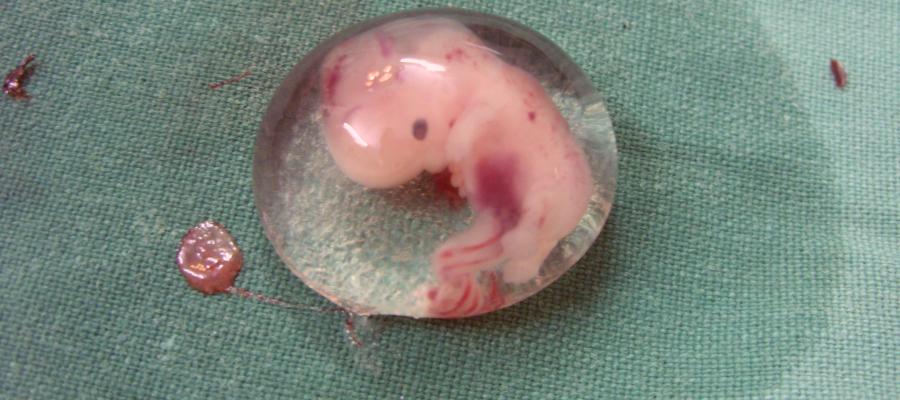
The picture is actually that of a dead human fetus and not of the brainless and heartless thing the mad scientists have created.
You can be rest assured that it is absolut impossible that humans
can create artificial humans.
This only the Creation is able to do in this world.
Same applies to artifical intelligence / Transhumanism.
Nor can they produce a (Corona) Virus which reproduces itself many million times
and is dangerous to body infection.
However not living things / nano parts, they can spread over the world by spraying
Alluminium, Barium, Strontium and manipulate weather. And many other things.
https://www.geoengineeringwatch.org/
This begs the question: when does the soul enter a new body?
And what’s the purpose? You can’t beat God’s nature when you try to be Gods yourselves. It will never happen. Mad scientismists backed by the Guardian to try and sway silly minds how advanced we are when we’ll never be. The bane of the progressive ay.
Thomas Faber–today there are a lot more human bodies than souls; the latter have to slowly evolve also, which means a lot of people have not got a soul
Gosh! It sure was easier and less expensive when all it took to make a Golem was a lump of clay, an outstretched finger, and a rabbi’s bad attitude!
By the way, are these things edible?
Can you please make some in new unique genders, with exciting, hitherto unknown genitalia?
Thanks a bunch!
And the dish ran away with the spoon..