
Oliver Parken – The War Zone May 23, 2023
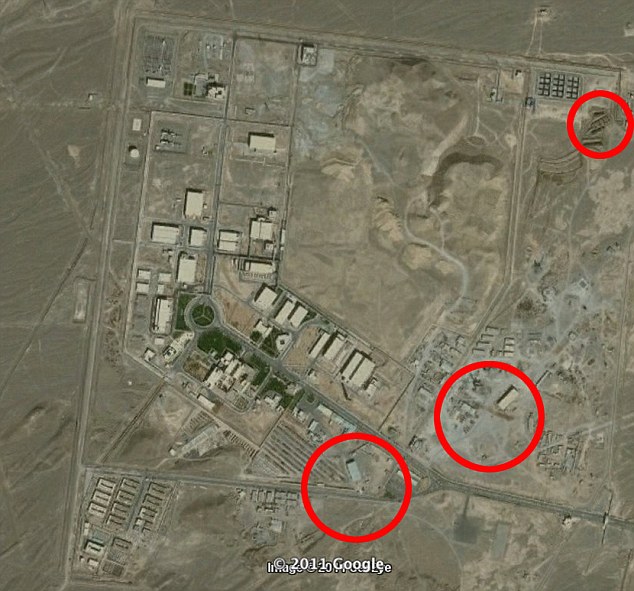
Satellite photo of Natanz from 2011. Click to enlarge
The U.S. military’s most powerful, deeply burrowing Massive Ordnance Penetrator bunker buster bombs, or MOPs, may be unable to penetrate a buried nuclear facility in central Iran, analysis of new satellite images suggests. The Air Force’s 30,000-pound class GBU-57/B MOPs are guided weapons specifically designed to penetrate highly fortified targets such as Iran’s underground nuclear facilities and can impact surfaces above targets with great accuracy. Most recently, a rare ‘live’ MOP was pictured at Whiteman Air Force Base, as you can read more about here.
The Associated Press first reported on these new developments observed at Iran’s Natanz nuclear site yesterday, based on images provided by Planet Labs, as well as analysis by the James Martin Center for Nonproliferation Studies. The Natanz site is located some 225 kilometers (140 miles) south of Tehran. As AP suggests in a separate article, Iran appears to be making “steady progress” in constructing various underground tunnels in the Zagros Mountains to the south of the Natanz nuclear site. Owing to its size, Iran would likely be able to use the underground facility to enrich uranium, AP reports, and not just to build centrifuges for the enrichment of uranium, with natural protection coming from the mountain.
Construction of the core elements of the Natanz nuclear facility itself began in the early 2000s. In September 2020, Iran announced it would be replacing the Iran Centrifuge Assembly Center (ICAC), an above-ground plant at the Natanz facility that was destroyed that June by a fire, with a new facility in the nearby mountain. Tehran blamed that incident at ICAC nearly three years ago on Israel.
Since then, observers and intelligence analysts have followed the development of underground tunnels in the mountain via satellite imagery, with fears that the new underground facility could aid Iran in developing nuclear weapons. Tehran has not publicly acknowledged any other plans for the underground facility beyond its use as a replacement for the ICAC, according to AP. Iranian authorities would have to declare the site to the International Atomic Energy Agency (IAEA) in Vienna if it decided to introduce uranium into it. Iran does, however, have a long history of deep-burying sensitive facilities, especially those linked to their nuclear and missile programs, among other things.
Citing experts at the James Martin Center for Nonproliferation Studies, AP reports that the new facility is likely being built at a depth of between 80 meters (260 feet) and 100 meters (328 feet) within the mountain. This extends deeper than what the U.S. military has publicly stated in the past is the maximum depth the 30,000-pound class GBU-57/B MOPs can burrow down to, around 60 meters (200 feet). It’s unclear exactly whether this figure also accounts for penetration through reinforced concrete layers, which are often used to shore up sensitive underground facilities.
Moreover, experts at the Institute for Science and International Security, a Washington-based nonprofit focused on Iran’s nuclear program, argue that the underground tunnels could be even deeper than the 260 to 328 feet estimate suggested by experts at the James Martin Center, AP notes.
—
“So the depth of the facility [in the mountain] is a concern because it would be much harder for us [the U.S., to penetrate],” Steven De La Fuente, a research associate at the James Martin Center, told AP. “It would be much harder to destroy using conventional weapons, such as like a typical bunker buster bomb.”
Analyzing a separate set of images, experts at the James Martin Center suggest that four entrances have now been dug in the mountainside, AP notes. Two of those are located to the east, while another two are located to the west. The entrances are roughly 6 meters (20 feet) wide and 8 meters (26 feet) tall.
Kelsey Davenport, director of nonproliferation policy at the Washington-based Arms Control Association, told AP that the completion of the underground nuclear site in the mountainside “would be a nightmare scenario that risks igniting a new escalatory spiral… Given how close Iran is to a bomb, it has very little room to ratchet up its program without tripping U.S. and Israeli red lines. So at this point, any further escalation increases the risk of conflict.”
The tunnel network close to the Natanz site isn’t the only Iranian underground facility reportedly beyond the reach of U.S. MOPs, it should be noted. Iran’s nuclear development site carved deep into a mountain at Fordo, often seen as Iran’s most sensitive nuclear facility, is reportedly some 90 meters (295 feet) deep. It is also protected by multiple feet of reinforced concrete. Back in 2012, experts highlighted to Reuters how Fordo then represented a more significant challenge to penetrate compared to the previous underground facilities at Natanz.
Of course, this all prompts questions about how the U.S. military might be able to utilize its bunker busters against these deeper underground facilities. The Air Force has remained very tight-lipped on the MOP program in general. However, much of its impetus in the early 2000s appeared to be a response to Iran’s push to bury its nuclear enrichment infrastructure underground in order to safeguard against pre-emptive U.S. or Israeli strikes.
Thanks to their GPS guidance, as The War Zone has noted in the past, it’s certainly possible that multiple bunker busters could be dropped on roughly the same spot by B-2 Spirit stealth bombers. B-2s are currently the only aircraft able to employ the MOP operationally. The Air Force’s future B-21 Raider stealth bomber is expected to be able to carry one MOP while the B-2 carries two.
The War Zone has noted in the past, based on statements received from the Air Force, that ‘inert’ versions of the BLU-127C/B warhead – the BLU-127C/B being the main explosive charge at the core of the GBU-57E/B variant – could be used to ‘dig down’ to the target, softening up the ground. Live ones could do this, as well. In the case of the tunnels within the Zagros Mountains, the ground would likely be very dense. Each subsequent bomb would then be able to penetrate deeper to the target, and through any reinforced concrete layers. There is also the possibility of weak points in the facility’s design and mechanical infrastructure that can be exploited to increase penetration.
Adding to this, large numbers of MOPs would likely be needed if the U.S. military were to strike the underground tunnel networks at the Natanz site, given how spread out they now appear to be. These facilities are now designed in segments with blast doors separating key sections. This means if one area is hit, the others will not be impacted or at least the damage will be drastically reduced to the entire facility.
Information is limited about how many MOPs exactly the Air Force has within its stockpiles currently. According to the service, 20 MOPs had been delivered by the bomb’s manufacturer, Boeing, since the early 2000s. The figure of 20 MOPs is accurate as of November 2015, according to the Air Force, but could have, and likely has, grown significantly since then. This would be inclusive of the GBU-57E/B variant, in operational inventory since 2016, and possibly the newest GBU-57F/B variant.
The MOP has been progressively improved over the years and we don’t know how many of the older variants have been retrofitted with modifications developed through the Enhanced Threat Response-IV (ETR-IV) and other upgrade programs.
It’s also very possible that the Air Force’s bunker busters may be able to individually penetrate deeper below the ground than the service has publicly indicated to date. Originally, the Air Force claimed its MOPs could burrow down to just over 18 meters (60 feet) to get to their targets. This figure was revised in 2007 to just over 60 meters (200 feet). As The War Zone has pointed out previously, it’s likely that newer MOP variants, including the GBU-57E/B and GBU-57F/B, can penetrate deeper than the MOP variants available in 2007, thanks to updated warhead designs. The BLU-127C/B warhead has a “booster” within the warhead’s forward position, for example – although it remains unclear if this constitutes a system to propel the section for added penetration or if it refers to an explosive charge accelerating the detonation of the main charge.
Sick, Millions spent to kill.
Mystic and Yogi
This, straight off the Langley basement presses.
In simple terms, it’s over 100ft of rock, and super strength concrete. The concrete is probably 10m’s thick, and it’s parabolic, if I’ve got that right.
The main problem, is protecting the warhead, and it passes through the rock and concrete, which is unlikely, and then you have your choices of warhead. Conventional, sub-critical, or a nuke.
To make such strikes safe, as in internationally safe, you’d need to be able to guarantee that you can penetrate the rock and concrete, and that said nuke detonates inside the cavern/target space, and that detonation self seals the cavern, thus preventing fallout.
Lots of ifs and buts here, and my best guess after the US did much testing a decade or so ago, is that it’s not runner.
The Russians recently took out a NATO bunker in or near Kiev, killing many senior NATO commanders, including US Generals and Brits. lol
This successful strike was achieved using a hypersonic weapon, and the target was at least 100ft underground. Surface defences proved useless. Still, could a Russian hypersonic weapon punch through 100ft of rock and superstrenth concrete, with the nukes detonating only on target? Very unlikely.
You see, in these Iranian facilities, they have nuke materials, radioactive stuff, so any attack must seal the target. Are the Nazis bothered, who knows, probably not.
“Nation x, y, or z is developing the “bomb”….”
“Jesus is coming soon…”
“Buy these windows this evening, otherwise the discount I’m offering will no longer be available…”
Let us abstract beyond x,y,z, and z…
“A situation is developing that we are telling you about – OUT OF THE GOODNESS OF OUR HEARTS – that there is something to be frightened of, or anticipated, so YOU must have the specific outlook demanded in anticipation of the coming scenario to ACT NOW”
***
I notice that the Indian in number 10 is getting on the AI bogeyman bandwagon. The posts by the evident computer specialist using the moniker of “me” were particularly interesting in pouring cold water over the current fear of Arnie coming back in time naked and demanding your motorcycle and clothes…
So I wonder what the TPTB game is with the latest fear porn on AI…
timewill come any fanatic Wahabis will force
any nation to pray to a certain time publicly
to their allah and the whole nation automaticly
will be islamic with outspoken creed . slick
unbelievers who think they can do it just
proforma forget that they later will be controled
by the fanatics if they are true believers .
and you think the the b21 flying at 500 mph will be able to penetrate iranian airspace? c’mon folks usa has never fought a war against determined opposition. they lost in vietnam, afghanistan and syria. as for israel forget it. they are already under surveillance and would be cur short even their daring troops as has been shown.
“In 2010, the then-president of Iran Mahmoud Ahmadinejad told the UN that he believed floods in Pakistan were the fault of the HAARP program. The same year, Hugo Chávez, the former president of Venezuela, also blamed the Chilean and Haiti earthquakes on the program.”
If there were any underground bunkers or perhaps a DUMB in Turkey I wonder how they held up to this. Demons playing the HAARP.
Redux is a dirty word.
No mention of Iranian missal defense systems and air power. They aren’t going to sit there with their finger up their ass while the US or Israel bombs them. The planes will play hell getting over the targets.
IDF will not have any remorse to send
a rock penetrating nuke + would not
regret any fallout . ashkeNAZIS !