
Vigilant Citizen – Feb 2, 2023
Warning: Ginormous spoilers ahead!
Guillermo del Toro is a movie director known for combining fairy tales with elements of horror, in a distinctive visual style that tends towards the grotesque. He is also known for crafting stories that take place in oppressive contexts where fascism, fatherhood, and Christianity are recurrent themes. His latest movie – Guillermo del Toro’s Pinocchio – perfectly encapsulates all of these characteristics. In fact, the movie is so quintessentially Guillermo del Toro that his name is embedded right in the movie’s title.
Guillermo del Toro’s version of Pinocchio is rather dark, creepy, and off-putting. While those who are familiar with the director’s style probably expected it, I’m convinced that quite a few parents thought that this would be a children’s movie. I mean, it can easily be found in the “kids” section of Netflix.
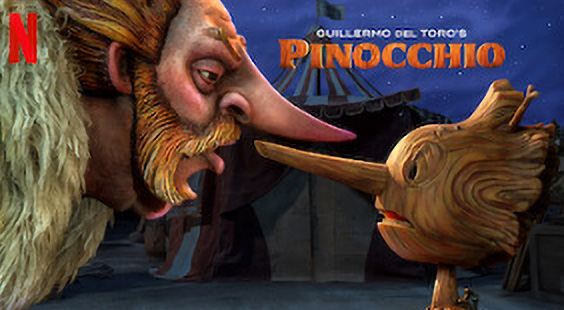
The movie’s thumbnail, as seen on Netflix. It definitely looks like a children’s movie … until one realizes that Pinocchio’s nose is rather … phallic.
While everything about this movie – from the source material to the stop motion visual style – screams out “children’s movie”, del Torro himself said that it was not made for children.
“It’s not necessarily made for children, but children can watch it.”
Sure, children can watch it, but don’t expect them to see the cute, rounded Pinocchio of the classic Disney movie. Nope, del Torro’s version of Pinocchio is an off-putting, jittery, and unstable pile of twigs whose limbs keep bending in all kinds of unnatural ways. Also, he dies several times during the movie. Furthermore, the story spends lots of time dwelling on dark concepts such as war and mortality while taking place in a universe that’s populated with lots of creepy creatures. In short, this movie can easily turn into nightmare fuel for children.
But beyond the overall creepiness of this movie, Guillermo del Toro’s Pinocchio communicates a profound occult message. And that was to be expected from del Toro.
In my 2010 article about del Toro’s Pan’s Labyrinth, I looked into the intense occult symbolism of the movie. I won’t explain the entire thing here however, in this case, a picture is worth a thousand words.
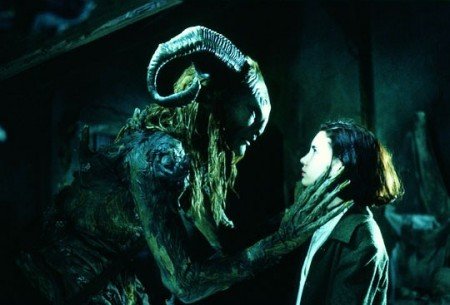
This screenshot sums up Pan’s Labyrinth: The horned god Pan “initiates” a young girl named Ophelia. And it’s all very creepy.
Pan’s Labyrinth shares several similarities with Guillermo del Toro’s Pinocchio: It takes place in a fascist regime (Franco’s Spain), the main character is a child and there’s a horned monster acting as a guide throughout. More importantly, the movies share a similar “moral of the story”.
its so funny because the US intelligence name for Tony Blair during the iraq was was Pinnochio
and my god does that name fit ?
I bid up to £40 for that wartime roll of toilet paper with Winston Churchills face on,
a French collector bid up to £700 to get it
for a roll of bog paper !
Its like those doormats with Tony Blairs face on made during the war on the people in iraq
have you sen what they fetch now ?
and who on earth would buy one of those black rubber effigies of Cliff Richards head
battery butt plugs, they are already fetching £25 each
just pure madness
All that and not one reference to the real-life Podesta…
Anyway, here is a glimpse into the future of Artificial Intelligence.
Artificial intelligence is to natural intelligence what drag-queen story-hour is to youth.
A commenter already mentioned the idea of Jews being what you get if lying makes the nose grow, but a puppet who comes to life might not have much meaning; for children, all dolls are alive
the irish people are demonstrating against the country becoming
a migrant cesspit of toerag scroungers like the UK
why are we in the UK alowing this ?
https://www.youtube.com/watch?v=zEUGqo7serQ
Del Toro looks like one of these Mexican Sephardic Jews.
Having distanced myself from movies and TV for so long I no longer care what symbolism, occult or otherwise, is being presented.
Gosh and here I am (silly me) believing spiritual understanding is achieved via the pineal gland while spiritual illumination is achieved via the heart.
Guillermo del Toro is like many a gifted film-maker. A talented visual artist with very fine story telling skills, seduced by the promises Hollywood brings. The higher production values, the greater potential for graphic realization, the wider selection of actors and technical expertise availed and of course, the compensatory delights of money, money, money.
The Hollywood movie studios exist within their own Noahide enclave, pursuing their own uniquely jewish trajectories.
The damage that the Hollywood moguls have brought to cinematic art is almost unquantifiable.
I’m a fan of Orson Welles’ films (apart from the execrable german-hating, propagandist effort, The Stranger.) Yet, for all of his Shakesperean verve, Welles’ ouevre, of itself, is a tragedy. The loss of his second, documentary film and the subsequent ruination of his third film – the nonetheless sublimely brilliant, Dickensian fare, The Magnificent Ambersons, brings the same gall to my throat, as does, reading about the wilful destruction of the Library of Pergamon in Mysia.
Pan’s Labyrinth is a great fairy story, in the finest tradition of the European tales of the Brothers Grimm, Charles Perrault and Hans Christian Anderson. Its imagery is befitting of the tale; nothing more. I haven’t seen Pinocchio, nor do I wish to see it.
When the housemaid slices open the Falangist officer’s mouth at the end of Pan’s Labyrinth and is pursued into the forest by the Francistas, who mean to summarily execute her, she is rescued by her brother’s unit of the Maquis, which was a Basque/ Breton/ Belgic resistence force, fighting largely for their own purposes (nationhood) during WW II. The Maquis didn’t surrender in Spain and eventually transmogrified into the Basque separatist paramilitary outfit, ETA, which holds fast as Europe’s only surviving armed civilian militia.
black magic in london
https://unlimitedhangout.com/2023/02/investigative-series/black-hand-the-devil-himself/?ref=unlimited-hangout
andyay–you remind me with the Grimm talk to note what I learned from MrBallen, who has dozens of real-life grim stories, which I should not be watching (but I have stopped). I knew that at least three types of ape have the bad habit of ripping people’s faces off for some reason, like the Krays with their “Chelsea Smile” and the same thing in Glasgow (says Gavin McInnes, hoping to be inclusive of Blacks), and MrBallen tells two or three stories where demon-possessed male humans do this with their hands–three if you count “the Russian sleep experiment” where they tore their own flesh using hands: it means apes and demons have something in common, as if apes are easily possessed, or the demons are sometimes dead apes. MrBallen has a cosy and relaxed style, smuggling more horror into the viewer, a trick I am learning to see through
The earliest Glasgow razor gangs shared an ethnic affinity with the Krays.
The Russian Sleep Experiment is a hoax; albeit a rather tasty one. It was written and produced by KJ Ozborne, who used to be called the “Scariest Story Ever Told” on YouTube but now makes videos of impossible to digest length, posted on the channel, “KJ’s What Happened?”
Watch out for the monsters, Lewis.
andyay–thanks for the reply; it is new for me to think of apes as bad, as we had more of that opinion about reptiles, traditionally, and Attenborough taught love of apes (although not to me). The Krays had croco— sorry, taxi here for hospital
What was I about to say? The Krays had crocs as an emblem and gave opponents a reptilian sort of mouth using a knife, and that animal is one of the most soulless and materialist. Someone, maybe you, said the Russian Sleep Experiment was fiction, and it did get very literary at the end, as if someone updated Doctor Jekyll and Master Hyde– “Who are you?”, the demon is asked, and he says “Have you forgotten already? We are you!”