

BN Frank – Activist Post Sept 5, 2022
Opposition to 5G is worldwide and for numerous significant issues associated with the controversial technology. This has limited, slowed, and/or stopped deployment in some locations (see 1, 2) including near U.S. airports due to aviation interference risks (see 1, 2, 3). Nevertheless, deployment continues worldwide on a massive scale and devastation continues to be reported where it has been activated, including on the Greek island of Samos.
5G Cell Towers Cause Massive Insect Decline on the Greek Island of Samos Part 2, Guest Blog by Diana Kordas Ed.m, M.A
(see Part 1 here)
Abstract
Insect declines have continued on Samos since the introduction of 5G. The situation has worsened since 5G became commercially available from July 1, 2022. Not only are insect numbers in general continuing to decline; pollinators including butterflies are declining very rapidly. Insectivore birds are declining also. Soil conditions have worsened as well, with the soil becoming more acidic than previously. There are no visible insects in the soil, and many plants are not growing as well as they should, or growing to full size. Melons and aubergines show signs of DNA damage. Lack of pollinators, poor yields and withered plants are apparent all over the island. The implications for food production generally are frightening: a combination of declining soil quality, declines in pollinator numbers and radiation-damaged plants means that it will be harder to grow food and that food prices will continue to rise. Total crop failures may occur in future.
Observational Study Area, May-July 2022
5G was introduced in July of 2021 on Samos, but only became commercially available at the beginning of July 2022. During the year in which the technology was live but not commercially available, adjustments were being made to the system so that it would operate properly. The 5G wavelengths of 0.7 GHz, 3.5 GHz and 22.5 GHz have been operational from July last year.
Insects
Serious insect declines began with 4G, but the introduction of 5G caused a rapid and massive decline in many types of insects, many of them pollinators. Climate change, which is often given as the reason for insect declines, could not have had this effect within a single growing season. Also, climate change should bring an increase in the number of insects rather than a decline. As mentioned in “5G Cell Towers Cause Massive Insect Decline on the Greek Island of Samos”, the area does not have pesticides.
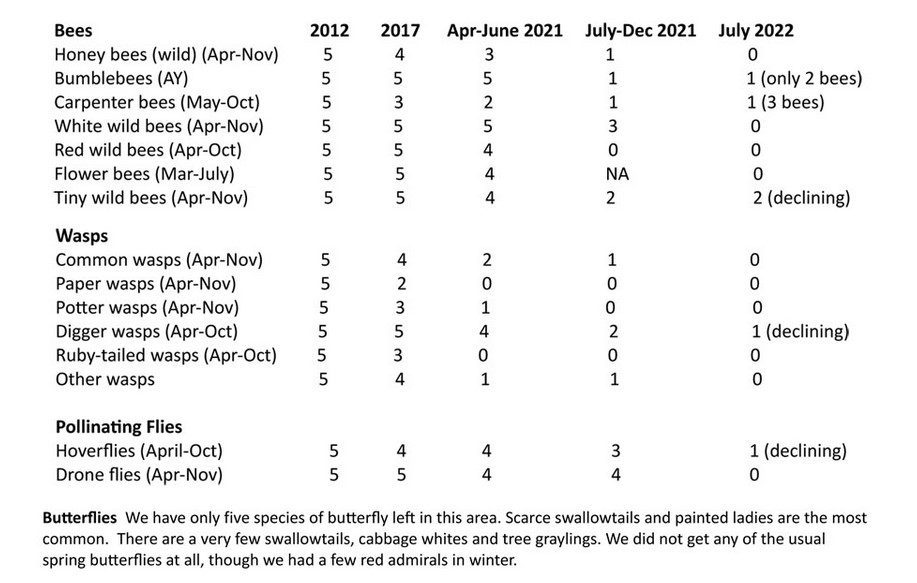
The number of pollinators has visibly dropped since the beginning of this summer (2022). In May we still had some hoverflies, bumblebees, honeybees and white bees. There were a few bee flies and, in general, the situation was much as it had been at the close of last summer. Now virtually all the larger bees and hoverflies are gone. Since July 1, we have seen only 2-3 carpenter bees, two bumblebees, and no honey bees. There are no drone flies and there are very few hoverflies or wasps. Of the hoverflies, the only two types we see now live in underground burrows—and there are not very many of them left. The same is true of the wasp species we are seeing: the only kinds we have left live underground, with the exception of very tiny wasps (see below). We have seen no red bees at all this year (there are several species which are mostly active in spring and early summer), and no white bees, which used to be the main pollinators of our summer vegetables along with bumblebees.
Crops are still getting pollinated, though we expect yields to be much lower than last year (courgettes are not being pollinated at all, very few melons have been pollinated, and we will definitely have farfewer tomatoes, less than a quarter of what we had last year). The main pollinators are very tiny wild bees, some only 2-3 millimeters long. We are seeing several species of these tiny bees. There are also a few tiny wasps, also 2-3 millimeters long, of a species we have not noticed before. Except for a few burrowing wasps, these are the only wasps we are seeing.
In general, insect numbers have continued to fall since last summer. There are very few grasshoppers, almost no crickets, very few beetles, fewer butterflies and moths, and fewer cicadas. Some species, such as the spoonwing lacewing and indeed most lacewings, have vanished entirely. Until recently, and despite overall insect declines since the introduction of 4G, species that lived or laid eggs underground were more abundant than species that lived or laid eggs above ground. This is mentioned in Lazaro et. al (2017) with reference to wild bees, but the same principle applies generally.
Cicadas hatch and develop underground, where they spend the whole of their lives until they emerge for a few weeks to find mates and breed. Until recently, they had not declined noticeably; only last year (2021) did we notice declines in numbers and see signs of DNA damage in some cicadas, in the form of damaged wings. This year, not only are there markedly fewer cicadas, but there are generally fewer insects that breed and live underground. This may be due to both direct and indirect effects of electromagnetic radiation on the soil. Insects like cicadas, which hunt underground in the larval stage, may be finding less to eat. The change in the electromagnetic balance of the soil itself may also be killing them (see the section “Soil Acidification” in “5G Cell Towers Cause Massive Insect Decline on the Greek Island of Samos”).
Table of Pollinators in the Study Area, 2012-July 2022
List of Abbreviations: NA= Not Applicable; AY= All Year
5 = 100% is given as a baseline for 2012 and does not reflect insect prevalence of earlier years.
4 = 80%-61%, 3 = 60%-41%, 2 = 40%-21%, 1 = 20%-1%, 0 = none seen
Birds
Birds are also being seriously affected by 5G. There are many fewer birds around than there were several years ago; bird populations have fallen all over the island and finches of all species seem to be virtually extinct, as do kingfishers. On our land, sardinian warblers, orphean warblers, great tits, blackbirds and jays all nested, but we have seen no juvenile birds except young great tits. We seem to have lost our wrens and song thrushes. Warblers are insectivores and with declining insect populations, their future is not assured. Other birds have also not bred successfully. Chukars, a common island subspecies of partridge, have had very few young this year; some pairs have not bred and of the few with young we have seen, there are fewer chicks than usual. We had a pair of tawny owls, but they do not seem to have bred and these days we only hear one owl. Since rodents have seriously declined, the decline in owls may be due to lack of food.
In our local wetlands, flamingos have failed to breed for the first time that we have seen. The lagoon there functions as a sort of creche for baby flamingos, and generally there are 30-40 first-winter and second-winter birds. This year there were only two first-winter flamingos and three second-winter ones. In addition, seven pairs of ruddy shelduck failed to breed at all. The lagoon used to have numerous little egrets; now there are none.
There were very few migrating birds this year. The bee-eaters arrived in early May, but not so many of them as usual. Barn swallows, house martins, common swifts and alpine swifts also arrived, but numbers are very small and red-rumped swallows have not arrived. These birds generally hunt insects on and above our land throughout May, and did so this year, but—and this was the first time we have ever seen this—they were relentlessly attacked by the yellow-legged gulls, who tore swallows and martins literally to pieces over our heads, and captured bee-eaters in their beaks and killed them. This went on day after day, and was sickening to watch.
Gulls are not raptors; they are mostly scavengers although they may steal eggs and young from other birds’ nests. However, the gulls may be starving as there is nothing in the sea at all: no urchins, starfish, shells, cuttlefish and other sea life that usually wash up on beaches where the gulls scavenge.
We have seen nothing washed up on beaches for several years except rubbish, driftwood and ribbonweed. There are also very few fish. Clearly the taking of smaller birds in flight was a new method of getting food for these gulls; they became more adept at catching other birds as the days passed.
Soil Conditions and Soil Insects; DNA Damage in Plants
The soil is becoming much more acidic. In April we dug a new vegetable bed, on virgin soil: the land has not been used since before World War II. We found absolutely no insects in the soil, not even a single earthworm. There should have been large numbers of earthworms, grubs, small centipedes and various beetles. In order to grow our summer crops we have had to add calcium to soil three times, and even so our peppers are showing signs of calcium deficiency, with black spots and areas of thin walls appearing near the tips of the fruits. The peppers themselves are thinner-walled than they should be, and cook down to nothing. Were we market gardeners, these would be unsaleable. Some tomatoes are also showing damage due to lack of calcium: weak spots like scars in the skins of the fruits and, in the plum tomatoes, some fruits where the lower half has turned black and rotted. A number of tomatoes and peppers rot entirely before ripening; this is not due to insect damage.
In last year’s summer bed, we attempted to grow peas and beans in the early spring. Nothing sprouted. We were not the only people whose beans did not grow. The same thing happened to several of our neighbours and friends, who all grow broad beans every winter. This year, their beans did not grow.
We used the other half of the same bed to plant potatoes, which like acidic soil. These grew, but yields were low, with some plants producing no potatoes at all. Despite the fact that the soil was kept moist, when we dug the potatoes out we found, once again, no insects at all, not even a single earthworm.
We planted courgettes and melons in the half of the bed where the peas and beans had failed to grow. They sprouted, but no courgettes and few melons have been pollinated, and the plants have not grown to normal size; they have remained very small despite fertilization (we use both goat and chicken manure, the one dug into the soil and the other watered in as the plants are growing).
Melons, zinnias and some aubergines are showing signs of DNA damage. Almost all the melons are very small, about the size of tennis balls, and many are misshapen, with obvious weak spots in the rind. Many of the seeds inside them are also misshapen. Some aubergines are also misshapen, with folds and odd fingers of flesh. DNA damage is also evident in some zinnias, which have developed huge protruding centers, sometimes with a miniature second flower on top. Our neighbours are having the same problems with melons as we are. Theirs were purchased as seedlings, whereas we grew our from our own seed. Their aubergines, unlike ours, have produced only tiny fruits which are inedible.
There’s no operation civilian 5G in the West. Maybe they have it in some places in China.
Real 5G works by beam forming, so beams use LTE to find you, then the beams allow 5G, but only if you are stationary. If you’re in a building, you’ll need a node outside and inside, both connected by cable, then you will get 5G. 5G won’t even go through trees.
This is how your fake 5G works, and I’m not a tech nerd. They’ve increased the number of aerials in your handset, and they’ve increased bandwidth. This gives you higher data flows.
There’s no doubt that 3G and 4G, and 5G, when it comes, will affect all living things. We are electric biological systems, so we must be affected in some way, just as solar and cosmic particles play a role in heart attacks and strokes. The magnitic field is collapsing, so watch out.
Not to worry the mindless idiots can view oceans of porn while they starve to death.
Declining INSECT populations ! Oh No.
Sound the Alarm,
There goes the ‘new’ Sunday roast. What are we going to eat ?
5G does not destroy calcium, it is a soft metal, so what are they on about?
Why isn’t 5G banned until further experimentation is done?
The Jew hates nature. The Jew is the enemy of all living things.
Jews hate nature, (themselves being unnatural organisms–mongrels) so they won’t be happy until most or all of nature–e.g., the feral uncontrolled insects/animals/forests etc. are destroyed & the planet is simply some wasteland permeated & ruined by chemicals & radiation..while their nanotech implanted slaves live in artificial ‘smart cities’ hooked to the ‘metaverse’ etc..
It’s nothing to do with the pesticide or the gmo seeds. It’s nothing to do with the record temperatures and dry soil. 5g is also not only affecting this one greek island its also affecting the isle of wight and the falklands. 49% of the people in my street have become borg since they turned 5g on. luckily, me and my family have been wearing 5g shielding clothing and we painted our house with 5g paint, so we’re still not in the collective. Apparently this island supplies the world with 80% of its cucumbers, so we’re all going to starve, especially when they start burning down the cucumber distribution centres.
> Declining INSECT populations ! Oh No.
> Sound the Alarm,
> There goes the ‘new’ Sunday roast. What are we going to eat ?
Another genius who thinks plants will pollinate themselves.
This is nothing but Tikkun Olam at work.
HA HA HA Bert !
You missed it by a country mile…
chill.
Humanity is so transfixed by fear of antisemitic label that they will gladly suffer a variety of life ending torments in order to avoid it.
I think of gruesome parasites in the animal sphere, e.g., one that latches onto a fish’s tongue, eats it, wedges itself into the the cavity and proceeds to devour all the food the slowly starving fish grabs.
While defecating down the fish’s throat … another prototype from Yahweh’s laboratory before he perfected the ultimate weapon against people.
Another example is some kind of spore that lands on an ant’s forehead, sends roots or tendrils into the brain and takes over its motor coordination while eating its insides according to a blueprint that allows for ant’s locomotion. In the end stage, it directs the ant to walk to the tip of a leaf, sprouts out of its head and sends further spores into the wind to infect other ants passing by.
But once again, Jew beats them all in terms of grotesque evil.
If there is any possibility of saving grace, it may be that the steadfast haters of Judendom are the ultimate paragons of the humanity, immune to jew’s wiles, so that as the parasite destroys all the available hosts, it will face its own extermination because whoever is left will be invulnerable.
God will beat Yahweh (Satan) as we beat the jew.