
Rachel Scheinerman – My Jewish Learning
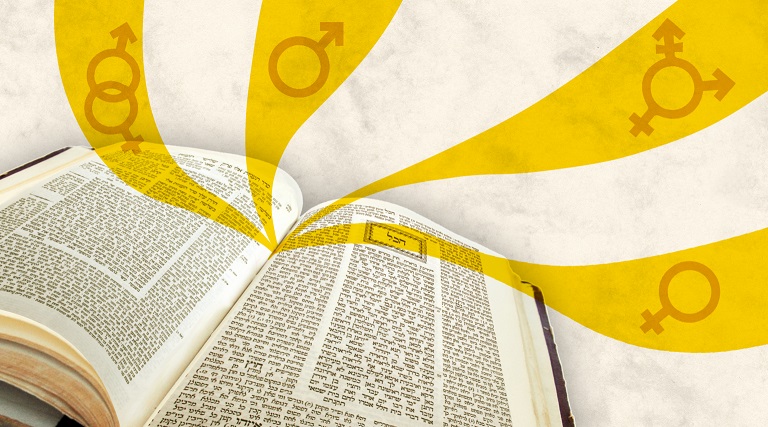
Thought nonbinary gender was a modern concept? Think again. The ancient Jewish understanding of gender was far more nuanced than many assume.
The Talmud, a huge and authoritative compendium of Jewish legal traditions, contains in fact no less than eight gender designations including:
- Zachar, male.
- Nekevah, female.
- Androgynos, having both male and female characteristics.
- Tumtum, lacking sexual characteristics.
- Aylonit hamah, identified female at birth but later naturally developing male characteristics.
- Aylonit adam, identified female at birth but later developing male characteristics through human intervention.
- Saris hamah, identified male at birth but later naturally developing female characteristics.
- Saris adam, identified male at birth and later developing female characteristics through human intervention.
In fact, not only did the rabbis recognize six genders that were neither male nor female, they had a tradition that the first human being was both. Versions of this midrash are found throughout rabbinic literature, including in the Talmud:
Rabbi Yirmeya ben Elazar also said: Adam was first created with two faces (one male and the other female). As it is stated: “You have formed me behind and before, and laid Your hand upon me.” (Psalms 139:5)
Rabbi Yirmeya ben Elazar imagines that the first human was created both male and female — with two faces. Later, this original human being was separated and became two distinct people, Adam and Eve. According to this midrash then, the first human being was, to use contemporary parlance, nonbinary. Genesis Rabbah 8:1 offers a slightly different version of Rabbi Yirmeya’s teaching:
Rabbi Yirmeya ben Elazar: In the hour when the Holy One created the first human, He created him as an androgynos (one having both male and female sexual characteristics), as it is said, “male and female He created them.” (Genesis 1:27)
Said Rabbi Shmuel bar Nachmani: In the hour when the Holy One created the first human, He created for him a double face, and sawed him and made him backs, a back here and a back there, as it is said, “Behind and before, You formed me” (Psalms 139:5).
In this version of the teaching, Rabbi Yirmeya is not focusing on the first human’s face (or, rather, faces) but on their sex organs — they have both. The midrash imagines this original human looked something like a man and woman conjoined at the back so that one side has a women’s face and a woman’s sex organs and the other side has a man’s face and sex organs. Then God split this original person in half, creating the first man and woman. Ancient history buffs will recognize this image as similar to the character Aristophanes’ description of the first humans as both male and female, eventually sundered to create lone males and females forever madly seeking one another for the purposes of reuniting to experience that primordial state. (Plato, Symposium, 189ff)
For the rabbis, the androgynos wasn’t just a thing of the mythic past. The androgynos was in fact a recognized gender category in their present — though not with two heads, only both kinds of sex organs. The term appears no less than 32 times in the Mishnah and 283 times in the Talmud. Most of these citations are not variations on this myth, but rather discussions that consider how Jewish law (halakhah) applies to one who has both male and female sexual characteristics.
That the androgynos is, from a halakhic perspective, neither male nor female, is confirmed by Mishnah Bikkurim 4:1, which states this explicitly:
The androgynos is in some ways like men, and in other ways like women. In other ways he is like men and women, and in others he is like neither men nor women.
Because Hebrew has no gender neutral pronoun, the Mishnah uses a male pronoun for the androgynos, though this is obviously insufficient given the rabbinic descriptions of this person. Reading on we find that the androgynos is, for the rabbis, in many ways like a man — they dress like a man, they are obligated in all commandments like a man, they marry women and their “white emissions” lead to impurity. However, in other ways, the androgynos is like a woman — they do not share in inheritance like sons, they do not eat of sacrifices that are reserved only for men and their “red discharge” leads to impurity.
The Mishnah goes on to list ways in which an androgynos is just like any other person. Like any human being, “one who strikes him or curses him is liable.” (Bikkurim 4:3) Similarly, one who murders an androgynos is, well, a murderer. But the androgynos is also unlike a man or a woman in other important legal respects — for instance, such a person is not liable for entering the Temple in a state of impurity as both a man and woman would be.
As should now be clear, the rabbinic interest in these gender ambiguous categories is largely legal. Since halakhah was structured for a world in which most people were either male or female, applying the law to individuals who didn’t fall neatly into one of those two categories was challenging. As Rabbi Yose remarks in this same chapter of the Mishnah: “The androgynos is a unique creature, and the sages could not decide about him.” (Bikkurim 4:5)
In many cases, the androgynos is lumped together with other kinds of nonbinary persons as well as other marginalized populations, including women, slaves, the disabled and minors. For example, concerning participation in the three pilgrimage festivals (Passover, Shavuot and Sukkot) during which the Jews of antiquity would travel to the Temple in Jerusalem, the mishnah of Chagigah opens:
All are obligated on the three pilgrimage festivals to appear in the Temple and sacrifice an offering, except for a deaf-mute, an imbecile, and a minor; and a tumtum, an androgynos, women, and slaves who are not emancipated; and the lame, the blind, the sick, and the old, and one who is unable to ascend to Jerusalem on his own legs.
As this mishnah indicates, it is only healthy, free adult men who are obligated to appear at the Temple to observe the pilgrimage festivals. People who are not adult men, and men who are enslaved or too old or unwell to make the journey, are exempt.
As we have already stated, the androgynos was not the only person of ambiguous gender identified by the rabbis. Similarly, the rabbis recognized one whose sexual characteristics are lacking or difficult to determine, called a tumtum. In the mishnah from Bikkurim we cited earlier, Rabbi Yose, who said the androgynos was legally challenging for the sages, said the tumtum was much easier to figure out.
The rabbis also recognized that some people’s sexual characteristics can change with puberty — either naturally or through intervention. Less common than the androgynos and tumtum, but still found throughout rabbinic texts, are the aylonit, who is born with organs identified as female at birth but develops male characteristics at puberty or no sex characteristics at all, and the saris, who is born with male-identified organs and later develops features recognized as female (or no sex characteristics). These changes can happen naturally over time (saris hamah) or with human intervention (saris adam).
For the rabbis, what is most significant about the aylonit and the saris is that they are presumed infertile — the latter is sometimes translated as “eunuch.” Their inability to have offspring creates legal complications the rabbis address, for example:
A woman who is 20 years old who did not grow two pubic hairs shall bring proof that she is twenty years old, and from that point forward she assumes the status of an aylonit. If she marries and her husband dies childless, she neither performs halitzah nor does she enter into levirate marriage.
A woman who reaches the age of 20 without visible signs of puberty, in particular pubic hair, is deemed an aylonit who is infertile. According to this mishnah, she may still marry, but it is not expected that she will bear children. Therefore, if her husband dies and the couple is in fact childless, his brother is not obligated to marry her, as would normally be required by the law of levirate marriage.
A nonbinary person who does not have the same halakhic status as a male or female, but is something else that is best described as ambiguous or in between, presented a halakhic challenge that was not particularly foreign for the rabbis, who discuss analogs in the animal and plant kingdoms. For example, the rabbinic texts describe a koi as an animal that is somewhere between wild and domesticated (Mishnah Bikkurim 2:8) and an etrog — yes, that beautiful citron that is essential for Sukkot — as between a fruit and a vegetable (Mishnah Bikkurim 2:6, see also Rosh Hashanah 14). Because they don’t fit neatly into common categories, the koi and the etrog require special halakhic consideration. The rabbinic understanding of the world was that most categories — be they animal, vegetable or mineral — are imperfect descriptors of the world, either as it is or as it should be.
In recent decades, queer Jews and allies have sought to reinterpret these eight genders of the Talmud as a way of reclaiming a positive space for nonbinary Jews in the tradition. The starting point is that while it is true that the Talmud understands gender to largely operate on a binary axis, the rabbis clearly understood that not everyone fits these categories.
Anyone ever consider the rabbis were just nuts?
Is this supposed to justify the Jewish tradition with modern thinking, or vice versa? Six or eight genders is not a hundred-and-fifty, and in any case the correct count is two. Hybrids of the two created another dimension eventually but that is not understood in science or religion.
There’s just one small problem. And it’s a big one! The Talmud has been around for 3,000 years or so, and they’ve only just discovered these definitions at the same time they’re trying this many-gender guff? Some of these expressions could refer to some animals like amphibians and reptiles etc known to change sex at times. Female plants can produce sacs of XX pollen to germinate other females when there’s not much male-produced XY pollen around. Maybe some were just descriptive terms for poof, dyke, tranny etc.
I don’t believe it’s multi-gender related. Not only would humanity have been aware of it thousands of years ago, but it would surely be spoken of somewhere in the New Testament and the Koran.
Male and female dictate life throughout all of the natural world and all the rest is the nonsensical ideas of twisted minds.
I do not need any jewish learning.
It is a surprise to find these articels on thruthseeker….
The fact that the Jews worldwide run the Rothschild
Central banks and issue all the money to other banks
and even the governement of all countries, is
disturbing enough. And the states who are the ones who
have the highest right to issue money, have to get this
right back. So Usuary will be stoped and minimalized.
When the ‘jews’ aren’t deceiving the ‘goyim’ they are deceiving themselves….
the yentas being ‘particularly’ ‘damaged’ and carrying the seeds of this ‘particularly’ ‘jewish’ madness….both physical and psychological.. (demonic feminine energy perhaps? so thought Weininger) …
this psychological contagion… spreads (via yenta) into your ‘social institutions’ (very dangerous) in support of their mentally impaired male theoreticians and talmudic bullshiters…
who pay mendacious ‘establishment’ imbeciles to concur with their lunacy…
and employ more ‘jews’… particularly social science yentas…
I am not the slightest bit interested in taking into account anything prescribed to me by people adhering to ideology from four thousand years ago,..I don’t care how “anti” that makes me.
As a species we must see these people as those who are misleading us and that includes the katholics of our society who are the twenty percent misleading the other eighty.
We all thought Kurt (mouthpiece of the Wrecking Crew) Vonnegut jr. was original in stating there were 7 sexes. In Slaughterhouse Five.
So all of this gender confusion and orchestration is coming from the Jews? They want credit for all of the nonsense and gender breakdown going on? Don’t they have enough problems? Surely some modern Jews are going to distance their faith and culture from all of this?
Hmm.. IMHO the only quote defining genders is ??
Men are from Mars ..
Women are from Venus..
All other Genders are from Uranus …
Just the stinking facts ma’am..
Second opinion
So the Talmud, the most evil book on Earth (or set of books), claims there are eight genders…I wonder if they also claim there are transhumans to go with transgenders (I mean, if Genesis 6 can make that claim about the Nephilim offspring of women and fallen angels)… but anyway, what else can be claimed by this anti-Christ crapola when Gitten 57a claims Christ is burning in Hell for eternity in His own excrememt…. and, oh yeah, that Talmudic Jews are gods… When they get the number of gentile slaves per Jew in the end times when Ha Mossiach comes in the end…is it 800 or 2800? Let me know… Bwahahahahahahah!
Two directions (of the three dimensions), two directions for time, inside-outside, birth-death, awake-asleep, male-female, Jew-Gentile, writer-reader: all these twos suggest two Gods, and not a God represented by One prophet, (who has to compete with all the other Ones). iN zOROASTER OR the Life of Brian, the prophet always says he isn’t one
@fung shway
The Koran says like this…
https://www.pinterest.com/pin/763641680571623109/
“And we have created you in pairs”
and anything other than that is an aberration.