
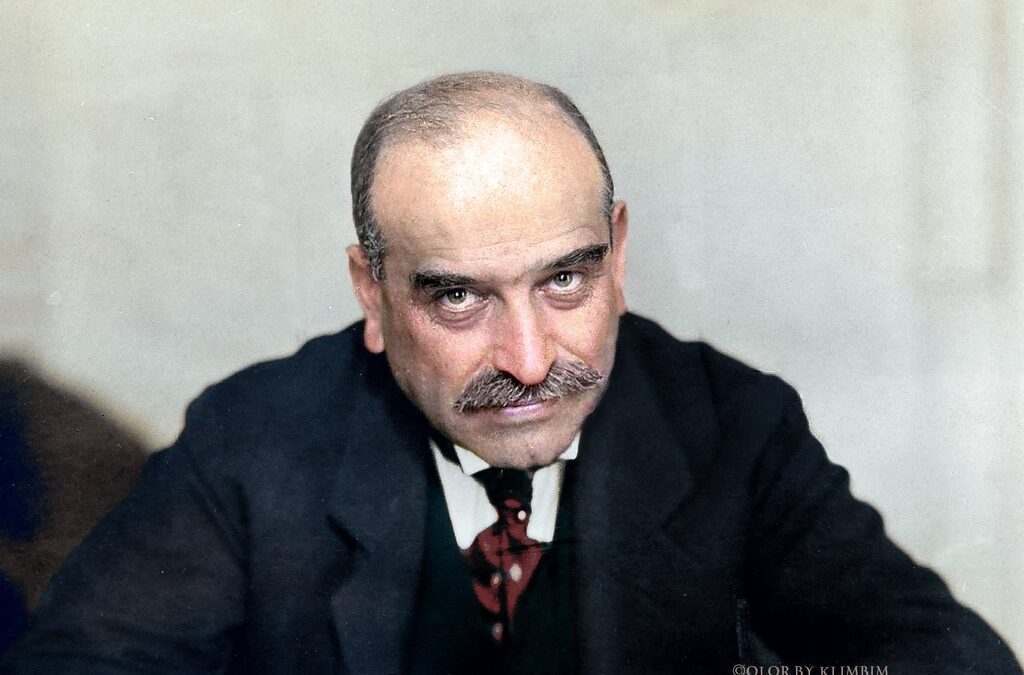
(Above, Max Warburg, 1867-1946, the mysterious Cabalist banker who helped mastermind the Russian Revolution and World War Two.)
HenryMakow.com – June 23, 2022
I was taught Communism was “public ownership” and the overthrow of capitalist tyranny, not how certain capitalists stole the wealth of other capitalists while pretending to champion the working class. This is their “Magick” i.e. deceit or lying, i.e. COVID, easy when you own the mass media, doctors & politicians.
German Secret Service documents instructed the Bolsheviks to “destroy the Russian capitalists as far as you please, but it would by no means be possible to permit the destruction of Russian enterprises.”
(This is an update of an important article, “The Illuminati World of Make-Believe” first posted in 2007.)
By Henry Makow PhD
If you asked Genghis Khan for his formula for world conquest, you’d expect to hear “overwhelming force” or “terror.”
You would NOT expect to hear, “‘Make-believe.'”
“Make-believe?” Who is this tyrant? Walt Disney?
Yet in the First Protocol of the ” Protocols of the Elders of Zion,” the author says three times, Our Countersign is “Force and Make-believe.”
“Make-believe” is the Illuminati’s “Magick.” Magick is simply deceit or lying which is pretty easy to do when you own the mass media and educators.
The evil magician Aleister Crowley defined Magick as “the science and act of causing change to occur in conformity with will… any willed change in ourselves or in our environment is Magick.”
In other words, Magick is reshaping the world according to their interests. The Illuminati are masters at using false pretexts to do this. Our reality is largely their magick spell.
I finally noticed this when I read “The Truth About the Slump” (1931) by A.N. Field.
The Bolshevik Revolution was portrayed as an egalitarian revolt. In fact, the Illuminati Jewish bankers financed it to confiscate Russian industry. (pp.62-72)
German Secret Service documents instructed the Bolsheviks to “destroy the Russian capitalists as far as you please, but it would by no means be possible to permit the destruction of Russian enterprises.”
The German Imperial Bank sent the Bolsheviks in excess of 60 million rubles. Documents 10 and 11 between the bankers and the Bolsheviks “give a complete synopsis of the terms on which the German banks after the war were to control Russian industry.” (p. 69)
Of course German Secret Service Chief Max Warburg, the brother of US Federal Reserve Chairman Paul Warburg, was behind this. We’re talking about international bankers and their confederates here.
DIS-ILLUSION
Plenty of “revelation of the method” and “making manifest all that is hidden” from these Jewish truthers.
I guess we are just meant to sit here and gaze on in awe and paralysis at the super criminals who run the world. Our final initiation into subhumans is complete. We sit here and do nothing while they cut our children’s genitals, kill our babies and subvert reality entirely.
Mind control works and we are living proof. We are no better than MK Ultra beta slaves. Our awareness of their plans gives them consent to carry them out. We do nothing – we are found guilty of allowing evil to flourish and claiming to be helpless against it. This is their magick too.
That whole visage screams, ‘MYZTEERIOUZ KABALEEEST BANKAH!!! Muuuwwwwwaaaahaaaaaaaaa!’
Not just the German banks, but Wall Street, London and Swiss banksters were part of the entire scheme, backing the Bolsheviks controlled and directed by the then Rothschild dynasty with tentacles everywhere, but mostly out of and also promoted by Old Jolly (England) with a history of backing and promoting creeps such as Karl Marx and funding various efforts in the 19th century to overthrow the Russian establishment and of course the 1905 attempted communist revolution in Russia.
The Zionists coincidentally with the backing of the same money power to get off of the ground have been a most ruthless lot and many people who have got over their conspiracy theoryitis have no problem seeing that these people despite their cartels everywhere have no monopoly on the sociopathic methods used to gain, sustain and increase their wealth and power. Just look at the histories of the Roman Empire, France, Spain, England, China, Japan, and in particular the history of the US. History from the perspective of the power game is simply one of might makes right, exclusive rights, privileges, high crimes, endemic injustice, rampant insider preference, murder, blackmail, conspiracies, mass deceptions, etc., etc. Incidentally these are the very things which entertainment for most people thrives upon.
Unlike the Jews who put their blood and lives into the birth and beginnings of Christianity in an effort to bring all people to the true God and reform us from the use of these diabolical methods, and especially from the doctrine of might makes right, the remaining Jews for the most part kept their blood and lives to their exclusive tribal loyalties and advancement, fighting back most often with more intelligent machinations, and as a result were able particularly over the last five hundred years to capitalize on the wars, empire building, exploits of the nations of the West whose establishments had squandered their Christian heritage for a pottage of mammon which has become their present god. Hence, in the war between these various evils it appears that the Jews have run circles around the gentile monarchs and powerbrokers all of whom are equally amoral and sociopathic.
Apart from that controversy, there is not one Western institution I have found in my life where those at the top are not really disciples of mammon and adherents to the rule of might makes right. What you get from the top of all our leading institutions is generally the “will to power” and the exercise of that so-called “Magick” which Henry talks about, or an obeisance to some even more evil power higher up the pyramid, and that is precisely why power corrupts. Power is simply the ability to do what you want and the more you have of it the more you can assert your own will. Having power without the checks and balances from the people you ought to be serving, or even from a people not connected to and acting in conformity to the will and nature of the true God, all you will have is more and more corruption. That is all we can see today in the running of any of our institutions and you cannot just sit back as so many of you do and blame the Jews. They have won the power war not just though their solidarity, intelligence, and skills with money but also because it is a war which Christians cannot fight using the same means. In any case, once won it is only a Pyrrhic victory, because the real war is the war between the kingdom of heaven and that of that which rules this earth.
Makow: “Communism is satanic. Its symbol, the five-pointed star, is satanic. The communist manifesto calls for the destruction of family, culture, science and religion (atheism), the confiscation of property and inheritance, control of communications and dictatorship. It also calls for private central banks and an income tax. Yet it has been tolerated and even praised. ”
Makow scares us again with communism but communism in itself is not satanic but ‘Jewish communism’ (Jewish internationalism) is because it is based on the power of the Jewish nwo-elite (Illuminati) and not on the power of the people. Whenever power is not with the people everything is dangerous, including capitalism as we see. By creating an insatiable fear of communism, Makow promotes Jewish capitalism and the power of the Jewish wef-mafia. Unlike Jewish communism real or non-satanic communism can only be realized through democratic socialism if the people are ready for it.
Psycho-Techno mesmerism with a big dash of pharmacopeia.
Would you like to super-size that..
What they’ve done to Russia during bolshevik revolution they are doing today to western world, they want to eliminate working and middle class so these jew overlords can rule the unarmed powerless remnants of population not destroyed by their vaccines yet…Even if you don’t believe the Bible, it’s obvious they are the ones described as Synagogue of satan by Saint John in Revelation Book.
Listen to Benjamin Freeman for the people who masterminded the creation of the Bolshevik Party and WWI. He was one of the planners in this and names who was involved. The Slaughterhouse of Osiris is an excellent mini documentary of the Bolshevik – Freemason movement. All are Talmudic and Kabbalist which is very heavy into the occult.
These people are among us and Bobby Fischer nailed it on Genetic Engineering being the next for this clan, organized by Judaism’s highest authorities to use Goyim as a front as well as that is the Nursery of the useful idiots for those who hide their actions. McFadden knew exactly who was behind it as well as Howie Long and both paid with their lives.
Their new earth will be a dead one. Destruction of nature is #1 goal and universities such as Purdue’s Ag department, creator of the terminator gene is just a hint of the level of depravity of these institutions. Most heads of Ag departments know exactly what they are doing around the world and laugh at the hope of “Contagion” which is what Arizona State’s current head did when he stated in Geoengineeringwatch.org saying live in front of his peers that the DNA modification will be built into the new generation of GMO seeds.
Crypto Jews are by dictates of the Sanhedrin in 1489 to subvert religions by being converts. This is not just Khazars which are far older than mentioned as they are the Proto-Mongols.
Religion has proven itself as an abomination of words of men in this current crisis of fake COVID-19 which is modeled by Computer for the deaths of those who are not of these ancient people who are Baal and Moloch worshippers and blood sacrifice. I don’t believe any written document is the word of the creator but that is a decision from within as we are born knowing the continuum of good and evil.
Next – Slavery – The belief in slavery in the Talmud promises 2800 slaves for each which is captured in video by Adam Green and his cohort in Dan Mark.
Here follows the names, locations, and details of more than two hundred such Jews who controlled commerce in early America during the colonial period:
Hart Aaron, colonial American Jewish merchant and shohet (Jewish butcher) in New York City, died in 1777.
Jonas Aaron, colonial American Jewish merchant residing in Philadelphia, Pennsylvania, in 1703.
Abraham Isaac Abrahams, colonial American Jewish merchant, tobacconist, and distiller in New York City; moel for Congregation Sherith Israel.
Chapman Abrahams, colonial American Jewish merchant who operated in Albany, New York, Detroit, and Montreal. Escaped capture during the Pontiac uprising of 1762.
Emanuel Abrahams, colonial American Jewish merchant, tobacconist and distiller in Charleston, South Carolina.
Isaac Abrahams, colonial American Jewish physician in New York, Philadelphia and Baltimore during the 1700s.
Israel Abrahams, colonial American Jewish merchant and interpreter of Spanish and Dutch to the Court of the Vice Admiralty in Newport, Rhode Island in 1746.
Levy Abrahams, colonial American Jewish merchant in Savannah, Georgia.
Abraham Alexander, Sr., Revolutionary War officer, Freemason, and U.S. Customs House auditor in Charleston, South Carolina.
Moses Ambrosius, colonial American Jewish merchant, refugee from Recife, Brazil, who arrived in New Amsterdam in 1654 along with Jacob Barsimson and other Jews.
Joseph Andrews, colonial American Jewish merchant in Philadelphia, Pennsylvania.
Michael Asher, colonial American Jewish shipping merchant, slave-trader, operating in Boston and New York in the 1700s.
Abraham Azuby, colonial American Jewish clergyman, arrived in Charleston in 1764, was the first paid rabbi in the colony of South Carolina.
Jacob Barsimson, colonial American Jewish merchant employed by the Dutch East India Company’s colony in Recife, Brazil, arrived in New Amsterdam aboard the Peartree on August 22 1654.
Isaac Benedix, colonial American Jewish merchant and postmaster in Savannah and Charleston during the 1700s.
Saul Brown (originally Saul Pardo),colonial American Jewish merchant who applied to trade in New York in 1685. Head of the Beaver Street synagogue which served a congregation of 20 Jewish families.
David Bush – colonial American Jewish settler, Freemason, supported the colonial rebellion against Great Britain in Philadelphia and Wilmington, Delaware.
Matthias Bush – colonial Jewish merchant, land owner in Philadelphia. One of six Jews who signed the non-importation agreement of October 25, 1765, boycotting British goods in colonial America.
Solomon Bush, colonial American Jewish merchant in Philadelphia who was one of six Jews who signed the non-importation agreement of October 25, 1765, boycotting British goods in colonial America. During the Revolutionary War, he served as deputy adjutant general of the Pennsylvania State Militia and was promoted to lieutenant colonel in 1779. A prominent Freemason, Bush was deputy inspector general of Masonry for Pennsylvania in 1781 and was a founding member of the Masonic Sublime Lodge of Perfection in Philadelphia.
Aaron Nunez Cardoza, colonial American Jewish merchant and tailor who settled in New York in 1750.
Isaac Nunez Cardoza, olonial AmericaJewish merchant who settled in New York in 1752, supported the colonial rebellion against Great Britain.
Joseph Carpelles, colonial American Jewish innkeeper in Philadelphia during the Revolutionary War.
Raphael Hayyim Isaac Carigal, Emissary of the Palestine Yishuv in Newport Rhode Island and New York City in the 1770s.
Jacob Coen, one of three Jews who on November 29, 1655, petitioned Peter Stuyvesant, the governor of New Amsterdam, for permission to trade on the Delaware River, claiming that under the act of February 15, 1655, they had received the consent of the directors of the West India Company to travel, reside, trade and enjoy the same privileges as other inhabitants. This petition was refused “for weighty reasons”, but they were permitted to send two persons to the South River (subsequently named the Delaware) in order to terminate a trading expedition already entered upon.
Israel I. Cohen, colonial American Jewish merchant and slave-trader in Richmond, Virginia, in the 1700s.
Jacob Cohen, colonial American Jewish silversmith, commander of Virginia cavalry during the Revolutionary War.
Jacob I. Cohen, colonial American Jewish banker, Merchant and Freemason in Philadelphia and Richmond, supported the colonial rebellion against Great Britain.
Jacob Raphael Cohen, colonial American Jewish merchant in Philadelphia and New York during the 1700s.
Joseph Cohen, colonial Jewish American merchant located in Philadelphia during the 1700s.
Mordecai Cohen, colonial Jewish American plantation owner, slave-holder, Commissioner of Markets and Commissioner of the Orphan’ House in Charleston, South Carolina.
Moses Cohen, colonial Jewish American merchant, shopkeeper and rabbi in Charleston, South Carolina during the 1700s.
Solomon Cohen, colonial postmaster and tax collector in Georgetown, South Carolina during the 1700s.
Lazarus David, colonial American Jewish merchant in Montreal during the 1700s.
Samuel David, colonial American Jewish merchant in Montreal during the 1700s.
Salvator Dandrade, one of three Jews who on November 29, 1655, petitioned Peter Stuyvesant, the governor of New Amsterdam, for permission to trade on the Delaware River, claiming that under the act of February 15, 1655, they had received the consent of the directors of the West India Company to travel, reside, trade and enjoy the same privileges as other inhabitants. This petition was refused “for weighty reasons”, but they were permitted to send two persons to the South River (subsequently named the Delaware) in order to terminate a trading expedition already entered upon.
Salvador de Andrade (Andrada) colonial American Jewish merchant, tobacconist born in the Netherlands in 1655, established a business in New Amsterdam during the 17th century.
Daniel Nunes de Costa, a Jewish merchant naturalized on Novermber 18, 1727.
Isaac de Costa, Sephardic Jewish shipping agent, merchant and slave-trader operating out of Charleston, South Carolina, in the 1700s. He appointed a Masonic Deputy Inspector General by fellow Jew Moses Michael Hayes and went on to establish the Sublime Grand Masonic Lodge of Perfection in Charleston prior to his death in 1783.
Jacob De Leon, a colonial American Jewish merchant in Charleston and Columbia, South Carolina, supported the colonial rebellion against Great Britain.
Israel De Leiben, colonial American Jewish merchant, shohet (Jewish butcher) in Philadelphia and Savannah during the 1700s, supported the colonial rebellion against Great Britain.
Abraham De Lucena, one of three Jews who on November 29, 1655, petitioned Peter Stuyvesant, the governor of New Amsterdam, for permission to trade on the Delaware River, claiming that under the act of February 15, 1655, they had received the consent of the directors of the West India Company to travel, reside, trade and enjoy the same privileges as other inhabitants. This petition was refused “for weighty reasons”, but they were permitted to send two persons to the South River (subsequently named the Delaware) in order to terminate a trading expedition already entered upon.
Abraham Haim De Lucena, colonial American Jewish merchant and rabbi in New York City
Samuel De Lucena, colonial American Jewish broker operating in New York City and Philadelphia during the 1700s.
Abraham De Lyon, a Jew who had been a vineron in Portugal, sent to Georgia by the trustees of the colony to supervise the cultivation of grapes and wine-making.
Myer Derkeim, colonial American Jewish merchant and itenerant moel operating in Philadelphia, Richmond and Charleston during the 1700s.
Marcus Elcan, colonial American Jewish merchant and founder of Beth Shalom synagogue in Richmond, Virginia during the 1700s.
Benjamin Elias, colonial American Jewish merchant and Hebrew instructor at Shearith Israel synagogue in New York in the 1700s.
Eleazar Elizer, colonial American Jewish postmaster in Greenville, South Carolina; born in Newport, Rhode Island in 1761.
Isaac Elizer, colonial American Jewish shipping merchant and slave-trader operating in Charleston, South Carolina in the 1700s.
Benjamin Etting, colonial American Jewish goldsmith, merchant; reocated to Norwalk, Connecticut, after New York came under British occupation during the Revolutionary War.
Elijah Etting, colonial American Jewish merchant and Indian trader in Pennsylvania, supplied Revolutionary Army with blankets during the Revolutionary War.
Moses Etting, colonial American Jewish merchant in Easton, Pennsylvania in the 1700s.
Reuben Etting, a Jew from York, Pennsylvania, who along with his brother Solomon and their uncle, Levi Solomon, opened a bank in Baltimore, Maryland, in 1796.
Solomon Etting, colonial American Jewish merchant, Freemason and shohet (Jewish butcher) from York, Pennsylvania, who along with his brother Ruben, and their uncle, Levi Solomon, opened a bank in Baltimore, Maryland, in 1796.
Abraham Forst, colonial American Jewish merchant, shohet (Jewish butcher), Freemason in Philadelphia in the 1700s.
Benjamin Franks, colonial Jewish privateer and Jeweler, born in Barbadoes in 1649, he served crew pirates under Capt. Kidd
David Franks, American-born Jew (son of David Franks) acting as King George III’s royal agent to the colony of Pennsylvania.
David Salisbury Franks, born in Philadelphia in 1740, he was the leader of the Spanish and Portuguese Synagogue of Montreal in 1775. During the Revolutionary War he was appointed paymaster of the Continental Army in Quebec, afterwards relocating to Philadelphia. He served as aide-de-camp for General Benedict Arnold at Westpoint, at the time of Arnold’s attempt to hand over the fort to the British. Later he was entrusted as a courier charged with delivering secret documents to Benjamin Franklin in France and John Jay in Madrid. After the Revolutionary War he was given a grant of land for his services and a position as assistant cashier for the Bank of the United States.
Henry (Naphtali) Benjamin Franks, colonial American Jewish merchant and shopkeeper in Mt. Holly, New Jersey during the 1700s.
Jacob Franks, German Jewish shipping-merchant and slave-trader who served as King George III’s royal agent for provisioning the British forces in New York during the French and Indian Wars; his dealings with the crown during this period exceeded £750,000 in value.
Naphtali (Hart) Franks, colonial American Jewish shipping merchant, slave-trader, and army purveyor in New York during the 1700s.
Solomon Franco, a Sephardic Jew who arrived at Boston in the Massachusetts Bay Colony in 1649 as an agent for Immanuel Perada, a Jewish merchant in the Netherlands.
Joseph Frazon, shipping merchant, slave-trader and landowner in colonial Boston, Massachusetts. Resisted Cotton Mather’s attempts to convert him to Christianity.
Moritz Frust, early American Jewish immigrant born in 1782, he became a coin designer/engraver for the United States Mint in Philadelphia.
Rowland Gideon, colonial American Jewish merchant in Boston, Masachusetts in the 1600s.
Samuel Goldsmith, colonial American Jewish shipping merchant and slave-trader in Richmond, Virginia, in the 1600s.
Barnard Gratz, Jewish merchant from Lancaster, Pennsylvania, who traded with Indians for land in the Illinois territory.
Michael Gratz, Jewish merchant from Lancaster, Pennsylvania, who traded with Indians for land in the Illinois territory.
Aaron Hart, colonial American Jewish merchant, army purveyor, land-owner, Freemason in Canada during the French and Indian War.
Bernard Hart, colonial American Jewish merchant, quartermaster, officer of the New York Stock Exchange.
Ephiam Hart, colonial American Jewish merchant, stock broker, land speculator, founder of Hebra Hesed Ve Emet Jewish fraternal organization, in New York and Philadelphia in the 1700s.
Ezekiel Hart, colonial American Jewish merchant, landowner, legislator, noted for his refusal to take the Christian oath of service.
Isaac Hart, colonial American Jewish merchant in New York and Newport Rhode Island, purchaser of land for Touro Synagogue.
Jacob Hart, father-in-law of Haym M. Salomon, was a Jewish merchant operating in Baltimore, Maryland, who headed a subscription of £2,000 ($10,000) loaned to Lafayette for the relief of the detachment under his command in 1781.
Joel Hart, colonial American Jewish physician, surgeon, Freemason, charter member of the New York Medical Society, U.S. consul to Britain.
Michael Hart, colonial American Jewish merchant, shohet (Jewish butcher), and landowner in Easton, Pennsylvania. Known as the “stuttering Jew”, he was born in 1738 and became very rich, owning much property in the surrounding country. Michael Hart deeded to his son Jacob, on March 25, 1800, ground for a burial-place for the Jews.
Moses Hart, colonial American Jewish merchant, banker, landowner, navigator, author, and deist philosopher in Canada and New York in the 1700s.
Myer Hart (de Shira), colonial American Jewish merchant, Revolutionary War agent for British prisoners, founder of Easton, Pennsylvania, in 1750. He took the oath of allegiance to the colonial government in 1764, and became one of Easton’s most wealthy citizens.
Samuel Hart, colonial American Jewish merchant, president of Shearith Israel congregation in New York City in the 1700s.
Andrew Hays, colonial American Jewish merchant in Montreal in the 1700s.
David Hays, colonial American Jewish merchant, president of Sharith Israel congregation in New York City in the 1700s.
David Hays, Jr., colonial American Jewish merchant, shopkeeper, furnished provisions to the Revolutionary Army, in New York in the 1700s.
Isaac Hays, tallow chandler, merchant in New York city in the 1700s.
Jacob Hays, colonial American Jewish merchant, one of the founding members who built the Shearith Israel Congregation synagogue in New York in the 1700s.
John Jacob Hays, colonial American Jewish merchant, Indian trader and agent, postmaster in Illinois territory.
Judah Hays, colonial American Jewish merchant, ship-owner, slave-trader, officer of Sheraith Israel Congregation in New York in the 1700s.
Michael Hays, colonial American Jewish merchant, shopkeeper, landowner, slave-holder, member of the New York state Constitutional Convention in the 1700s.
Moses Michael Hays, colonial American Jewish merchant, slave-trader, banker, and Freemason’, introduced the Scottish Rite Masonic Order to America. Grand Master of Massachusetts Masonic Lodge, founder of the King David Lodge in 1769. During the colonial rebellion, Hays moved from Newport to Boston in 1776 where he opened a shipping office. In June, 1776 Hays protested the requirement that Jews sign loyalty test before the fledgling government. Founder of the Massachusetts Fire and Marine Insurance Company. In 1784 as the first depositor, Hays became a founder member of the Massachusetts Bank which became part of the still operating Bank of America.
Samuel Hays, colonial American Jewish merchant, broker, member of Mikvah Israel Congregation in Philadelphia in the 1700s.
Solomon Hays, colonial American Jewish merchant, shohet (Jewish butcher) in New York City in the 1700s.
Harmon (Menachem) Hendricks, colonial American Jewish merchant, copper monger in New York in the 1700s.
Uriah Hendricks, colonial American Jewish merchant and importer who immigrated to New York from the Netherlands in the 1750.
Jacob Henry (born Jacob Gratz), North Carolina legislator born in Philadelphia in 1776; know for his address on religious liberties.
Elias Hyneman, colonial American Jewish merchant and innkeeper in Philadelphia during the Revolutionary War.
Benjamin Isaacs, colonial American Jewish scholar in Connecticut during the 1700s, associated with Yale University.
David Isaacs, Jewish merchant in Richmond and Charlottesville, Virginia, a partner in the firm of Cohen & Isaacs. He operated a store in Charlottesville, Virginia, which supplied goods to Thomas Jefferson. Isaacs had a common-law marriage with Nancy West, a free woman of color and by her fathered a mulatto daughter, Julia Ann Isaacs, who married Eston Hemmings, the son of Thomas Jefferson’s slave, Sally Hemmings.
Ralph Isaacs, colonial American Jewish merchant in New Haven, Connecticut in 1763.
Solomon Israel, colonial American Jewish distiller operating in New Haven, Connecticut in 1777.
Abraham Jacobs, colonial American Jewish distiller operating in New Haven, Connecticut in 1777.
Solomon Jacobs, colonial American Jewish legislator, Freemason, acting mayor of Richmond, Virginia, representative of Rothschilds Bank in Richmond.
Manuel Josephson, colonial American Jewish merchant in Philadelphia and New York, spokesman to George Washington for the Jewish community.
Baruch Judah, colonial American Jewish landowner, slave-holder in New York in the 1700s.
David Judah, colonial American Jewish merchant arrested for peddling in Hartford, Connecticut, on November 9, 1659.
Benjamin S. Judah, colonial American Jewish merchant, founder of the Tontine Coffee House in New York in the 1700s.
Hillel Judah, colonial American Jewish merchant and shohet (Jewish butcher) in New York and Newport, Rhode Island, in the 1700s.
Michael Judah, colonial American Jewish businessman in Norwalk and Hartford Connecticut, and New York. He left his property to the Jews of New York in his will dated 1786.
Naphtali Judah, colonial American Jewish merchant, printer, publisher, and Freemason, public defender of Judaism, member of the Shearith Israel Congregation in New York in the 1700s.
Samuel Judah, colonial American Jewish merchant, signer of the Non-Importation Agreement in Philadelphia in the 1700s.
Jean LaFitte, Jewish shipping merchant, privateer and slave-trader operatring out of New Orleans.
Elias Legarde (or Legardo), a Sephardic Jewish vigneron who arrived at Jamestown, Virginia, on the HMS Abigail in 1621, brought to Virginia by the trustees of the colony to supervise the cultivation of grapes for wine-making.
Aaron Levy, a Jewish merchant who in June 1779 bought off a Mr. Wetzel a tract in Haines township, Centre County, Pennsylvania, known as the Alexander Grant warranty. Upon this he laid out and planned the town of Aaronsburg, the town plan being recorded at Sunbury on October 4, 1786. Levy was interested with Robert Morris in the well-known speculation in lands in the western portion of the state which resulted so disastrously to the “financier of the Revolution”.
Asser Levy (Van Swellem), Dutch-Jewish refugee from Recife, Brazil, who arrived in New Amsterdam in 1654 along with 23 other Jews. Levy was owned and operated a trading-post in Albany, New York, and served as the (kosher) butcher for the small Jewish community. He fought for Jewish rights in the Dutch colony and is famous for having secured the right of Jews to be admitted as Burghers and to serve guard duty for the colony.
Benjamin Levy, a Jewish merchant and trader in West Indian products, located in Baltimore, Maryland, circa 1773.
Hayman Levy, Jewish merchant and slave-trader who operated a trading post in New York where he acted as an agent for Phyn, Ellice & Co. of Schenectady, Montreal and London. Later set up a business distilling spirits in Newport Rhode Island.
Levy Andrew Levy, Jewish merchant and slave-trader in Lancaster, Pennsylvania during the 1700s, supplied smallpox infected blankets given to the Indians by the British in 1763, leading to a deadly outbreak of smallpox that devastated members of the Indian tribe.
Moses Levy, Jewish merchant and slave-trader operating out of New York and Newport, Rhode Island during the mid 1700s.
Samson Levy, a Jewish merchant living in Philadelphia, led a boycott in on October 25, 1765, against the importation of goods from England to the colonies by signing a resolution along with six other Philadelphia Jewish merchants in protest against the tax known as the Stamp Act.
Moses Lindo, a Jewish plantation owner and slave-holder who arrived in Charleston, South Carolina, from London in 1756, became actively engaged in commercial manufacturing of dye made from Indigo, making this one of the principal industries of the state. In 1762 he was appointed “Surveyor and Inspector-General of Indigo, Drugs, and Dyes.”
Aaron Lopez, a Sephardic Jewish shipping merchant and slave trader, member of a cartel of whale-oil merchants and a manufacturer of spermaceti candles operating out of Newport, Rhode Island.
Nicholas Lowe, a Jew who was engaged in the business of distilling alcoholic spirits in Newport, Rhode Island in the 1700s.
Jacob Lumbrozo, a Jewish physician who arrived in Maryland on January 24, 1656, and who, in 1658, was tried for blasphemy, but was released by reason of the general amnesty granted in honor of the accession of Richard Cromwell (March 3, 1658). Letters of denization were issued to Lumbrozo September 10, 1663. Besides practising medicine, he also owned a plantation, engaged in trade with the Indians, and actively engaged in business with Jewish merchants in London.
Moses Malkhi, Jewish emmisary of the Safad community in Palestine, who visted with the Jews of the Shearith Israel Congregation of New York in 1759.
Levy Marks, colonial American Jewish merchant, tailor, member of the Mikveh Israel Congregation in Philadelphia during the 1700s; supported the colonial rebellion against Great Britain.
Michael Marks, colonial American Jewish merchant, importer, ship owner in Philadelphia in the 1700s.
Isaac Rodriguez Marques, colonial American Jewish merchant in New York in the 1600s.
Abraham A. Massias, American Jewish Freemason, army major and paymaster, born in Charleston, South Carolina in 1772.
Isaiah Mesa (also spelled “Masa” and “Mara”), “a Jew”, is mentioned in the annals of Jacquet’s administration as a participant in several lawsuits in Pennsylvania, in 1657.
Benjamin Bueno de Mesquita, colonial American Jewish merchant, Jamaican slave trader; at the time of his death in 1683, he was the first Jew to be buried in New York’s Chatham Square cemetery.
Joseph Bueno de Mesquita, colonial American Jewish shipping merchant, West Indian slave-trader; he purchased the land that New York’s Shearith Israel cemetery is located on before his own death in 1708.
Moses Michaels, colonial American Jewish shipping merchant and slave trader operating between New York, Boston and Curacao in the early 1700s.
Abigail Minis, colonial American Jewess merchant in Savannah, Georgia, in the 1700s.
Philip (Uri) Minis, a Jew, was the first child of a colonist born in the colony of Georgia, on July 11, 1734.
Philip Minis, colonial American Jewish commissary general and paymaster during the Revolutionary War, president of the Mikve Israel Congregation in Savannah, Georgia, during the 1700s.
Isaac Miranda, a Jew appointed in 1727 to act as an “agent to receive and collect the perquisites and rights of Admiralty” in Philadelphia and on June 19, 1727, he was appointed “deputy judge of the Court of Vice-Admiralty” – the first judicial office held by a Jew in the provinces. He was a large holder of land in Lancaster, Pennsylvania, and his name is frequently mentioned in the archives of the colony. In 1730 (or 1720), the Indians of Lancaster made a complaint that he had acted unfairly toward them.
Abraham Moise, colonial American Jewish merchant, shopkeeper, slave-trader and auctioneer in Charleston, South Carolina, in the 1700s.
Judah Monis, North America’s first college instructor of the Hebrew language, teaching at Harvard College from 1722 to 1760, and authored the first Hebrew textbook published in North America. Monis was also the first Jew to receive a college degree in the American colonies.
Isaac Monsanto, a Sephardic Jewish merchant plantation-owner and slave-trader in Louisianna during the 1700s.
Abraham Mordecai, colonial American Jewish merchant, Indian-trader, from Pennsylvania who settled in what is now Montgomery, Alabama, by 1785. Operated the first cotton gin in Alabama.
Jacob Mordecai, colonial American Jewish merchant, plantation-owner and slave-holder who had worked as a clerk under David Franks, the Jewish quartermaster to General George Washington, who supplied the Continental Army. After the war, Mordecai moved to Warrenton, North Carolina, where he became a tobacco merchant After his wife Judith died in childbirth, he remarried, to Judith’s younger half-sister, Rebecca Myers, and opened the Warrenton Female Academy. Mordecai later sold the school and moved his family to Richmond, Virginia, where he purchased a plantation and slaves and became president of Beth Shalome Congregation.
Mordecai Mordicai, colonial Ameican Jewish merchant and distiller in Philadelphia, Pittsburg, Easton, Pennsylvania, and Richmond, Virginia, in the 1700s.
Samuel Mordecai, early American Jewish merchant and author in Richmond, Virginia.
Isaac Moses, colonial American Jewish merchant and broker in Boston and New York, a founder of the Bank of New York, supported the colonial rebellion against Great Britain; first president of Mikveh Israel Congregation in Philadelphia in the 1700s.
Meyer Moses, colonial American Jewish merchant in Charleston, South Carolina in the 1700s, supported the colonial rebellion against Great Britain.
Solomon Moses, early American Jewish merchant in New York City in the 1700s.
John Moss, early American Jewish merchant and Freemason in Philadelphia in the 1700s.
Benjamin Myers, colonial American Jewish merchant in New York, Baltimore, Richmond and Nashville, Tennessee.
Jacob Myers, took the southeast corner of Gay and Baltimore streets and built an inn in Baltimore, Maryland in 1758.
John Myers, early American Jewish merchant, customs collector in Norfolk, Virginia.
Mordecai Myers, colonial American Jewish merchant, first postmaster of Georgetown, South Carolina, in the 1700s.
Mordecai Myers, early American Jewish legislator, Freemason, mayor of Schenectady, New York.
Moses Myers, early American Jewish banker and shipping-merchant in Norfolk, Virginia, operating a fleet of five vessels for his import-export business. In 1795 he was elected president of the Norfolk city council and in 1804 was commissioned colonel of a regiment of Virginia volunteers. He was appointed vice-consul for both Denmark and the Netherlands at Norfolk and in 1828, President John Quincy Adams appointed him collector of customs for the port of Norfolk.
Moses Myers, early American Jewish lawyer, court clerk in Georgetown, South Carolina.
Myer Myers, colonial American Jewish silversmith, merchant, Freemason in New York City in the 1700s supported the colonial rebellion against Great Britain.
Naphtal Hart Myers, colonial American Jewish merchant operating in New York, Newport, Philadelphia and Easton Pennsylvania, in the 1700s.
Samuel Myers, colonial American Jewish merchant and tobacco dealer in Richmond, Virginia in the 1700s.
Benjamin Nones, colonial American Jewish merchant, broker, politician, government interpreter, supported the colonial rebellion against Great Britain, noted for his political defense of his Jewishness. Lived in Philadelphia in the 1700s.
Moses Nunes, colonial American Jewish merchant, landowner, customs officer, Freemason, government interpreter to Indians. Lived in Savannah, Georgia in the 1700s.
Samuel Nunes, colonial American Jewish physician, landowner in Savannah, Georgia, in the 1700s.
Joseph Solomon Ottolenghe, an Italian Jew sent to Georgia in 1733 by the trustees of the colony as a superintendent of the silk industry there. Later served as a tax collector and as a member of the Georgia Assembly colonial legislature.
Benjamin Mendez Pacheco, colonial American Jewish merchant in New York in the early 1700s.
Joseph Palacios, colonial American Jewish landowner, slave-holder, and merchant operating in Louisianna, Mobile and Charleston in the 1700s.
Moses Levy Maduro Peixotto, early American Jewish merchant, Freemason and rabbi in New York city’s Shearith Israel synagogue, born in 1763.
Jacob Philadelphia (born Jacob Meyer), colonial American Jewish astrologer, alchemist, occultist, necromancer, stage magician, Rosicrucian member, author of “Little Treatise on Strange and Suitable Feats” published in 1774.
Aaron Phillips, early American Jewish actor, playwright, born in 1778, manager of Philadelphia’s Arch Street Theatre.
Jonas Phillips, (born Jonah Feibush), colonial American Jewish merchant, slave-trader, shohet (Jewish butcher), Freemason in New York in the 1700s. Signer of the Non-Importation Agreement, supported the colonial rebellion against Great Britain, enlisting in the Philadelphia militia in 1778. By the year 1782 was the second wealthiest Jew in the city.
Naphtali Moses Taylor Phillips, early American Jewish journalist, politician, owner of New York’s “National Advocate” newspaper, born in 1773, lived in New York and Phladelphia.
Solomon Pietersen, a Dutch-Jewish merchant from Amsterdam who arrived in New Amsterdam as a refugee from Recife, Brazil, in 1654.
Abraham Pinto, colonial American Jewish merchant in New Haven, Connecticut, supported the colonial rebellion against Great Britain.
Jacob Pinto, colonial American Jewish broker and merchant in New Haven, Connecticut, supported the colonial rebellion against Great Britain.
Joseph Jeshurun Pinto, colonial American Jewish rabbi, hazan of Sherith Israel Congregation in New York City in the 1700s.
Solomon Pinto, colonial American Jewish merchant and warehouse owner in New Haven, Connecticut, supported the colonial rebellion against Great Britain.
Isaac Pinto, colonial American Jewish wine merchant, signer of the Non-Importation Agreement, operated in New York, Norwalk, Connecticut, Charleston, South Carolina in th 1700s.
Cushman Polock, colonial American Jewish merchant, financier, supported the colonial rebellion against Great Britain; operated in Philadelphia and Savannah in the 1700s.
Isaac Polock, early American Jewish real estate developer and businessman. First Jewish resident to locate in Washington, D.C., also active in Savannah, Georgia, born in 1765.
Myer Polonies, colonial American Jewish merchant in New York in the 1700s, member of the Shearith Israel Congregation, principle benefactor of the New York Hebrew school that bears his name.
Michael Prager, colonial American Jewish merchant, broker, founder of the Insurance Company of North America in Philadelphia in the 1700s.
Abraham Rodrigues Rivera, colonial American Jewish merchant, ship-owner, slave-trader, active in New York and Newport, Rhode Island, died in 1765.
Jacob Rodrigues Rivera, colonial American Jewish whale-oil merchant, candle-manufacturer, ship-owner and slave-trader; supported the colonial rebellion against Great Britain, died in Newpot, Rhode Island in 1789.
Philip Moses Russell, colonial American Jewish founder of Mikveh Israel Congregation in Philadelphia, surgeon’s assistant, supported the colonial rebellion against Great Britain.
Ezekiel Salomon, early American banker, cashier in New Orleans, born in Philadelphia in 1778.
Haym Salomon, colonial American Jewish merchant, broker for slave-traders and overseas merchants, financier, Freemason, supported the colonial rebellion against Great Britain; bankrolled the American army $20,000 to continue fighting the revolution. On December 23, 1783, Salomon was among a number of Jews who protested to have the Pennsylvania Council of Censors remove the religious test oath requiring each member of the Assembly to affirm his belief in the divine inspiration of the New Testament, saying: “I am a Jew; it is my own nation; I do not despair that we shall obtain every other privilege that we aspire to enjoy along with our fellow-citizens.” The law was subsequently changed, and all civil restrictions against the Jews were removed.
Francis Salvador, colonial American Jewish plantation owner, slave-holder in South Carolina, nephew of Joseph Salvador; first Jew elected to public office as a member of the Provincial Congress in 1774. Supported the colonial rebellion against Great Britain, first Jew killed in the rebellion. Received an inheritance of £60,000, engaged in business with his uncle Joseph wealthy DaCosta relatives in London.
Joseph Salvador, colonial American Jewish merchant, landowner, member of the Royal Society, director of the British East India Company, purchased 100,000 acres of land near Fort Ninety-six for £2,000. Twenty years later Salvador sold 60,000 acres of land for £3,000 to thirteen London Sephardic Jews. This land was known as the “Jews’ Lands” purchased as part of a plan to settle Jews and their family members in the New World.
Abraham Mendes Seixas, colonial American Jewish merchant in New York,Philadelphia and Charleston; supporter of the colonial rebellion against Great Britain.
Benjamin Mendes Seixas, colonial American Jewish merchant, one of the founders of the New York Stock Exchange.
Gershom Mendes Seixas, colonial American Jewish clergyman. First rabbi born in North America, parnas (president) of New York’s Shearith Israel Congregation, founder of Hebra Hased Ve Amet Hebrew school, trustee of Columbia College, supporter of the colonial rebellion against Great Britain.
Isaac Mendes Seixas, colonial American Jewish merchant in New York in the 1600s.
Moses Mendes Seixas, colonial American Jewish merchant, broker, served as parnas (president) of Newport Rhode Island’s Touro Synagogue, was a founding member of the nation’s oldest Jewish Masonic Lodge (King David in Newport) and Grand Master of the Masonic Order of Rhode Island. In 1795 Moses Seixas organized the Newport Bank of Rhode Island and served as its first cashier until his death in 1809.
Benjamin Sheftall, colonial American Jewish settler, merchant, landowner, founding member of the Hebrew Union Society and Mikveh Israel Congregation in Savannah, Georgia.
Levi Sheftall, colonial American Jewish merchant, landowner, cattleman, shohet (Jewish butcher), supporter of the colonial rebellion against Great Britain.
Mordecai Sheftall, colonial American Jewish merchant, plantation-owner, slave-holder, cattleman, Freemason in Savannah, Georgia. In 1768 the Georgia Houses of Assembly appointed him Inspector of Tanned Leather for the Port of Savannah. He was a leading protestor against the Stamp Act and a member of the Savannah Parochial Committee which called for colonial rebellion against Great Britain. During the Revolutionary War, Sheftall was appointed Commissary General of Purchases and Issues to the Georgia militia in 1777.
Moses Sheftall, colonial American Jewish physician, alderman, port warden, legislator, judge, Freemason in Savannah, Georgia; founder of the Georgia Medical Society.
Sheftall Sheftall, colonial American Jewish merchant, attorney, in Savannah and Charleston, supporter of the colonial rebellion against Great Britain, supplier of goods to the American army.
Joseph Simon, colonial American Jewish Indian-trader, land speculator and distiller and merchant in Pennsylvania in the 1700s. Supplied goods to the army during the French and Indian War. Purchased land from Indians in Illinois territory.
Abraham Simons, colonial American Jewish merchant and Georgia legislator, supported the colonial rebellion against Great Britain, member of the Augusta Jockey Club.
Joseph Simson, colonial American Jewish merchant, Hebrew scholar, officer of Shearith Israel Congregation of New York.
Nathan Simson, colonial American Jewish merchant, ship-owner, slave-trader in New York in the 1700s.
Sampson Simson, Sr., colonial American Jewish merchant, ship-owner, slave-trader, founding m,ember of the Chamber of Commerce in New York during the 1700s.
Solomon Joseph Simson, colonial American Jewish merchant, businessman, Freemason, founding member of the Chamber of Commerce in New York in the 1700s.
Ezekiel Solomon, colonial American Jewish merchant and Indian-trader in Montreal, Canada, and Mackinaw, Michigan. Captured by Indians during the Pontiac uprising, aided the British army.
Levi Solomon, a Jew from York, Pennsylvania, who opened a bank in Baltimore, Maryland, in 1796.
Levi Solomons, colonial American Jewish merchant, Indian trader in Albany, New York, Montreal, Canada and Michigan. Prosecuted by the British for supplying goods to the American army during the colonial rebellion.
Joseph Tobias, colonial American Jewish settler, Spanish language interpreter, founding member and parnas (president) of Beth Elohim synagogue in Charleston, South Carolina, in the 1700s.
Isaac Touro. colonial American Jewish merchant, slave-trader, rabbi in Newport, Rhode Island, in the 1700s.
Simon Valentine, one of four Jews who applied for citizenship in South Carolina in 1697, he became the first documented Jewish landowner in South Carolina, which entitled him to vote. In 1703 a protest was raised against “Jew strangers” voting in an election for members of the Assembly.
Slave trade and it was NOT normal in ancient times either:
It was not until 1655 that slavery for life became a legally sanctioned institution in the North American colonies. In that year, Anthony Johnson, a free black Angolian who had been brought to Virginia as an indentured servant and who had worked off his term of indenture years earlier, went to court over the ownership of a black servant named John Casor, who Johnson claimed ownership of saying that Casor had been sold to him as his slave for life. Corroborating testimony in the case was provided by a Jewish merchant named Capt. Samuel Goldsmith, with the court deciding in Johnson’s favor, legally recognizing John Casor as his slave for life, setting the precedent for lifetime slave ownership in the colonies of North America; a peculiar institution that Jewish sea-faring merchants and traders soon found extremely profitable. For a time, free black people could even “own” the services of White indentured servants in Virginia as well. Free blacks owned slaves in Boston by 1724 and in Connecticut by 1783; by 1790, 48 black people in Maryland owned 143 slaves. One particularly notorious black Maryland farmer named Nat Butler “regularly purchased and sold Negroes for the Southern trade,” according to R. Halliburton, Jr.’s article Free Black Owners of Slaves, published in the July 1975 issue of The South Carolina Historical Magazine (Vol. 76, No. 3, pp. 129-142).
Picture
While supplying negro slaves to colonies in the New World was a recently developed enterprise among Jews in the 17th and 18th centuries, Jews had long been involved with the business of buying and selling white slaves out of Europe who the Jews sold to Turks, Moors, and Arabs. According to Adam Mez’ The Reniassance of Islam, “The slave-dealers in Europe were almost all Jews. The slaves came almost exclusively from Eastern Europe as is the case today with the white slave traffic…..Says Khwarezmi: “We take to Turks when no other slaves are available. The chief article of export from Bulgar – capital of the Volga Bulgarians – was slaves who were thence taken to the Oxus’. Samarkand was the greatest slave-market noted for the supply of the best white slaves, and depending like Geneva or Lausanne of our time on its educational industry. The second channel of import for slaves of Slavic nationalities lay through Germany to Spain and the Mediterranean harbours of Provence and Italy…..Finally the third route for the slave trade likewise led from the western slave countries, then at war with Germany and consequently productive of human merchandise, to the East over Prague, Poland and Russia – a route followed by Rabbi Petachja in the 6th/12th century. In the 4th/14th century Prague was the starting-point, being a centre of the then slave-trade. Saint Adalbert gave up his bishopric in 989 A. D. because he could not redeem all the Christians whom a Jewish dealer had purchased.”
Picture
Jacob Franks
In 1710 a Jewish immigrant named Jacob Franks arrived in New York from London and lived as a boarder in the household of Moses and Rachael Levy, later marrying their 16 year old daughter, Abigail in 1712. Acknowledged as a linguist and Judaic scholar, Jacob was the son of Adam Franks of Germany, a friend of King George of Hanover, who loaned that monarch the most valuable jewels in his coronation crown. Jacob Franks was the British king’s sole agent for the Northern Colonies at New York and his son David was the king’s agent for Pennsylvania. An eminent and wealthy merchant, he engaged in the slave trade, privateering, general commerce, and shipping. He was also very involved in the Jewish community and the construction of the Shearith Israel synagogue as well as president of the congregation in 1730. The Franks family was one of the leading families in Colonial New York, not only within the small Jewish community but also within the larger elite secular social circle comprised of prominent Protestant families.
Picture
Moses Levy
Moses Levy, brother-in-law to Jacob Franks, was born in New York in the early 18th century. A prominent slave-trader and merchant, Moses Levy of New York and Newport, was one of several Ashkenazi Jewish families in Newport at that time. Levy lived in one of Newport’s large colonial mansions at 29 Touro Street, which he willed to Moses Seixas in 1792. Levy was also one of the original benefactors of Touro Synagogue.
Among the early American Jewish merchants to establish an ongoing trade with the Indians was Hayman Levy of New York. Prior to the Revolutionary War, Levy began trading glass beads, textiles, earrings, armbands and other goods imported from Holland, which were exchanged with the Indians for fur pelts which Levy obtained as an agent for Phyn, Ellice & Co. of Schenectady, Montreal and London. Hayman Levy was soon joined by a couple of Jewish associates, Nicholas Lowe and Joseph Simon, and together they set up a distillery in Newport, Rhode Island, producing rum and whiskey which they sold to other colonists and traded with the Indians. Within a short time there were 22 distilleries in Newport, all of them owned by Jews.
Joseph Simon, a Jewish colonist, was one of the most prominent Indian traders and merchants and one of the largest landholders in America during the last quarter of the 18th century. His enterprises extended not only over Pennsylvania, but to Ohio, Illinois and to the Mississippi river. Another colonial era Jew by the name of Levy Andrew Levy, a resident of Lancaster, Pennsylvania, “with two female slaves and one house,” was Joseph Simon’s business partner, and Simon’s sons-in-law, Levi Phillips, along with Solomon M. Cohen, Michael Gratz, and Solomon Etting, were also associated with him at various periods. In partnership with William Henry, Simon supplied the Continental army with rifles, ammunition, drums, blankets, and provisions. The name Levy Andrew Levy appears on the receipt for a number of infected used blankets and handkerchiefs from the smallpox hospital that were given to the Indians by the British in 1763, leading to a deadly outbreak of smallpox that devastated members of the Indian tribe.
A list of twenty-two residents of Lancaster to whom various Indian tribes in Illinois conveyed a tract of land comprising the southern half of the present state of Illinois, includes the following names of Jews: Moses, Jacob, and David Franks, Barnard and Michael Gratz, Moses Franks, Jr., Joseph Simon, and Levy Andrew Levy.
Picture
Aaron Lopez
Aaron Lopez, was born in 1731 in Lisbon, Portugal, as “Duarte Lopez” to a muranno Jewish family who had ostensibly converted to Catholicism in order to avoid deportation but secretly continued to practicing Judaism. Lopez followed his older brother, Moses, to North America in 1752, where he immediately dropped the Christian name Duarte, took the Hebrew name Aaron, submitted to ritual circumcision, and began openly living as a Jew. Settling in Newport, Rhode Island, where his brother had located a decade earlier. Like his uncle and future father-in-law, Aaron established himself as a whale-oil merchant and a manufacturer of spermaceti candles. In 1761, Aaron, Jacob Rodriguez Rivera, and seven other merchants formed a cartel to control the price and distribution of whale oil. That same year he and Jacob Rodriguez Rivera, purchased a brigantine sailing ship named Grayhound which sailed to Africa in 1763, bringing back a cargo of 134 Africans who were sold as slaves to fellow Jew, Isaac de Costa, in South Carolina. Four captains made thirteen of the voyages to Africa, bringing back some 1,275 black slaves. Between 1761 and 1774, Aaron Lopez underwrote 21 slave ships and by the beginning of the Revolutionary War, he owned or controlled 30 vessels. Lopez soon amassed a vast fortune through shipping, the slave trade, candle making, distilling rum, producing chocolate, textiles, clothing, shoes, hats, bottles and barrels. By the early 1770s, Lopez had become the wealthiest person in Newport and his tax assessment was twice that of any other resident.
Picture
Jacob Rivera
Jacob Rodriguez Rivera (uncle and father-in-law of Aaron Lopez) hailed from a Marrano family from Seville, Spain. He arrived in Newport via Curacao in 1748 where he became a prosperous merchant and slave-trader. Next to Aaron Lopez, Rivera occupied the highest position in the commercial, religious and social life of Newport’s Jewish community. His daughter Sarah, married Aaron Lopez and his son Jacob owned a grand mansion on the Parade that is today located at 8 Washington Square.
In 1733 a group of 40 Jews arrived aboard the second boat carrying passengers to the English colony of Georgia where they intended to establish a silk manufacturing industry. Among them was a Dr. Nunis who became the colony’s first practicing physician. The following year, a Jew by the name of Philip (Uri) Minis became the first colonist born in Georgia on July 11, 1734. Three years later in 1737, Abraham de Lyon, a Portuguese Jew, arrived in the colony of Georgia with the intention of establishing a wine-making industry.
The majority of the Jews who arrived in Georgia in 1733 were Sephardim, most of them having fled from Portugal to England before departing for the New World. Several years later in 1741 many of the Jewish families who had settled in Savannah, Georgia, left and moved to Charleston, South Carolina, due to the fact that the trustees of the Georgia colony would not allow them (or anyone else) to hold slaves. The state of South Carolina, which had long embraced slaveholding, was thus a welcoming place for these families. By 1749, when Georgia rethought the ban and decided to allow slaveholding, it was too late. Some families moved back, but many remained. Thereafter Charleston decisively eclipsed Savannah as the center for Southern Jewish settlement.
The charter of the Carolina Colony, drawn up by John Locke in 1669, granted liberty of conscience to all settlers, expressly mentioning “Jews, heathens, and dissenters.” Simon Valentine along with four other Jews applied for citizenship in the English Colony of South Carolina in 1697. He later became the first Jewish landowner in the colony, entitling him to the right to vote. Other Jews soon followed and by 1703 a protest arose among the other colonists against the “Jew strangers” being allowed to vote in the election for members of the Assembly.
In 1747 Isaac de Costa, a Sephardic Jew born in London, arrived in Charleston, South Carolina, where he established himself as a merchant, shipping-agent, and slave-trader, who built a considerable fortune bringing hundreds of black slaves overseas from Africa. Isaac da Costa had been initiated into Freemasonry and appointed a Masonic Deputy Inspector General by fellow Jew Moses Michael Hayes and went on to establish the Sublime Grand Masonic Lodge of Perfection in Charleston prior to his death in 1783.
In 1748 some prominent London Jews set on foot a scheme for the acquisition of a tract of 200,000 acres of land in South Carolina. Nothing came of this, however, though on November 27, 1755, Joseph Salvador purchased 100,000 acres of land near Fort Ninety-six for £2,000. Twenty years later Salvador sold 60,000 acres of land for £3,000 to thirteen London Sephardic Jews. This land was known as the “Jews’ Lands.” Another of the Salvadors (Francis Salvador, the nephew of Joseph) purchased extensive tracts of land in the same vicinity in 1773 and became the first Jew elected to public office in North America. He was also the first Jew killed during the Revolutionary War.
In 1756 Moses Lindo, a Sephardic Jew born in London in 1712, arrived in Charleston, South Carolina, where he established himself as a slave-owning planter and merchant in the cochineal and indigo trade with London. Lindo imported 49 slaves from Barbados to his South Carolina plantation in the 1750s. At one point in his career he ran an advertisement in the South Carolina Gazette stating that: “If any person is willing to part with a plantation of 500 acres with 60 or 70 Negroes, I am ready to purchase it for ready money.” In 1762 he was appointed “Surveyor and Inspector-General of Indigo, Drugs, and Dyes.”
Picture
Jonas Phillips
Also arriving in Charleston, South Carolina, in 1756, was Moses Lindo’s twenty year old indentured servant, Jonas Phillips, who had been born Jonah Feibush in Frankfurt, Germany. After serving his term of indenture, Phillips moved first to Albany, New York in 1759, and then to New York City, where he became a merchant and dealer in slaves. By 1760 Phillips had joined the New York Lodge of Freemasons, and served as shohet (ritual slaughterer) and bodek (examiner of meat) for Shearith Israel. Settling in Philadelphia just before the American Revolution, Phillips was a staunch advocate of the Non-Importation Agreement, and by the beginning of the Revolutionary War he supported the cause of American Independence and in 1778 he enlisted in the Philadelphia militia. By the year 1782 was the second wealthiest Jew in the city. He and his wife Rebecca Mendes Machado maintained their South Carolina ties through several of their 21 children.
Picture
Picture
Picture
Advertisements from colonial era newspapers placed by Jewish slave-owners Isaac Franks, Jonas Phillips, and Jacob Mordecai
In 1757 Isaac Monsanto, a Sephardic Jew born in the Netherlands arrives in New Orleans by way of Curacao establishing himself as a merchant and engaging in the business of shipping slaves and cargo from the Caribbean to the Gulf of Mexico. In 1767 Monsanto purchased a plantation known as Trianon outside of New Orleans. By the time the second Spanish governor took control in 1769, expelling the Jews from Louisiana, Isaac Monsanto had become one of New Orleans’ wealthiest merchants. Under Spanish rule, Monsanto was stripped of his holdings and forced to leave the territory, relocating to the town of Mancha near Lake Pontchartrain in British territory, where he was joined by his brothers, Manuel, Jacob and Benjamin; while their sisters relocated to Pensacola, then part of British West Florida. Following Isaac’s death in 1778, Manuel, Jacob and Benjamin Monsanto continued to manage their mercantile firm, dealing not only in dry goods but in real estate, commodities, debt collection and slaves. Records show that Benjamin Monsanto traded thirteen slaves for some three thousand pounds of indigo in 1785. By 1790, Manuel and Jacob had set up shop on Toulouse Street in New Orleans, while Benjamin and his wife Clara moved to a 500 acre plantation worked by eleven slaves on St Catherine’s Creek near Natchez, Mississippi, where he continued operating part of the family business until his death in 1794. The Monsanto chemical corporation was founded by John Francis Queeny, who married Olga Mendez Monsanto, daughter of Emmanuel Mendes de Monsanto, a descendant of this family.
Picture
Jean Lafitte
Jean LaFitte, a pirate and privateer who operated in the Gulf of Mexico during the early 1800s was born in France in 1780 to Sephardic Jewish parents whose Conversos grandmother and mother fled Spain for France in 1765, after his maternal grandfather was put to death by the Inquisition for “Judaizing”. By 1805, he operated a warehouse in New Orleans to help disperse the goods smuggled by his brother Pierre Lafitte. After the United States government passed the Embargo Act of 1807, the Lafittes moved their operations to an island in Barataria Bay, Louisiana. By 1810, their new port was very successful; the Lafittes pursued a successful smuggling operation and also started to engage in piracy. By 1814 he was known as the “greatest trader in all the West” and sold slaves in the ports of New Orleans and Brazil. The Lafittes became spies for the Spanish during the Mexican War of Independence and moved to Galveston Island, Texas, where they developed a pirate colony they called Campeche. Lafitte continued attacking merchant ships as a pirate around Central American ports until he died in 1823, trying to capture Spanish vessels.
By the time of the American Revolution, over 30 Jewish families could be found in Newport, Rhode Island, alone, bearing family names such as Lopez, Levy, Rivera, Seixas, deToro (Touro), Gomez and Hays. In the New World, the Jews continued to engage in their long established careers as merchants and money lenders, manufacturers and sellers of alcoholic beverages, and were leaders in the forefront of the slave trade, amassing vast fortunes by importing and selling African slaves to the colonial plantations.
Some of the Jews of Newport and Charleston who were engaged in the distillery or slavery trade, or both, were: Isaac Gomez, Hayman Levy, Jacob Malhado, Naphtaly Myers, David Hart, Joseph Jacobs, Moses Ben Franks, Moses Gomez, Isaac Dias, Benjamin Levy, David Jeshuvum, Jacob Pinto, Jacob Turk, Daniel Gomez, James Lucana, Jan de Sweevts, Felix (cha-cha) de Souza (known as the ‘Prince of Slavers’ and second only to Aaron Lopez), Simeon Potter, Isaac Elizer, Jacob Rod, Jacob Rodriguez Rivera, Haym Isaac Carregal, Abraham Touro, Moses Hays, Moses Lopez, Judah Touro, Abraham Mendes and Abraham All. The following is a partial list of the slave ships owned by Jews:
‘Abigail’ owned by Aaron Lopez, Moses Levy and Jacob Franks.
‘Crown’ owned by Isaac Levy and Nathan Simpson.
‘Nassau’ owned by Moses Levy.
‘Four Sisters’ owned by Moses Levy.
‘Anne & Eliza’ owned by Justus Bosch and John Abrams.
‘Prudent Betty’ owned by Henry Cruger and Jacob Phoenix.
‘Hester’ owned by Mordecai and David Gomez.
‘Elizabeth’ owned by David and Mordecai Gomez.
‘Antigua’ owned by Nathan Marston and Abram Lyell.
‘Betsy’ owned by Wm. DeWoolf.
‘Pouy’ owned by James DeWoolf.
‘White Horse’ owned by Jan de Sweevts.
‘Expedition’ owned by John and Jacob Rosevelt.
‘Charlotte’ owned by Moses and Sam Levy and Jacob Franks.
‘Caracoa’ owned by Moses and Sam Levy.
Slave-runners, also owned by Jews, were the ‘La Fortuna’, the ‘Hannah’, the ‘Sally’, and the ‘Venue’.
I have no pity for those who follow the “Brahmic” faiths of stolen beliefs and contempt for the lives of all other creatures and the use of hoarding their “assets” and the abomination of taking water and land for themselves to plunder the earth leading to Global Omnicide along with the “Knowledge” of their Tree of DEATH because that is what it truly was, and is. Without wisdom, knowledge is a detriment to life itself and now a proven FACT.
Christianity, which seems to be gaining a lot of new followers these days (there are no atheists in foxholes, goes the saying) lamentably has as a central pillar, the refusal to fight against those, not merely threatening us but actually and actively killing us and our children, in ever greater numbers.
In fact they make a positive virtue of it.
But is it though, really anything more than a religious version of Q Anon or *Operation Trust?
After all, who could be more powerful than God himself?
And if he’s got everything covered, why take matters into your own hands?..
Peter Gelderoo’s seminal work, How Non Violence Protects the State is instructive
https://theanarchistlibrary.org/library/peter-gelderloos-how-nonviolence-protects-the-state
*The Bolshevik counterintelligence operation run from 1921 to 1926 to neutralize any fight back by creating the false impression that a powerful group of military leaders had organized to stop the communists’ takeover.
Goshen is in Yemen. OT never mentions pyramids. It’s now well known that Exodus never happened but the Hyksos were run out of Egypt which is a group that has the same gods as the Hebrews as they lied as YHWH had a wife and quit and entourage. It all starts in the Indus Valley and progresses westward. Baal and Melech worship cycle and systems are known to have started in the Indus Valley (Kush Empire I), and continued with these marauders to the Arabian Peninsula where they stole from Ethiopia and Sudan (Kush Empire II – Jews refer to people of color as Kush). The rest is all a fraud and has history of evil from Japan in their drawings to West Asia, Eastern Europe and Africa. Tired of all the crap. Blood sacrifice was forbidden and yet the fools who read think that Abel was good which is an abomination. To hit a Jew is to hit god, their god which is themselves. Rabbis and the priests and imams are not worth the the air that they spill their diatribe.
https://ashraf62.wordpress.com http://perankhgroup.com and a massive number of volumes of Egyptology, none of which show the OT as a bit legitimate making all the rest as idiotic as the original bunch of liars and murderers who think nothing of the suffering of the rest of life as we live in a slaughterhouse run by the depraved (watch some of the slaughterhouse videos and after just a few it’s obvious). The rest of creatures that we share a common bond show more care and love for life and their little ones than all of humanity now which is going to the most pernicious ends to save their own pathetic minds as life means nothing and hoarding their interests are everything.
The Illuminati are very weak because the magic will needs genuine emotion behind it. They need to influence the emotions of real people, as their own are too mechanical, but what if we get out of the propaganda matrix?. “The magic will” is also a synonym for God-connection
How can anyone think of Max War Burg as anything but a Philanthropist™!?
How can anyone think of a Philanthropist™ as anyone but a Jew!?
How many times you read about (e.g., wikipedia) great Philanthropists™, Pritzkers, Soros, Wexler, Montefiores, Monsantos, Adelson, Rothschilds, Schiffs, Sassoons, Sacklers, Bronfmans … on and on the list goes into generational mists with only a smattering of (((goyim)))—oxymoron intentional—such as Rockefellers, Roosevelts, the righteous cryptos whose illustrious names grace in outsized lettering the hospitals, medical faculties, galleries, research institutes, museums, stadiums, courthouses, avenues, promenades so that you become keenly aware of unbreakable bond between culture and Jew, i.e., the former is entirely the product of the latter and don’t you ever forget of how miserable your existence would be without Jew.
Honestly, I cannot imagine world and life without Jew, I in particular would have to cast about for another line of pursuit, like herpetology (study of reptiles and what may have become of them had Yahweh done his job right—”Let there be MAX WAR!”)
Jesus Christ would likewise have felt like a fifth wheel, basically telling us what good folks we have been, offering heartfelt congratulations on good conduct, handing out free passes to the Pearly Gates while living into a deep old age in some nursing home.
Surely Makow means Ghengis Cohen?….
They also need to bribe and blackmail those with power, because they have none ; this is the only reason for predatory banking