
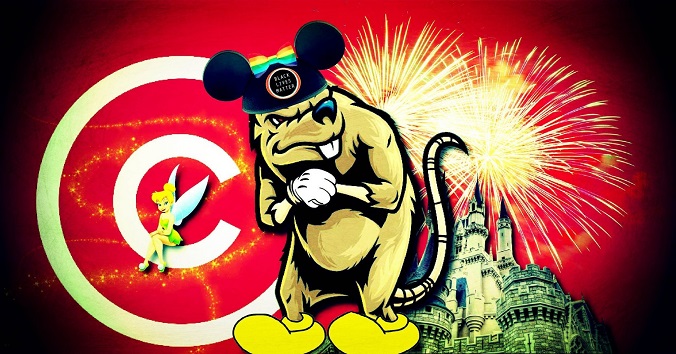
By E.C. Knight — Revolver May 21, 2022
“Disney makes its money on Middle Americans who go to their theme parks, who buy their content and those people should know this corporation hates you,” the Manhattan Institute’s Christopher Rufo told Tucker Carlson recently. “It hates your culture, and it hates the color of your skin.”
Tucker Carlson & @realchrisrufo Discussing Disney's Embrace Of Wokeness & Documents Obtained By Chris Rufo Showing Disney's Anti-American & Anti-White Training Sessions For Employees
Chris: "This corporation hates you, it hates your culture, and it hates the color of your skin." pic.twitter.com/fYRRT2hxE9
— The Columbia Bugle 🇺🇸 (@ColumbiaBugle) May 8, 2021
Disney laid off tens of thousands of workers due to the COVID-19 pandemic. As Rufo’s reporting exposed, despite those financial headwinds, the company still found a way to roll out a corporate diversity, inclusion, and equity program (commonly known by the acronym DEI, but deserving of the Freudian descriptor DIE, the fate reserved for the based in these programs, and straight white males in particular) featuring a Two Minutes Hate against white people and other race-and-sex-shaming content.
Disney’s new DIE program is not the first time the House of Mouse violated Middle America’s conscience. In 1997, the Southern Baptist Convention, the largest Protestant Christian denomination in the United States, called for a boycott of Disney. At the time, CNN reported the Convention’s objections “to Disney’s policy of giving health benefits to same-sex partners of employees, ‘Gay Days’ at theme parks, and the release by Disney and its subsidiaries of controversial books and films like ‘Pulp Fiction’ and ‘Kids.’”
Like many of the cultural right’s other projects over the years, the boycott failed at every level. Thankfully, to use Benjamin Franklin’s words, “God governs in the affairs of men.” Providentially, a GOP-controlled Congress’ previous coddling of Disney presents America First Republicans with a timely opportunity.
Mickey Mouse Goes to Washington
What comes to mind when you see the term “copyright law”? Maybe the blue FBI warning screen accompanying an old VHS cassette or perhaps the ill-fated file sharing service Napster and its similarly-doomed cousin Grokster. Probably not a cultural battlefield.
Copyright law predates the Founding. The Constitution grants Congress the power to “promote the Progress of Science”— i.e., knowledge — by giving authors “exclusive rights” with respect to their protected content, including articles, books, and music. Subject to the fair use defense, modern copyright law gives the copyright holder the exclusive right to reproduce, make derivative works of, and publicly perform the copyrighted content. Once copyright expires, the work passes into the public domain where the public can copy at will.
As the year 2000 approached, Disney had a problem. Copyrights on some of the company’s earliest cartoons, including “Steamboat Willie,” were set to expire soon. As one 1998 report put it, “[w]ithout copyright term extension, the company faces the potential nightmare of seeing its greatest treasures pass from corporate possession into the public domain.” Americans would be free to reproduce Disney’s public domain works, and even make new stories derived out of that content, without worrying about getting sued for copyright infringement. With “billions of dollars in revenue” at stake the report adds, Mickey Mouse went to Washington.
The story of how the Sonny Bono Copyright Extension Act, known within the copyright bar as the Mickey Mouse Protection Act, came to be is pure Swamp. In 1998, Disney Chairman Michael Eisner descended on Trent Lott’s office to ask the Senate Majority Leader for help. “He was very much interested in seeing the copyright bill,” Lott said at the time. As Congressional Quarterly reported, “[b]efore he left the spacious offices of the majority leader at the U.S. Capitol on June 9, Eisner was assured that his company’s pet bill would get the help it needed.”
In addition to Eisner’s visit, the company donated money to key committee leaders, including Republican Congressman Howard Coble of North Carolina, who was then the chairman of the House Judiciary Subcommittee on Arts and Intellectual Property. Disney also “paid $2,700” to host House Speaker Newt Gingrich and his wife “for three days at Disney Institute, the company’s educational facility in Orlando.”
When it was all over, Mickey Mouse had his way with the Republican-controlled Congress. With unanimous consent in the Senate and a voice vote in the House, Congress enacted the extension, tacking an additional twenty years onto existing copyright terms.
MAGA to Disney: Take a Hike
Fast forward to today. The extension Disney toiled for on Capitol Hill in 1998 is about to run out. As early as 2024, key Disney cartoons will pass into the public domain. When the company came to Congress in 1998, it struck a decidedly neutral tone, however false those pretenses might have been at the time.
“Mickey Mouse is not a Republican or a Democrat,” a former Disney lobbyist once said. What Rufo’s reporting on Disney’s DIE program shows is that, if that were ever true in the first place, it is no longer the case. Now Mickey is a cartoon Gramsci and Adorno, an open critical theorist. MAGA Republicans must resist Disney’s inevitable call to further extend its copyright control over this entertainment from a bygone America.
Such opposition will no doubt roil Disney. Good. Disney is ashamed of much of this content anyway. The company now adorns old movies with warnings about “negative depictions and/or mistreatment of people or cultures.” Disney moralizes its audience in these warnings, informing them that “[t]hese stereotypes were wrong then and are wrong now.” Wait a second. What’s this about moral truth for all time? It’s evidence of what Paul Gottfried has observed about the left in general: the woke aren’t “relativist” in any meaningful sense, rather they are about the business of tearing down anyone and anything that gets in their way.
Disney wants us to “learn from” this old content and “spark conversation to create a more inclusive future together.” If Disney wants “conversation,” there is no better way to do that than to get these works into the public domain, so Americans can freely engage with, modify, and improve upon them.
As with its DIE program, Disney is not really interested in conversation so much as it is controlling the terms of debate. The company used copyright law to bankrupt a service called VidAngel, which allowed families to stream censored, curated versions of Disney content. For its part, the useless Beltway Right, in the form of the American Conservative Union, lent its support of Disney, urging in a blog post now removed from ACU’s site, that the streaming service “operates in violation of the Ten Commandments: Thou Shalt Not Steal.”
One can already hear the handwringing over not giving Disney what it wants. For its part, the modern iteration of the Southern Baptist Convention is unlikely to pose any opposition to Disney’s woke agenda. Nowadays, Southern Baptist Convention President JD Greear says “God has not called us to save America.” (Let not your heart be troubled, Pastor Greear, who closed his church’s doors during the COVID-19 pandemic, apparently did hear the Lord calling him to encourage his flock to take to the streets in the aftermath of George Floyd’s death last summer.)
To self-identified evangelical and Never Trump conservative David French, Disney’s Marvel franchise, especially Avengers: Endgame, is not just entertainment, the films are one of the things French loves most about America.
Disney, like community, ceased to exist a very very long time ago — before most of us were born. It has long been a holding company run by bankers (with a capital w). I’ve never paid disney a single penny and I never will, but then I’ve not watched any of their trash later than the 80s, when it ceased to be a production company. Before that, it made some good animation (but still trash live action), after that everything it stamps with its “I didn’t make this” logo is pure 100% unadulterated trash. They don’t even have an animation department any more. Now they make movies about people eating each other, sexualize all their female staff and “characters”, and generally nauseate at every turn. They’re worse than netscum, who also never make anything. They just buy things and then tell you to die if you don’t pay them for their greatness. Most of america thinks disney made all the ghibli movies.
Disney had to go woke lest anyone point out that Mickey is the cartoon version of Al Jolson in blackface. I’m sure you agree, “Black Mice Matters!”…Really? Get Woke Go Broke!!!
Don’t you know? Diversity, Equity, Inclusion are simply code words for Nonwhite Supremacy. Supplant/diminish whites via Jewish linguistic legerdemain.
That’s what its all about. That can only be the ultimate outcome of these policies & ideas. Its not about living in or sustaining some ‘multiracial equitable pluralistic society’, but about conclusively disempowering/liquidating whites.
http://theunhivedmind.com/UHM/walt-disneys-war-with-hollywoods-jews/
“Pure swamp”, but he means pure Third World Semitic relations.
Way back in my early public school days they would have a movie night. The school gymnasium was used as the cinema and Disney was often featured. When you’re in Grade 2, ‘Snow White and the Seven Dwarfs’ was a magical experience. The music was also stellar. ‘Someday My Prince Will Come’ even became a ‘standard’ amongst jazz musicians. I have an old ‘fakebook’ with a chart of that song which was to be interpreted in an up-tempo, swinging, jazz waltz, style.
The Chick Corea Akoustic Band just might have ‘said’ it best.
https://youtu.be/H4G2sWSJtN0
The people behind all the shenanigans should be stood up against a wall and be shot at dawn, buried by lunch and forgotten by dinner.
The Downfall of America will continue unless this Marxist communist agenda is called out and stopped.
Good builds things, Evil doesn’t build it seeks to destroy. These people that call for the over throw of America should be sent to China for a week and see how far they will get. That is one thing I like about China they will not allow it’s culture to be torn down and fucked up.
@ O
Writing songs for children takes a particular skill. Kids are a tough audience. They’re not going to fake it, if they don’t like the tune.
I’ve beheld many a-time, though, how squabbling or otherwise occupied children, can be immediately carried away into enchantment land by melodious song, put aside their activities and actually listen and/or wobbly dance. I’ve noticed this, with the songs “Puff The Magic Dragon” and “The Lion Sleeps Tonight” in particular and during the especially fine vocal performance by Baloo on “I Wan’na Be Like You” which seems to have an invigorating energy impact on children.
The English folk musician, Ralph McTell (of the “Streets Of London” fame) wrote a series of wonderful record-albums for children; “Tickle On The Tum” and “Alphabet Zoo” among others.
Another beautiful song for young hearts is Eleanor Farjeon and Cat Steven’s “Morning Has Broken” which we all used to sing together as a class at primary school.
Whoops! It wasn’t Baloo, was it? It was King Louey. Just rap me across the knuckles.
@andyay
RRRRRRAP!!!
Jungle Book? All good fun. I had that LP is well. “I am the king of the swingers, the jungle VIP!!” Priceless! : )
We enjoyed a lot of Disney in the early 1970s like The Love Bug, an alive and superior VW Beetle, and Mary Poppins with the anti-gravity umbrella and psychokinesis revealing the true nature of the cosmos, not to mention the chimney-sweeps with their supernatural self-confidence.
My favourite Disney film and still, I think, one of the greatest films I’ve ever seen, is the 1963 version of The Incredible Journey, where a Labrador Retriever, an English Bull Terrier and a Siamese cat, called Tao (if you remember, Lewis) endure a three hundred mile journey across Canada’s forbidding landscapes, during winter and spring, after being accidentally left behind, when their family moves to a new home.
It excites my protective instincts, makes me blubber and has me biting my fingernails, rooting for the three friends, to this very day.
To andyay–I only saw clips from that film; Australia has a hero dog that made a similar journey, put together from sightings and made into a film, and a human version is Ice Cold in Alice.