
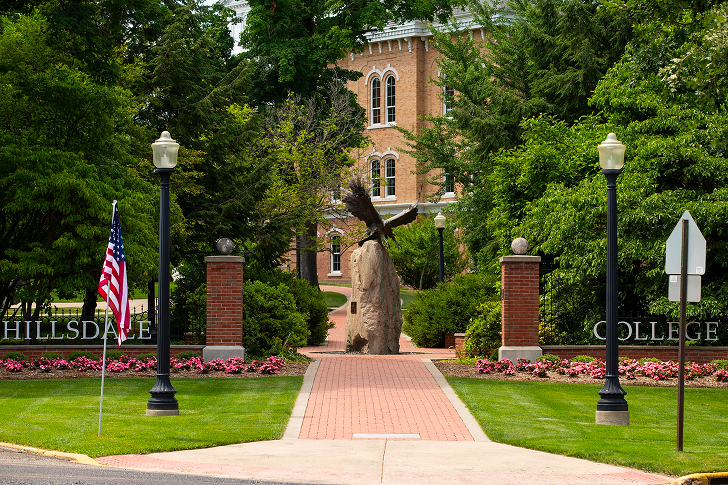
The people at Hillsdale were the wealthiest and most liberal I had ever encountered
Jane Kitchen – YourDestinationNow.com Feb 1, 2022
My family is liberal and not at all religious. Depending on where you grew up, that fact can either be a non-event or a defining part of who you are. In Queen Creek, Arizona, it meant everything.
I was regularly taunted by kids in my class who said that non-believers like me were going straight to hell. My mom took our Obama-Biden campaign sticker off our car after the second time it got keyed and I remember hearing the n-word in elementary school after Obama’s election. In sixth grade, I learned that a friend’s mom wouldn’t let her play with me if she knew I didn’t go to her church so I hid defining characteristics about myself—my three sisters and I had only ever been to church for my Catholic aunt’s wedding—in order to not be completely lonely.
I couldn’t wait to get out. I dreamed of going to Harvard, but was enamored with all of the old, storied New England schools. I loved watching “The Daily Show” with Jon Stewart and reading The Atlantic. I fantasized about finally feeling like I belonged.
So I worked hard in school. I have a single mom and we don’t have a lot of money, so I knew that I would have to score a near-full scholarship.
When I graduated high school at 16, my mom didn’t want to send me so far away so young. I enrolled in my local school, Arizona State University, and we both agreed that I could transfer out after my freshman year.
I arrived on Bryn Mawr’s campus, a Seven Sisters school in Pennsylvania, in the Fall of 2019. I was overjoyed. The campus was gorgeous, and, to this day, it is probably the most beautiful place I’ve ever seen in real life. There were gothic towers and acres of manicured lawns. I was eager to join the other nerdy girls and to find friends I’d have for life.
I’d gone to underfunded, overcrowded public schools my whole life and this was my first experience with small classes and teachers who seemed to love teaching. I took a poetry class where the professor would sing folk songs to us in the hallway as we made our way into class. I learned to write short stories from an Italian instructor who compared writing to preparing homemade pasta. I had been nervous about not being able to keep up academically, but the calculus class I took that first year was easier than the one at ASU.
Socially, it wasn’t entirely what I expected. The people at Bryn Mawr were the wealthiest and most liberal I had ever encountered. During my first week on campus, a girl I met suggested over dinner that 9/11 was justified because the United States had meddled in Middle East politics. She went on to say that the 9/11 memorial should be changed so as to show more respect to Muslims. One of the girls in my hall casually mentioned that Michelle Obama had been in a spin class she had taken in the Hamptons that summer. At first, I thought she was kidding.
I joined a sketch comedy group, which often started meetings by asking members to answer a question. One day, the question was “How is your semester going?” A few people answered directly, and then one girl said “I’m having a great semester, but I totally acknowledge that some students, especially BIPOC students, face a lot of challenges on campus.” Then, every person after her prefaced their answer by saying that students who aren’t white were probably having a worse semester than them.
I didn’t sit around with my friends all night arguing about big questions like I thought I would. It was assumed that we all agreed on the answers. But I made friends, and I loved my classes. I went to parties at nearby colleges, and I was making plans to study abroad in Ireland, which, as someone who had only left my home state twice, was a huge deal for me.
That was supposed to be in the Fall of 2020, but of course it never happened. I remember talking about the coronavirus on the way home from a party with my friend, a self-professed germaphobe, in January of 2020. She asked if I thought we should be worried. I told her that as a campus we should be more worried about binge drinking, and we both laughed. I thought that would be the end of it. Weeks later, Bryn Mawr announced that my spring semester would be held online.
The next few months were the worst of my life.
While many of my classmates retreated to their big houses on the East Coast or their family’s second homes, I moved home to our apartment in Tempe. There were two bedrooms between the five of us; myself, my mom, and my three younger sisters. At the time, I didn’t even have a desk where I could do my schoolwork and, regardless, I couldn’t escape the distraction of my younger siblings. Their schools were closed, too.
There was no library or coffee shop open to decamp to, and the internet in our building was shaky. But the poor connection was not my biggest problem. It was finding the motivation to attend online class as I watched everything I’d worked for evaporate.
Bryn Mawr’s Covid safety precautions for Fall 2020 were announced in July. They included, but were not limited to, isolating for 10 days prior to returning to campus and quarantining for two weeks upon arrival, living alone in a single dorm room, canceling all sporting events, weekly PCR testing, eating cafeteria take-out in our dorms, and wearing masks at all times, indoors and out. The masks could only be taken off with the door closed in our dorm room, or “outside in an area where you will not encounter others.”
If you did test positive, you were even further isolated to a dorm at the edge of campus, and food would be left at a drop-off point. I wanted to be at school, but why would I spend my days 1,600 miles away from my family, with no clubs or activities, eating alone in my dorm room, avoiding all social interaction?
So I stayed home for the entirety of my junior year, except for a trip back to campus to empty my room, and put my things—about $300 worth of clothes, bedding, and notebooks—in a storage unit nearby. I hoped I’d be back on campus soon. By the time I went to retrieve my things, the bill for the storage unit totaled well over $1,200.
Those two semesters at home hadn’t been kind to me. I didn’t really keep in touch with my Bryn Mawr friends; gazing at their mansions through a glitchy Zoom made me feel like an outsider. When we did talk, they obsessed over how scared they were of the virus and how many precautions they were taking, as though it was some kind of competition. Instead of sharing my thoughts and experiences, I stayed silent because I feared their criticism and eventually dropped off. I started sleeping a lot, but only during the day. I became scared of the dark. I lost my appetite, and 20 pounds along with it. There was nothing left to look forward to.
I stopped logging on to school, and my As and Bs turned to Fs. Ultimately, I decided to withdraw.
The stakes of leaving were high. I had to walk away from my $75,000 scholarship, my friends—everything. After a few weeks of being overcome with uncertainty, I started looking for schools that were more aligned with my values.
I quickly discovered that almost every school that was operating even remotely normally was overtly religious. That was really hard for me to wrap my brain around given I had a somewhat fixed view of conservatives being rigid and intolerant. Yet, here I was, confronted with the fact that these religious institutions were, in practice, far more aligned with my values like individual liberty, critical inquiry, and diversity of thought than the place that explicitly claimed to be those things.
In my admissions interview for Hillsdale, a small school of less than 1,500 students, founded by Baptists in Michigan, I praised Christopher Hitchens—a staunch and unapologetic atheist—as one of my intellectual heroes. I disclosed that I was not religious. I debated with my interviewer about whether math was invented or discovered.
And they wanted me anyway. When I received that acceptance letter in November for the Spring 2022 semester, I cried.
I’ve been at Hillsdale for three weeks, and life here is blissfully normal. I have sorority sisters. We get together and study and play board games. The student union and dining hall are packed. No one asks anyone else’s vaccine status. There are no mask mandates, and no mandatory Covid testing. You’ll see an occasional student in a mask but no one thinks anything of it.
Students and staff I’ve encountered disagree on the utility of masks and the danger of Covid, but it’s rarely the focus of conversation and certainly not the organizing principle of anyone’s life. It feels like someone finally turned off the fire alarm that had been blaring for nearly two years.
I went to office hours—in person—the other day for one of my new classes, a required course about classic literature and I got into an interesting debate with a professor. Upon sharing an idea that directly refuted his interpretation of a line from Genesis, which I had never read before, he said, “That’s a great point. Why didn’t you share that in class?” “I didn’t want to be argumentative,” I told him. “Be argumentative,” he said emphatically.
Of course, there’s a serious social learning curve. I curse a lot, my classmates, generally, don’t. I get a lot of invitations to church services and Bible study, which I politely turn down. There is a distinct lack of PDA on campus. But I do not feel judged for thinking differently.
Someone on Twitter cited my migration to Hillsdale as an example of following an ideology to my own peril. I think just the opposite happened; I rejected an ideology and it set me free. When I stopped being scared to say what I really thought and surrounded myself with people who put their principles into practice, I was able to begin really thinking for myself.
There’s an alternate universe where Covid doesn’t exist, where I stay at Bryn Mawr and am never forced to learn these lessons or to confront my own limitations. I graduate believing that deep down there was something wrong with me for not seeing the world the way my peers did, and feeling ashamed for not being brave enough to voice my dissent. I am the same fearful girl I was at 10, who pretended to go to church so she could make friends.
My advice to upcoming high school seniors is this: try not to buy into the idea that any prestigious institution or affiliation will determine your future success. Credentials are no longer the proxy for knowledge that they once were; the internet has removed the gatekeepers of even the most specialized information. You don’t have to go to a particular college—or even college at all—to have a meaningful experience. Real growth isn’t about your GPA or the letters after your name; it’s about choosing discomfort and challenge rather than going along.
These past few years have introduced a lot of potential for regret and embarrassment, but instead, I was forced to embody the values I had previously only performed, like honesty and courage. In that respect, I’m glad this all happened. I know what I really believe. And I’m not afraid anymore.
A version of this piece first appeared on Common Sense
THE BBC hid up abuse by Jimmy Saville paul Gambacinni Stephen Fry and Philip Schofield
they also hid up abuse my muslim gangs up north see it here
https://www.youtube.com/watch?v=afJMNPXuZGI
Ahhhhh university, the gateway to superiority and abusing all those ‘below’ you. You can be an ‘expert’ with the masses hanging on your every word. And all that money. What’s not to like? And then ‘covid’ comes along and scuppers it. It turns out that you don’t like being abused, but the current ‘experts’ say you have to be, with the masses hanging on their every word. And they have all that money. What’s not to like?
Lovely story. Just always be true to your self. Most of all…be yourself!
With “educational” institutions shut down we get some advances in science, and thinking in general, like when Cambridge University shut and Isaac Newton pushed on unhindered for two years. The universities are there with(now) all their Jews to kill knowledge. Even without Jews their inertia prevents innovation.
“My family is liberal and not at all religious.”
This is the problem will all often have: viewing the world in “1s” and “0s”. There is a whole spectrum between BLM and bible bashing…
the BBC has always supported perversion that amazing guy tried to take down the pedo statue out front good on him
the BBC should go
I attended one of these ultra-liberal, and ultra-pricey, East Coast, once-upon-a-time-Ivy-League-affiliated colleges in my day. I always had the impression that we students just weren’t very interesting to any of the higher-ups. The leadership was too busy perpetually reseeding the grass on campus (at a cost of US$3 million a shot; probably close to 30 million in today’s money); setting up tents for Dvořák music festivals attended by trustees (now, there’s a word we heard all the time) from the Fifth-Avenue, ladies-who-lunch crowd (incl. Mme Soros); snapping up the latest Nobel-Prize-in-Literature winner to join and pretend to teach for a year (during my time, it was the very frail and wheelchaired Chinua Achebe; a couple times I saw him in the school cafeteria, and that was that).
60% of the students identified as LGBT. Several of the big bosses were African-American (or just African-African) women who insisted on wearing outlandish tribal getups every day. Hanging T-shirts on a clothesline and screaming ‘My Sistah Got Raped!’ was a regular happening. Drug use was persistent (which, from what I understand, was what attracted many of the rich kids – not just local but also many from India, Pakistan, Bangladesh, Argentina…) to enroll in the first place, getting Dad to sign the $26,000 tuition check and then taking courses like Listening to Music, and Movement for Actors 101). Even some of the excellent students would drive up to NYC’s Grand Central station on weekends, pick up some ‘crazy mushrooms’ from a dealer, get back to campus, inject and pass out for 48 hours. Student parties attended by the college President would commonly feature hardcore pornography films projected onto a wall. Upon graduation, many students ended up working as cashiers in a nearby Grand Union supermarket.
What a way to screw up and disorient young people for life, and to make sure that except for drugs and sex, they believe in nothing at all. And this was in the early 1990s! I can’t imagine where things stand today.
The modern confused woman.. laid bare in all her solipsistic glory, it would be tragic if it weren’t so predictable..
I think the intelligent ‘white’ gals are going to have a tough time ‘going forward’, having found much of the current neo-liberal nonsense of great benefit to them materially and quite happy to marginalise and betray their own cultures and anyone the credentialed imbeciles in service to ‘jews’ tell them to, they will of course in due time come into the cross hairs themselves….
most reasonable and intelligent men having been shat on for long enough not to bother too much…
no doubt all part of the white erasure project…
Sounds like Covid was helpful for her to start her wake-up process. However, there are many signs of continued brainwashing from her background. She greatly enjoys the liberties and genuine learning in her new Christian-based college in comparison to the Yuppy, PC, secular one from which the Covid crimes emancipated her, but like 90% of the people these days she never ever really considers the likely source of anything, perhaps still being more afraid of what others may think of her than just following the truth and choosing God no matter where he leads.
@ DAYNE
all ideologies + religions are prisons,
some are real gulags (koran,talmud,
cientology,mormons,jehovas witness,
sects). i as german be glad did not must
live the american way. i would like living
in any tropical suroundings untouched
by modern commerce . but even this
dont exists anymore (Jack Londons world).
did,nt bother reading this tripe, there is NO pandemic, there is NO covid
END the UN
IMHO, Hillsdale (Christian or not) is THE only college I would even consider going to at this point…well, except for Texas A&M, of course (I’m an Aggie mom and mother-in-law…) Like reading their newsletters as well. One of the best arguments ever against CRT was in their newsletter. Oh, and I grew up liberal as well…and then I saw the light in the early 80s.
Good piece from this young lady and I am very happy she started experiencing her awakening. I know Bryn Mawr College well, as I used to shag a couple wealthy girls there back in the day and one of my close cousins went there…and no, she was not one of the girls I had shagged! Bryn Mawr, despite the wealth and prestige, was, and surely remains, an utterly dreadful place if one would like to obtain an education of any actual relevance. The story of the author of this piece rings very true.
A bunch of snooty pampered c*nts there, really, and I would certainly never recommend it to anyone, let alone a girl from the lower working class as it will pollute you with nothing but all the wrong values and ideas. It’s a shame really, because Bryn Mawr College was an excellent institution of higher learning many decades ago before the cancer of liberalism took hold.
My first university was an Ivy League school and the snobbery and elitism made me want to wretch. It would be absolutely unbearable now with unhinged progressivism and deranged liberalsim running so disgustingly rampant. More and more, I see liberalism as a mental illness and progressivism as an enemy of truth and freedom.
All the best to the author of this piece in finding her way.
@kiwi
There is no real “pandemic” but the virus is real but also no big deal. You have to be one somewhat at risk of some more serious symptoms as I was to be able to say that the proof of the pudding is in the eating of it. I personally have found people who say there is no virus as a rather confined lot without access to enough real people in any medial field, or they are just pragmatists thinking that if they deny the existence of the virus and push the authorities to “isolate” and “show” it to them, they will just back off the whole thing. Well it is real and the authorities do not engage us with any facts on anything whatsoever and they do not feel they have to justify anything to us.
Our governments will not back off of their nonsensical Covid emergency conditions to interfere with their totally unnecessary, lethal and forced vaccine programs. restrictions and forced vaccines. All they need to do is to have some hospitalizations and some deaths clearly associated with the virus symptoms, while withholding proper treatment.
I suggest you get out and do some more research or at least ask why the US military in particular just loves some of those saying it in our ranks saying there is no virus. The facts are that they used the SARS-CoV-1 virus as a basis in gain-of-function experiments some 20 years ago to concoct the SARS-CoV-2 (Covid-19) virus. What a better way to get the perps who spread it all around the world off of the hook than to say it does not exists, but we don not say it is a real virus just because it is Yank virus. It is because the plandemic facts are far worse than you think, and you must realize that nothing will be gained with any short circuiting the facts. Unless the perps in the entire top-down order are pinned down with the facts they will just keep using one bioweapon virus after another on us to continue one bioweapon vaccine to break down the immune systems of the more vulnerable. .
In around May or June 2020 I took issue with psychiatrist, Dr. Andrew Kaufman, who advanced the theory of no Covid virus based on his spurious views of some of the shortcuts virologists and microbiologist take with coding and he wrongly held the virus has never been “isolated” to his satisfaction. The implications of his remarks are like your own, in that you discount all of the independent scientists and medical experts on our side who are unbale to ignore any of the facts.
Of course Kaufman never saw my comment but he also never dealt with the age-old method of determining what one viral disease is from another which is still mainly based on distinct symptomatology, and if you and your friends are lucky enough to get it and to get over it, you will know it is real, and you will realize that the US with the cooperation of our governments not only deliberately released the damn thing, but that all of the bastards involved have supressed proper treatment of those with serious symptoms through, which are the various long-known and very effective therapeutics including the HCQ and Ivermectin protocols.
The authorities could never have maintained the pandemic restrictions nor imposed the bioweapon vaccines without both the trackable spread and the same unique tell-tail symptoms. The actual virus was the food to maintain the conformity and cooperation of those in our health-care systems, without which they would have seen the lack of substance there would have been nothing but the media hype and government scare tactics.
@Fred
> There is no real “pandemic” but the virus is real but also no big deal.
LOL. Tell that to the dead.
@ Fred B.
“the age-old method of determining what one viral disease is from another which is still mainly based on distinct symptomology.”
If you could only hear yourself sometimes, “God.”
There is no “age-old” virology. That’s a plain lie. Virology as medical theory is, at best, a 120 year old polemic, originating with Pasteur’s proven data falsifications and perpetuated into our times, by those who’ve been entrained into his lucrative modelling. Penny for a paradigm, please, mister?
Virology will be shown to be one of the greatest errors of conjecture, in the history of western diagnostic medicine.
Why would differences in symptoms infer distinctive viruses, anyway? Who says so? Why should a sneeze and a cough, as opposed to a cough and a sneeze point to a virus at all? What a slovenly logical fallacy that is. Underestimate toxicity, fungi and bacteria at your peril.
Surrogate spook a-spooking.