
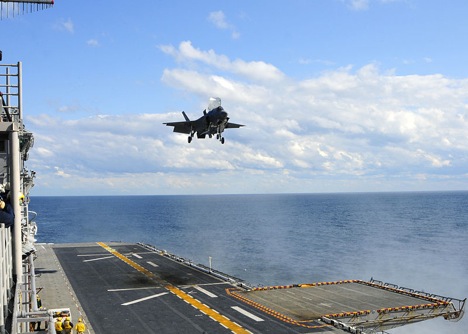
Fears secret technology from America’s most advanced jet could fall into enemy hands
- The USS Carl Vinson on Monday suffered a ‘landing mishap’ with F-35C warplane
- The Navy said the stealth fighter ‘subsequently fell to the water’
- It is packed with the latest technology and advances in radar-deflecting design
- The ship is currently in the South China Sea, taking part in exercises
- The pilot of the F-35 ejected safely and was rescued by helicopter
- Seven were injured: three required evacuation to a medical facility in Manila
Daily Mail Reporter – Jan 25, 2022
The U.S. faces a race to beat China in recovering an F-35 stealth fighter that plunged into the South China Sea on Monday after what the Navy termed a ‘landing mishap’ aboard the USS Carl Vinson.
The pilot was forced to eject and seven military personnel in total were injured.
The $100m warplane, customised for naval operations, plunged overboard, the US 7th Fleet said – making it the second time in three months that an F-35 has been lost overboard.
‘An F-35C Lightning II assigned to Carrier Air Wing (CVW) 2, embarked aboard USS (CVN 70) had a landing mishap and impacted the flight deck and subsequently fell to the water during routine flight operations,’ it said in a statement to US Naval Institute News.
‘Impact to the flight deck was superficial and all equipment for flight operations is operational.’
It added that the aircraft carrier had been able to resume normal flight operations shortly after.
But it leaves the Navy with a complex salvage operation if it is avoid its most sophisticated warplane, crammed with futuristic technology, falling into Chinese hands.
The US Navy did not respond to follow-up questions about whether it had launched a salvage operation.
The F-35C is the only long-range stealth strike fighter designed to operate from aircraft carriers.
It carries an arrestor hook – to help it land on aircraft carriers – and the expanded wingspan needed to be launched by catapult.
As well as its radar-avoiding design, it is crammed with sensors that beam updates directly to the pilot’s helmet.
Last year, Britain appealed to the US for help in finding an F-35B Lightning II that toppled from HMS Queen Elizabeth into the Mediterranean during a failed takeoff.
London asked for help amid fears that Russia would try to salvage the jet and copy the technology.
It was retrieved last month during a secret operation.
The US Navy jet was part of a deployment designed to bolster American presence near Taiwan after China had buzzed the island’s airspace.
A Navy statement said the incident happened during ‘routine flight operations’ in the South China Sea.
‘The pilot safely ejected from the aircraft and was recovered via U.S. military helicopter,’ it said.
‘The pilot is in stable condition. There were seven total sailors injured.’
The statement said three of personnel required evacuation to a medical facility in Manila and four were treated by on-board the carrier and released.
It said all the personnel evacuated were assessed as being in stable condition.
The Navy said the cause of the ‘inflight mishap’ on the nuclear-powered carrier was under investigation.
‘The status of the aircraft is currently under investigation as are the factors involved in the mishap,’ Brenda Way, a spokesperson for the U.S. Pacific Fleet, told The War Zone.
China would like that F-35, not because they want to know how it works but because they want to know why it doesn’t.
I wouldnt worry too much about these falling into chinese hands!! They probably own the patents on most of the tech already!!
I would not copy the technology unless I wanted to keep losing them overboard.
I call BS on this Daily Mail report. The US Navy knows exactly where the plane fell into the sea. The typical compliment of the US Navy air craft carrier will include a nuclear submarine. The drowned plane will be guarded day and night, above and below water and satellite coverage over a wide area. Neither China nor Russia will be interested to steal that plane. Underwater salvage work is tricky and almost impossible to be done successfully in ‘stealth or covert’ mode without Umrica knowing it.
I think, Umrica is just embarrassed that one of their plane suffers technical failure and Umrica just wanted to divert interested parties attention from this failure. Typical of Umrica; they have no honor and no moral values left in them.
Pathetic editors of a large newspaper. “It’s location” on first display is incorrect. They meant “its location.”
R.C.
You are so correct about the antiwhite Umerican US gov. No honor or moral values left.
Tiedättekö että juutalaiset kabbalistit tietävät ettei maa ole mikään pallo! Vieläkin moni uskoo maapallo valheeseen!
https://ifers.123.st/
Kunnon sivusto ei kontrolloitu oppositio niinkuin lähes kaikki muut!
rothschilds israeli spies surely already
gave the patents to the chinese since
they want the chinese as winner in
coming escalation . rothschild has
many investments in china since
decades .
china saved an antiaircraft missile, big shoutout to affirmative action pilot, send her a big bouquet of roses with dildo packed inside.
she and the plane deserve each other.