
One blue sky above us,
One ocean lapping all our shores,
One earth so green and round,
Who could ask for more? – Pete Seeger
Arthur Firstenberg – Cell Phone Task Force Jan 12, 2022
In 2018, on land and in space, preparations to deploy millions of antennas were very publicly being made and advertised, for “5G,” “Smart Cities,” and the “Internet of Things.” At the same time, and without any publicity, governments, research laboratories, and commercial and military interests were collaborating on plans to create “Smart Oceans” and the “Internet of Underwater Things” (IoUT). They did not consult the fishes, whales, dolphins, octopuses, and other inhabitants of those depths.
In the United States, the National Science Foundation funded what it called the SEANet Project. The goal was to enable broadband wireless communication from any point on or in the oceans to anywhere else on the planet or in space. The Internet of Underwater Things is being designed to enable all the same communication capabilities that are being provided on land, including “real-time video streaming from underwater.”
In the last three years, a flood of papers have been published by scientists and engineers in the U.S., China, Pakistan, Qatar, South Korea, Spain, Australia, Greece, Italy, France, Morocco, Saudi Arabia, and elsewhere. In 2020, the IEEE Internet of Things Journal published a Special Issue on Internet of Things for Smart Ocean. In 2019, the journal Sensors published a Special Issue on Smart Ocean: Emerging Research Advances, Prospects and Challenges, and the same journal is now publishing another Special Issue on Internet of Underwater Things.
Some of the activities that supposedly “need” this technology in the oceans are:
- climate change monitoring
- pollution control and tracking
- disaster prevention including tsunami warning systems
- ocean exploration
- fishing and aquaculture
- coral reef harvesting
- tectonic plate monitoring
- navigation
- global oceanic trade
- oil and gas exploration and production
- military communication and surveillance
The infrastructure that is beginning to be deployed, throughout the oceans, includes:
- sensors and antennas (“nodes”) on the ocean floor
- nodes at different depths
- surface nodes
- relay antennas at different depths to transmit data vertically from the ocean floor to the ocean surface, and horizontally between nodes
- Autonomous Underwater Vehicles (AUVs)
- Autonomous Surface Vehicles (ASVs)
- underwater robots
- wireless surface buoys
- smart boats and ships
- smart submarines
- smart shores
Communication being more difficult to accomplish underwater than through the air, and more subject to interference, several different types of communication media are being used in the oceans to send data at different speeds and over different distances. Acoustic waves, radio waves, lasers, LED light, and magnetic induction are all being used to flood the oceans with data. An underwater GPS system is being developed. Most of these media work only for short- to medium-range communication. Long-range communication relies on acoustic waves, and is similar to the technology used in ocean sonar.
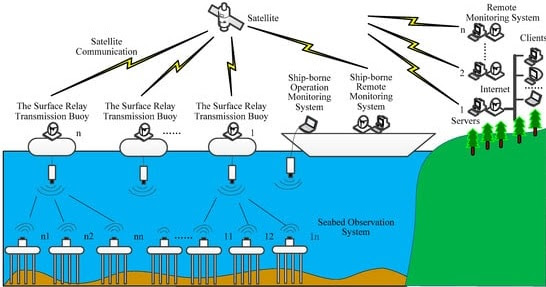
These technologies are already being marketed commercially and installed in the world’s oceans today. At the 2022 Oceanology International conference, which will be held in London from March 15 to 17, dozens of these companies will be exhibiting their products.
WaterLinked sells underwater sensor technology through distributors around the world for use in aquaculture, and in underwater navigation. “Our Wireless Sense™ technology enables reliable wireless communication and innovative subsea sensor solutions,” says their website.
EvoLogics sells underwater acoustic modems, both mid-range and long-range, that “provide full-duplex digital communication.”
SonarDyne International sells underwater acoustic modems to the oil and gas industry and to governments and navies.
Voyis sells short- and long-range underwater laser scanners.
GeoSpectrum sells “integrated, end-to-end acoustic systems” for oil and gas exploration and for military purposes.
Dynautics sells autonomous underwater vehicles (AUVs).
Seaber sells “off-the-shelf micro-AUVs.”
Hydromea markets “the first ever tether-less underwater drone.”
Mediterraneo Señales Maritimas sells “data buoys that integrate sensors through our datalogger so the data can be transmitted to a remote station and displayed on our software.”
3D at Depth, Inc. “provides advanced subsea LIDAR laser systems.”
Teledyne Marine sells Autonomous Underwater Gliders, Autonomous Underwater Vehicles (“unmanned robot submarines”) and “laser systems for both shallow and deep-sea submerged diving.”
“Underwater robots swarm the ocean,” says a page on the website of the Woods Hole Oceanographic Institute. The Institute has developed an acoustic-based navigation system that is enabling large numbers of underwater robots to work together. “Instead of using just a single, larger and more expensive underwater robot to cover an area of the ocean, we want to have hundreds or even thousands of smaller, lower-cost robots that can all work in sync,” says their webpage.
Ocean protection organizations have long been campaigning against noise pollution in the oceans, but they are only beginning to be aware of this new type of assault, which has the potential to dwarf all previous noise assaults in its scope and magnitude. For example, one of the campaigns of the environmental organization, Sea Shepherd, is “Silencing the Deafening Roar of Ocean Noise Pollution.” They write:
“In 1953, Jacques Cousteau published a classic memoir on his early days of underwater exploration. He titled this book The Silent World. Today, human activities make a mockery of that title. Over the past several decades, marine noise pollution has grown at an exponential rate. Noise from vessel traffic is doubling every decade. Pile-driving, dredging, sonar, and seismic exploration for oil and gas add to the cacophony. For marine wildlife, and especially for acoustically-sensitive cetaceans, this anthropogenic racket poses a grave and growing threat. Ocean noise pollution causes severe stress, behavioral changes, masking (i.e., difficulty perceiving important natural sounds), strandings, and noise-induced loss of hearing sensitivity.”
To this mix is now being added the Internet of Underwater Things, which is beginning to flood the oceans with sound in order to connect them to the Internet. And this sound will be pulse-modulated with the same harmful frequencies as radio waves in order to carry the same data. And to communicate over large distances, some of the underwater acoustic modems that are being marketed are capable of producing sound as loud as 202 decibels. That is equivalent to 139 decibels in air. It is as loud as a jet engine at a distance of 100 feet, and is above the threshold for pain in humans. These modems blast modulated sound at frequencies ranging from 7 kHz to 170 kHz, encompassing almost the entire hearing range of dolphins, which use sound for hunting and navigating.
The effects of sonar on whales and dolphins have been widely publicized. But the effects of noise pollution on fish and other denizens of the deep are just as devastating, as Lindy Weilgart details in her 36-page report for OceanCare. She reviews 115 research studies on the effects of noise on 66 species of fish and 36 species of invertebrates.
“Most fish and invertebrates use sound for vital life functions,” she writes. “Noise impacts on development include body malformations, higher egg or immature mortality, developmental delays, delays in metamorphosing and settling, and slower growth rates… Anatomical impacts from noise involve massive internal injuries, cellular damage to statocysts and neurons, causing disorientation and even death, and hearing loss… Behaviorally, animals showed alarm responses, increased aggression, hiding, and flight reactions; and decreased anti-predator defense, nest digging, nest care, courtship calls, spawning, egg clutches, and feeding… Some commercial catches dropped by up to 80% due to noise, with larger fish leaving the area.”
If the new assault continues, it will provide the last nails in the coffins of our oceans, and — since the oceans are the source of all life — of our planet. Already in 1970, just 17 years after he published The Silent World, Jacques Cousteau, returning from 3½ years of exploration in which he traveled 155,000 miles, told the world: “The oceans are dying. The pollution is general.”
“People don’t realize that all pollution goes to the seas,” said Cousteau. “The earth is less polluted. It is washed by the rain which carries everything into the oceans where life has diminished by 40 per cent in 20 years. Fish disappear. Flora too.” And what was not being poisoned was being mined for food as though ocean life was an inexhaustible resource. “The oceans are being scraped,” he said. “Eggs and larvae are disappearing. In the past, the sea renewed itself. It was a complete cycle. But this balance was upset with the appearance of industrial civilization. Shrimps are being chased from their holes by electric shocks. Lobsters are being sought in impossible places. Coral itself is disappearing. Even in the Indian Ocean, which is little traveled.”
Life in the oceans today is hanging by a thread. If the rate of population declines continues, there will be no almost fish left in the oceans by 2048.[1] The oceans are absorbing 24 million tons of carbon dioxide every day, are 26% more acidic than before we began burning fossil fuels,[2] and have absorbed 93% of the heat generated by greenhouse gases since the 1970s.[3] The damage already done to coral reefs by acidification, rising temperatures, and bottom trawling would take 100,000 years for nature to repair.[4] Diatoms — a type of algae at the base of the ocean’s food chain that is also the source of a third of the world’s oxygen production — have been declining by more than 1% per year for two decades.[5] Populations of krill — the small shrimplike crustaceans that make up a large portion of the diet of many species of whales, penguins and seals — have declined by 80% since the 1970s.[6] And the deepest layers of the oceans are severely depleted of oxygen — so much so that deep-diving fish no longer dive deep but remain near the surface in order to breathe. And populations of fishes that live in the deep sea are drastically declining. Warming oceans can no longer hold as much oxygen, and it is the deepest waters that are depleted of oxygen first.[7][8][9][10] Large numbers of bottom-dwelling crabs have suffocated off the coast of Oregon.[11] More than a thousand manatees died of starvation in 2021 off the coast of Florida because the seagrass they eat has been killed by pollution.[12] And there is so much plastic throughout the oceans[13] that sardines sold in an Australian fish market contain 3 milligrams of plastic in every gram of their tissue.[14]
Although many are the assaults on the oceans, and on the Earth, the single most urgent assault, which is destroying the planet the quickest, is wireless technology. It is the most destructive itself, and it speeds up and coordinates all the other assaults. And driving all of wireless technology, including wireless technology on land, in space, and in the oceans, is the cell phone. All of wireless technology, from 2G to 5G to the Internet of Things to the Internet of Underwater Things, requires everyone to be holding a cell phone in their hands. It is the director, it is the target, and without it, the present rate of destruction could not continue.
As Hillel said two thousand years ago, “If not now, when? If not me, who?”
[1] Boris Worm et al. Impacts of Biodiversity Loss on Ocean Ecosystem Services. Science 314: 787-790 (2006).
[2] Oceaneos. Ocean Acidification.
[3] D. Laffoley and J. M. Baxter. Explaining ocean warming: Causes, scale, effects and consequences. International Union for the Conservation of Nature. Sept. 2016.
[4] Charles Clover. The End of the Line: How Overfishing is Changing the World and What We Eat. New Press, 2006, p. 67.
[5] Cecile S. Rousseaux and Watson W. Gregg. Recent decadal trends in global phytoplankton composition. Global Biogeochemical Cycles 29: 1674-1688 (2015).
[6] Matthew Taylor. Decline in krill threatens Antarctic wildlife, from whales to penguins. The Guardian, Feb. 14, 2018.
[7] Craig Welch. Oceans Are Losing Oxygen—and Becoming More Hostile to Life. National Geographic, March 12, 2015.
[8] Laura Poppick. The Ocean Is Running out of Breath, Scientists Warn. Scientific American, Feb. 25, 2019.
[9] Kirsten Isensee. The Ocean Is Losing Its Breath. Ocean and Climate Platform, 2018.
[10] International Union for the Conservation of Nature. Ocean Deoxygenation.
[11] Bradley W. Parks. Low oxygen levels off Northwest coast raise fears of marine “dead zones.” Oregon Public Broadcasting, July 22, 2021.
[12] Corryn Wetzel. Florida Wildlife Officials Move to Feed Starving Manatees in Experimental Conservation Approach. Smithsonian, Dec. 8, 2021.
[13] Captain Charles Moore. Plastic Ocean. Avery, NY 2011.
[14] Francisca Ribeiro et al. Quantitative Analysis of Selected Plastics in High-Commercial-Value Australian Seafood by Pyrolysis Gas Chromatography Mass Spectrometry. Environmental Science and Technology 54: 9408-9417 (2020)
—
Arthur Firstenberg
Author, The Invisible Rainbow: A History of Electricity and Life
Administrator, International Appeal to Stop 5G on Earth and in Space
Caretaker, ECHOEarth.org (End Cellphones Here On Earth)
P.O. Box 6216
Santa Fe, NM 87502
USA
phone: +1 505-471-0129
arthur@cellphonetaskforce.org
January 12, 2022
More evidence that it’s not “just” Humanity and land animals these (((bastards))) want to exterminate, but ALL LIFE.
Even their claim to want a world of their own is demonstrated to be just another LIE.
Their “g-d” (=NOT God, or ANTI-God, = the devil) HATES the real God, and these lunatics think they can somehow “defeat” God if they can destroy the whole of Creation.
What they’re too stupid to understand is that while Creation takes Genius far beyond Human understanding, any IDIOT (like them) can knock something down.
We’re in the final war between good and evil, and we MUST win it if life on Earth is to survive.
In a recent article about identifying the ‘Anti-Christ’, Bill Gates was forwarded as the most probable candidate. I only read part of the article.
My own view is that Elon Musk is a better candidate, & the tech outlined in this article is right up Musk’s street (pun) with Tesla & his Starlink system which ties everything together. All the systems mentioned could link to Musk’s wider business model.
I believe that at this moment, Musk is the wealthiest sheeple on the planet, and although the markets are in for a rough ride, Musk’s various stocks are almost a safe haven, because he gets grants and his space work is funded by the military… this link to the military could be very important, because if the UK collapses into a dictatorship, as recently forecast, Musk would be in a good position to be appointed leader by the US deep state.
Bezos and Gates are damaged goods IMHO. While I suggest Musk, there’s a good chance that someone relatively unknown sheeple will rise to power, because while history doesn’t repeat itself, it dies rhyme. I see the US in a similar position to per WW2 Germany, so the US is the new Germany, & the UK is the new Japan.
As time moves on, the tricks used, to hide the economic collapse will fade and a huge void will present itself & someone will fill it, just as Hitler did.
We can see the Eastwards advance of NATO as the equivalence to Hitler’s escapades in Europe… & Russia is the new UK, about to resist the evil empire, and China is the new US.
I am not saying it is an exact copy of pre WW2, but it is similar in my opinion, & yes, all the big players are either controlled or have key sheeple around them.
Churchill was overheard one boozy morning, in his Whitehall bunker, and he said something like: “I think all of us (the respective WW2 leaders) are controlled by hidden hands, puppeteers.” I am sure someone knows the exact quote, but is Putin the new Churchill about to thwart the new NAZI empire called NATO? Is this why NATO loves the Nazis in Kiev?
In the book of Revelation it says that God will destroy them that destroy the earth. The oceans and rivers are part of our earth. Judgment is coming and it won’t be fun.
Revelation 11:18 states:
“And the nations were angry, and Thy wrath is come, and the time of the dead that they should be judged, and that Thou should give reward unto Thy servants the prophets, and to the saints, and them that fear Thy name, small and great; and [that Thou] should destroy them which destroy the earth.”
Pay back time:
Revelation 16:3 states:
“And the second angel poured out his vial upon the sea, and it became as the blood of a dead man; and every living soul died in the sea.
4 And the third angel poured out his vial upon the rivers and fountains of waters; and they became blood.
5 And I heard the angel of the waters say, Thou art righteous, O Lord, which art, and wast, and shalt be, because Thou hast judged thus.
6 For they have shed the blood of saints and prophets, and Thou hast given them blood to drink; for they are worthy.”
All their multi million dollar yachts will be going no where, and since they love to drink the blood of babies and children whom they terrorize first, God will give them lots of blood to drink. But they won’t like it. I love God’s judgments because they are always well-deserved.
We will be able to talk to the whales, and see if they have anything to say.
Ok, I declare a conflict of interest: I work for an underwater robotics firm. I’m also ex Mobile technology (stopped at 4G prototypes and got a real job).
But….
1. There is a big push to deploy technology underwater, but only in ‘places of interest’ – i.e. where underwater operations take place (oil rigs, etc). There is no plan to deploy wide Comms across the ocean because there is no benefit/profit in doing this.
2. Microwaves don’t work underwater, so forget about 2G,3G,4G, etc. The Comms links are either ELF or more often now optical.
3. Sonar is actively used but it’s very short range.
Seriously, I can transmit a signal to Pluto easier than I can transmit 100m underwater. The water makes it a naturally inert environment which kills modern signalling very quickly.
Don’t mix your conspiracy theories: there is a lot to worry about, mostly on land, definitely in space and incoming in high altitude aerospace. People mostly don’t give a damn about the ocean: either good or bad.
If you do want something to worry about in the ocean technology area, you need to research what is going on in the defence realm underwater (US, Russia China). This is much more scary, but you won’t find that at the OI show.
the whales are already sick by ships diesel noise
and navy lowsound frequencies adicional they
will get 5G frequencies in their brain like we .
modern technics + industry destryes more+more
balance in nature.
maybe its better we loose 7 billion people .
And then there is this to cover the other areas where there is less interest.
Navy Patents Sound Weapon
Imagine a day when a submarine could blast a target to smithereens using nothing more than acoustic energy. https://www.wired.com/2007/04/navy-patents-ca/
https://www.engadget.com/2007-04-30-navy-patent-reveals-underwater-sound-weapon.html
Coincidentally, Navy tests of this weapons system and others, have correlated to dolphin and whale beachings around the world for decades.