
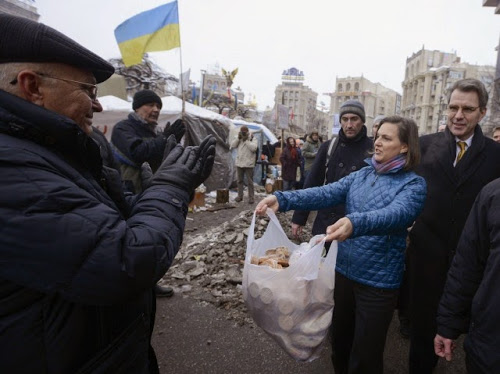
Victoria Nuland handing out cookies to protesters in Kiev.
Ted Galen Carpenter – Responsible Statecraft Dec 28, 2021
At the end of 1991, the Soviet Union dissolved — a surprisingly peaceful end to a brutal empire. Russia, as the principal successor state, sought to join the democratic West, and the United States and its European allies officially welcomed that aspiration. Three decades later, however, the West and Russia are locked in an increasingly acrimonious cold war struggle. It is a tragic development, and one that could escalate into a catastrophic armed conflict. Neither side is blameless for the onset of a new cold war, but there is a substantial difference in the degree of culpability. Provocations by the United States and NATO were more numerous, more egregious, and began earlier.
U.S. and NATO officials, as well as most of the Western news media, contend that Russia is to blame for the current ugly confrontation. They highlight four Kremlin actions that severely spiked East-West tensions. The first episode, according to that version of history, occurred in 2008 when Russian forces invaded Georgia and advanced to the outskirts of the capital, Tbilisi. A second, even more serious offense, took place in 2014 when Russia seized Crimea from Ukraine and annexed that strategic peninsula after holding a bogus referendum. The third incident followed just months later when Russia orchestrated a separatist insurgency in Ukraine’s eastern Donbas region and then sent in troops to assist the rebellion. During the years that followed, Vladimir Putin’s government exacerbated the emerging cold war by interfering in the internal political affairs of numerous Western countries, especially the United States.
Those allegations contain some truth, but all of them conveniently omit crucial context. For example, the 2008 invasion of Georgia occurred only after the Georgian military fired on Russian peacekeeping troops that had been in the secessionist region of South Ossetia since the early 1990s. Even a European Union investigation concluded that Georgian forces had initiated the fighting. The conflict also occurred in large part because President George W. Bush encouraged Georgia’s president, Mikheil Saakashvili, to believe that the United States and NATO would support his country if it became embroiled in a conflict with Russia.
Putin’s seizure of Crimea was indeed a blatant violation of international law, but it occurred only after the United States and key EU allies had shamelessly assisted demonstrators to overthrow Ukraine’s elected pro-Russia president, Viktor Yanukovych. That thinly disguised coup triggered Russian fears that Ukraine was about to become a forward staging area for NATO military power. Among other worries, the Kremlin suspected that it would lose access to its crucial naval base at Sevastopol on the Crimea peninsula and watch that facility become a hostile NATO base.
The one-sided, self-serving indictments of Russia’s behavior invariably ignore the numerous Western provocations that took place long before Moscow engaged in disruptive measures. Indeed, the deterioration of the West’s relations with post-communist Russia began during Bill Clinton’s administration.
Western provocation number 1: NATO’s first eastward expansion.
In her memoir “Madame Secretary,” former U.S. ambassador to the United Nations and secretary of state Madeleine Albright concedes that Clinton administration officials decided already in 1993 to endorse the wishes of Central and East European countries to join NATO. The Alliance proceeded to add Poland, the Czech Republic, and Hungary in 1998. Albright admitted that Russian President Boris Yeltsin and his associates were extremely unhappy with that development. The Russian reaction was understandable, since the expansion violated informal promises that President George H. W. Bush’s administration had given Moscow when Mikhail Gorbachev had agreed not only to accept a unified Germany but a united Germany in NATO. The implicit quid pro quo was that NATO would not move beyond the eastern border of a united Germany.
Western provocation number 2: NATO’s military intervention in the Balkans.
NATO’s 1995 air war against Bosnian Serbs seeking to secede from the newly minted country of Bosnia-Herzegovina and the imposition of the Dayton Peace Accords greatly annoyed Yeltsin’s government and the Russian people. The Balkans had been a region of considerable religious and strategic interest to Moscow for generations, and it was humiliating for Russians to watch impotently as a U.S.-led alliance dictated outcomes there. The Western powers conducted an even greater provocation four years later when they intervened on behalf of a secessionist insurgency in Serbia’s restless Kosovo province. Detaching that province from Serbia and placing it under U.N. control not only set an unhealthy international precedent, but the move also displayed utter contempt for Russia’s interests and preferences in the Balkans.
The Clinton administration’s decisions to expand NATO and meddle in Bosnia and Kosovo were crucial steps toward creating a new cold war with Russia. Former U.S. Ambassador to the Soviet Union Jack F. Matlock Jr. cites the negative impact that NATO expansion and the U.S.-led military interventions in the Balkans had on Russian attitudes toward the United States and the West: “The effect on Russians’ trust in the United States was devastating. In 1991, polls indicated that about 80 percent of Russian citizens had a favorable view of the United States; in 1999, nearly the same percentage had an unfavorable view.”
Western provocation number 3: NATO’s subsequent waves of expansion.
Not content with how the Clinton administration antagonized Moscow by moving NATO into Central Europe, George W. Bush’s administration pushed the allies to give membership to the rest of the defunct Warsaw Pact and to the three Baltic republics. Admitting the latter in 2004 dramatically escalated the West’s military encroachment. Those three small countries had not only been part of the Soviet Union, they also had spent most of their recent history as part of Czarist Russia’s empire. Russia was still too weak to do more than present feeble diplomatic protests, but the level of anger at the West’s arrogant disregard of Russia’s security interests rose.
Expanding NATO to Russia’s border was not the only provocation. Increasingly, the United States was engaging in “rotational” deployments of its military forces in the new alliance members. Even George Bush’s secretary of defense, Robert Gates, expressed worries that such actions were creating dangerous tensions. Putin’s February 2007 speech to the annual Munich Security Conference made it extremely clear that the Kremlin’s patience with U.S. and NATO arrogance was coming to an end. Bush, tone-deaf as ever, even tried to secure NATO membership for Georgia and Ukraine — a policy that his successors have continued to push, despite resistance from France and Germany.
Western Provocation number 4: treating Russia as an outright enemy in Ukraine and elsewhere.
Western leaders did not take Putin’s warnings seriously enough, however. Instead, the provocations on multiple fronts continued and, in some cases, even accelerated. The United States and key NATO powers bypassed the U.N. Security Council (and a certain Russian veto) in early 2008 to grant Kosovo full independence. Three years later, Barack Obama’s administration misled Russian officials about the purpose of a “humanitarian” U.N. military mission in Libya, convincing Moscow to withhold its veto. The mission promptly turned into a U.S.-led regime-change war to overthrow Libyan leader Muammar Qaddafi. Shortly thereafter, the United States worked with like-minded Middle East powers in a campaign to oust Russia’s client, Bashar al-Assad, in Syria. The egregious U.S.-EU meddling in Ukraine’s domestic politics followed.
It is unfair to judge Russia’s aggressive and destabilizing actions, including the annexation of Crimea, the ongoing military intervention in Syria, continuing support for separatists in eastern Ukraine, and attempted interference in the political affairs of other countries, without acknowledging the multitude of preceding Western abuses. The West, not Russia, is largely responsible for the onset of the new cold war.
“The West” recruited, equipped, funded & sent the Wahhabi mercenaries to Libya & Syria & DESTROYED those countries…Putin, the Syrian army, Iran & the Shia militia saved Syria…& the Christians there & in N. Iraq.
The first example, the claimed 2008 Russian invasion of South Ossetia is a lie. The Russians were peace keepers, and Georgia backed by special forces from the US, UK, Israel and others, were pushed back into Georgia.
This is the problem when fake news creates history, and future analysis is based on these lies. Just the other week we had a story on this site claiming Putin was in Beijing during the South Ossetia fighting. This was a lie. Putin flew to Beijing to confront George Bush, who stood there with his hands shaking, as Putin tore him down.
The entire Western narrative on the current situation is based on lies. I didn’t get passed the first point. Why should I insult myself with crap?
You all need your own personal security system, this is when you decide to stop reading or watching.
The West is a vast financial bubble that is about to burst. It needs war and the looting of other countries to sustain itself. The US dreams of the resources that Russia has. It wants Canada. It is trying – and failing – to push into Africa.
The brained-freak Biden has just promised the Ukrainian leader assistance if Russia attacks them etc.
REMEMBER…BOTH BIDEN AND THE UKRAINIAN LEADER ARE CRYPTO JEWS.
In the case of the Ukrainian leader it is relatively easy to PROVE this fact.
In Bidens case it is a little more tricky…BUT he is a crypto jew without a shadow of a doubt.
So here we have the perfect example of how the jews RUN BOTH SIDES OF A CONFLICT…..
Most people know the utter prick Biden should not be president….it is an offence against COMMONSENSE.
The question remains…is Putin a crypto jew…..the answer seems to be difficult to establish.
You should know that the “Russian” Revolution was actually a Jew Revolution against the Romanov Dynasty and the nation-state of Russia, the purpose of which was to steal the wealth of the Romanovs.
At the time of the abdication, Nicholas II was the richest man on the earth. Jews HATE Russia. WHY?
The destruction of Khazaria is a big reason. All the items presented are rooted in the Jew hatred of Russia and the Jew hatred of Christians anywhere. Nuland is a Jew and is married to a Satanist. The cold war against Russia comes from the Satanic Jews who run America. Look at Biden’s cabinet…….Jews are grossly over-represented. And, yes, the evil and Satanic Nuland is back in the Dept of State. The problem in Ukraine has its origin in the hatred of the Satanic Jew. Each leader of Ukraine since the overthrow of the elected government in 2014, from Yats to the current clown, has been a Jew.
” seizure of Crimea was indeed a blatant violation of international law, ” rubbish. Crimea was never legally given to Ukraine, Kruschev’s parliament was not quorate when he decided to make that gesture. Then on 2014 Crimea voted on secession – with a 90% or so majority in favour – when a coherent Ukraine government hardly existed and the Kiev regime was shelling its own people.
That vote might have been supressed by the Kiev government were it not for the presence of Russian troops in Crimea. However their presence was fully in accord with treaties.
The Russian parliament then considered and accepted the Crimean request to re-join the Russian Federation. A few years later another plebiscite was taken in Crimea which likewise showed a huge majority endorsing the re-union with Russia.
Its called democreacy.
What an absurdly staged photograph of that vile demon at the top; two sniveling treasonous geezers applauding the destruction of their country. And what kind of imbecile with a death wish would take a “cookie” from that satanic sociopath?
Nuland should have been pummeled with rubble, stripped naked, dragged by her ankles up the stairs all the way to the roof of one of those taller buildings in the background, shoved off, then used as a public urinal.