
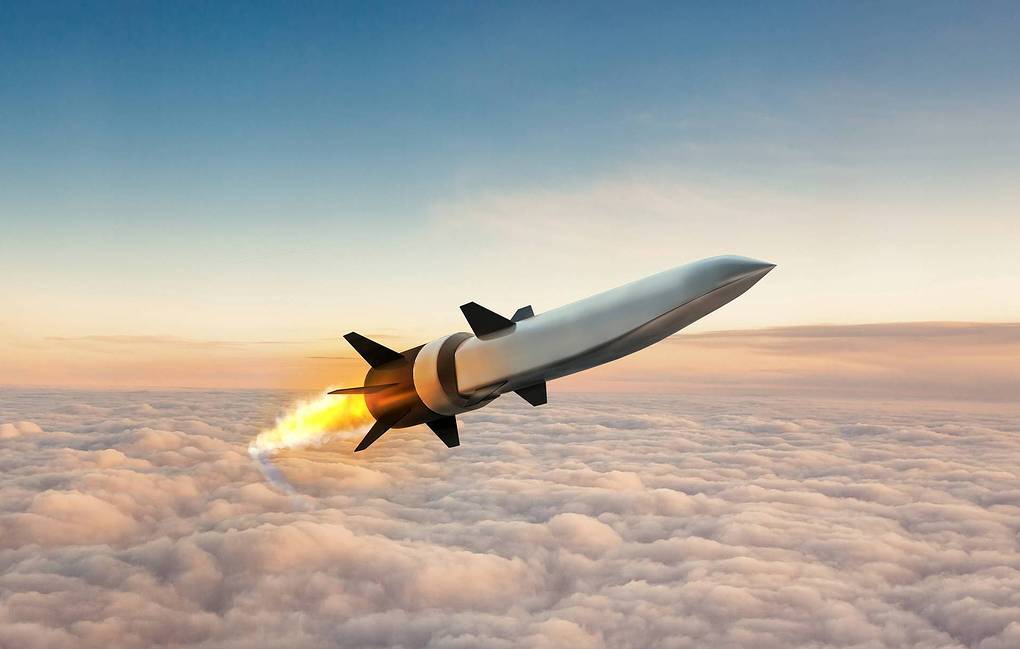
Introduction – Sept 28, 2021
The successful test of this U.S. hypersonic weapon should be a cause for celebration but it’s not. That’s because the weapon was first tested on Monday and it may still be years from being ready to deploy.

A still from a Russian government video shows the Kinzhal hypersonic missile detaching from a MiG-31 aircraft. Some units of the Russian Air Force have already been equipped with hypersonic weapons. Click to enlarge
In contrast Russia already a number of hypersonic weapons. Some are in the final stages of development and some, like the Avangard missile system have already been deployed. In fact the Avangard system was first deployed in December 2019, while the Khinzal air-to-ground hypersonic missile entered service in 2018.
However, Russia isn’t alone in possessing hypersonic weapons. China also has its own hypersonic missiles, like the DF-ZF, which has been operational since 2019.
There is also a stark contrast in the performance of the aforementioned weapons. While the Avangard can reach speeds of Mach 20-27 and the DF-ZF can reach speeds up to Mach 10, Raytheon’s new missile can only manage Mach 5.
In other words the U.S. is falling behind dramatically in the race to develop hypersonic missiles. While they are only one facet of military technology they give Russia and China a crucial edge over America. Ed.
US successfully tests Raytheon hypersonic weapon, Pentagon says
Helen Elfer – The Independent Sept 28, 2021
The United States has successfully tested a Raytheon hypersonic weapon – an air-breathing hypersonic weapon capable of speeds faster than five times the speed of sound, according to an announcement by the Pentagon on Monday.
The mission, which resulted in the first successful test of this type of cruise missile since 2013, was completed by the US Air Force, in partnership with the Defense Advanced Research Projects Agency (DARPA).
The free flight test of the Hypersonic Air-breathing Weapon Concept (HAWC) took place last week, and demonstrated the weapon to have “highly effective” capabilities, said Andrew Knoedler, program manager at DARPA, in a statement.

DF-17 hypersonic glide vehicles on parade in Beijing in 2019. Click to enlarge
Mr Knoedler added: “HAWC’s successful free flight test is the culmination of years of successful government and industry partnership, where a single, purpose-driven team accomplished an extremely challenging goal through intense collaboration.”
He added: “This historic flight would not have been possible without the dedication of industry, U.S. Air Force, and Navy flight test personnel who persevered through the pandemic to make the magic happen.”
The mission aimed to test, among other aspects, safe separation from the launch aircraft, booster ignition and engine ignition. According to a DARPA press release, all primary test objectives were met.
Built by Raytheon Technologies, the HAWC missile’s engine propelled the cruiser at a speed greater than Mach 5 – five times the speed of sound.
The press release detailed: “HAWC vehicle operates best in oxygen-rich atmosphere, where speed and maneuverability make it difficult to detect in a timely way. It could strike targets much more quickly than subsonic missiles and has significant kinetic energy even without high explosives.”
Mr Knoedler added: “The HAWC free flight test was a successful demonstration of the capabilities that will make hypersonic cruise missiles a highly effective tool for our warfighters. This brings us one step closer to transitioning HAWC to a program of record that offers next generation capability to the US military.”
Its just the Zionist Overlords playing chess against themselves…They have no real ‘adversaries’ anymore…After the Zionists-Communists defeated their real enemies in WWII (Nazism) & became the undisputed rulers of the world, they then must fabricate fake enemies like the USSR/Russia/China etc, in accordance with their Hegelian-Marxist dialectic principles, to mask the reality of their global governance & synthesis of the West into Technocommunist nation-states devoid of white gentiles…
But BLM and Antifa have got better weapons in their plastic bottles, so they must rule America.
Thanks for making the gaping gaps in speed. However, I wouldn’t take this claim as gospel. This is rather insulting, so it could be the usual fake news misdirection and I’m sure the Chinese & Russians are skeptical. In fact, I wouldn’t be surprised if the US has similar weapons to the Russians with similar performance.
Well, they say it was a successful test, but I’m inclined to doubt it.
Nico X Do you think that your so called Sionist “Over Lords” (???) control China ??
First Chinese are not White European Judaeo-Christian with # 1 commandment : If someone strike you on the left cheek, offer the right cheek to be stricken…
& BTW all the Chinese persons that I met, do know very well their history of the Opium Wars & funny, they do know who really implemented it & who really then pillaged China … Hmm as Napoleon said .. China is a sleeping Dragon & when she’ll wake the World will shake …
Quand la Chine s’éveillera, le monde tremblera.
Napoléon Bonaparte
lets arm the people of gaza against jew terror attacks
http://www.renegadetribune.com/lets-arm-the-gazans/
@Mr Reynard…I’ve covered this before on here…Jews installed Communism in China in 1945 & surreptitiously govern it to this day. They probably even wrote Mao’s ‘Little Red book’ for him.. Just as there are ‘Russian Jews’ & ‘English Jews’, there are also ‘Chinese Jews’–the Jews migrate to these gentile nations, mate with the host population & then take them over… Just obtain the newest edition published by Ostara publications of Frank Britton’s book ‘Behind Communism’ for all the proof. As I’ve stated before, China is simply a fabricated enemy funded, armed & directed by the global Zionist Overlords..
@ ELLIS C TAYLOR
and who arms us germans + even when
we would have all arms + ONE WILL .
israhell has nukes + Samson option .think
about this is also for YUKON JACK !