
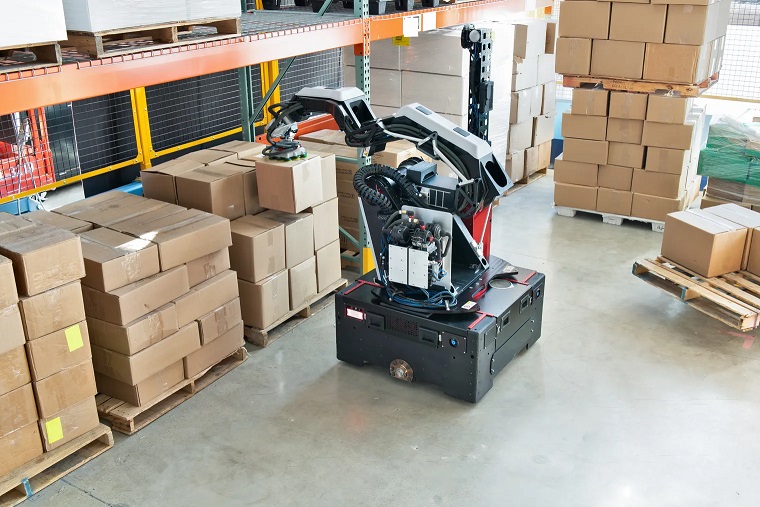
Above: Boston Dynamic warehouse robot that can identify and move up to 800 boxes an hour
Franz Walker – Natural News Sept 12, 2021
In an effort to fill labor gaps and speed up deliveries, North American warehouses are turning to automation.
A growing number of self-driving or remote-operated machines are shuttling clothing, sports equipment and electronics down warehouse aisles, pulling bins of groceries, toiletries and even industrial parts from high stacks before handing them off to human workers. All this to process and deliver orders faster.
Meanwhile, some operators are testing forklifts that can be operated from remote locations. This is allowing warehouse owners in tight labor markets to draw from a geographically broader pool of workers.
Warehouse operators turning to automation during the pandemic
The push to automate warehouses comes as many employers say that they can’t hire warehouse workers fast enough to meet surging online demand for everything from frozen food to furniture in pandemic-disrupted supply chains. This situation is accelerating their adoption of robots and other technology in a sector still largely dependent on manual labor. (Related: Coronavirus lockdown leads to increase in automation as employers turn to robots to keep their businesses running.)
“This is not about taking over your job, it’s about taking care of those jobs we can’t fill,” said Kristi Montgomery, vice president of innovation, research and development for Kenco Logistics Services LLC.
The Chattanooga, Tennessee-based Kenco is rolling out a fleet of self-driving robots from Locus Robotics. These robots are now helping workers fill orders at Kenco’s largest e-commerce site in Jeffersonville, Indiana.
In addition, Kenco is also using autonomous tractors that tow carts loaded with pallets.
Meanwhile, shipping giant DHL is investing $300 million in emerging automation technologies at its U.S. and Canadian distribution centers.
Much of the company’s investment is going into autonomous mobile robots from Locus Robotics. It’s also looking to deploy unmanned forklifts.
Adrian Kumar, global head of operations science and analytics at DHL Supply Chain, praised the technology’s flexibility and ability to work within existing warehouse infrastructure.
“If you have 10 sites that are all running Locus Robotics, you could move those robots between the different sites as one site hits a peak and another hits a trough. We could lease more robots at peak season,” he said.
Kumar also stated that the company is also testing technology that can autonomously perform multiple warehouse tasks, such as unloading trucks, transporting pallets to and from the dock and to different parts of the warehouse and placing pallets into racking.
Remote control also seen as an alternative
Robots aren’t the only thing warehouse owners are using to address the labor gap. Remote operation, allowing workers to control equipment from outside the warehouse, is another option companies are looking into.
Kenco has partnered with technology startup Phantom Auto to test remote-operated forklifts. These forklifts have been equipped with technology that allows drivers to operate them remotely using real-time video and audio streams.
Using the technology, operators can switch between different vehicles in different locations depending on demand. This opens up jobs to workers in regions far from the warehouses.
The technology could also let companies like Kenco access untapped sections of the label market. This includes people who are physically disabled, Montgomery said.
Labor market remains small despite growing e-commerce segment
Increased automation has traditionally come with raised fears of shrinking the labor market, with robots usually seen as taking jobs from humans. But the global pandemic and efforts to combat it have turned that dichotomy on its head.
Federal figures show that American warehousing and storage companies added nearly 168,000 jobs between April of 2020 and April of this year in response to the growth of e-commerce during the pandemic. But according to a preliminary report by the Department of Labor, sector payrolls contracted by 4,300 jobs from March to April.
May logistics employers say that they cannot hire enough staff to keep pace with strong demand as the U.S. economy emerges from the pandemic. These employers are therefore turning to automation to fill the gap.
“Robots are beginning to fill that void,” says Gartner Inc. supply-chain research vice president, Dwight Klappich. Gartner forecasts that demand for robotic systems that deliver goods to human workers will quadruple through 2023.
“We have been benefiting from that significantly since the second half of last year,” says Jerome Dubois, co-founder and co-chief executive of the Shopify Inc.-owned robotics provider 6 River Systems. “The driver here is not to reduce costs, but simply to serve the customer’s needs. They simply cannot hire.”
Despite the increase in automation, the demand for human labor remains high thanks to the e-commerce segment’s growth.
“With all the growth we see in demand and e-commerce, we are continually looking for more and more workers while we are adding more and more robots,” Ashfaque Chowdhury, president of supply chain for the Americas and Asia Pacific for XPO Logistics, says.
Historically, warehouses have simply provided a staging area to ship raw materials to factories and finished goods to retailers. But e-commerce has changed the retail side of the businesses. Now, warehouses must also sort through different items for delivery to homes and offices.
According to XPO, it takes three times as much space and effort to individually ship to consumers than it does to send goods over to a retail store. This means that warehouses will have to continue to expand their workforces, with both human workers and robots, as the e-commerce segment grows.
Follow Robotics.news for more on how e-commerce businesses are turning to automation when they can’t find workers for their warehouses.
Sources include:
The main problem with automation is that the only benefit is profit. Automation should be taxed. When you replace a job, all the taxes and spending power, buying widgets for sheeple, all that has gone.
It is no good saying x worker will find another job.
Another way to look at it, each robot should represent a worker and it should be paid, the pay sent to the state to pay benefits.
I am saying this as a compromise in corporate dominated world.
Until a robot can replicate every action of a human being they have limitations where many would have to be built to perform all human functions for it to truly be a take over. They would have to build who knows how many machines to replace one human? Ten? And that machine in the image looks useful but it couldn’t manage to climb one step. What else can’t it do that the human it replaced could do so easily?
As only some machines can do one or two jobs and most really can’t do any I see most machines as less of a threat to jobs and more a threat to workers’ rights. Replace us all with machines? Yeah. Right! Not until they’ve got Arnie T-8000s they won’t. But using robots to put us underfoot is another reason why people who need to go off-grid to survive should work to destroy the world’s power grids. Then after we defeat the prison grid and remove the elite we can rebuild, with that rebuild becoming the new economy.
As in ancient times and early civilisations our first priority must be to secure agricultural and other food supplies, to build up reserves and a trading surplus and make our first currency a food (corn) exchange. We just have to ensure those who control the land don’t conspire to take ownership of it and become the new robber barons as in medieval times. The elite complain about going back to the ’70s, 50 years, but we’ll have to go back 5,000 to repair the damage those so-called conservatives have done just for profit.
The Zionist-Communist plan for all these Caucasian created nations, is to gradually phase out white gentiles for non-whites & robots–via miscegenation, AI, immigration, primate on white homicide, ‘vaccines’….
There is another side to this story. In the late 1970’s, the trade unions were completely out of control. Wildcat strikes and organised violence were a daily occurrence.
That is when and why industry started to invest heavily in robotics.
all who are ordering by internet Amazon + others
are guilty. first they enrich jews and they abolish
work jobs.
@ MM
ALL AFRICANS +ISLAMS
HAVE TO BE SEND BACK
FIRST AGAINST FOODSHORTAGE !
Anonymous: that is a very twisted view of history.
In Germany, bosses made serious deals with their unions and workers, which led to decades of strong corporate progress where workers were looked after and paid well.
Here in the UK, we had the them and us, mainly by the bosses who thought and treated workers like lumps of shit. This opened the door to extremists in the Union movement. The fake news would take the piss out of UK car production workers for their low productivity (1 car compared to German workers making 6). As one Oxbridge professor said on BBC Today in the early 80s, ‘UK car workers are still using engineering equipment from the 19th century, whereas German car workers were used the latest equipment. A massive failure by UK management and the City of London who hated investing in UK manufacturing, when they received bigger returns from foreign operations.
Japanese car makers who based some production in the UK did exactly what the Germans did. Working for the Japanese is a very good job.
British management is and has always been a shower of shit who had the benefit of a large pool of unemployed Labour, so the bosses attitude was always, ‘if you don’t like it, collect your cards.
Today it’s even worse, beacuse many employers take on huge numbers of immigrants/ethnic minorities, so the work deal is much worse than the 80s/90s, hence why there are over 25% not in any paid work. Take HGV drivers, 100,000 left the UK after Brexit, they put up with the terrible conditions and low pay, low pay when you look at the cost of getting a HGV licence and the small fortune the DRIVER must payout every three years just to keep their licence.
On countless messures, the UK is a failed state. The regime thinks they can entice over 10 million working age back to work. I think they’ll fail like usual.
Hmm.. Soon Daleks as the Police Force IMHO ???