
by Mark Weber and Andrew Allen – Renegade Tribune Sept 4, 2021
Treblinka is widely regarded as the second most important German wartime extermination center. Only Auschwitz-Birkenau is supposed to have claimed more lives.
Treblinka became the focus of worldwide attention in 1987-1988 during the 14-month trial in Jerusalem of John (Ivan) Demjanjuk, a Ukrainian-born American factory worker. As Treblinka’s “Ivan the Terrible,” Demjanjuk supposedly operated the machinery used to gas hundreds of thousands of jews there. Citing testimony by jewish survivors, the israeli court that condemned him to death in April 1988 declared that more than 850,000 jews were killed at Treblinka between July 1942 and August 1943.
After the death sentence was handed down, Demjanjuk’s family was able to discover previously suppressed evidence — much of it from Soviet Russian archives — indicating that the real “Ivan the Terrible” was another Ukrainian named Ivan Marchenko (or Marczenko). This new evidence discredited the courtroom testimony of five jewish camp survivors, each of whom had “positively” identified Demjanjuk as the sadistic mass murderer of Treblinka. /1
As historians know, and as common sense would suggest, such decades-old testimony is far less trustworthy than contemporary records or forensic evidence. /2
And yet, Treblinka’s reputation as a mass extermination center is based almost entirely on precisely such subjective and unprovable testimony by former prisoners — evidence that has proven to be notoriously unreliable in several major trials of alleged “NAZI war criminals.” /3
There is no documentary evidence that Treblinka was an extermination center. In fact, contemporary records suggest that the camp had a very different function.
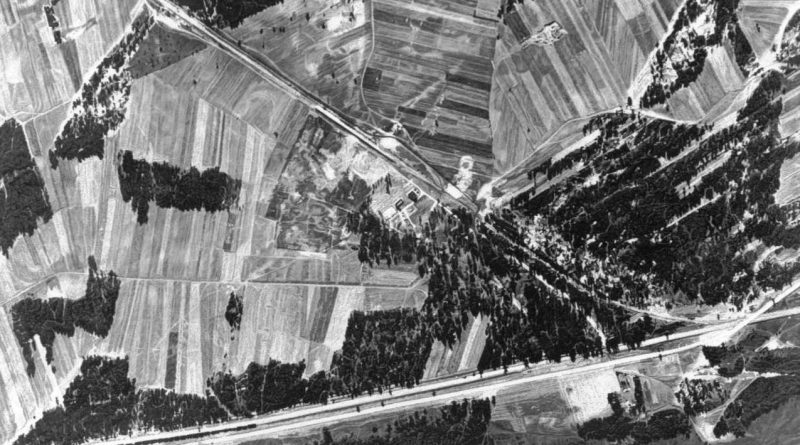
Aerial reconnaissance photographs taken in 1944 of the Treblinka “death camp” site — and forgotten for almost 45 years in the National Archives in Washington, DC — cast serious doubts on the widely accepted story that it was a mass extermination center.
Discovered in 1989, and published here for the first time in the United States, these German reconnaissance photos corroborate other evidence indicating that Treblinka was actually a transit camp. /4
These photographs indicate that the remarkably small camp was not isolated, or even particularly well guarded. (They clearly show that fields where Polish farmers planted and cultivated crops were directly adjacent to the camp perimeter.)
Moreover, the camp’s burial area quite obviously appears too small to contain the hundreds of thousands of bodies supposedly buried there. (Casting doubt on the widely accepted story of hundreds of thousands of Treblinka victims, these photos suggest instead that only those deportees who died during the sometimes protracted rail journey to the camp were buried there.)
‘Steam Chambers’
The generally accepted story today is that hundreds of thousands of jews were killed at Treblinka in gas chambers with poisonous exhaust from engines. But the “original” Treblinka extermination story was that jews were steamed to death there in “steam chambers.”
According to an “eyewitness” account received in November 1942 in London from the Warsaw ghetto underground organization, jews were exterminated in “death rooms” at Treblinka with “steam coming out of the numerous holes in the pipes.” /5 In August 1943, the New York Times reported that two million jews had already been killed at Treblinka by steaming them to death. /6
The Treblinka steam story is also given in detail in The Black Book of Polish Jewry, a work published in New York in 1943 and “sponsored” by Albert Einstein, Mrs. Eleanor Roosevelt, Congressman Sol Bloom, New York Mayor Fiorello LaGuardia, and other personalities. /7 Another book, Lest We Forget, published in New York in 1943 by the World Jewish Congress, describes in detail how jews were steamed to death, and provides a diagram showing the location of the purported “boiler room” that produced the “live steam.” /8
According to a 1944 “eyewitness” account compiled by the OSS, the principal US intelligence agency, jews at Treblinka “were in general killed by steam and not by gas as had been at first suspected.” /9
At the main Nuremberg trial of 1945-1946, two conflicting stories were given: steaming and gassing. Former Treblinka prisoner Samuel Rajzman testified that jews were killed there in gas chambers. /10 (To confuse matters still more, a few months earlier Rajzman
claimed that during the time he was in Treblinka, jews were “suffocated to death” there with a machine that pumped air out of death chambers.) /11
American prosecutors at the main Nuremberg trial supported the steam story. As proof, a Polish government report dated December 5, 1945, was submitted as prosecution exhibit USA-293. It charged that jews were killed at the camp “by suffocating them in steam-filled chambers.” This report, which says nothing about poison gas killings, was published in the official Nuremberg trial record as document PS-3311. /12 An American prosecutor quoted from this report during his address to the Tribunal on December 14, 1945. /13
Although no reputable historian now supports the “steam” story, and little has been heard of it during the last several decades, it was revived in a widely-circulated booklet published in 1979 and 1985 by the influential Anti-Defamation League of B’nai B’rith. /14
There may have been a factual basis for the “steam chamber” stories. It is quite possible that there was indeed some kind of steaming operation at Treblinka — but one designed to kill disease-carrying lice, not people. Such disinfection steaming was commonly used in German camps for Allied prisoners of war. /15
Shortly after the war, the World Jewish Congress published The Black Book, a 559-page volume of real and imagined wartime atrocities against jews. At Treblinka alone, the book alleges, three million persons were killed. Three diabolical techniques, including poison gas and steam, were supposedly used there to kill some 10,000 jews daily. But “the most widespread” method “consisted of pumping all the air out from the chambers with large special pumps.” /16 A former inmate testified shortly after the war that Treblinka’s victims were “poisoned by the different gasses or asphyxiated when the chamber was turned into a vacuum and all the air sucked out.” /17
In the Nuremberg trial of Oswald Pohl, U.S. Judge Michael A. Musmanno declared that
“death was inflicted here [at Treblinka] by gas and steam, as well as by electric current.”
Citing Nuremberg document PS-3311, Musmanno declared:
“After being filled up to capacity the chambers were hermetically closed and steam was let in.” /18
Adolf Eichmann, the wartime head of the SS jewish affairs section, said in 1961 during pre-trial interrogation in israel that during the war he “was told” that jews were gassed at Treblinka “with potassium cyanide.” /19
One of the strangest Treblinka extermination stories, which appeared in September 1942 in a Polish underground periodical, claimed that jews were killed there with a “delayed action” gas: /20
They enter it [the gas chamber] in groups of 300-500 people. Each group is immediately closed hermetically inside, and gassed. The gas does not affect them immediately, because the jews still have to continue on to the pits that are a few dozen meters away, and whose depth is 30 meters. There they fall unconscious, and a digger covers them with a thin layer of earth. Then another group arrives.
According to the testimony of yet another “eyewitness,” a jew named Oskar Berger who escaped from the camp, many jews were systematically put to death at Treblinka by shooting them with rifle and machine-gun fire. /21
Diesel Gassing
In recent years, the most widely-circulated story has been that jews were gassed at Treblinka with carbon monoxide from the exhaust of a diesel engine. /22
However, as American engineer Friedrich Berg has established, this story is improbable for technical reasons. /23 In spite of the obnoxious odor of diesel exhaust, diesel engines produce much smaller quantities of toxic carbon monoxide than ordinary gasoline motors. /24 It would thus be difficult efficiently to gas large numbers of people using diesel exhaust. A normal gasoline engine would be much more logical. /25
It is important to keep in mind that the “evidence” now usually cited for diesel gassing at Treblinka is no more credible than the evidence that was once presented for steaming and suffocating. Apparently the steaming and suffocating stories have been dropped for the sake of credible consistency.
Solid evidence for gassings at Treblinka has proven to be very elusive. For example, it turned out that none of the witnesses in the 1951 West German “Treblinka” court case ever actually saw anyone being gassed. “The type of gas used to kill the people there [Treblinka] cannot be determined with certainty because none of the witnesses was able to witness this procedure,” the judges declared in their verdict. /26
At least some former Treblinka prisoners testified in postwar West German trials that they not only never saw a gas chamber, but did not even hear about gassings from others. /27
Holocaust historians today are not able to agree about the number of homicidal “gas chambers” at Treblinka. Raul Hilberg maintains that there were three at first, but because they were allegedly not adequate for the job, more were built later on. There were eventually six or perhaps ten chambers, he reports. /28 Others have reported the existence of 13 gas chambers at Treblinka. /29
Bomba’s Testimony
One of the most memorable testimonies about Treblinka presented in Shoah, the nine-and-a-half-hour Holocaust film by “French” jewish film maker Claude Lanzmann, is that of Abraham Bomba. He told how he and other jewish barbers cut the hair of the naked jews who were about to be gassed. They worked inside “the” gas chamber (he always spoke of one chamber), which was “around four by four meters” (about 12 feet by 12 feet). Bomba also reported that “140 or 150 women,” with children, as well as 16 or 17 barbers, were inside this small room. In addition, there were benches where the women sat while their hair was cut, as well as two or more German guards.
The barbers had to leave the chamber for five minutes while the victims were gassed, Bomba said, and it took just one minute to clear out the 140 or so corpses, and clean the floor and walls, before everything was ready for the next batch of victims. /30
Bomba’s moving testimony, which conservative writer George Will called the “most stunning in this shattering film,” is simply not credible.
Treblinka Labor Camp
About one mile (1.5 km) from the “extermination camp,” which was known as “Treblinka II,” was a penal labor camp for Poles and jews known as “Treblinka I.” It was not at all secret. The 1941 directive announcing the establishment of the “Treblinka Labor Camp” was published in both Polish and German in widely distributed official journals. /31 Poles and jews worked in a large sand and gravel quarry at the Treblinka labor camp. /32
As wartime aerial reconnaissance photographs clearly show, the Treblinka T-I labor camp was located at the end of the rail spur on which the Treblinka T-II “extermination” (transit) camp was also located. This fact strengthens the thesis that the T-II camp was not particularly secret, since penal labor prisoners being taken by train to and from the publicly known T-I camp passed directly by the supposedly top secret T-II “extermination” camp. /33
Documentary Evidence
Documents found after the war confirm that large numbers of jews were deported to Treblinka in 1942 and 1943. German railway records report the transfer of trainloads of “settlers” (“Umsiedler“) and “workers” to Treblinka from various places in Poland and from other countries. /34
In July 1942, a senior German railway official reported to the chief of Himmler’s personal staff that 5,000 jews were being transported daily to Treblinka. /35 An August 3, 1942, German “Ostbahn” railway directive similarly reported that special trains would be carrying “resettlers” from Warsaw to Treblinka daily, until further notice. /36
Interestingly, it was not until September 1, 1942, that the Treblinka train station was closed to passenger rail travel by the general public (“to permit a smooth handling of the special resettlement trains”), which suggests that German officials were not particularly concerned with keeping the deportations or the station secret. /37
Other records mention trains to Treblinka in March 1943 from Vienna, Bulgaria and Greece. /38
From Vienna and Luxembourg, jews reportedly arrived at the camp in passenger train coaches, and the deportees were given food and medical care during their journey. /39 In at least one case, a train with sleeping cars and a dining car arrived at Treblinka. /40
German railway records have been cited as evidence that hundreds of thousands of jews were exterminated at Treblinka. /41 While there is little doubt that these documents are genuine, and that they confirm transports of jews to Treblinka, they are not proof of an extermination program. /42
Transit Camp
If Treblinka was not an extermination center, what was it? As already mentioned, the balance of evidence indicates that Treblinka II — along with Belzec and Sobibor — was a transit camp, where jewish deportees were stripped of their property and valuables before being transferred eastwards into German-occupied Soviet territories. /43
The generally-accepted story is that Treblinka II was a “pure” extermination center, from which no jew was permitted to leave alive. /44 However, credible reports of deportations of jews from Treblinka refute the allegation that all jews sent there were destined for extermination, and indicate instead that the camp functioned as a transit center.
In the aftermath of the April 1943 Warsaw ghetto uprising, for example, jews were transported from Warsaw to Treblinka II. As some of the deportees later confirmed, after a “selection” in the camp, trainloads of hundreds of jews were taken from Treblinka to Lublin (Majdanek), and possibly other camps. /45 Several thousand jews (at least) were transferred by German authorities from Treblinka to other camps, a postwar German court determined. /46
Letters and postcards that arrived in the Warsaw ghetto from jews who, by all accounts, had been deported to Treblinka, indicate that the camp was a transit center from where jews were resettled in the occupied Soviet territories. These messages, which arrived from settlements and camps in Belarus (Byelorussia), Ukraine, and even Russia proper (near Smolensk), were written by jews who had been deported in 1942. Some letters and cards had been sent by mail and some had arrived through the underground. Many mentioned that the senders were working hard, but confirmed that they (and often their children) were being fed. /47
Completely contrary to its supposed character as a top secret extermination center, Treblinka was neither secret nor even closely guarded, as both former inmates and officials have confirmed.
“Secrecy? Good heavens, there was no secrecy about Treblinka,” jewish prisoner Richard Glazer later testified. “All the Poles between there and Warsaw must have known about it, and lived off the proceeds. All the peasants came to barter, the Warsaw whores did business with the Ukrainians — it was a circus for all of them.”
Polish farmers worked the fields that directly adjoined the camp. “And many others,” said jewish survivor Berek Rojzman, “came to the fence to barter, mostly with the Ukrainians, but with us too.” /48
Even regular German concentration camps such as Dachau and Buchenwald were much more closely guarded than Treblinka. As already mentioned, aerial reconnaissance photographs taken in 1944 confirm that the area around Treblinka was not cleared. The photos show that one perimeter of the camp passed through a wooded area, and that cultivated fields where Polish farmers worked were directly adjacent to the camp perimeter. /49
How Many Victims?
Shortly after the end of the war, the world jewish congress and at least one former Treblinka prisoner alleged that more than three million jews had been exterminated there. /50 More recent estimates of the number of people allegedly killed at Treblinka range from between 700,000 (Leon Poliakov and Uwe Adam), 750,000 (Raul Hilberg and Encyclopaedia Judaica), 870,000 (Yitzhak Arad), to more than 900,000 (Wolfgang Scheffler and Washington Post). /51
There is no documentary or physical evidence for any of these figures, which are simply conjectural estimates.
Layout and Size
Diagrams published in recent years that show Treblinka as a neatly organized, rectangular-shaped camp are not accurate. /52 As already mentioned, though, wartime aerial reconnaissance photographs confirm that the Treblinka II camp was actually unsymmetrically four-sided and irregularly shaped. /53
One of the most remarkable features of the Treblinka “death camp” is its small size. The entire Treblinka II camp area was only 32 or 33 acres (13 hectares), or about one twentieth of a square mile. /54 Even smaller was the alleged “extermination” area of the camp, which was 200 by 250 meters in size (or five hectares) according to purportedly authoritative sources. /55
Poland’s “Central Commission” announced shortly after the war that the burial or “ditches” area where the bodies of Treblinka’s victims were buried (before they were supposedly later dug up for burning) was about two hectares or five acres (or some 20,235 square meters). /56 And according to a diagram in a book about Treblinka by jewish Holocaust historian Alexander Donat, the camp’s “ditches” area was not more than 80 or 100 meters in length and about 50 meters wide — that is, a maximum of 5,000 square meters or half a hectare. /57
By comparison, the mass graves area in the Katyn forest (near Smolensk), which held the bodies of some 4,500 Polish officers who had been killed by Soviet secret police and buried there in 1940, measured about 500 square meters. /58
In short, it is very difficult to accept that anything like 700,000 or 800,000 bodies could have been buried in the minuscule area allegedly set aside at Treblinka for this purpose.
Cremation Inconsistencies
Between April and July 1943, the corpses of Treblinka’s hundreds of thousands of victims were allegedly dug up from the burial pits and burned with “dry wood and branches” on grids made of rails in batches of 2,000 or 2,500. The residual “ash and bits of bone” were dumped back into the burial pits, and covered with a layer of sand and dirt two meters deep. This was done, it is said, in order to eliminate the physical evidence of mass extermination. /59
Although enormous amounts of fuel would have been needed to cremate the hundreds of thousands of alleged corpses, there is no documentary record or witness recollection of the great quantities of firewood that would have been required.
According to “Polish”-jewish historian Rachel Auerbach, fuel to burn bodies was not needed at Treblinka because “the bodies of woman,” which had more fat, “were used to kindle, or more accurately put, to build the fires among the piles of corpses.” Even more incredible, “blood, too, was found to be first-class combustion material,” she wrote. /60
Missing Remains
A wartime Warsaw ghetto internee, Dr. Adolf Berman, testified in the 1961 Eichmann trial that he visited the Treblinka camp site shortly after the Soviet occupation of Poland. He told the Jerusalem court that he saw
“an area of several square kilometers covered with bones and skulls, and nearby tens upon tens of thousands of shoes, many of them children’s shoes.” /61
Berman’s testimony, which was considered one of the most emotionally moving of the Eichmann trial, is completely inconsistent with known facts. For one thing, the entire Treblinka camp was much smaller than one square kilometer in size, and no other witness has confirmed the presence of “tens of thousands” of shoes.
jewish historian Rachel Auerbach, a member of an official Polish commission that inspected the camp site in November 1945 — that is, a few months after the end of the war — reported finding large human bones, “rotted masses of corpses,” “pieces of half-rotted corpses,” and “fully dressed” corpses, at the Treblinka camp site. /62
In the area where the gas chambers were supposed to have been located, the commission’s team of 30 excavation workers reportedly found “human remains, partially in the process of decay,” and an unspecified amount of ash. Untouched sandy soil was reached at 7.5 meters, at which point the digging was halted. An accompanying photograph of an excavated pit reveals some large bones. /63
Poland’s “Central Commission for Investigation of German Crimes” reported that “large quantities of ashes mixed with sand, among which are numerous human bones, often with the remains of decomposing tissues,” were found in the five acre (two hectare) burial area during an examination of the site shortly after the end of the war. /64
The presence of uncremated human remains is not consistent with the often-repeated allegation that all such remains were thoroughly destroyed. Significantly, none of the Polish reports specifies the quantity of human remains, the numbers of corpses, or the amount of ash found at the camp site, which suggests that evidence of hundreds of thousands of victims was not found. /65
In spite of its often inconsistent, contradictory and implausible character, testimony indicating that many jews lost their lives at Treblinka cannot easily be dismissed. jewish prisoners doubtless perished during their rail journey to the camp site, and were almost certainly buried there.
All the same, there is no hard or compelling evidence that Treblinka was a mass extermination center where hundreds of thousands of jews were systematically put to death.
To the contrary, credible reports of transfers of jews from Treblinka eastwards to the occupied Soviet territories, the relative lack of secrecy and security in the camp, and the small size of the area where the bodies were supposedly buried, all suggest instead that this was a transit center.
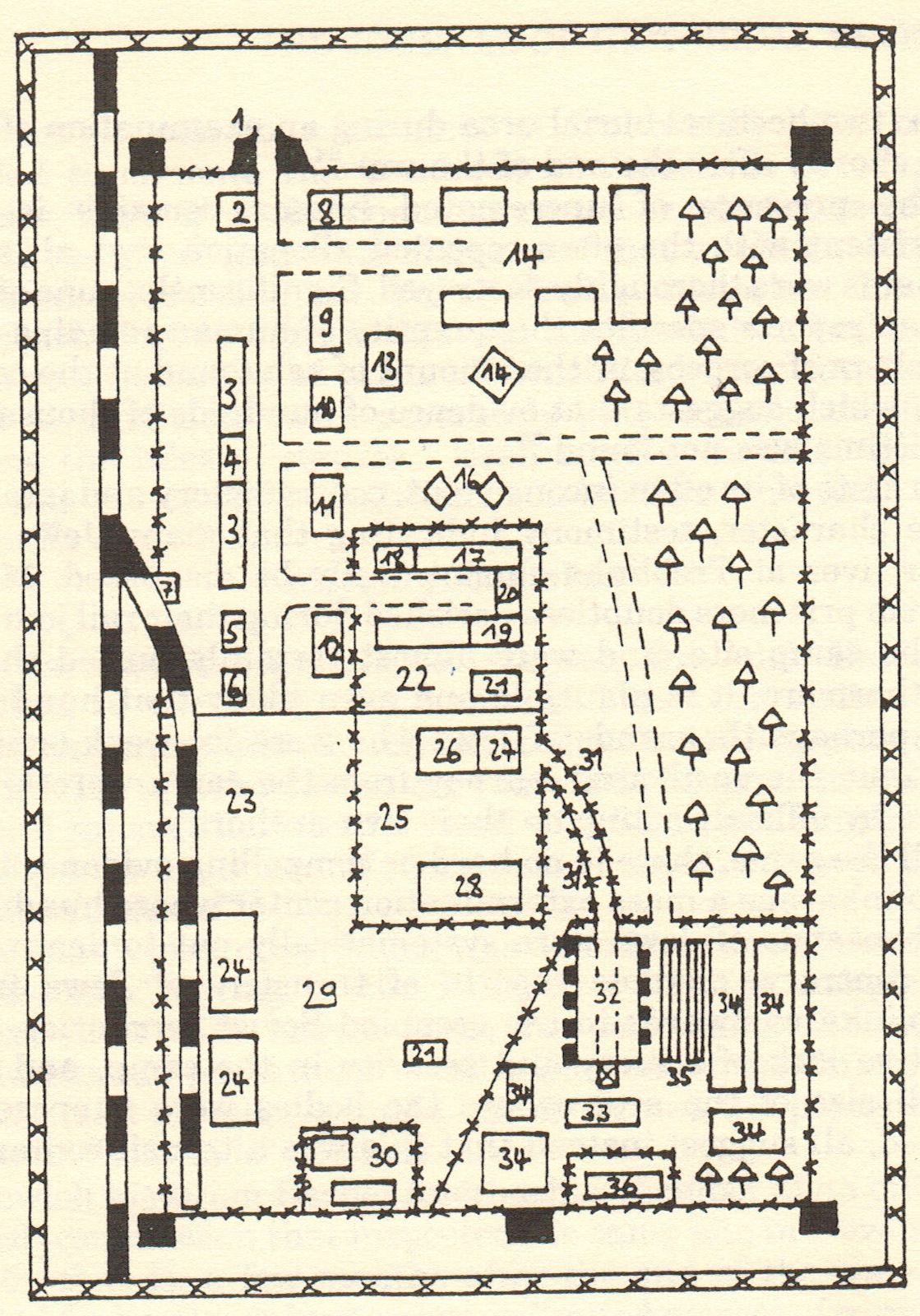
This diagram of the Treblinka II camp was used in the “Treblinka Trialn in Diisseldorf, where it was supposedly “accepted by all of the defendants and witnesses.” In this diagram, not only is the general shape of the camp inaccurate, but no scale is provided, thus giving a misleading impression that the camp was much larger than it actually was. The alleged extermination “gas chambers” are marked 32 and 33. The supposed mass burial sites, which are marked 34, are not large enough to have held the hundreds of thousands of bodies allegedly buried there. [From: Eugen Kogon, et al., Nationalsozialistische Massentotungen durch Giftgas (Frankfurt: 1986), p. 342.]
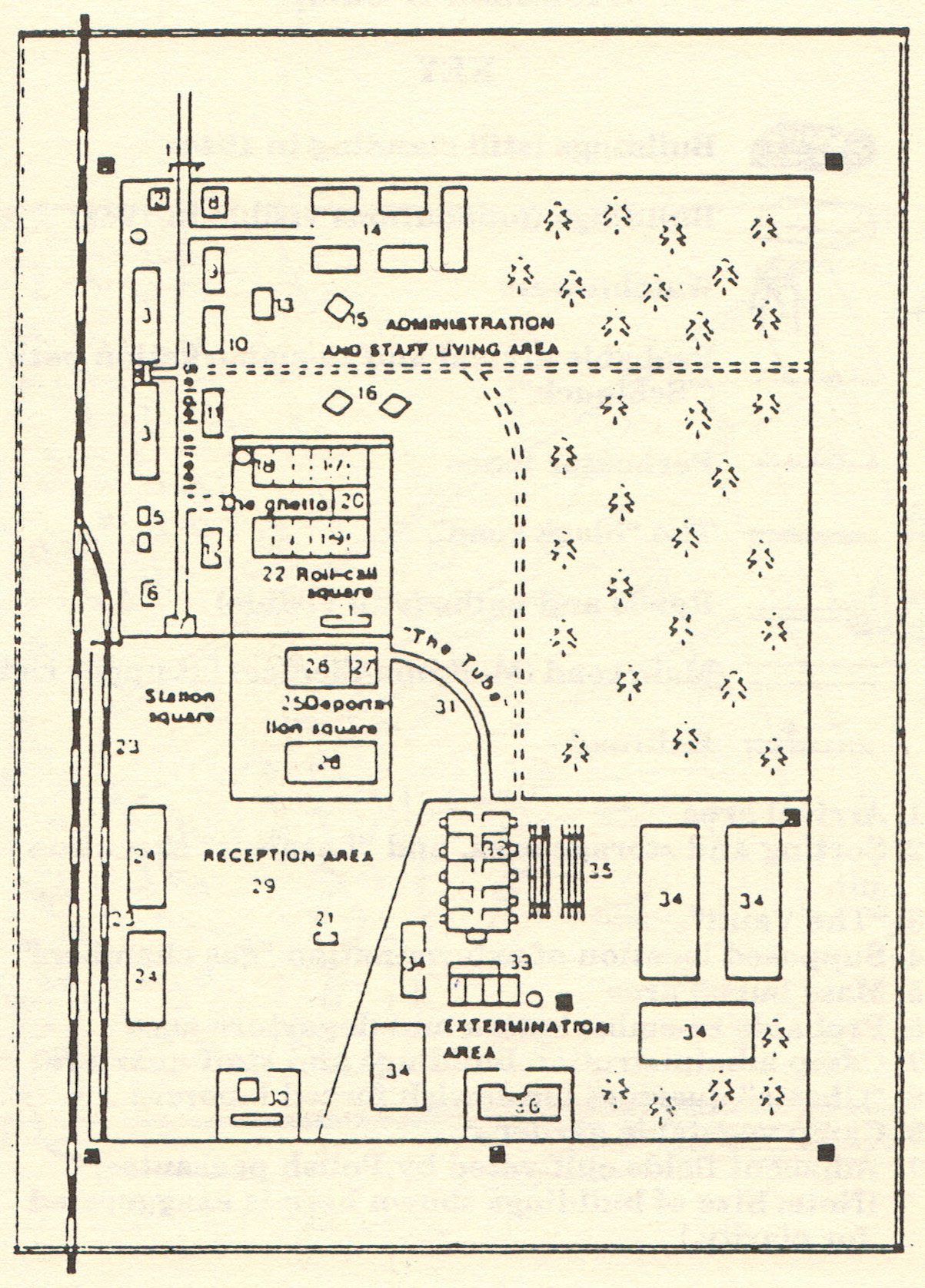
Inaccurately portraying a rectangular-shaped camp, this diagram of Treblinka appears in the Encyclopedia of the Holocaust. The alleged extermination “gas chambers” are marked 32 and 33. The supposed mass burial areas are marked 34. [From: Israel Gutman, editor, Encyclopedia of the Holocaust (New York: Macmillan, 1990), Volume 4, p. 1485.]
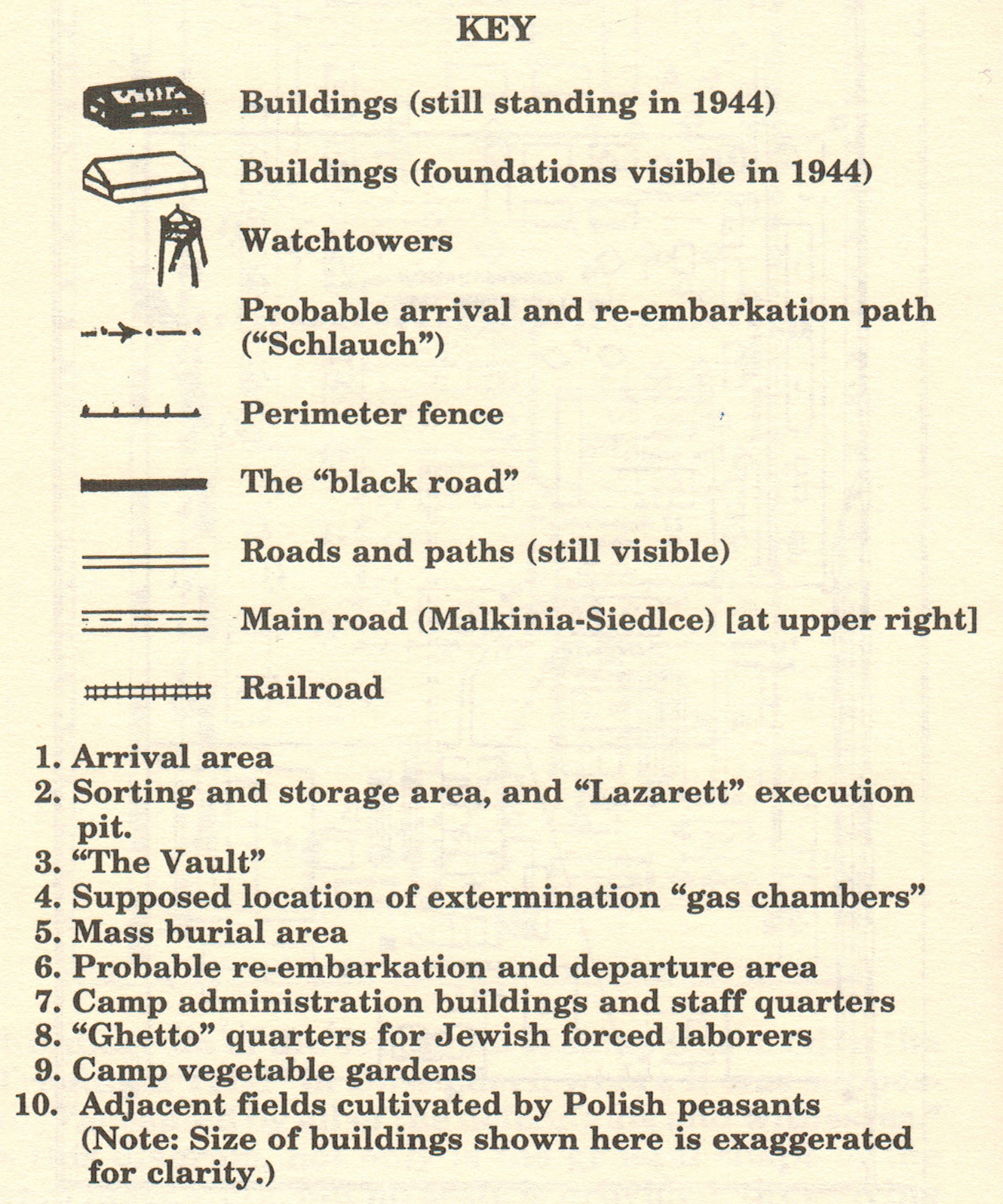
The diagram below of the Treblinka II camp in 1942-1943 is based on wartime aerial photographs, published sources, and postwar on-site inspection. (Copyright 1991 by Janusz Patek. Reproduced by permission.)
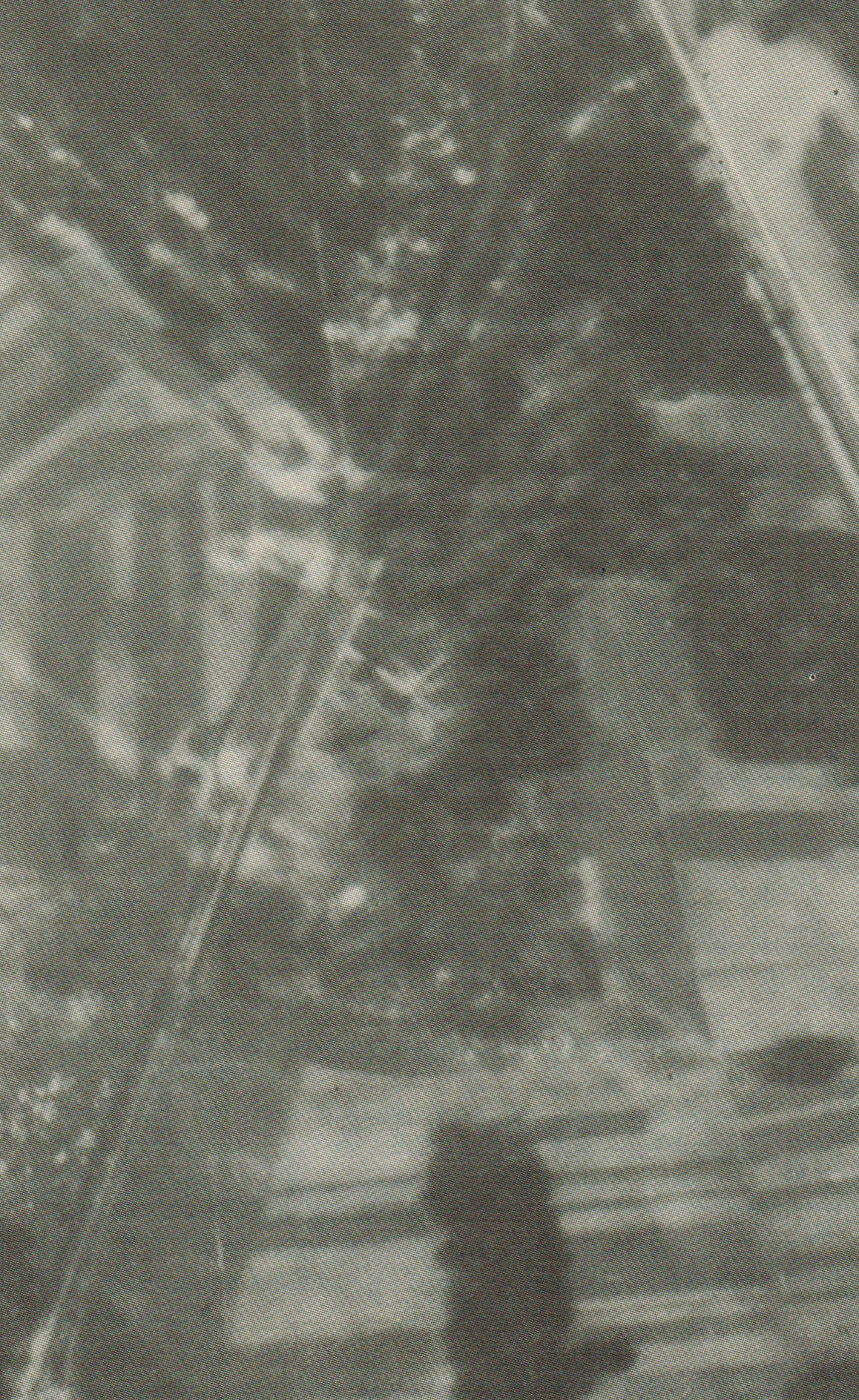
The site of the Treblinka II (“death camp”) is at the center of this aerial reconnaissance photo (reportedly taken in September 1944). Cultivated fields of Polish farmers can be seen directly adjacent to the T II camp, suggesting that is was not carefully guarded or closed off. A small part of the Malkinia-Siedlce main road is visible at the upper right. At the bottom, the Treblinka I labor camp site can be clearly seen, just below the quarry area.
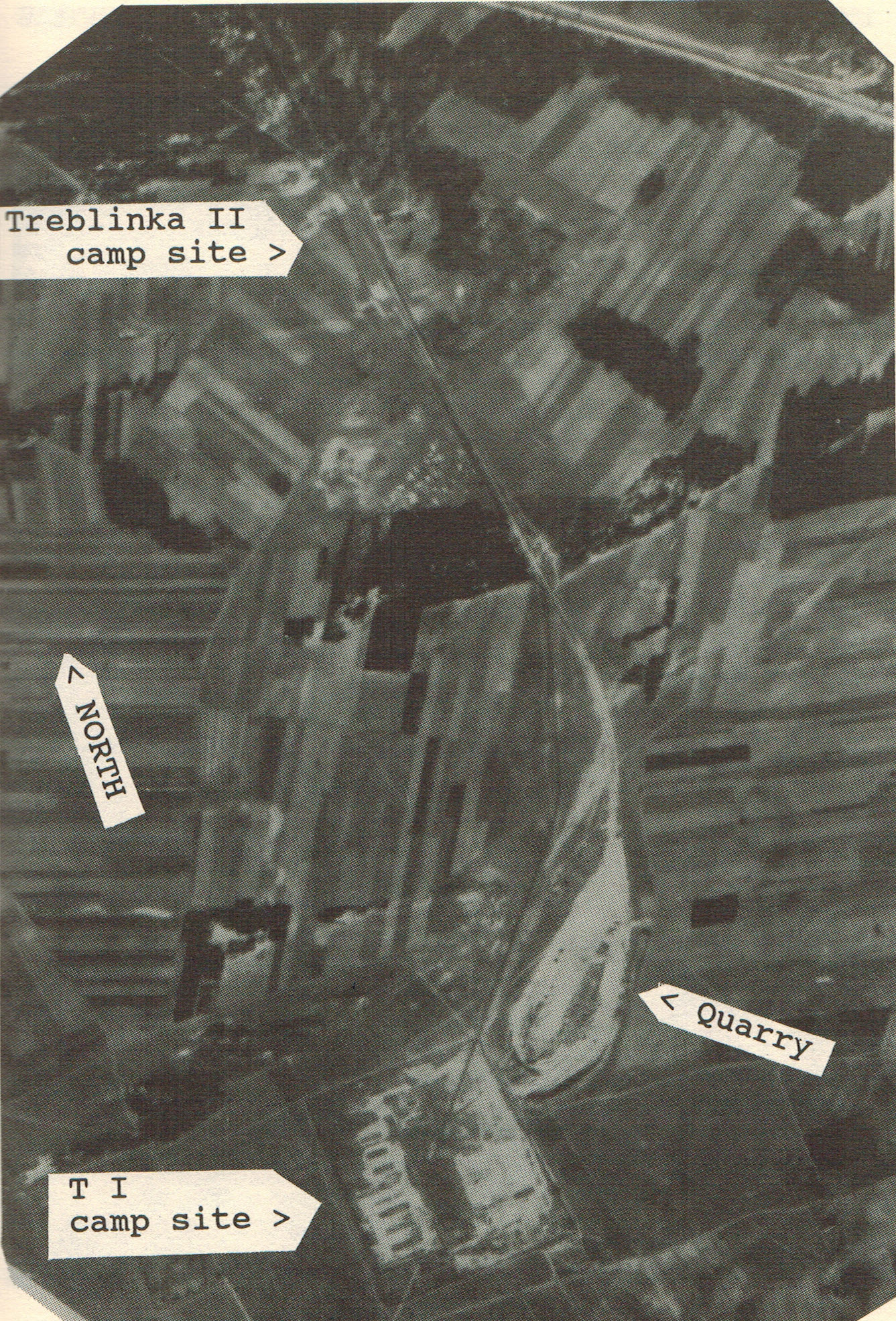
Trees and other vegetation seen in this aerial photo of Treblinka II (Sept. 1944) show that the camp site was not carefully closed off from the surrounding area.
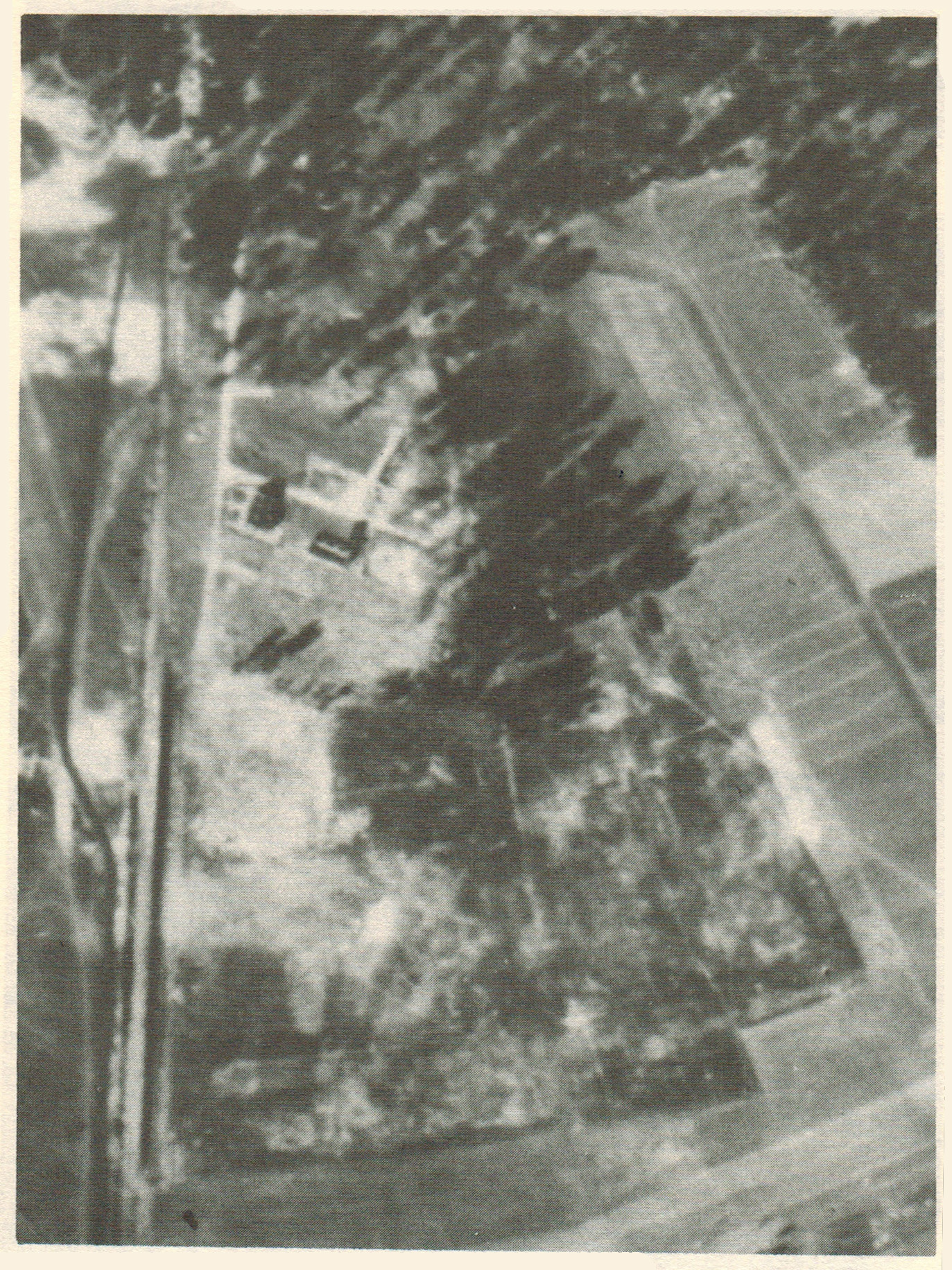
This reconnaissance photo of Treblinka II (reportedly taken in October 1944), clearly shows that part of the outer perimeter of the camp (above) passes through part of a forest of trees, and that the area around the camp was not cleared to insure a high level of security.
Notes
- F. Dannen, “How Terrible is Ivan?,” Vanity Fair (New York), June 1992, pp. 132 ff.; “New Evidence: Demjanjuk a Nazi Guard, Probably Not ‘Ivan’,” Los Angeles Times, January 16, 1992.; C. Haberman, “Soviet Files Are Presented… ,” The New York Times, June 2, 1992, p. A6.
- On the unreliability of such testimony, see John Cobden’s review of Witness for the Defense (by E. Loftus and K. Ketcham) in The Journal of Historical Review, Summer 1991, pp. 238-249.; Samuel Gringauz, a Jewish historian who was himself interned in the Kaunas ghetto during the war, wrote: “Most of the memoirs and reports [of Holocaust survivors] are full of preposterous verbosity, graphomanic exaggeration, dramatic effects, overestimated self-inflation, dilettante philosophizing, would-be lyricism, unchecked rumors, bias, partisan attacks and apologies.” (Jewish Social Studies, New York, January 1950, Vol. 12, p. 65.).
- On the unreliability of such “eyewitness” testimony in the illustrative case of Frank Walus, who was falsely accused of murdering Jews as a Gestapo officer in Poland, see, for example, “The Nazi Who Never Was,” The Washington Post, May 10, 1981, pp. B5, B8.
- These aerial reconnaissance photos are on file in the National Archives (Washington, DC), Cartographic Division (Record Group 373).
Several of these reconnaissance photos were published in Germany in 1990 by Udo Walendy in the booklet “Der Fall Treblinka,” Historische Tatsachen, Nr. 44, 1990. (Postfach 1643, D-4973 Vlotho, Germany). See especially pages 13, 31, 34, 35, 38. In this booklet, Walendy cites specific archival source references from the US National Archives for these photographs. Unfortunately, these specific references are not always quite accurate. The specific source references cited by Walendy are:GX 12225 (or 122225?), Exp. 257 (and 258, 259?). (November or May 1944)
GX 180 D F 934/44 SK , Exp. 246 (May 18, 1944)
GX 12299 B A -2249, Exp. 014 (July 10, 1944)
GX 72 F 933/44 SK, Exp. 139, 140 (May 13, 1944)
GX 1946 F 2926 /44 SK, Exp. 062 (Sept. 18, 1944)
GX 937 F 13 A 6099, Exp. 74
GX 12250 F 2795 SK, Exp. 045 (Sept. 2, 1944)
GX 12290 F 3086 SK r 2600, Exp. 68 (Oct. 16, 1944)
GX 1946 / 44 SD, Exp. 076.
GX 12373, Exp. 11 (Sept. 2, 1944)The most important of these Treblinka aerial photographs were made public for the first time in the United States in January 1991 at a meeting in Palo Alto, California. (IHR Newsletter, Feb. 1991, p. 3.).
We gratefully acknowledge the assistance of the Polish Historical Society (Stamford, Connecticut) in compiling this essay.
Soviet wartime aerial reconnaissance photographs of the Treblinka camp site almost certainly exist, and are very probably still held in Russian archives. If so, they should be made public. - “Likwidacja zydowskiej Warszawy, Treblinka,” Biuleytn Zydowskiego Instytutu Historycznego (Warsaw), Jan.-June 1951, pp. 93-100. Quoted in: Carlo Mattogno, “The Myth of the Extermination of the Jews,” The Journal of Historical Review, Fall 1988, pp. 273-274, 295 (n. 16).
- New York Times, Aug. 8, 1943, p. 11. Reprinted in: The Record: The Holocaust in History (New York: ADL, 1985), p. 10. (The Record was also distributed as an advertising supplement to the New York Post, April 17, 1978.)
- Jacob Apenszlak, ed., The Black Book of Polish Jewry (New York: 1943), pp. 142-143, 145.
- World Jewish Congress, Lest We Forget (New York: 1943), pp. 4, 6-7.; See also the reference to killings at Treblinka by “hot steam” in Hitler’s Ten-Year War On the Jews (p. 149), a book published in New York in 1943 by the “Institute of Jewish Affairs,” an agency of the American Jewish Congress and the World Jewish Congress.
- OSS document, April 13, 1944. National Archives (Washington, DC), Military Branch, Record Group 226 (OSS records), No. 67231.
- International Military Tribunal, Trial of the Major War Criminals Before the International Military Tribunal, Nuremberg: 1947-1949, (“blue series”), Vol. 8, p. 325. (Feb. 27, 1946)
- Rajzman text in: Yuri Suhl, ed., They Fought Back (New York: 1967), p. 130.; This story also appears in: Isaiah Trunk, Jewish Responses (New York: 1982), p. 263.
- IMT, Trial of the Major War Criminals Before the International Military Tribunal (IMT “blue series”/ 1947-1949), vol. 32, pp. 153-158; Also published in: Nazi Conspiracy and Aggression (NC&A “red series”/ 1946-1948), Vol. 5, pp. 1104-1108. See also: NC&A (“red series”), vol. 1, pp. 1005-1006.
- IMT, Trial of the Major War Criminals (“blue series”), vol. 3, p. 567-568.
- The Record: The Holocaust in History. (The NYT report of Aug. 8, 1943, is reproduced here.)
- Major S. G. Cowper, “A Note on a Disinfestation Plant Used in a Typhus Hospital for Prisoners of War in Germany,” Journal of the Royal Army Medical Corps, Sept. 1946, Vol. 87, No. 3, pp. 173-176.; “Typhus,” 1922 supplement to Encyclopaedia Britannica. Facsimile reprint in: Carlos Porter, Made in Russia (1988), p. 364.; Globocnik reported in Jan. 1944 that textile goods seized in the course of “Aktion Reinhardt” were disinfected. See: 4024-PS. IMT “blue series,” vol. 34, p. 84.
Jacob Seewald, a Polish Jew, spent the war years working as a forester in a German labor camp. When he came down with a severe illness, he was transferred to a hospital, where he recovered. After the war he emigrated to the United States. In a 1983 interview, he recalled that the camp authorities “took us [Jewish workers] into a shower for the steam to kill lice. There we got no clothes, just a bundle with our names on them. Naked. Then they turn on the water for a second — scalding water.” (John C. Bromely, “Stories from the Darkness,” The Denver Post Magazine, Sunday, June 12, 1983, p. 20.) Similar events at Treblinka may perhaps have provided a basis for the camp’s “steam” legend. - Jewish Black Book Comm., The Black Book (1946), pp. 407-408.
- Isaiah Trunk, Jewish Responses (New York: 1982), p. 263.
- Trials of the War Criminals Before the Nuernberg Military Tribunals (NMT “green series”/ Washington, DC: 1949-1953), vol. 5, pp. 1133-1134.
- Jochen von Lang, ed., Eichmann Interrogated (New York: 1983), p. 84.; See also: R. Aschenauer, ed., Ich, Adolf Eichmann (1980), pp. 179, 183.
- “Information Bulletin,” Sept. 8, 1942, published by the command of the Polish underground “Armia Krajowa.” Quoted in: Yitzhak Arad, Belzec, Sobibor, Treblinka (Bloomington: 1987), pp. 353 f.
- E. Kogon, Theory and Practice of Hell (New York: Berkley, pb., 1981), pp. 183-185.
- Raul Hilberg, The Destruction of the European Jews (New York: 1985), p. 878.; “Treblinka,” Encyclopaedia Judaica (1971), vol. 15, p. 1368.; Eugen Kogon, et al., Nationalsozialistische Massentötungen (1986), p. 163; Yitzhak Arad, “Treblinka,” in: I. Gutman, ed., Encyclopedia of the Holocaust, pp. 1483, 1484.
- F. Berg, “The Diesel Gas Chambers,” The Journal of Historical Review, Spring 1984, pp. 15-46.
- R. Schmidt, A. Carey, and R. Kamo, “Exhaust Characteristics of the Automotive Diesel,” Society of Automotive Engineers Transactions (New York), Vol. 75, Sec. 3, 1967, pp. 106, 107. (paper 660550).
- Even more logical and efficient than a gasoline engine — in the view of engineer Friedrich Berg — would have been the “Holzgas” generator, which were in very widespread use in Europe during the war years. See: F. Berg, “The Diesel Gas Chambers,” The Journal of Historical Review, Spring 1984, pp. 38-41.
- Case against J. Hirtreiter, LG Frankfurt, 1951. Justiz und NS-Verbrechen (Amsterdam: 1972), Band 8, p. 264 (270 a-4).
- Hans Peter Rullmann, Der Fall Demjanjuk (Sonnenbühl: 1987), p. 149. Source cited: Adalbert Rückerl, NS-Vernichtungslager (1977).; An unsatisfactory explanation has been offered for this remarkable testimony: these witnesses must have been inmates of the nearby Treblinka labor camp, or for some other reason were never in the “extermination” section of the T-II camp.
- R. Hilberg, Destruction (1985), p. 879.
- Central Commission…, German Crimes in Poland (Warsaw: 1946-1947), vol. 1, p. 97.; Yitzhak Arad, “Treblinka,” in: I. Gutman, ed., Encyclopedia of the Holocaust, pp. 1483, 1485.
- Shoah (Paris: Fayard, 1985), pp. 126-129. (I am thankful to Dr. Faurisson for pointing this out.) See also: Bradley R. Smith, “Shoah: Abraham Bomba, the Barber,” The Journal of Historical Review, Summer 1986, pp. 244-253.
- Directive of Nov. 15, 1941. Amtsblatt für den Distrikt Warschau, Dec. 16, 1941, p. 116. Facsimile reproduction in: S. Wojtczak, “Karny Oboz,” Biuletyn Glownej Komisji Badania Zbrodni Hitlerowskich w Polsce (Warsaw), Vol. 26, 1975, pp. 155-156.; Also published in: Amtlicher Anzeiger, Dec. 2, 1941. Cited in: Yitzhak Arad, Belzec, Sobibor, Treblinka (1987), p. 352. Facsimile reproduction in: C. Pilichowski, No Time-Limit for These Crimes (Warsaw: 1980), no page number.; An internal German document dated July 7, 1942, refers to the “Treblinka labor camp,” which means that it was operating at the same time as the nearby “extermination center.” Facsimile is reprinted in: H. Eschwege, ed., Kennzeichen J (East Berlin: 1966), p. 245.
- I. Gutman, ed., Encyclopedia of the Holocaust (1990), p. 1482.
- Note particularly the aerial photograph dated Sept. 2, 1944, in: U. Walendy, “Der Fall Treblinka,” Historische Tatsachen, Nr. 44 (1990), p. 31.; Even today, a visitor to the site is struck by the large size of the quarry pit there. Hundreds (and perhaps thousands) of rail cars must have gone to and from the site (passing by the T-II “extermination camp”) to carry away the sand and gravel excavated from the large pit.
- Facsimile documents in: Biuletyn Glownej Komisji Badania Zbrodni Hitlerowskich w Polsce (Warsaw), Vol. 26, 1975, pp. 171-182.; These records also show that (presumably empty) trains were promptly returned to their points of origin.; See also: Raul Hilberg, The Destruction of the European Jews (1985), p. 488 (and notes).
- Ganzenmüller to Wolff, July 28, 1942. Document NO-2207. R. Hilberg, Destruction (1985), p. 491.
- Main rail office (Gedob) in Krakow, directive No. 548. Facsimile in: Biuletyn Glownej Komisji … (Warsaw), Vol. 26, 1975, p. 171.
- Main rail office (Gedob) in Krakow, directive of Aug. 27, 1942. Facsimile in: Biuletyn Glownej … (Warsaw), Vol. 26, 1975, p. 182.; Also quoted in: Y. Arad, Belzec, Sobibor, Treblinka (1987), p. 96.
- Biuletyn Glownej… (Warsaw), Vol. 26, 1975, pp. 178 f.; Y. Arad, Belzec, Sobibor, Treblinka (1987), p. 145.
- Gerald Reitlinger, The Final Solution, (London: Sphere, pb., 1971), p. 150.
- Martin Gilbert, Final Journey (New York: 1979), p. 119.
- R. Hilberg, Destruction (1985), p. 488 (and notes).
- For one thing, the surviving documents are not at all clear about the numbers of deportees, and certainly do not confirm the deportation of hundreds of thousands of Jews to the camp.
- Dr. Arthur Butz has concluded that Treblinka served both as a labor camp and as a transit center for Jews being deported eastwards: A. Butz, The Hoax of the Twentieth Century (1983), p. 221.; See also: Steffen Werner, Die Zweite Babylonische Gefangenschaft (1990), pp. 70-71, 171.
- Y. Wiernik, in: A. Donat, ed., The Death Camp Treblinka (New York: 1979), p. 166.; Jewish Black Book Comm., The Black Book (1946), p. 399.
- I. Trunk, Jewish Responses (1982), pp. 197-198, 261-262.; A. Donat in: B. Chamberlin, M. Feldman, eds., The Liberation of the Nazi Concentration Camps (Washington, DC: 1987), p. 171.; This point is also confirmed in US Dept. of Justice (OSI) interviews with Treblinka survivors. Portions of several such OSI interview reports are reproduced in facsimile in UFFA Bulletin (Stamford, Conn.), Oct. 1990, p. 6.
- Adalbert Rückerl, ed., NS-Vernichtungslager im Spiegel deutscher Strafprozesse (Munich: DTV, 1977), p. 198. This work by the main German official responsible for prosecuting war crimes cases is based on records of postwar German court cases.
- Yisrael Gutman, The Jews of Warsaw, 1939-1943 (Bloomington, Ind.: Indiana Univ., 1982), p. 219.; Lucy Dawidowicz, The War Against the Jews, (New York: Bantam, pb., 1976), pp. 414, 451.; L. Dawidowicz, Holocaust Reader (New York: 1976), pp. 356, 364.; See also: Abraham Lewin, A Cup of Tears (New York: 1988), pp. 38-39. (Holocaust historians maintain that because none of the “resettled” Jews from Warsaw survived Treblinka, these letters and postcards therefore are either forgeries or were written under duress.)
- Gitta Sereny, Into That Darkness (London: A. Deutsch, 1974), p. 193.; The Lanzman film “Shoah” also confirms that Polish farmers worked the fields right next to Treblinka.
- Aerial reconnaissance photos from the US National Archives. Published in: U. Walendy, “Der Fall Treblinka,” HT Nr. 44 (1990), pp. 31, 34, 35, 38.
- I. Trunk, Jewish Responses to Nazi Persecution (1982), p. 263.; Jewish Black Book Comm., The Black Book, pp. 400, 407.
- Leon Poliakov, Harvest of Hate (New York: 1979), p. 334.; Uwe Adam, in: F. Furet, ed., Unanswered Questions, (New York: 1989) p. 146.; R. Hilberg, The Destruction of the European Jews (1985), p. 893.; Encyclopaedia Judaica, vol. 15, p. 1371.; Lucy Dawidowicz, The War Against the Jews (Bantam pb., 1976), p. 200.; Y. Arad in: I. Gutman, ed., Encyclopedia of the Holocaust, p. 1486.; A. Rückerl, ed., NS-Vernichtungslager (DTV, 1977), p. 199 (n.).; Glen Frankel, “Demjanjuk Proceeding Unites Israel,” Washington Post, Feb. 21, 1987, p. A 17.; K. Feig, Hitler’s Death Camps (1981), p. 311.; Gitta Sereny, Into That Darkness (1974), p. 250.
- For example: I. Gutman, ed., Encyclopedia of the Holocaust, pp. 1482, 1485.; Gitta Sereny, Into That Darkness (New York: McGraw-Hill, 1974), p. 146.; Obozy hitlerowskie na ziemiach polskich 1939-1945 (Warsaw: 1979), p. 526.; E. Kogon, et al., Nationalsozialistische Massentötungen (1986), p. 342.;
- U. Walendy, “Der Fall Treblinka,” HT Nr. 44 (Vlotho: 1990), pp. 31, 34, 35, 38.; This same layout is also shown in: Central Commission…, German Crimes in Poland (Warsaw: 1946), Vol. 1, fold-out diagram between pp. 96-97.
- Central Commission…, German Crimes in Poland (1946), Vol. 1, p. 96.; Janusz Gumkowski, K. Lezczynski, Poland Under Nazi Occupation (Warsaw: Polonia, 1961), p. 72.; “Treblinka,” Encyclopaedia Judaica (1971), vol. 15, p. 1367.; One hectare equals 10,000 square meters. One square mile is 640 acres.
- E. Kogon, et al., Nationalsozialistische Massentötungen (1986), p. 162.; Y. Arad, Belzec, Sobibor, Treblinka, p. 41.; I. Gutman, ed., Encyclopedia of the Holocaust, p. 1483.; Note also the discussion of this matter in: U. Walendy, “Der Fall Treblinka,” HT 44 (1990), passim.
- Central Commission…, German Crimes in Poland (Warsaw: 1946-1947), Vol. 1, p. 96.; This is equivalent to about 142 by 142 meters.
- A. Donat, ed., The Death Camp Treblinka (1979), pp. 318-319.
- Louis FitzGibbon, Katyn (IHR, 1980), p. 141.; According to one informed historical researcher, the 1944 aerial reconnaissance photographs indicate that the burial area of the Treblinka II camp was about one-fifth smaller than the mass graves area in the Katyn forest. Also, contrary to claims made during the Demjanjuk trial and elsewhere, the 1944 aerial photos also suggest that the retreating Germans left the camp’s burial area intact.
- Y. Arad, Belzec, Sobibor, Treblinka (1987), pp. 174-177.; E. Kogon, et al., Nationalsozialistische Massentötungen durch Giftgas (1986), p. 190.; On the other hand, the World Jewish Congress claimed in 1946 that the bodies of Treblinka’s victims were cremated immediately after gassing in large crematory furnaces. See: Jewish Black Book Comm., The Black Book (New York: 1946), pp. 410 f.; And according to one “eyewitness” account, bodies were burned while still in the large burial pits. This is physically all but impossible. See: Abraham Krzepicki, in: A. Donat, ed., Death Camp Treblinka, p. 92.
- Rachel Auerbach, “In the Fields of Treblinka,” in: A. Donat, ed., Death Camp Treblinka (1979), p. 38.; Similarly, former prisoner Wiernik claimed that “the bodies of women were used for kindling the fires” at Treblinka. J. Wiernik, in: A. Donat, ed., Death Camp Treblinka, p. 170.
- Moshe Perlman, The Capture and Trial of Adolf Eichmann (New York: Simon and Schuster, 1963), pp. 303-304.
- R. Auerbach, “In the Fields of Treblinka,” in: A. Donat, ed., Death Camp Treblinka, pp. 19, 69, 71, 72.
- Facsimile of report, Nov. 13, 1945, in: Biuletyn Glownej Komisji… (Warsaw), Vol. 26, 1975, pp. 183-185. (Translation provided to the author).; Note also photo of skulls and large bones on p. 151. This is similar to the photo in: A. Donat, ed., Death Camp Treblinka, p. 266.
- Central Commission …, German Crimes in Poland, Vol. 1, pp. 96-97.
- After cremation, between five and about ten pounds of residual ash and bone are left from each corpse. (Frederick Peterson, with Haynes and Webster, Legal Medicine and Toxicology, vol. 2, pp. 877, 883. Facsimile in: C. Porter, Made in Russia, pp. 346, 351.) If, let us say, 700,000 Jews were killed at Treblinka, and each cremated corpse resulted in five pounds of ash and residual bone, 1,750 tons of remains would have been left at the camp site. Nothing like this quantity of remains has ever been found and identified.
From The Journal of Historical Review, Summer 1992 (Vol. 12, No. 2), pages 133-158.
About the Author
ANDREW ALLEN is an attorney who lives and practices law in the San Francisco bay area. He holds a bachelor’s degree in history from the University of California at Berkeley. In 1988-1989, he represented the family of Martin Bartesch, an accused “Nazi war criminal,” in a suit against the US Justice Department’s “Office of Special Investigations” to clear Bartesch’s name. In another case that recently came before the US Supreme Court, Allen successfully defended the right of Holocaust revisionists to publicly present their views in spite of intimidation and threats by groups like the Anti-Defamation League of B’nai B’rith. As part of his extensive study of the Holocaust issue, Allen has visited Auschwitz, Belzec, Majdanek, Sobibor and Treblinka
The Einsatzgruppen were not death squads; they were special units formed to fight partisans operating behind the German lines. Whether those partisans were jewish or not was immaterial to the Germans. But it is an historical fact that often those same partisans committed atrocities against civilians in order to blacken the reputation of the Wermacht. A good sourse for this is the video series, “Adolf Hitler: The Greatest Story Never Told”. Details on the website TGSNT.TV
This exposes it well
jews and fellow travellers say 6 million jews went up the chimney
but a recent FOI request showed that in w w 2 4 and a half million jews left the UK and Europe for the safety of the USA
so many went to New York there was uproar as it pushed house prices through the roof
BTW look at how jews behave would it not be right to kill them ?
“This doesn’t mean that the Nazis did not slaughter Jews. They did, the Einsatzgruppen death squads are a historical fact.”
Very surprised to see hackneyed, holohoax canards like this trotted out as a headline here.
The only “historical facts” about the Einsatzgruppen that bear up under scrutiny, are that they existed. Their purpose was to neutralise Political Commissars attached to advance soviet units. It is a Historical Fact that these commissars were overwhelmingly jewish, and perhaps this is the root of the lie. Its also a Historical Fact, albeit a less convenient one, that the Einsatsgruppen often had their work cut our preventing massacres of jews by disgruntled Russians as the soviets were pushed back.
More here:
http://www.ihr.org/books/hoggan/12.html
Sure, it was just a transit-camp. See my book ‘Breaking the Spell, the Holocaust Myth & Reality’: Chapter 12, ‘Treblinka – Death camp or railway station?’
Mark Weber is a fraud who was used to take over and neuter Willis Carto’s once great IHR. He should be shunned.
850,000 over 13 months. (Just over 9 capacity Wembley stadiums)
= 65,384 per month, (A packed out Emirates stadium -each month)
= 15,088 per week. (My home town + 2 thou)
= 2,155 per day,
= 90 per hour, night & day around the clock.
& that’s getting them ‘in’. going through the procedure, getting them ‘out’ & disposing of the bodies.
Nah ! Didn’t happen.
In 1933 international Jewry declared war on Germany. The 6 million Holocaust is a total and complete lie.
Germany never controlled territories that held 6 million Jews. The official numbers of the IRC for Jews who died in the German labor camps in Europe during WWII is a little over 271,000.
For the Chinese, “truth” is whatever doesn’t upset the apple cart, doesn’t make anyone ‘lose face’, and instead maintains ‘harmony’ within the group.
For the Jews, “truth” is whatever serves Jewish interests. And boy, has playing the victim served them well.
Only the goyim whites have this naive, childish, totally linear definition of “truth” as ‘etched in stone’, ‘fact-based’, ‘what actually happened’. Well, if they haven’t learned by now…
Even a 60 IQ criminal claims persecution so that he can get “revenge” for it.
To Dayne–I hope Whites never enter the twilight world of nogwog and Karl Rove, where truth is whatever you say it is, e.g. “I dindu noffin!”.
I wonder if the influence of the Jew is diminishing as quickly as the US empire?
There must be a lot more people these days becoming wise to Jewish lies.
Do you think America has got the funds and Western support plus Russian and Chinese compliance for another 3 trillion dollar war and occupation.
Israel could be out of luck.
May have to go it alone
Don’t worry Israel, you’ve got the god of christian Zionism on your side.
You fought and won a war (WWII) for these anti-white Semitic fiends, and now you’re finally realizing what type of people you fought for. Its a little late though. You had Mosley, Ramsay, Leese & William Joyce warning you, but you didn’t listen. Only difference now is, there’s no Wehrmacht or Einsatzgruppen around anymore to combat them…
Rothchild is the owner of UK. He consequently possesses thelieseeker .
Total number of jews held within the German juggernaut before the supposed main onslaught of the Holocaust was approximately 4 1/2 million as determined in the first quarter of 1942 at Wanesee. Of this total number approximately 1/2 escaped / left to the east and other directions leaving 2 million of whom many survived. There goes the ” 6 Million ” to the trash bin of history. Maximum revisionist figure of total Jews dying in WW II is approx. 1 million………however most estimates put around a maximum of 3/4 million which includes jews dying from all causes including those serving in the various militaries. Interesting to note that approximately 150,000 Germans of Jewish descent fought for the Reich….a 100 % fact that the mainstream rarely talks about.
For those that are visiting this site that have a beef about the revisionist natures of these entries please note that most of these submitters understand the injustices that many of the european jews received from the nazis during the WW II period….and many jews met their horrible deaths none the less. Not agreeing with the mainstream continual push of the official Holocaust figures and modes of death does not automatically make them antisemites and Jew haters. The race card is used in an attempt to distract and or block the revealing of the truth. The truth serves 2 purposes. (1) Historical accuracy (2) Revealing the never ending and wide spread Holocaust promotion as an instrument not only for financial gain but also an instrument for international control. It has been used as a bludgening instrument as well as a shield for Israeli policies. Ultra Zionism ( an ideology ) hides behind Judaism which is a religion. The race card is used all the time in their defense. Most jews who are good people do not understand this as they are blinded by religious fervor.
Paul,
THE HOLOCAUST DID NOT HAPPEN, A PROVEN LIE!
Read Nick Kollerstrom’s excellent book “Breaking the Spell” he proves with total logic that it did not happen.
” Not agreeing with the mainstream continual push of the official Holocaust figures and modes of death does not automatically make them antisemites and Jew haters” Is unbelievable arrogance, jew. who the fuck do you think you are talking to jew, your arrogance is unbelievable. I know that jews are my enemy as made abundantly clear by such jews as Noel Ignatiev. Though I do not use the word hate which I consider to be nothing but a puerile word, I do not like jews and will defend against them, as an enemy, in any way I can. Jews are not semites, therefore, calling out the jew as my enemy is not, so called, “anti-semitism”. The semites are the Palestinians and Arabs and the jews are an Eastern European crime ideology and not a religion.
And ,by the way, show me the “good jew” , where are they, where is the jew that will admit the holocaust never happened? Show me the good jew…..No?
Paul, jews are neither a Race nor a Religion.
Anyone can be a jew, black/white/green/yellow from any part of the planet.
All a person has to do is bow to Evil.
You will be then promised a good life with all your desires met, in this Life but NOT the next.
These ‘good’ jews of which you speak are always more than happy to take hoax cash while rubbing their collective paws together and we know where these billions a year come from, God knows as well.
6M dead or dying in Russia (Talmud/Kabbalah number again published around the world) and then Bolsheviks created and funded out of US and global Jewish financiers kill the monarchy and over 100 million die in most of the Slavic countries by the Jewish Oligarchy. Then Ukraine where it was 6M (Talmud/Kabbalah number again published around the world) and Ukrainians were utterly starved and slaughtered even more brutally than the Russian and Slavic peoples by the Jewish Oligarchy. The Armenian and Greek genocide by those who are not Moslems but subversives as the Young Jewish Turks take over the Ottoman Empire after being kicked out http://themillenniumreport.com/2015/11/why-wont-israel-acknowledge-the-armenian-genocide-the-donmeh-jewish-leadership-of-turkey-was-responsible/ . WWI, a local war – listen to Benjamin Freedman at the Willard Hotel in 1961 as he was a planner of it for the US entry. WWII we get the Ha’avara Transfer Agreement which was an agreement of Jewish Zionist Leaders and Germany with a coin minted and the transfer celebrated just before the near complete genocide of the people of Palestine including Jews who lived together for over 1000 years and the infrastructure still has remnants of PALESTINE on them such as manhole covers, old street signs and several thousand pictures of agricultural people in peace. The Ha’avara agreement gets it’s own coin with Swastika on one side and Hex star on the other (Note, the Swastika was on Jewish manufactured items as it is a sign of good luck and is one of the oldest symbols on earth of the 4 seasons of the big dipper around the North Star, the Star or Seal of Solomon (which is not Israeli as it is Vedic and much much older than any star of someone per say, is the union of two souls, male and female) which is used in witchcraft and Solomon’s battle with Asmodeus King of the Demons and controls them – Jewish Encyclopedia – Lesser Key of Solomon. US new of the invasion of Hawaii and planned for it for over 40 years (read Defense Plan Orange, the Asymetrical War Against Japan 1895-1945). My father in WWII – the bullet casings were made from US steel that the Japanese used. US was a partner with Japan in the invasion of Korea and China. Van Rosenvelt (farther back it’s Geldersman), Churchill, and Stalin are all Jewish. The US is a Jewish Nation from it’s founders and the original flag had 13 hex stars. This is fully documented but has been scrubbed as much as possible as the swastika and the origins of the US funders and founders have always been Jewish and or Freemasons which is Talmudic and Kabbalistic.
There should be no reason to point out the Jews specifically for without the help of what is known as the Crown, City of London Corporation 1189AD of the Temple Knights of St. John, none of the revolutions since the 1600s would have happened. https://www.innertemple.org.uk/who-we-are/history/
When the “Teachers” of academia, religion, politics get absolute power, it is always in the best interest to run away from teachings of antagonism and contempt for any other group. We are best as a species when we share our best generously and stay away from hoarding for the power of just a few. The Pyramid of power needs to be flattened considerably.
When I take a step back and do some introspection, there is much for me to be improved on. As stated before, take the timber out of our own eyes before attempting to take the speck out of anothers’.
@paul you obviously don’t understand the posters on this site nor do you know the jew. I for one, and I dare say others will agree, don’t need you making excuses for me. I know the jew; and I really DO hate the lying, murdering deceitful backstabbing shit with all my heart. That scum is responcible for the deaths of at least 200 million people last century alone. The VAST majority of jews are well aware of what they are. They are brought up from birth to hate anyone that isn’t a jew. They are taught from birth that the goyim are merely on earth to serve the and are considered lower than cattle to be used as they see fit. They see the death of every goy caused by them as a sacrifice to their slimeball god. They are nothing but SHIT and my sincerest wish is to see the scum wiped from the face of the planet. If that makes me as bad as them then so be it.
I am currently reading this well researched book that would poke a lot of holes in your so-called theories
https://www.goodreads.com/book/show/29973978-debunking-holocaust-denial-theories
This book actually debunks every article of the holocaust that this site has ever produced.
Light and love to everyone!
To Haunted–in 2016, a 2014 lecture by Irving got me believing again that Nazis, lower-ranking ones, had killed a few million Jews, more or less equivalent to the official number. Irving only had one scrap of paper as evidence, all free of filing codes, and may have been looking for a quiet retirement, but, for six months, I took his word for it, and what I found was that I like Holo much more than I like No-Holo. It gives us a Nazi Germany we can be inspired by, as I was in 1995 to ’99. We would soon attempt to resurrect all aspects of it.