
-> News Media Association raises fears over plans to change Official Secrets Act
-> Change to law would remove defence for reporters handed leaked documents
-> Home Office says it would ‘undermine efforts to prevent damaging disclosures’
-> Maximum jail term for journalists could go from two to 14 years under proposal
Mark Duell – Daily Mail July 22, 2021
 Journalists could be hit with lengthy prison sentences if their stories upset the Government under ‘sweeping reforms’ to the Official Secrets Act, the newspaper industry warned yesterday.
Reporters given leaked documents would be treated similarly to spies and face jail sentences of up to 14 years under planned changes to the Official Secrets Act.
A consultation by Priti Patel ‘s Home Office closing this week wants to update the 1989 act to account for changes in the digital age, especially around data transfer
Human rights groups and the Law Commission, which drew up the plans, called for a ‘public interest defence’ to prevent journalists with leaked papers being prosecuted.
But the Home Office insisted such a move would ‘undermine our efforts to prevent damaging unauthorised disclosures, which would not be in the public interest’.
Now the News Media Association, which represents the UK’s national, regional and local publishers, has said the plans will ‘deter whistleblowers from coming forward’.
NMA legal policy and regulatory affairs director Sayra Tekin said today: ‘As part of any thriving democracy, the public and a responsible press must be free to shed light on the state’s injustices.
‘The proposed measures will deter whistleblowers from coming forward with vital information which the public have a right to know and place a chill on investigative journalism which holds power to account.
‘We strongly urge the Government to reconsider these measures and instead work with the industry to place appropriate protections for journalism at the heart of the Official Secrets Act so that freedom of speech is enhanced by the new regime rather than weakened further.’
The organisation added that reforms could ‘criminalise public interest journalism by exposing journalists and whistle blowers to harsh new penalties’.
The NMA warned that proposals for stiffer custodial sentences and widening the scope for prosecuting individuals could ‘open the floodgates to the media and its sources being prosecuted despite acting in the public interest’.
It added that a public interest defence should instead be introduced to the regime to protect freedom of speech and a new Statutory Commissioner could be created to provide swift redress for whistleblowers caught by the Official Secrets Act.
It said the to the law ‘must not come at the expense of public interest press freedoms which do so much to expose wrongdoing’.
Veteran broadcaster John Simpson admitted yesterday that he ‘probably’ would have been prosecuted if this had been law at the beginning of his career in the 1970s.
And Laura Dodsworth, author of Sunday Times bestseller A State of Fear, said yesterday that ‘it shouldn’t only be the Government that decides what is in the public interest’.
She told talkRADIO: ‘This is in a bigger backdrop – we’ve also got the police crackdown bill which looks to avoid noisy and annoying protests.
‘Protests can be noisy and annoying, and that’s part of the point – and they don’t always work, they didn’t stop the Iraq War but we do have gay marriage. So protest is good, and it’s part of being in a democracy – as is a free press.
‘So the proposed changes to the Official Secrets Act could see journalists being jailed, being treated in the same way as spies, if they disclose leaked documents that are under the Official Secrets Act.
‘Now, the media should be there to hold the Government to account – it shouldn’t only be the Government that decides what is in the public interest, and that’s what the Government wants.’
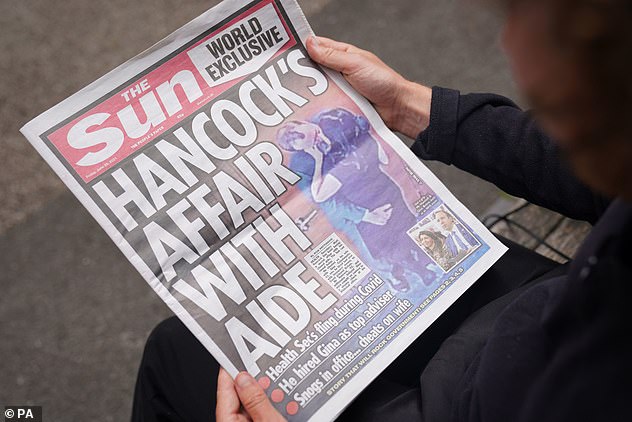
Critics suggested that if the rules were in place now it could have led to a prosecution of the journalists who revealed this month that Matt Hancock was breaking Covid rules by having an affair with his married aide, because it relied on leaked CCTV footage.
And Mr Simpson tweeted: ‘Priti Patel’s Home Office wants to make it a crime for journalists to embarrass the govt by publishing leaked official documents. The maximum penalty would be 14 years in prison. This would put British journalists on a par with foreign spies.’
Quoting his tweet, ex-BBC Newswatch presenter Raymond Snoddy added: ‘And the government the equivalent of tinpot dictatorships everywhere.’
A Twitter user also asked Mr Simpson: ‘If this had been law at the start of your career, would you have been prosecuted?’ And he replied: ‘Probably.’
On a similar theme, Neil Mackay, writer at large at The Herald in Scotland, said: ‘I’d have been jailed under these changes to the Official Secrets Act for my reporting on the work of British intelligence in both Northern Ireland during the Troubles, and in the run up to the Iraq War. This is how democracies die: slowly and by 1,000 cuts.’
So funny, whistle-blowers can send info to foreign presstitutes or the presstitutes can send info overseas.
“But the Home Office insisted such a move would ‘undermine our efforts to prevent damaging unauthorised disclosures, which would not be in the public interest”.
The thing here is that this has nothing to do with the ‘public’. 95% of sheeple couldn’t give a toss about a secrets breach.
The only ‘interest’ here is the deep state and regimes interest.
The reason why they need these tyrannical laws is that they (ragime & deep state) are upto some really serious shit. Murdering old sheeple in care homes, releasing bioweapon, the deep state sheeple who probably murdered the Skripal’s.
There is a cracking dam holding back a massive swamp of regime and deep state crimes & they are very worried. They must monitor the sheeple who work in supporting the regime and deep state, & while there has always been disgruntled sheeple, we are now at a time when the numbers of potential leakers and whistle-blower is at a point where they are losing control.
I’ve been saying this on here for years. The UK is by far the most corrupt country the world has ever known. It is a kind of corruption that doesn’t use money. I can tell you now that every council in the UK is engaged in high level corruption in the form of contracts that the regime demands they use so they can get services provided by the so say private sector. Some of these provided are massive corporations. These councils just hand the contracts and sheeple taxes over. Same with the NHS, the military, the police, corporations, the regime/one party state and we can’t leave out the City crime cartels, one of the principal reasons for Brexit.
The level of action by this regime reflects the building threat to ‘their’ system.
All cash flow must go to the City. Everything above has a cash flow to the City. Every action in the UK is about feeding cash into the City. Outside of the City, they only maintain the system so it functions well enough and remains ‘stable’ enough so the City keeps milking the sheeple.
Over all, the regime probably believes that working from home is a profit margin winner and that in out tech age, we should be contained in our prisons on Springfield Avenue where we remain under surveillance.
One last point. I would say that we only get a glimpse of a fraction of 1% of all the likely leaks, and that fake news presstitutes grass on the leaker & whistle-blowers.
Perhaps it’s a good thing that TPTB need to be openly repressive rather than couch their propaganda into fine-tuned psychology delivered by well-dressed standard English speaking news presenters. I mean, this open tyrannical posturing could indicate sheer arrogance or/and desperation in the face of the increasing realisation that their BS programme won’t work. Part of their modus operandi hitherto has been to keep the sheeple in the dark by subtle psychological warfare; this latest move is not part of that playbook.
Who knows what leverage is being used against the likes of Israel visitor Patel and others. In her case there are probably a few financial skeletons that need to be kept in the closet. In the case of Whitty, and apologies to all bald headed Gollum looking wimps who may be reading, if anyone looks like a paedophile it is him.
Independent media which employed real journalists would be disturbed by this. The fact they’re not proves newspapers have become the publishing arm of establishment propaganda and the broadcasting media its theatrics division.
I am always at sea to hear or read articles still giving the impression of a ‘Government’ when events in the past 18 months have clearly demonstrated we do not have a Government. A recent video of Warren Buffet describing all world governments as ‘SELECTED’ is a testimony.
So-called governments treating citizens as cattle that have to be forcibly given a medical procedure whether or not they need it and after giving themselves, manufacturers and medical staff immunity from prosecution do not represent the people.
Wild sheep have a native intelligence equivalent to that of the most intelligent dogs.
There are still wild sheep on the Orkneys and the St. Kilda archipelago in the U.K.
When confronted by an obstacle, such as a tall wall, the wild sheep of the Orkneys stand together in triangular formation, with the greater number of rams at the lowest file, tapering upward until a living ovine ladder allows the flock to clamber up the backs of their compadres and scale the wall. The same ladder shape is then reformed on the other side and the two strongest rams stand atop the wall to pull the rams on the bottom row over as they spring.
The wild sheep on the Orkneys are particularly fond of the fresh coastal grasses, which can only be accessed within one particular bay, which floods at high tide and the fierce North Atlantic prohibits all comers therefore. The sheep have learned to scramble an overland route during low-tide to reach their favourite food and know perfectly well how long they have to engorge themselves before the tide begins to quickly rise again. The route of entry doesn’t provide a means of exit at higher tides, however because of the sodden terrain. So the wild sheep have learned to wait till the water level has reached a particular height, whereupon they all dive into the sea and let the incoming tide sweep them easily around the groynes and breakwaters to the safety of the nearby drier shores.
I wouldn’t annoy a wild ram either. They’re fast, fearless and bruising exponents of the surprize, headlong, counter-attack.
There are readers who habitually use the derrogative, “sheeple” who might wish to ponder on this.
“I’ve been saying this on here for years. The UK is by far the most corrupt country the world has ever known. It is a kind of corruption that doesn’t use money. I can tell you now that every council in the UK is engaged in high level corruption in the form of contracts that the regime demands they use so they can get services provided by the so say private sector. Some of these provided are massive corporations. These councils just hand the contracts and sheeple taxes over. Same with the NHS, the military, the police, corporations, the regime/one party state and we can’t leave out the City crime cartels, one of the principal reasons for Brexit.”
Excellent analysis. And while I did vote Brexit I did it as a desperation vote showing my disdain for mass immigration; not that it makes much difference….
Related to another topic you raised on “fascism” and council politics I’ve just posted Carl…I have to say when I was a councillor I had no idea that people were so influenced by taking money. To me then it was all about ideology. I would have been a far better councillor if I’d realised it was all about financial scrutiny. The other side of corrupt local government is of course the disinterest of local people that has provided the fertile ground for this to develop.
I believe that in a complex society there has to be delegation to others, but without scrutiny this power is always abused.
Jewish global power reaches into Japan.
A Japanese director of the opening Olympic ceremony was “discovered” to have made a joke about the holocau$t YEARS AGO.
HE GOT SACKED….obviously the Japanese elites are all too aware of the power of the jews.
Usually Jewish threats about X person are followed up with threats on trade if the targeted person is not penalized.All thanks to the total domination of America by the jews.
This incident is by no means unique….the “FF’S” (FUCKING FIENDS) got Bobby Fisher the former chess champion thrown out of Japan….after hounding him around the world….AND stealing all his assets in the USA where he could not return to because of the danger if immediate arrest.
Yet the fiends keep insisting they are a helpless persecuted people.They are able to do this thanks to their DOMINANCE of the Wests media…
If you believe in a higher power in the Universe, you should know that the arrival of the Age of Aquarius heralds a paradigm shift as the Great Awakening manifests across the World. It is hard to keep up with the truth bombs dropping everywhere. The evil entities have exposed themselves for all to see. The desperation to keep the system intact is evident; the Globalists are losing the information war, and no matter how draconian the surveillance and suppression measures they impose, they will lose the war because the public will not accept their vision of the future.
I read a political commentary years ago which stated that Democracy was just a passing phase in a long history of totalitarian rule. We’re almost there.
only Stalins Pravda will be accepted
under the ministry of truth !
MM: “Independent media.” What a strange idea.
Simon Smith: of course they use cash at the bottom of the food chain. They need the sheeple who so say monitor contracts to take cash, but the real money in in the contact abuse. So a simple 10 worker cleaning contract is also maned at 8, so that’s is total corporate gain of nearly £50k and this is a tiny example. If councils employed direct, no corruption and Labour who is just a part of the one part state would never change this gravy train.
We’ve just had a £5 billion tank contract cancelled because the corruption got out of hand and they couldn’t hide it. This tank couldn’t fire while it was moving! A lot of sheeple should be going to prision
Same with £10 billion NHS computer system that didn’t work, where are the arrests and prison sentences?
I love this. Turn them all into Julian Assanges