
Introduction – June 29, 2021
Either the Guardian is trying to “dumb down” its readers, or it assumes that they are already very stupid.
“The vaccines are not perfect”, claims the Guardian but in doing so it entirely misses the point. It normally takes up to 15 years to fully test a new vaccine. Meaning that the Covid vaccines are still essentially EXPERIMENTAL. So we do not know what their long-term impact will be.
However, the Guardian ignores what should be obvious and continues:
“We can perhaps assume there is at least 95% protection against Covid-19 death, which means the lethal risk is reduced to less than a twentieth of its usual value.”
Again the Guardian entirely and perhaps even deliberately misses the point. Given that the survival rate among those infected with Covid-19 is in excess of 99 percent, why get vaccinated when the vaccine itself could be potentially lethal?
What this article does do is illustrate how the MSM is trying to allay quite genuine public concerns about the vaccine. While it pretends to open-minded and liberal, the Guardian is using pure sophistry to promote the official vaccination policy.
In essence the media is working with the authorities to disseminate disinformation that could have dire consequences for readers who don’t think for themselves. Ed.
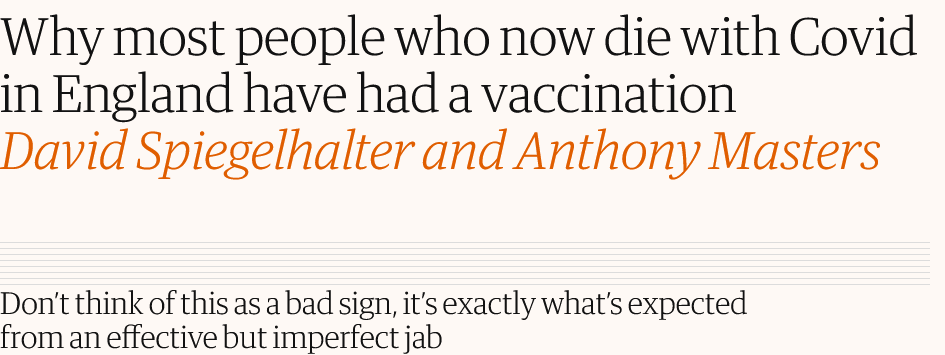
Why most people who now die with Covid in England have had a vaccination
David Speigelhalter and Anthony Masters — The Guardian June 27, 2021
A MailOnline headline on 13 June read: “Study shows 29% of the 42 people who have died after catching the new strain had BOTH vaccinations.” In Public Health England’s technical briefing on 25 June, that figure had risen to 43% (50 of 117), with the majority (60%) having received at least one dose.
It could sound worrying that the majority of people dying in England with the now-dominant Delta (B.1.617.2) variant have been vaccinated. Does this mean the vaccines are ineffective? Far from it, it’s what we would expect from an effective but imperfect vaccine, a risk profile that varies hugely by age and the way the vaccines have been rolled out.
Consider the hypothetical world where absolutely everyone had received a less than perfect vaccine. Although the death rate would be low, everyone who died would have been fully vaccinated
The vaccines are not perfect. PHE estimates two-dose effectiveness against hospital admission with the Delta infections at around 94%. We can perhaps assume there is at least 95% protection against Covid-19 death, which means the lethal risk is reduced to less than a twentieth of its usual value.
But the risk of dying from Covid-19 is extraordinarily dependent on age: it halves for each six to seven year age gap. This means that someone aged 80 who is fully vaccinated essentially takes on the risk of an unvaccinated person of around 50 – much lower, but still not nothing, and so we can expect some deaths.
The PHE report also reveals that nearly a third of deaths from the Delta variant are of unvaccinated people over 50, which may be surprising given high vaccine coverage; for example, OpenSAFELY estimates more than 93% among the 65-69s. But there are lower rates in deprived areas and for some ethnicities and communities with limited coverage will continue to experience more than their fair share of loss.
Coverage and effectiveness are important numbers for assessing vaccination programmes. It is better to look at cool analysis by analysts, rather than hot takes on social and other media.
I saw an article about deaths last week attributed to the virus onMonday.
Apparently….50 unvaccinated people died of Covid in England last week. And…50 people who had received BOTH shots died of Covid in England last week.
The people behind the articleconsulted two EXPERTS about the matter. The experts of course…were Statisticians.
Unfortunately it’s become crushingly obvious that democracy just doesn’t work. Better kiss it goodbye you’re watching the last kicks of a dead hippopotamus.
Tottenham Hotspur is the most Jewish football club and the one they mention relative to needling the goyim.
Another fail for the British and European authorities over Covid concerns the Euros football tournament. It’s been announced in Yahoo News UK that England fans will not be able to attend the match on Saturday against Ukraine in Rome because the Italian authorities say England fans must isolate for five days after leaving from Britain. But what about England’s football team, they did too? And what about the Ukraine team and their fans who were in Scotland? Covid wouldn’t stop at borders but they’ll be there no doubt. It was bad enough the Johnson government gave a no-isolation pass to privileged foreigners with links to either team, or who had invitations from those who do have links.
These rules are contrary and in-yer-face selective, and while freedoms are being eroded at a pace and those of us who say so are called conspiracy nuts, perhaps what’s happening over the “footy” will open the eyes of those still as blind as three-day old kittens – especially if they were fool enough to get two shots so they could travel, but who still aren’t going anywhere except maybe to an early grave.
the vaccine could be harmfull to your immunesystem
so when you next time encounter a flu the immune response is weak or misdirected
Just wait a few more months and you will see the suicidal death jabbers around the world dying in huge numbers. This is a fitting end for fools who can not find the truth. Most governments are the enemies of the citizens. The safest path is to do the exact opposite of what “government” recommends. Of course, you could opt for a civil war……………but, that will not work in the UK as the British people allowed themselves to be disarmed.
If you could possibly fail an IQ test, did you read that all the test animals died should be one of the questions on said test from now on. It should be read, said, AND let’s go to the tape of “adverse reactions”. We can perhaps assume there is at least adverse consequences to bullshitting.
Save your soul,hell is real its the end of days
If you’re a Guardian reader you ARE stupid.
It’s why, when I used to go to the pub, I made a habit of looking to see what paper people were reading. I would know to avoid them in conversation should they peruse the Guardian.
When people say “Yes, the world is overpopulated and we need to bring down the population” I always ask them why they haven’t removed themselves, to help with overpopulation? They always look at me, to imply “oh you don’t mean me? You know I’m speaking of people in the 3rd world?”
Regardless of IQ, race, religion, social status, wealth etc, everyone, on this earth, has as much of a right to be here over anyone else. It’s about survival of the fittest, combatting that which nature, not man, throws against you. Sadly, however, we have two types of people on this earth; those who believe, because of their religion that this world is theirs and there are those who believe, that because, they’ve successfully plundered everyone else and got stinking rich, they should therefore get life over all others. And of course, they’re the last people, that should walk the earth.
Let’s also look at the reality here that the two above, mentioned groups are also incredibly in favour of world depopulation, because the last thing those who have robbed and murdered want is to have the mob out for revenge when they wake up to understand why their lives are sh*t and others aren’t. It’s a defense mechanism.
But anyway, the Guardian is essentiall Pravda. It’s a communist rag, that will continue to promote the hatred of anything anti communist which just happens to be white people, the family, heterosexuals, nationalists and essentially everything that isn’t jewish and LGBTQ+.
I do not think the Guardian is trying to dumb down its readers as suggested. The vaccine, as what the Guardian published is exactly what is expected from an effective but imperfect jab. It is effective to perform what mRNA or adenovirus is supposed to do to human being as evidenced by the various (adverse) vaccine reporting system and imperfect delivery system as evidenced by the less than 100% acceptance by the public worldwide
“It is better to look at cool analysis by analysts, rather than hot takes on social and other media.” So…. “trust the experts” then! That’s the best they’ve got. Ha ha ha.
https://www.zerohedge.com/covid-19/panic-porn-dressed-science-exposing-truth-about-delta-variant
“Panic Porn Dressed Up As Science” – Exposing The Truth About The Delta Variant
But is the Delta variant really “far more contagious” than earlier iterations of SARS-CoV-2?
In a recent piece published by the Blaze, writer Daniel Horowitz explains that the existing data suggests Delta isn’t any deadlier or more infectious than other strains. Horowitz described the warnings from epidemiologists and public health bureaucrats like Dr. Fauci as “panic porn dressed up as science.”
After each city and country began getting ascribed its own “variant,” I think the panic merchants realized that the masses would catch on to the variant scam, so they decided to rename them Alpha (British), Beta (South African), Gamma (Brazilian), and Delta (Indian), which sounds more like a hierarchy of progression and severity rather than each region simply getting hit when it’s in season until the area reaches herd immunity.
However, if people would actually look at the data, they’d realize that the Delta variant is actually less deadly.
As you can see, the Delta variant has a 0.1% case fatality rate (CFR) out of 31,132 Delta sequence infections confirmed by investigators. That is the same rate as the flu and is much lower than the CFR for the ancestral strain or any of the other variants. And as we know, the CFR is always higher than the infection fatality rate (IFR), because many of the mildest and asymptomatic infections go undocumented, while the confirmed cases tend to have a bias toward those who are more evidently symptomatic.
In other words, Delta is literally the flu with a CFR identical to it. This is exactly what every respiratory pandemic has done through history: morphed into more transmissible and less virulent form that forces the other mutations out since you get that one. Nothing about masks, lockdowns, or experimental shots did this. To the extent this really is more transmissible, it’s going to be less deadly, as is the case with the common cold.
its very good when state trusting people die out !
Ratchild: We’ll kill off the old white goyim first…
there are no alpha beta gamma delta variants . its just priones +
spikeproteines shedding and this was as bioarm intended from the
beginning . the insidious governments just declare them as new
corona variants for to lie to the publico to continue with their varints lies
to enforce more stricter regulations to the people . you can guarantee
this to the next flu season in autum.
@Mark Borah,
I only read the first 5-6 lines of the Guardian article before realizing that it was structured by an unscrupulous biostatistician whose sophistry trumps his ethics. The figures are spewed in 3-card Monte fashion to distract the eye from the bouncing ball, which is that these numbers are picked to mislead and deflect from the darker truth, which may be guessed at by seeing what the detour is trying to avoid.
Any such exercise WITHOUT CONTROL is worse than pointless, a license to lie and deceive.
The properly designed retrospective analysis would match a RANDOM sample of the vaccinated against a RANDOM SAMPLE of unvaccinated, stratified for age and maybe other demographics and baseline health status.
Then it makes sense to compare infection and mortality (both Covid-specific and all-causes) rates over the chosen time frame.
The jabs were not vaccines, they are not ‘imperfect vaccines’. They are doing now what the American and Chinese designers designed them to do. No doubt tested fully on people in China.