
Chris Cole – Drone Wars June 9, 2021
The MoD’s internal think-tank, the Development, Concepts and Doctrine Centre (DCDC) along with the German Bundeswehr Office for Defence Planning (BODP) has published a disturbing new report urging greater investigation of – and investment in – human augmentation for military purposes. The following is a brief summary of the 100+ page document with short comment at the end.
‘Human Augmentation – The Dawn of a New Paradigm’ argues that humans are the ‘weakest link’ in modern warfare, and that there is a need to exploit scientific advances to improve human capabilities.
“Increasing use of autonomous and unmanned systems – from the tactical to the strategic level – could significantly increase the combat effect that an individual can bring to bear, but to realise this potential, the interfaces between people and machines will need to be significantly enhanced. Human augmentation will play an important part in enabling this interface.”
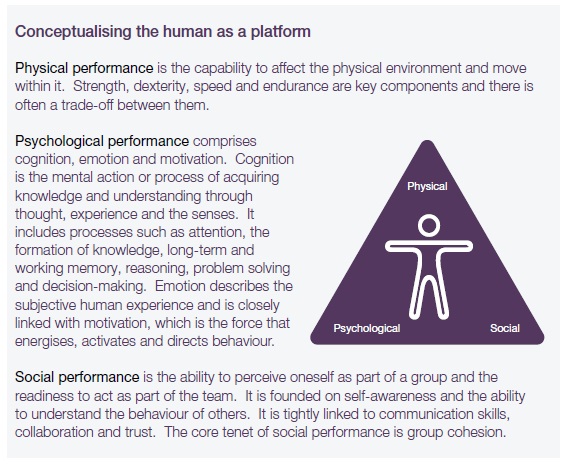
Suggested human augmentation to explore for military purposes includes the use of brain interfaces, pharmaceuticals and gene therapy. Humans, argues the report, should be seen as a ‘platform’ in the same way as vehicles, aircraft and ships, with three elements of ‘the human platform’ to be developed: the physical, the psychological and the social (see image below).
The report defines human augmentation as ‘the application of science and technologies to temporarily or permanently improve human performance.’ It then differentiates between human optimisation which can “improve human performance up to the limit of biological capabilities without adding new capabilities” and human enhancement which can take the humans “beyond the limits of biological potential.” While noting that night vision googles and binoculars should be technically be included in the definition of human augmentation, the reports states it is focusing “on the implications of novel science and technology that are more closely integrated with the human body.”
The authors of the report argue:
“We want ‘war fighters’ – whether they be cyber specialists, drone pilots or infantry soldiers – to be stronger, faster, more intelligent, more resilient and more mobile to overcome the environment and the adversary. As technology has become more sophisticated our thinking has become more focused on the machine rather than the person, but this needs to change if we are going to be effective in the future.”
Although “advances in artificial intelligence, robotics and autonomy mean that human processing power, speed of action and endurance are being rapidly outpaced by machines” say the report, it accepts that machines “have weaknesses of their own.” Suggesting that humans have ‘an advantage in the areas of creativity and judgment,’ the report argues that human augmentation is needed in order to take greater advantage of the developments in these areas:
“Future wars will be won, not by those with the most advanced technology, but those who can most effectively integrate the unique capabilities of both people and machine… Human augmentation is the missing part of this puzzle.”
High-end augmentation
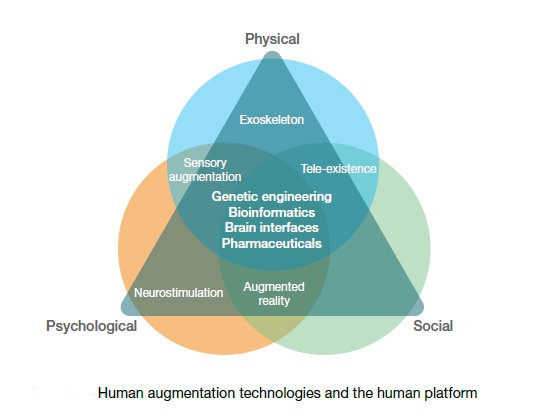
After outlining the basics of human optimisation such as sleep, nutrition and dietary supplements, the report turns to what it calls ‘high-end augmentation’. It outlines and discusses four ‘core human augmentation technologies’ that it suggests are crucial to explore in this context: genetic engineering, bioinformatics, brain interfaces and pharmaceuticals.” It then turns to their implications for the military.
Arguing that the deployment of armed forces is being made increasingly difficult by the proliferation of long-range precision weapons, the report suggests that greater use of unmanned systems in conjunction with lighter, mobile and more versatile ground forces is the solution. “Human augmentation will directly support these solutions” the report asserts. Through brain interfaces, personnel will be able “to increase the combat power they can bring to bear by networking them with autonomous and unmanned systems.”
The increasing use of computers and AI in warfare means that the “cognitive load on personnel is likely to increase, particularly for those involved in command and control.” It suggests that ‘bioinformatics’ – the study and analysis of large amounts of biological data – could help at the recruitment stage by “identifying commanders and staff with the right aptitude for command and control roles.” It goes on:
“Brain interfaces, pharmaceuticals and gene therapy could all play a significant part in optimising and enhancing command and control proficiency. In the short term, non-invasive brain interfaces could improve performance by being used to monitor cognitive load, develop better processes and improve training. In the longer term, brain interfaces could network brains with headquarters providing a completely shares operating picture, improving the quality and speed of decision-making.”
However, the report acknowledges that such human augmentation will have an impact on personnel as they prepare for life after the military.
“The use of invasive human augmentation may require surgery to remove or downgrade implants that may not be permitted in civilian life. Reintegration to society could be complicated from a technical perspective but learning to live without military-grade augmentation could present even bigger mental health challenges.”
Attempting perhaps to put a positive spin on it, the reports goes on: “equally, veterans who have benefitted from human augmentation in Service life may be highly sought after by civilian employers.”
A scant look at ethics
In a relatively short section on ethical considerations, the report states that it does not address larger ethical questions about human augmentation as they “rightfully continue to be the subject of wider debate.” It does, however, make clear arguments in favour of military use. In particular it declares:
“Defence cannot wait for ethics to change before engaging with human augmentation – we must be in the conversation from the outset to inform the debate and understand how ethical views are evolving.”
In a sign of how it is going to make its argument in the debate, it likens opposition to human augmentation to the opposition by some to vaccines, saying that the discovery of smallpox saved millions of lives but was condemned at the time by some of the world’s leading thinkers. “We cannot assume human augmentation will be automatically effective or accepted in its intended use, no matter how beneficial its effects may be. Human augmentation may be resisted by elements in society that do not trust the effectiveness and motive of augmentation.
At the same time, the authors of the report make clear that military developments in this area should not wait for public agreement or ethical debate but be “based on the national interest in terms of prosperity, safety and security.”
“The imperative to use human augmentation may ultimately not be dictated by any explicit ethical argument, but by national interest. Countries may need to develop human augmentation or risk surrendering influence, prosperity and security to those who do.”
Ominously, the report argues that “relationships with industry and academia will be key to understanding how emerging augmentation technologies could be repurposed or developed for Defence.” Life sciences, unlike nuclear physics or cryptography has “relatively little experience of classified research and its links with national security apparatus are less developed.” This relationship – including with “government departments responsible for health and social care” – need to be “revised” declares the report, urging a move towards “a more sophisticated relationship between the public and private sector” in this area.
The report does not underestimate the opposition to such moves, but insists, as ever in these type of discussions, that if we do not develop these systems, our enemies we be able to use such squeamishness against us:
“Successfully exploiting human augmentation will require Defence and society to face up to uncomfortable ethical and legal dilemmas. So far, Defence organisations in liberal democracies have adopted a ‘wait and see’ approach, choosing to let ethical debate and technical developments play out. This passive stance will cede momentum to our adversaries and cause Defence to miss opportunities to improve the well-being and effectiveness of our Armed Forces.”
Eroding humanity from warfare
 The argument, as this report makes, that we are weak and ineffective in the face of sophisticated and deadly enemies is far from a new one. It has been used for centuries to develop and sell tools to increase our lethality and reach in order to project deadly force around the globe. But there is a qualitative difference between equipping a soldier with night-vision goggles or a high-powered rifle and implanting a computer interface in the brain of a drone pilot in order to increase data processing or network with an AI. That is before we get to the idea of somatic gene engineering to reduce pain thresholds or increase cognition.
The increasing use of computers, robotics, unmanned and remote systems in warfare is – in part – about enabling the erosion of humanity from warfare. Eroding hesitation, empathy, risk to oneself. Eroding the possibility of capture rather than kill. Eroding public knowledge and understanding of what is happening on the ground thousands of miles away. Such remote warfare distances us, in different senses, from the consequences of our warfare.
Human augmentation – as the report acknowledges – could change our understanding of what it means to be human. But using human augmentation to eliminate so-called weaknesses in order to increase our aptitude for organised violence also threatens our humanity. The notion that humanity is a weak link to be eradicated in order to be more lethal is simply appalling.
Gene Roddenberry the creator of Star Trek
has close ties to the pentagon and NASA
in his TV series he desribed the borg which mens bank
as the group where all people were turned into half machines
you can see he knew well in advance
The British and Germans have no political power and have no intention of getting any, so the weapons are all irrelevant to politics and are driven by the yin-yang relationship, in this case the one between the people and the machine. The technocrat is the medium (representing zero), the masses are yin (passive), the machine is yang, the cyborg is the hybrid, and engineering is at the chaos position, which represents infinity. I have this as the sixteenth level in a progression, or retrogression. After this comes a yang within the cyborg, who, as yet, adds up to yin. Yang cannot stand a hybrid.
Its “Bad Humans” that take us to war in the first place. How is it we dont have a department for peace and prosperity for all?
Interesting! And it makes me wonder who the “adversaries” are that this technology will be used against. Since this world is destined to have a one-world government and ruler, I suppose it would be used against all who would not submit to the dictates of the dictator. That would be me, for one, and many others who are opposed to a one-world super government. And although all the evil armies raise their weaponry against the soon coming true King, Jesus, at His return, they will be utterly annihilated!
military scientists as usufructuaries of mentaly disturbed political
structures and payed by them must understand that the innermost
nature of humans is peacefuly . this peaceful nature is only outbalanced
when in contact with powergame worshiping psychopates . it is a mentaly
illness and all thinking + ideas to solve that problem are only agitationes
of devils brainstorming . the only cure : MEDITATION ; COME OUT OF
THE BRAIN; GO INTO THE HEART .
however killing of traitors of their own people is MANDATORY !
Remember, all this A.I., drones, robots, nanotech etc will be programmed by the anti-white Jewish Overlords to institute & implement their biotech or wetware sociological schemes upon the goyim…
‘Soylent green’ is on the horizon. Now ‘Universal Soldier’ is too. Were classic sci-fi films a warning, or were they planting the seed?
I haven’t bothered to read the article because lunatics that think they know better than God Himself just make me ANGRY.
These idiots can’t even create a working blade of grass, and yet they think they can “improve” us by turning us into robots.
@Ann Blue
Keep Dreaming.
@ COLIN MCNALLY
it would not help . look to the semites : they greet each other with
shalom + salam . but dont get peace but only war because its a SPELL !
YOU GET ALWAYS THE NEGATIVE FROM WHAT YOU WANT !