
Introduction – June 13, 2021
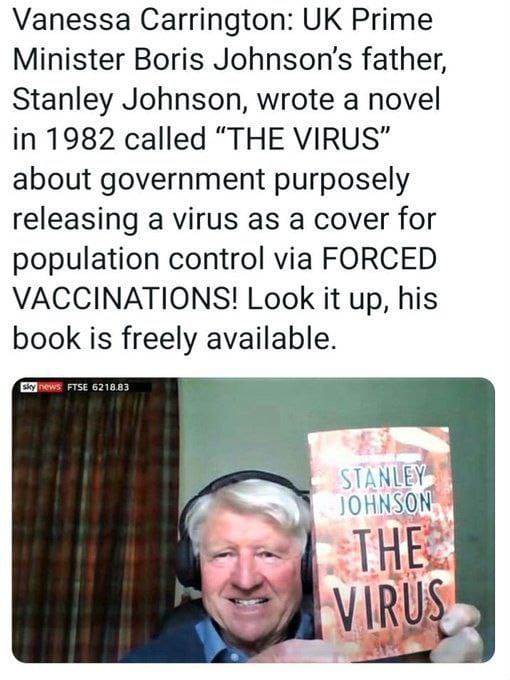 The old saying that people “get the leaders they deserve” seems to have been confirmed in a recent poll in which respondents were asked about Boris Johnson’s plan to delay the lifting of lockdown in Britain.
More than half of those questioned indicated their approval of a proposed delay in lifting restrictions. According to Sky News this was due to concern over the rapid spread of new variants of Covid-19.
Those who helped orchestrate the media generated illusion of a deadly “pandemic” must be encouraged by the fact that so many believe it. Even though there has been NO CHANGE in overall death rates many people still seem to believe that we are in the midst of a deadly “pandemic”.
This level of public gullibility will inevitably lead to the imposition of yet more restrictions. After all, if those behind the plandemic can convince the public that what is essentially a variant of seasonal flu is a ‘deadly pandemic’ then they can proceed to the next stage of their plan.
The first signs of this may be found in new findings from Australia where “researchers” found that ‘vaccine hesitancy’ might prevent the country from achieving herd immunity. The implication being that those who refuse vaccinations or question the official narrative may be contributing to the spread of Covid-19.
In other words those behind the plandemic have introduced a new complication – “vaccine hesitancy” – that needs to be dealt with. It’s anyone guess what their proposed solution will be but it’s likely to be along the lines of mandatory vaccinations and internment. Ed
Vaccine hesitancy and variants mean Australia may not reach Covid herd immunity – researchers
Melissa Davey – The Guardian June 12, 2021
Australia is unlikely to achieve herd immunity with current levels of Covid-19 vaccine hesitancy and the higher infectiousness of new variants, modelling from Melbourne medical research laboratory the Burnet Institute has found.
The scenarios modelled by researchers assume a vaccine rollout speed of either 150,000 or 250,000 doses per week, and that on detection of the first case, symptomatic testing increases, isolation of positive cases continues, masks become recommended but not mandatory, and contact tracing continues for up to 250 diagnoses per day.
The projections represent hypothetical near-worst-case scenarios, and model outbreaks that occur once Australia is Covid-free, without lockdowns and other public health measures in place.
The models reveal that public health initiatives will remain vital even in vaccinated populations and that without those measures, “thousands of Victorians would be hospitalised and die if an initially small outbreak was left to spread through the community unchecked,” the research published on Friday says.
Burnet Institute’s head of modelling, Dr Nick Scott, said public health measures, such as lockdowns, social distancing, mask wearing and use of QR codes, would need to continue to prevent a projected 4,800 deaths in Victoria alone within 12 months if the virus were to spread without a public health response beyond vaccination.
“Those who are vaccinated would be protected and may only experience mild or no symptoms,” Scott said. “But among those not vaccinated – possibly up to 30 per cent of the community – we could see a large number of hospitalisations and deaths, as well as many cases of ‘long Covid’.”
The modelling presents scenarios projecting Covid-19 infections, hospitalisations and deaths one year after new infections enter the community, even when people are vaccinated. Parameters around vaccine efficacy, viral infectiousness, vaccine coverage and the speed of the vaccine rollout can be modified under the model.
They closely monitor the amount of “hesitancy” and I am pretty sure they want it at a particular level, and present information themselves to keep it there. Great to see how well the tax money is spent.
If they want herd immunity in Australia they should lynch their politicians. They will reach herd immunity when the last Australian hears about it because then their shit-show will be over.
Excellent news! Now Australians will be kept under permanent lock down, and Scott Morrison will be replaced by Dan Andrews.
Come on Aussies – don’t fall for it.
i think the ‘large number of hospitalisations and deaths’ will be coming from the vaccinated this winter – but they won’t tell you that
This is preparing the public for the use of force.
As far as I can find out the Burnet Institute is funded by the Australian govt. So hardly credible or independent.
The CSIRO used to be the official scientific body but because they were too “independent minded” MorriScum gutted the funding and sacked hundreds of scientists and researchers.
Now they fund quasi independent “Institutes” so they can engineer the outcome.
Well, well, just look at what these unlawful, lying criminal scum politicians in Melbourne are now pulling off…
https://www.theage.com.au/politics/victoria/andrews-government-secretly-negotiating-permanent-pandemic-laws-to-replace-state-of-emergency-20210611-p5807t.html