
Guardian staff and agency – June 3, 2021
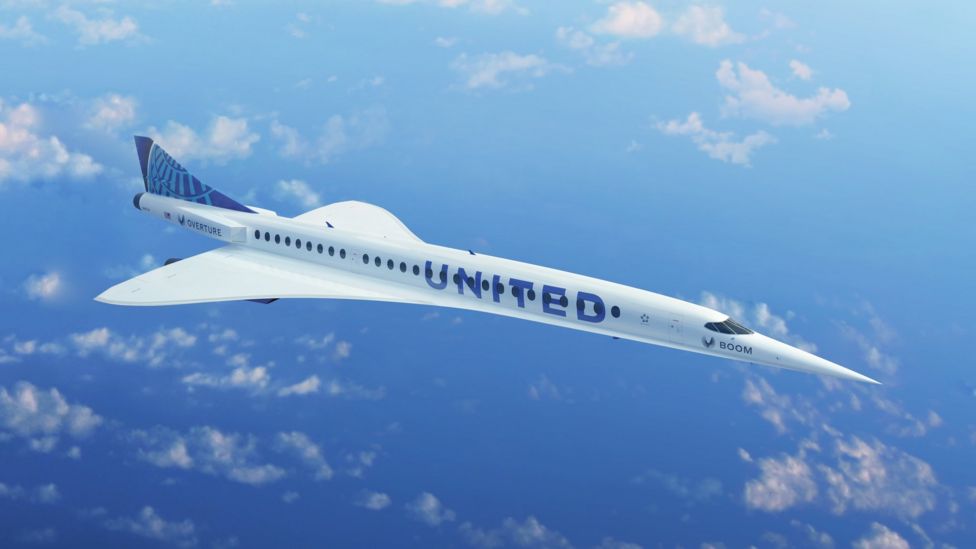
United Airlines has bought 15 planes capable of travelling at twice the speed of modern airliners as it aims to bring back supersonic travel 18 years after Concorde’s final flight.
The airline agreed to purchase the Overture aircraft from Boom Supersonic, with the planes able to fly at Mach 1.7 (1,300mph), potentially halving the transatlantic journey from Newark to London to three and a half hours.
Trial flights are scheduled to begin in 2026, with commercial use coming three years later.
United has an option on an additional 35 planes from the Denver-based manufacturer. The initial order will be finalised once the aircraft meet “demanding safety, operating and sustainability requirements”.
The Overture will carry fewer passengers than existing subsonic passenger jets, with 65 to 88 seats – less capacity than Concorde – which will initially be priced at business class fares.
Environmental campaigners have criticised the use of supersonic aircraft, which require more fuel per passenger than regular airliners.
But United, which has pledged to reach net zero emissions by 2050, said the Overture was expected to be the first large commercial aircraft to use 100% sustainable aviation fuel.
The airline’s chief executive, Scott Kirby, said: “United continues on its trajectory to build a more innovative, sustainable airline and today’s advancements in technology are making it more viable for that to include supersonic planes.
“Boom’s vision for the future of commercial aviation, combined with the industry’s most robust route network in the world, will give business and leisure travellers access to a stellar flight experience.”
Blake Scholl, the chief executive of Boom Supersonic, said: “The world’s first purchase agreement for net-zero carbon supersonic aircraft marks a significant step toward our mission to create a more accessible world.”
The Civil Aviation Authority in the UK and the US Federal Aviation Administration must grant approval for the return of supersonic passenger planes to the skies. And noise pollution campaigners and residents living under flight paths could set themselves in opposition to the plan.
Concorde holds the record for the fastest transatlantic flight by a civilian plane – two hours, 52 minutes and 59 seconds – between New York and London in 1996. But the airliner was retired from service in 2003, with British Airways and Air France blaming a downturn in passenger numbers and rising maintenance costs.
So much for this carbon-neutral and global guff. And the rich who fly them–because only the rich could afford the tickets–will still demand heavy subsidy on the tickets or even many of them will find the cost too prohibitive. I watched a program about Concord shortly before it was withdrawn, and the musician Sting was on the plane and asked what Concord meant to him. He replied he could get from London to New York quicker on Concord than he could from London to Newcastle on the train.
What he didn’t mention but the reporter informed us was his £3,000 ticket would have cost him £8,000 without the subsidy. So a multi-millionaire got more subsidy from the government for a privileged three-hour flight than [at that time] an unemployed person and his family got to live on for a full year, all while being called a workshy bum for claiming it. I’m not sure Sting would have flown it that often if not for the £5K subsidy. He’d have been better off hiring his own jet and selling a few seats.
Joe Vialls suggested that the four Concordes were sabotaged in retaliation for the four Boeings lost on 9-11, but, come to think of it, it means he was a big disinformation agent. It was when he credited the event to Russia, Germany, France and “some technical help from Japan”. I believed him for over two years, like when I believed Irving’s 2014 Holohoaxing for six months in 2016.
Makes a lot of sense when air traffic is near zero.
Are they blowing their bailout money?