
Pepe Escobar – The Unz Review May 27, 2021
When Iran’s Interior Ministry released on Tuesday the final list of candidates approved by the 12-member Guardian Council to run for President in the upcoming June 18 election, all hell was breaking loose in Tehran for at least 24 hours.
An “unofficial” list of the 7 candidates for the presidential election was already circulating and causing quite a stir, but not confirmed yet to be final.
The talk of the town was that the list barred a lot of important people. Former President Mahmoud Ahmadinejad was out. So was Ali Larijani – a former Parliament speaker, and even the current Iranian Vice President, Es’haq Jahangiri, who should be the top reformist running.
The Fars news agency had broken the story on Monday, announcing the final 7. They got everything right – from the elimination of Ahmadinejad, Larijani and Jahangiri to the fact that no women candidates were approved.
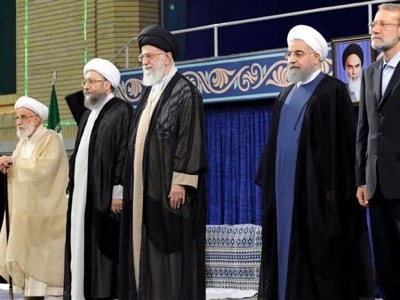
From left to right : Ayatollah Ahmad Jannati (President of the Assembly of Experts, the 86 religious sages who preside over Iran) ; Ayatollah Sadeq Larijani (Chief of the Islamic Judiciary) ; Ayatollah Ali Khamenei (Supreme Leader of Iran) ; Cheikh Hassan Rohani (President of the Islamic Republic) ; Ali Larijani (brother of the Chief of the Islamic Judiciary and President of the National Assembly).
Fars is very close to the IRGC. So what happened makes perfect sense. Including the rumors swirling around Tehran that outgoing President Rouhani went into panic mode, calling Ayatollah Khamenei for a revision of the list.
As it stands, the Magnificent Seven who will be running are Ebrahim Raeisi, Saeed Jalili, Mohsen Rezaei, Alireza Zakani, Seyyed Amir-Hossein, Ghazizadeh-Hashemi, Albdolnasser Hemmati and Mohsen Mehr-Alizadeh.
The undisputed leader of the pack is Raeisi, the head of the Judiciary since 2019. He is technically a Principlist – an Islamic Revolution conservative, in Iranian terms – but says he will run as an independent. Call him a soft hardliner.
Among the others, the only one relatively known outside of Iran is Jalili, also a Principlist, and former top nuclear negotiator as secretary of the Supreme National Security Council from 2007 to 2013.
At least in thesis, two reformists are left: Mehr-Alizadeh and Hemmati, the current governor of the Central Bank. But they have no national appeal.
So Raeisi now seems to be nearly a done deal: a relatively faceless bureaucrat without the profile of an IRGC hardliner, well known for his anti-corruption fight and care about the poor and downtrodden. On foreign policy, the crucial fact is that he will arguably follow crucial IRGC dictates.
Raeisi is already spinning that he “negotiated quietly” to secure the qualification of more candidates, “to make the election scene more competitive and participatory”. The problem is no candidate has the power to sway the opaque decisions of the 12-member Guardian Council, composed exclusively by clerics: only Ayatollah Khamenei.
The Guardian Council cryptically stated that only 40 out of 592 candidates had submitted “all the required documents” to the Interior Ministry’s election HQ. There was no explanation about the content of these “documents”.
Abbas-Ali Kadkhodaee, the Council’s spokesman, dismissed any politicking: decisions were made based on “election law”. So no one can contest them – except Khamenei. He stressed that the Council “had not been informed” of any action by the Leader.
The end of the reformist era
Vice President Jahangiri, who would have been the reformist standard bearer, did not take it lightly: in a forceful statement, he said, “the Council naturally bears the responsibility for the decision and its legal basis and for the political and social consequences arising from it.”
More crucially for the Tehran establishment, he highlighted a “serious threat” to the system: “I hope that the republican aspect of the establishment, the effective participation of the people in determining their own fate, the national interests, and the future of Iran will not be sacrificed to immediate political expediencies.”
Advisers to former President Ahmadinejad – still extremely popular nationally – told me they are still weighing their options: “It is a very big disappointment, but expected. A big mistake, that will lead to anger and distrust among common people, and eventually backlash.”
Professor Mohammad Marandi of the University of Tehran remarked, “there’s still some uncertainty about the candidates.” He’s not making a full assessment yet because he’s not sure the vetoing of Larijani, especially, “will be the final say”.
Even as the Magnificent Seven are now free to start campaigning, the overall sentiment is that the Rouhani-Zarif era seems to be over, not with a bang but a whimper.
At the JCPOA negotiations in Vienna, Iranian deputy Foreign Minister Abbas Araghchi continues to sound as a realist, stressing, “I am not confident that it would be possible to conclude the negotiations but there is a possibility.” That would require “political decisions to be made”, a direct reference to Washington.
Everyone in Vienna knows that what was agreed to far on the JCPOA revival was the easy part. The real problem are the remaining hundreds of sanctions that must be canceled by the US Congress – and that’s not gonna happen.
Besides, the Americans continue to insist that Tehran should first resume the nuclear commitments it has suspended – following its legal retaliation rights as defined by Article 26 of the JCPOA. Tehran’s red line is clear: it was Washington which ditched the JCPOA, so it’s up to the US to first remove all sanctions, “practically and verifiably”.
Tehran has reiterated over and over again it will walk out of Vienna by the end of May if there’s no deal. The IRGC couldn’t care less: they are already in post-JCPOA mode. Focused on the Iran-China strategic deal. Focused on wider Eurasia integration alongside Russia and China. And relying on the perfect candidate placed to become the next Iranian president.
(Republished from Asia Times by permission of author or representative)
Black-clad shrouded politics.
Follow the rise of the Pan Eurasian Superstate! China and Russia are mentioned here as having close relations with Iran, the only one missing is Israel which gets Greater Israel in this deal (brokered by China’s Belt and Road Initiative), with Iran getting ‘The ‘Stans’ (Afgani- , Paki- etc)
Around 1917 some Russians were saying “Communism yes, but beat up the Jews”, like the mouse that gets the cheese out of the trap, and this attitude is still a player within the Conspiracy on the goy side. It has made things difficult for the Jews, whose codified hypocrisy was never going to be anything else.
I do wonder if it had been the European powers who had won the Crusades and the Muslims defeated, would the Muslims have gone on to have the Enlightenment and Industrial Revolution while our own political system remained Christian fundamentalist and whose leaders wore religious robes? Looking at those Iranians, they could have been us.
The Crusades are said to be religious wars but that’s not quite so, according to an Oxford historian whose name and book title I forget but whose book was bought from political publishers Zed Books. He said although the Catholic Church endorsed the Crusades because they wanted to convert heathen souls to Christianity, the Crusades were meant to seize military control of the Silk Road to tax the merchants at every trading post. As the Road was about 7,000 miles long, and each caravan only travelled several hundred miles at the most, there will have been two to three dozen trading posts at least, and each trade marked up the prices. Who controlled the Road could also restrict prices, meaning European kings and barons and the Templars etc could get cheaper silk, lacquer, paper and sell it themselves at huge profits.
Like all wars the Crusades were economic wars, and the political systems of east and west could have been very different because of the outcome. Our leaders might have been the men in dresses.
Thank you, MM, for that comment.