
Alex Moshakis – The Guardian March 7, 2021
When Gregg Nome was 24 years old, he slipped into the churn beneath a waterfall and began to drown, his body pummelled against the sandy riverbed. What he saw there surprised him. Suddenly, his vision filled with crystal-clear scenes from his childhood, events he had mostly forgotten, and then moments from early adulthood. The memories, if that’s what they were, were vivid and crisp. Was he reliving them? Not quite. They came at high speed, almost all at once, in a wave. And yet he could process each one individually. In fact, he was able to perceive everything around him: the rush of the water, the sandy bed, all of it brilliantly distinct. He could “hear and see as never before,” he recalled later. And, despite being trapped underwater, he felt calm and at ease. He remembered thinking that prior to this moment his senses must have been dulled somehow, because only now could he fully understand the world, perhaps even the true meaning of the universe. Eventually, the imagery faded. Next, “There was only darkness,” he said, “and a feeling of a short pause, like something was about to happen.”
Nome recounted this story at a support group in Connecticut, in 1985, four years after the experience. He had survived, but now he hoped to understand why, during a moment of extreme mortal crisis, his mind had behaved the way it did. The meeting had been organised by Bruce Greyson, now a professor emeritus in psychiatry at the University of Virginia. (Some of the group’s members had responded to an ad Greyson placed in a local newspaper.) As Nome spoke, Greyson sat in a circle of 30 or so others, as if at an AA meeting, listening intently, nodding along.
Greyson had been hearing of events like these for years. A month into his psychiatric training, in the 1960s, he had been “confronted by a patient who claimed to have left her body” while unconscious on a hospital bed, and who later provided an accurate description of events that had taken place “in a different room”. This made no sense to him. “I was raised in a scientific household,” he says, over Zoom. “My father was a chemist. Growing up, the physical world was all there was.” He felt certain someone had slipped the patient the information. He also thought, “What does that even mean, to leave your body?”
For years, he tried to put the account behind him, but repeatedly he faced heady stories of people experiencing other-worldly events, either when they had been pronounced clinically dead or thought they were close to it, before being wrestled back to life. In the 1975 best seller Life After Life, the psychiatrist Raymond Moody, once a colleague of Greyson’s, labelled these episodes “near-death experiences”, or NDEs, a term that stuck. “It occurred to me for the first time that this wasn’t just one patient,” Greyson says. “It was a common phenomenon.” He became fascinated by the qualities of the episodes and the questions they raised, including perhaps the biggest of all: what actually happens when we die? “I plunged in,” he says. “And here I am, 50 years later, trying to understand.”
Greyson is 74 now. When we talk, he is at home in Charlottesville, Virginia, waiting out the pandemic in a pressed shirt and tie, kind and affable. Over the years, he has collected hundreds of near-death experiences, he says, either from people who, aware of his research, have volunteered their stories, or from patients who happened to have episodes in hospital. In those cases, Greyson’s process is nearly always the same: he sidles up to the bedside and gently withdraws information. “I ask: ‘What’s the last thing you remember before you blacked out?’” he says. “Then: ‘What’s the next thing you remember after that?’ And finally: ‘And what do you remember between those times?’” Not everyone reacts well to the questions; most people stare at him blankly. “But around one in five will say, ‘Well, you know, I thought I saw my father, who died 20 years ago,’ and I say, ‘Tell me about that’ – and I let them go…”
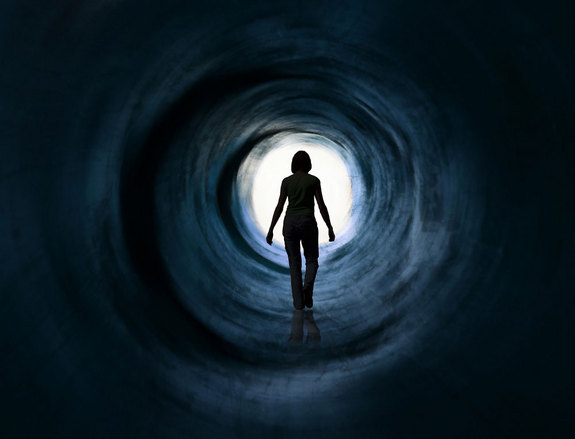
Greyson presents his research in a new book, After, which is bound by a series of case studies. The accounts are mystical, like those we know from TV and books, but there are common themes. After a bad reaction to anaesthesia, one patient recalled: “I found myself in a meadow, mind cleared, identity intact.” The meadow, she went on, was “lit with this glorious, radiant light, like no light we’ve ever seen,” and “a gentle, inner glow shone from each and every plant.” Most episodes involve similar feelings of wonder, mental clarity and bliss, Greyson says. Some people recall out-of-body experiences, or report travelling through a long tunnel; others meet entities they think of as God or Allah or long-dead family members; some feel time bend and warp, as though it were elastic. Once, a policeman who almost died during surgery asked Greyson: “How do you describe a state of timelessness, where there’s nothing progressing from one point to another, where it’s just all there, and you’re totally immersed in it?” Another person recalled: “The energy of my spirit seemed to flow like a great whale gliding through a sea of silent euphoria.”
t has been Greyson’s role as a psychiatrist to provide a space in which “experiencers” feel comfortable retelling often incomprehensible stories – though even when patients discover the courage to try, they can struggle to find the right language. “When I talk to near-death experiencers, one of the first things they say is: ‘I can’t put it into words. There’s no way to express this.’” A frustrated experiencer once told him that when he tried to recall events, “I always fall short.” Another explained it would be difficult to describe her experience because we live in three dimensions, and what she saw on the border between living and dying seemed bigger somehow. Greyson has found that sometimes people turn to painting or music to recall events, as if true meaning can be shared non-verbally. But even that’s insufficient. A subject once told Greyson that recalling his near-death experience was like trying “to draw an odour with crayons”, which is to say, basically impossible.
Given that near-death experiences happen with limited warning, they are almost impossible to test. “We’re dealing with a very short space of time,” Greyson says. A swimmer is trapped underwater, a roofer falls from a ladder, a bystander, peering down at their phone, is struck by a car. In After, Greyson points out that his career has coincided with advances in brain-imaging technology, including the emergence of fMRI scanners, which help neuroscientists observe thinking in action. But equipment like that requires compliance: an appointment is made, a patient agrees to sit still. What happens when an experience occurs randomly, nowhere near a hospital? How do you capture a moment as fleeting and unannounced as the point of near-death?
When I ask Greyson why he decided to publish After now, after all these years, he explains that “we had to wait until we had enough knowledge about near-death experiences to be able to understand what was going on,” by which he means not that we know what NDEs are, but that advances in science have allowed us to rule out a heap of things they are not. “There are physiological hypotheses that seem plausible theoretically,” he says, but none have stuck. Are feelgood chemicals, like endorphins, released into the body at the point of peril, creating euphoria? Does the brain become starved of oxygen, prompting real-seeming fantasies? Do various areas of the brain suddenly begin to work in concert to create strange, altered states? Nobody knows for sure. “We keep thinking, ‘Oh it’s got to be this,’” Greyson says. “No, the data doesn’t show that. ‘Oh, this then?’ Well, nope, the data doesn’t show that, either.”
At the University of Kentucky, the neurologist Kevin Nelson, who, like Greyson, has spent years recording NDEs as a kind of academic side-gig, thinks of the experiences as “a blending of two states of consciousness – wakefulness and REM sleep – during a time of great physical or emotional danger,” and argues that many NDEs are “dream-like”, existing in a neurological “borderland”. (Fainting, he added, might bring about similar experiences.) Other researchers, including the late neurologist Oliver Sacks, have thought of NDEs as “extremely complex” hallucinations, an idea that, if nothing else, seems culturally accepted.
When Greyson mentions his research to colleagues, he receives “a variety of reactions, from, ‘Are you out of your mind?’ to ‘Oh, let me tell you about my near-death experience.’” To formalise NDE research in the 1980s, he developed a survey, the Greyson Scale, which has been translated into over 20 languages and is still in use. (Did you suddenly seem to understand everything? Did you feel a sense of harmony or unity with the universe?) And he has been published widely in respected medical journals. But he can have quirky ideas. In After, Greyson writes: “I take seriously the possibility that NDEs may be brought on by physical changes in the brain,” though he also accepts that the mind might be able to function “independent” of it. There have been reports of people experiencing near-death episodes while their brains are inactive, he says, and “yet that’s when they say they have the most vivid experience of their lives.” This doesn’t make sense to him. Partway though our conversation, he asks: “Are these the final moments of consciousness? Or the beginning moments of the afterlife?”
These kind of theories put Greyson on wobbly ground among neuroscientists, who mostly agree the mind to be a product of the brain. Of the afterlife, Nelson told me: “This claim is the most extraordinary in science, and there is no ordinary, let alone extraordinary, scientific evidence to support it.” (He added: “These are matters of faith.”) Sacks called claims like these “anti-science”. Daniel Kondziella, a neurologist affiliated with the department of neurology at Copenhagen University Hospital, told me that if “people are able to describe and report their experiences, even many years later”, then surely “they have been processed by the brain and stored in its memory centres.” (Like Nelson, Kondziella believes NDEs are somehow related to REM sleep.)
Greyson knows that events in near-death experiences are impossible to corroborate. “We can’t do research on a deity,” he says, drily. But still, he finds it tough to dismiss wackier theories, even if the data isn’t there. When I ask him what his current logical understanding is, he looks resigned. “It seems most likely to me that the mind is somehow separate to the brain,” he says, “and, if that’s true, maybe it can function when the brain dies.” Then he adds, “But if the mind is not there in the brain, where is it? And what is it?”
Near-death experiences are not a new phenomenon. Socrates had one, according to Plato; Pliny the Elder recorded another (in the first century); history is filled with examples of mountaineers falling from cliffs and experiencing bliss rather than terror. But we seem as enthralled now by their meaning as ever, and they continue to be sprinkled liberally across popular culture.
Last year, my four-year-old son and I watched Soul, the Disney film, which introduces the near-death experience to a new audience, very young people, and examines consciousness, the afterlife, and the imperceptible stuff that makes us us. (My son is convinced now that when we die we ride an ethereal, very cool-looking travelator toward a blinding light in the sky.) Often in these screen-based times, we are encouraged to celebrate narratives that promote living the “right” way, which tends to involve appreciating and accepting every moment for what it is, and mindfully placing experiences and relationships above the pursuit of power or prestige or material goods. (Broadly speaking, this is the plot of Soul.) Most of us do not live like that, not entirely, and yet we feel like we should, lest we waste our precious time on this planet. Which is why near-death narratives fascinate us, and why they persist as events of interest in the culture. They ask: “What would you do with your life, if you had another chance?”
To Greyson, the impact near-death experiences have on people’s lives has been his most surprising discovery. “I make a living by trying to help people change their lives,” he says. “It’s not easy to do. But here I’ve found an experience that, sometimes in a matter of seconds, dramatically transforms people’s attitudes, values, beliefs, and behaviours.” Often, these changes persist over decades. In most instances, experiencers realise they are no longer afraid to die, which “has a profound impact on how they live their lives”, because “you lose your fear of life as well – you’re not afraid of taking chances.” Greyson sometimes asks people to describe their partners before and after an event, “and they’ll say, ‘Yeah, this isn’t the person I married; this is someone different.’” He adds, “They see a purpose in life they didn’t see before. I don’t know of anything else that powerful.”
I ask for an example. “I’ve spoken to people who were policemen,” he says, “or career military officers, who couldn’t go back to their jobs, couldn’t stand the idea of violence.” I ask why. He says, “The idea of hurting someone becomes abhorrent to them.” He shrugs. “They end up going into helping professions. They become teachers, or healthcare workers, or social workers.”
I ask if Greyson’s research has changed the way he thinks.
“I don’t think it’s changed me in terms of my relationships with other people,” he says, “except it’s made me more accepting, more open to unusual ideas.” As a psychiatrist, he remains “aware of what it means to be psychotic”, but, he says: “I’m more accepting of unusual thoughts that aren’t crazy, and it’s made me much more conscionable with the unknown.
“I grew up without any kind of a spiritual background,” he continues. “And I’m still not sure I understand what spiritual means. I am convinced now, after doing this for 40, 50 years, that there is more to life than just our physical bodies. I recognise that there is a non-physical part of us. Is that spiritual? I’m not sure. Spirituality usually involves a search for something greater than yourself, for meaning and purpose in the universe. Well, I certainly have that.”
After: A Doctor Explores What Near-Death Experiences Reveal About Life and Beyond, by Bruce Greyson, is out on 11 March (£16.99). Buy it for £14.78 at guardianbookshop.com
There is much resistance to this knowledge being shared
The UK psychologist and professional nutjob Chris French known to students as ” The dirty Jew”
is very against his students even reading about NDES
and the now disgraced Susan Blackmore experemented on her own children
the zio run left wing universities do their utmost to stop this knowledge getting out
Thankyou for publishing this
It’s funny that doctors and experts WILL have much to say on the subject…. except that life continues after death.
Belief and unbelief is the great filter that works like the liver removing toxins. Hard heads fail their first level of life unfortunately. The rest continue to the next level.
NEDs are a fascinating area of human experience. The unfortunate factor is that there are opportunists who fake them, usually to get a book published, or a good job, or to glamourise an unremarble life. The common factor among the genuine cases is the changed life of the experiencers, attested to by family members and intimate friends. I hope NEDs continue to be studied by competent, unbiased researchers.
Shakespeare’s Hamlet says: “And therefore as a stranger give it welcome. There are more things in heaven and earth, Horatio, than are dreamt of in your philosophy.”
The writings of Colin Wilson can cure you of the mundane attitudes that make people suitable for Mammonite exploitation.
Before I became a follower of Jesus I’d been living in NYC and moved to Los Angeles. I was not a drug addict and really did not use narcotics. A few days after I arrived in LA, I was arrested for possession of a small amount of marijuana, and I was imprisoned in jail, but I was released after one month. While there, I was sleeping on my cot, and I had a horrible dream experience. In my dream I was given a choice between good and evil, and I chose evil ( being the sinner that I was). I could immediately feel myself being pulled down, down, down, and I was being strangled and was gasping for breath! I could feel all the sensations of this dreadful plight, and I heard the most evil satanic laughter, the likes of which I’d never heard before. Something exceedingly evil was insidiously laughing at me while I was being strangled! I quickly changed my mind about the evil choice I had made just moments before, and I cried out, “No, no, I don’t want to be evil, I want to be good!” When I cried out those words, I immediately was back on my cot, but I was gasping for breath! I was alive, and I was not being strangled, but what did that experience mean?
A few days after being released from jail, I accepted Jesus as my Savior, and I never went back into the life of sin. Sometimes God allows things to happen to us so we will wake up to the reality of the spiritual world of good and evil and make the right choice.
Why do NDE’s fascinate us? First we want to know what happens when we die, and the big question is whether we survive death, as the soul is a religious idea not proven by science.
If we do have a soul that survives death, and we go back to source, that is powerful evidence that we are in a simulation.
https://healthimpactnews.com/2021/doctor-mocks-anti-vaxxers-while-filming-himself-get-the-experimental-covid-shot-but-then-dies-days-later/
Doctor Mocks “Anti-Vaxxers” While Video Taping Himself Get the Experimental COVID Shot but Then Dies Days Later
as a nonbeliever i´m convinced in NDE and that there is a soul what is nothing
else as one spark of the ultimate fire of truth what created this world and dont
interferes in this world in our understanding. LaoTse : THE TAO TREATS THE
CREATURES LIKE OFERINGS OF STRAW ! and as we are a litle spark of
this fire i dont fear death, only the body pain. and even when a FREE soul
decides not to be born again it will be still in the arms of the ultimate truth !
I never had a near-death experience as described in this post, but two of my trilogy book characters did after having heart attacks. https://omegabooksnet.com
What about those who are experiencing a real death experience. If you are given the luxury of having a few moments before you die; you had better have that conversation with your maker.
Be careful of those people who don’t believe in God but claim they imagined it in their mind(s)
What happens when we die? Nobody knows for sure as no one comes back to tell us, except with NDE’s they do supposedly. So should we trust what they say? Does is matter? Is there really a heaven or hell?
This is one of my favorite topics and I have written extensively on it, so I have some opinions I formed over time and all the research I spent trying to figure it out. Do not take me serious, as I am obviously cray cray ’cause I believe aliens created us.
I could not figure it out until I had some self realizations – or insights, and it may or may not be correct, but here it is, and you probably won’t like it.
1. My first insight or realization. Humans do not want to die so they invented the afterlife. If you believe it, then the fear of death is overcome, this does not make it true, but what the heck you alleviate your fear of death if you believe.
(This is not a problem for me at least, death would be a welcome relief IMO)
2. When you are dead you are dead, anyone can see that. So my second insight is to sell the afterlife the priest must invent the soul, the part that survives death. The soul is said to survive death, but there is no proof of it, unless you want to believe in reincarnation memories. But you MUST have something to survive death otherwise what part would be going someplace?
3. My third insight. The soul is a good idea and has some evidence behind it like past lives and everyone has a different soul or everyone has soul feelings. Some even say feelings are the language of the soul. That describes something, so we call it the soul. But the soul idea reeks of a computer simulation and the soul is the part injected into the matrix. This means physical reality is the playground of the soul, and your body meat suit, an expendable thing. Thus our fear of death – that is our mind’s fear of death – is real because the soul is using the body like toilet paper.
4. So what happens when we die? If we have no soul nothing happens we are just dead, but everyone hates that idea, except me, as death is a welcome relief from this hell. If we have a soul it snaps back to source. This is just like a computer animated character on your screen. Where does the lifeforce exist for Sim? The simulated character only exists when it is brought forth and computed. If a sim character dies, it goes back to the motherboard (source) and sits dormant until you call it up again.
5. Insight #5. If we are sims in a computed universe as so many physicist now say, what is our ultimate purpose? To collect data for the matrix architect. All of our data, that is stored in the hall of records (Edgar Cayce/Akashic Records) has value for the designer Ai that created the matrix to start. Thus each matrix run is improved, as the computer would want to make it more realistic each time just as we do with our gaming technology. (Note: I have seen this Akashic records more than once in dreams, glowing blue letters, holographic)
6. Now once I understood all of the above, and being familiar with Buddhism, all life is suffering claim, the next insight is also obvious, the food chain is really and energy chain, all of it feeding the godhead. So I came to the firm conclusion that all of Creation is actually evil because in it suffering is a precondition for life to exist, and it all only exists as to feed the machine that created it all.
7. Thus my seventh which makes most people really mad. God is the ultimate abuser because God created infinite universe with infinite species who are all suffering, so God the Creator created infinite suffering, thus God is immoral and the greatest of sinners. Thus the only real solution to the problem of suffering is to shut the sim down, pull the plug.
8. These final insights are worse than #7. In order for this simulation to work, because it is based on suffering, hope becomes a primal quality for life to exist. Thus God the Programmer, remains hidden, yet feeds us small amount of hope so we keep going – but you see it is a great scam, because the simulation is really a torture chamber with no escape, so hope is just input to keep the scam going. Hope is the cope dope while treading water in hell I say.
9. Thus, I concluded, God remains in the background and hidden, because God is not just the greatest of sinners for creating this “torture”verse, God is scamming us with hope so we keep our struggle going – and the energy flowing to the godhead, thus God is the greatest of parasites, and thus it makes sense God would choose the Jews as his earthly reps because Jews are parasites also, and birds of a feather flock together. You can know a lot about God by the company he keeps.
10. So as you can see I am totally cray cray because I don’t fall on my knees and lick God’s feet like so many willingly do. This makes me believe that humans, being tortured, are seeking God only for favor. Why because humans are not natural, so they must beg divinity for favors and benefits. The real way to live is to forget the bastards that created us and live in integrity and do the best you can without being compromised by God or his followers.
The brave atheist who says this is all there is, our freedom to chose our reality, as he inches toward abyss finds his courage slipping. To him, looking up is to look up to the empty sky or at stars far away. He somehow missed the inbetweeness of things and never found the real up in his mind. He beings to see that that consciousness is the mirror of reality without which nothing could exist or live, and that finality which made his life so meaningless is the real illusion. A terrible dread falls upon him as he sweats that his final moments will be stretched into an eternity trapped in himself. It is then that Yukon Jack calls for a priest.
I was an East London swimming teacher of young boys
and ran a teenage boys cycling club
I used this to sexually abuse them and pass them on to others
such as the Kray twins to use for blackmail.
The police knew what i was but because i passed them good info
they let me carry on.
I was well over weight and after a heart attack where i had an NDE
i changed me ways, i sought treatment and gave up homosexuality
and being a jew ad i became a christian
and wet on a pilgramage to ireland, i liked it so much that i stayed and married an irish woman. If my homosexuality and evil ways can be cured so can others
@ Yukon Jack
Just as an Omniscient, Omnipotent, Omnipresent Creator gifts human creation with a free will to make personal choices, holy prophets throughout history came with Divine Guidelines to aid in the process of soul evolvement in preparation for that next phase of existence that follows, which we all get to experience at some stage whether we believe in an Afterlife or not.
The two polar opposites of good and evil exist for a reason which determines our fate in the next stage that follows bodily extinction (the Afterlife) depending on our own personal choices made in this life, mental, physical and spiritual.
Disbelief in an Afterlife makes not an iota of difference to the soul’s final destiny. Only regrets once final reality dawns.
I have many Near-Death-Experiences; if you like to hear them, please contact me.
Better late than never, perhaps.
I’m 100% convinced life is eternal. I don’t pretend to know what comes next, but not only do we live on after this period trapped in the body, we lived before.
My issue is with those who claim to know EXACTLY what we will experience following the death of the body. How can they know? Also, it seems to me that people’s experiences would be tailored to their individual needs and expectations.
For example, I’d imagine the worst kind of “bible thumpers”, those who like to denounce us all as sinners and who would happily condemn us all to eternal damnation, might find themselves facing judgement, and barely scraping by with a “score” of 51%, which enables them to avoid the fate they’d like to impose on everyone else.
We make a lot of mistakes in this life, often only learning things just AFTER we needed to know, but we learn by them, even though such situations are unlikely ever to arise again, and depending on our health, we continue to acquire knowledge right up to our last day here.
WHY? Why would we need to continue learning right up to the end, if “the end” really was the end? Why are we driven to keep learning if that knowledge is going to be lost, if we’re not going to exist?
I don’t pretend to know the nature of the ultimate authority, but I have no doubt that there is one, who we generally refer to as God.
If this life really was all there is, what would be the point of anything?