
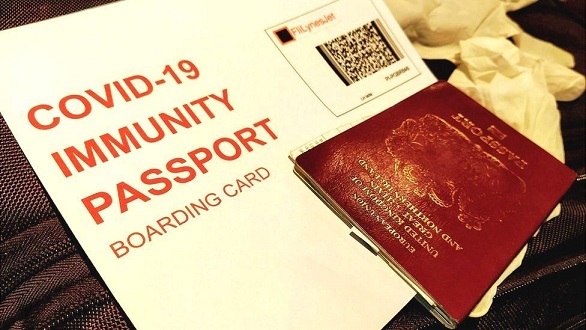
Kate Connolly — The Gaurdian.co.uk Sept 7, 2020
It is the question being asked with increasing urgency around the world, at least in countries where the vaccine is already available: how much freedom to live life as it was before the pandemic should be granted to those who have been vaccinated against Covid-19?
Its impacts range from the speed at which economies can open, to when grandparents and grandchildren can hug again, but it is causing growing unease among decision-makers who warn there is a danger of dividing societies already under huge strain due to pandemic restraints.
Germany’s ethics council, an independent body that advises the government, has recommended that no special conditions be granted to the inoculated. It declared it was “currently unacceptable to lift state restrictions on civil liberties”, arguing not only was there a lack of evidence over whether vaccinated people could still spread the virus, but that introducing special privileges for them might encourage an “elbow mentality” which could lead to unrest. If there was to be a priority, it should go to the vaccinated residents of care homes in recognition of the extraordinary burdens they face.
But private enterprises including restaurants and cinemas could not be prevented from applying their own rules, the council conceded, and last week the German ticket company Eventim said it had already revamped its online booking service to allow for customers to upload proof that they had been vaccinated in anticipation that organisers of events from concerts to sports tournaments will in future require it as a condition of entry.
State-backed schemes are moving ahead more quickly in Scandinavia, where Denmark has announced plans to introduce a digital vaccine passport and Sweden said it would have a digital vaccine passport by summer if international standards were in place. Sweden’s digitalisation minister, Anders Ygeman, said such documentation would have to become the norm if the world was going to get going again.
“When Sweden and countries around us start to open up our societies again, vaccination certificates are likely to be required for travel and possibly for taking part in other activities,” he said.
The UK vaccine minister, Nadhim Zahawai, has said the government does not plan to introduce vaccine passports to enable people to travel abroad, but those who needed proof could get it from their GP.
Israeli officials have hinted at the prospect of a “green passport” to allow vaccinated people to eat in restaurants, go to the theatre and cinema, travel freely and be exempted from quarantine when travelling internationally.
The passport, which would be given to those with two Pfizer shots, has been sold as a way to encourage people to be immunised, but is also viewed as an effort to jump-start the economy. However, as there is uncertainty around whether vaccines reduce transmission, the idea has been met with scepticism.
Fear over the more transmissible virus variants has delayed a decision and legal issues are causing authorities a headache. A proposal to only allow vaccinated teachers to restart work has face pushback from those who argue it is an illegally coercive measure.
In the US, President Joe Biden asked government agencies to investigate the feasibility of producing digital versions of vaccine certificates in one of his first executive orders. Greece’s prime minister, Kyriakos Mitsotakis, has proposed the EU push ahead with a common vaccination certificate that could help create a “fast travel lane”.
A universal document, probably digital, providing official proof that someone has been vaccinated against, or tested for, coronavirus may become a reality within months – as much a part of life as going out of the house with a face mask.
The evidence is already out there that this so called “covid” (which is flu rebranded) (note how the flu has mysteriously disappeared) has a 99% recovery rate and that the stats have been heavily tampered with for public consumption only to make it look far worse than it actually is, courtesy of a complicit and criminal mainstream media.
Not content with cancelling freedom of movement on domestic soil for an invented virus, these psychos are now salivating for lethal injections to force compliance for the basic right to travel.
Only the most depraved of subhumans would be consenting to this travesty.
Vaccine macht Frei.
These vaccines that are getting shoved down peoples throats…
Coercion and nothing else.
Do people realise that when the madness has passed Nuremberg type trials WILL be held… come hell or high water… and those pretty ladies behind cameras shouldn’t imagine that they’re immune (excuse the pun) .
Sports and concerts do not matter today, since the culture has been bent out of all recognition by the Jewish enemy. He uses music to promote Satan and sport to promote African tree-dwellers.
Sports and concerts do not matter today, since the culture has been bent out of all recognition by the Jewish enemy. He uses music to promote Satan and sport to promote European tree-dwellers like lewis jones.
Look. Micheal : vaccine macht NICHT frei. To the contrary…you’re finished
So I’ll never travel or see a movie in a cinema or eat in a restaurant again?
FINE BY ME.
@ Mark Borah;
The meter is running and clocking up every second of every minute of every day for every lying abuser of power that assumes they are getting away scott free from any legal redress on the covid hoax which will make any Nuremberg type trial look like a walk in the park.
That meter is the soul that cannot lie once released from its temporary bodily habitat when it comes face to face with the enormity of what has been accumulating throughout its entire earthly existence.
The vaccine passport is the id2020,36 grid luciferase florecent sugar nodes points of light imbeded in the right hand or forehead.The solution integrates with the body and leaves a mark visible with certain light and each person will have a unique codex of 36.666.This is proof of vaccination.Darpa has included nano 5g chips in the covid vaccine that hooks you up to 5g,the nasal swab opens a door for the 5g chips to enter the brain.We also talking chemtrail nanofibers.This hooks your central nervous system up to an IA mainframe.This allows for total mind and body control.The covid19 vaccination is a necessary step towards integration of nanochips directly into the human nerve system and the brain.The genetic mutation that the vaccine does to your dna allows for the interface of human and synthetic dna to create a spike protein.The spike protein can relay information from the body and to the body.Its a relay switch or node connected to IA via nano chips and 5g interface.Once the bridge is made geneticly, flow of information can take place bidirectionally via 5g allowing for immersion of mind and body into an IA field of reality.Artificial reality.You will be in the physical world but your senses will only perceive an IA world.You will not be able to perceive reality anymore.Your mind have been captured into a system where they control your reality.Your body can be monitored and controlled including hormone function.This has been perfected long ago with grey bioengineered humanoids.You saw the matrix this is exactly what it is.The movie Gamer also a good example.The trials where done on dolphins and other creatures.Full emmersion IA.Welcome to the transhumanist agenda.Its exactly this.They cant have their NWO untill we all hooked up to IA via vaccination and id2020.Its got zero to do with a virus but yes they do want to cull 90% of the population at the same time.Its a 2 for 1.They think we to stupid to realise what they are doing to us.
https://yandex.com/turbo/en.wikipedia.org/s/wiki/Biological_computing?sign=929bc1a4fa08bc074e0491f040940fb40232fc36eb0783b4b7fce8bc63dcca71%3A1612815403
We become computers post vaccination 666.
So you see why Bill Gates has an interest in vaccines.Its The creation of human computers via vaccination.There lies the connection.He is still involved in IT.Human integration into IA systems.Dna spike node IA protein computing systems.The virus is a smokescreen to get us nano chipped and spike node protein connected and integrated into 5g cloud.He is such a big deceiver.You can imagine this integration from man into machine will be harmfull to many.Most will not survive the transformation.
”Israeli officials have hinted at the prospect of a “green passport” to allow vaccinated people to eat in restaurants, go to the theatre and cinema, travel freely and be exempted from quarantine when travelling internationally”…………………Why not go the whole hog and make people without the vaccine poison wear Yellow Stars just like the JWO did in the 2nd world war
“Don’t sweat it’, it will not work .Bill Blogs if still alive after the almost lethal reaction to JAB will have crashed his car outside the airport killing his family and other motorists, but then has to dash on to the Airport with his “digital good health passport” giving him full immunity , they claim .
Then he hears the words “Sir, have you taken the Covid 19 jab vaccine?”
You cannot fly if you are having fits and spasms .
It has already happened this way in China.
Such depraved evil infesting the world. We have witnessed shameless acts of mass murder and relentless psychological conditioning for purposes of obtaining more power or a tighter grip of control, but this Covid-1984 crime has been stunning in scope and wicked almost beyond belief.
So many times we have said “they have gone too far”; they have gone too far with their parasitic system of banking and credit in looting citizens and countries. They have gone too far in illegal and immoral wars which they started with false-flag attacks on innocent civilians. They have gone too far in the relentless lying and shameless propaganda shoveled out by their stranglehold on the corporate media and tightly controlled narratives. They have gone too far rigging elections and fraudulently manipulating financial markets. They have gone too far in making the air unfit to breathe, the food unfit to eat, and water unfit too drink. They have gone too far flooding countries with foreign scum and degrading values and mores. They have gone too far so many times with so many things. But this time, this time is a whole new level of stunning evil. This time THEY HAVE GONE TOO F***ING FAR. Rebel now or doom generations of humanity to abject slavery.
Yes they have gone too far but biblicly this is the time it unfolds exactly as it is unfolding perfectly, word for word.Dont worry, they have no escape from their actions.They have no escape from their actions.They cannot and will not escape the pain and suffering they are inflicting on us right now.They will pay, they will pay, in pain and suffering into all enternity,Forever,and Ever and Ever.We suffer now,they will suffer for trillions of years.And trillions and trillions more to come.Be quiet,be strong.Their time is up, they need to play out their stupid game for a brief second of eternity.Let them play out their game, we know they will be burning in sulpher for all eons and eons to come.This will come to pass as has been written and so it will be.Stay confident in your redemption, you are not of this world.There is a new world coming.