
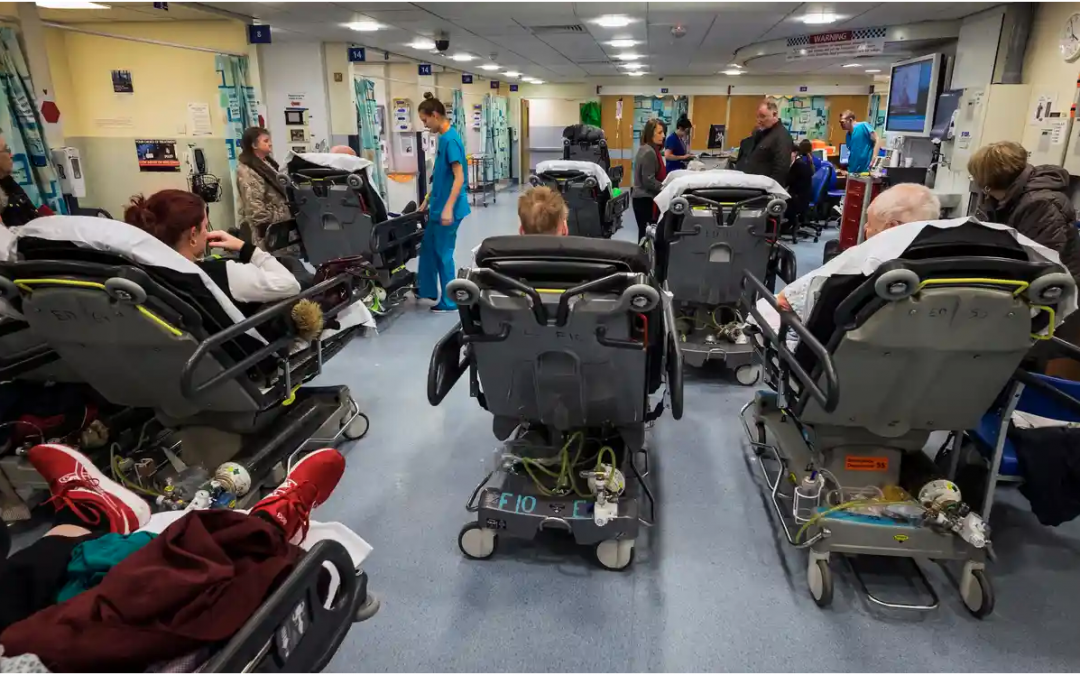
Pictured above: patients wait on hospital trolleys in a corridor due to wards being full in December 2017, BEFORE the Covid crisis.
Lockdown Sceptic — Jan 29, 2021
A Lockdown Sceptics reader and registered nurse who has been working in NHS hospitals throughout the crisis has written the following article for us about his experience.
Matt Hancock said that there are 37,475 patients in hospitals in the UK with coronavirus – yet no context was offered. So there are approximately 120,000 NHS beds in England, which would make Hancock’s figure around 30% of NHS England bed capacity (and that’s not taking into account bed capacity of Wales, Scotland or Northern Ireland). That also doesn’t take into account extra potential capacity from private hospitals nor the Nightingale hospitals. A headline grabbing statistic like “37,000 Covid admissions” might sound alarming, but without context it is meaningless.
It is also important to stress that this figure of 37,475 are patients admitted for any health reason, with a positive PCR test on admission or within the last 14 days – it is definitely not 37,000 patients who are unwell with Covid respiratory symptoms.
Patients are tested on admission to determine whether to be put in “green” or “red” areas. I have seen first-hand patients admitted to hospital for completely unrelated conditions, nil Covid symptoms, but have a positive PCR test on admission. These go down as “Covid admissions” but they are actually admitted for conditions completely unrelated to the respiratory system, such as heart failure or kidney disease.
I am sure by now we all have known somebody who has had a positive Covid test result but no symptoms. This is true also for hospitalised patients being admitted for other reasons – massively inflating the “Covid admission” numbers.
I have also had first-hand experience of patients who have been admitted into hospital for an unrelated reason, and caught Covid whilst there (nosocomial infection) – and then they also go down in the NHS statistics as Covid admissions.
Hancock’s figures without context are not only unhelpful, they are misleading the public.
Surprisingly, NHS bed occupancy rates are at relatively low levels for this time of year. So are the staff on the wards lying? No they are not. I know first-hand how busy it feels, but I see four main reasons to explain why it feels so busy:
(1) Staff self-isolating – this is causing huge numbers of staff to be off work. I feel the impact of this first-hand in my ward. On a regular basis we have staff awaiting a test, as they or someone in their household has a symptom, however mild. I am sure most my colleagues are genuinely concerned not to be infected and pass it on to their vulnerable patients, so are acting ultra cautiously. But there is also room to milk the system, as it is fully paid time off work, and not counted as “sick leave”. Nurses are absolutely hard working people – but we are only human too, not saints. As soon as the decision is made to get a test, then we cannot return to work until PCR tested and the result comes back negative. Reduced staffing is causing the NHS significant strain.
(2) Thousands of NHS beds have been removed. This is not due to budget cuts this time (which in fact have reduced NHS beds significantly year on year) but due to social distancing requirements. I have experienced this first-hand: the hospitals I work in have removed beds for social distancing regulations, which has meant the departments fill up much quicker, and can cause backlog in the system.
(3) Regulations such as donning and doffing PPE (which is actually very time consuming when done properly) – and segregating patients in “green zones” or “red zones” – causes logistical problems, making workloads much busier and much more stressful.
(4) A huge amount of bed capacity has been lost due to a lack of NHS funded nursing home beds. Previously, the NHS funded beds in nursing homes to take “medically fit” elderly who were awaiting care packages to begin from social services – these beds were referred to as “hub beds” in my Trust. However, at the moment this option seems to be unavailable (for understandable reasons, as nursing homes were not “Covid safe” environments during the spring). This results in “bed blocking” in the hospital, and causes a backlog further down, ultimately filling A&E.
I’m not saying that hospitals are not busy – they are incredibly busy, particularly ICUs in London and the South East. What I am saying is the amount of patients coming in to the hospitals is not unprecedented. It is the policy decisions that are making this period feel unprecedented, and not the actual crude work load.
This is so important to understand as the severe restrictions on our lives are justified in order to “protect the NHS”. I therefore feel obligated to speak out, as how I am experiencing my work within the NHS is not quite how the media is portraying it.
The image above is from December 2017. It is a photograph of patients on hospital trolleys due to the wards being completely full – the NHS was in crisis. Yet we didn’t realise how good we had it – back then we had no staff self-isolating, more hospital beds, no routine time-consuming PPE requirements, and better discharge flow of patients out of hospitals. It is decisions by NHS policymakers that are making this winter feel so much worse.
Manufactured stress. I am sure most nurses and hospital staff will jump at the chance to off work on full pay & the regime likes this game as well. Go into any commercial kitchen in the UK or into any reasonably developed country and you will see dedicated powerful extraction hoods above every cooking station. Hospital wards are treatment areas that are NOT FIT FOR PURPOSE.
On ‘manufactured stresses’. The regimes do this with water and power. By limiting supply, the UK has no significant water capacity infrastructure increases since 1976, scarcity is the name of the game. Same with electricity, we import from France. But you can see how energy saving are really a bullet in the foot. We all buy expensive LEDs with a big chink of VAT going to the regime, so demand goes down theoretically, but we pay more for our power. Follow this to its logical conclusion where a typical house uses just 1-watt per day or 365 watts per year and you/ll still get a bill for £600/700 quid, assuming you are still allowed to use gas. lol
My doctor has now had his second Covid vaccine shot. He says that he was lucky and just happened to be around when no one was there to have it, so rather than it goes to waste he had his second shot. So this suggests that some sheeple are not showing up for their vaccinations? My doctor said that it’s not ideal to have them so close together. He knows my feelings on this matter.
They’re killing us off, the old and frail first then the ill. I bet if you can afford it you can continue getting treatments and operations in private hospitals.
Stay well, all dear Truthseekers. Never before is it cheaper to stay healthy than to be sick. Avoid the devoid. Love not the world! Grow your own if at all possible. Treasure your precious temple. Nourish every part of your existence with Truth! Keep shining! You are all amazing!