
Dave Makichuk – Asia Times Dec 5, 2020
On paper, as they say, China has a distinct advantage when it comes to naval power.
Over the past decade, it has aggressively built up its navy to over 300 warships and submarines, making it the largest navy in the world.

China’s navy might have the advantage in numbers, but in the treacherous Taiwan Strait, Taiwan’s new submarines would give any invasion force serious problems. Pictured: China’s 2nd aircraft carrier in Dalian, Liaoning province. Click to enlarge
And, it plans to continue to expand its armada to 450 ships and 110 submarines by 2030, a stark reality which is keeping US Navy officials up at night.
So concerned, is the US, that the Chairman of the Joint Chiefs, Army General Mark Milley, predicted “a lot of bloodletting” in the Pentagon as the military strives to get the Navy the hundreds of new ships it says it needs to confront China, Breaking Defense reported.
“It’s a very, very difficult exercise we’re going to have to go through. It’s going to be ruthless, there’s going to be a lot of bloodletting and a lot of stuff left on the floor. We’re gonna have to do that in the coming years — no question about it,” said Milley.
But we are not talking about the United States, we are talking about the small, democratic island of Taiwan, which remains a juicy invasion target for Beijing.
Currently, Taiwan’s underwater navy arsenal consists of a rather jumbled group of aging warriors — in fact, it’s like something out of a movie. A Second World War movie.
Consider a rapidly aging fleet of four submarines, including two Chien Lung-class submarines, SS-793 Hai Lung (Sea Dragon) and SS-794 Hai Hu (Sea Tiger), which were purchased from the Netherlands in the 1980s, The Taiwan News reported.
Older still, are its Hai Shih-class submarines, SS-791 Hai Shih (Sea Lion) and SS-792 Hai Bao (Sea Leopard), which were acquired from the US in the 1970s and date back to the 1940s.
Not exactly the Red October, eh?
It is for this reason, that Taiwan felt the urgent need to build up its fleet of submarines to counter the threat of a full-scale invasion.
After decades of being denied purchases of submarines and components from foreign shipbuilders, Taiwan in 2015 decided to build its own fleet, with the first of eight prototype submarines expected to cost NT$49.36 billion (US$1.72 billion) and scheduled to be completed by the third quarter of 2024, Taiwan News reported.
The indigenous underwater vessels will be constructed at a specially-designed new shipyard in Kaohsiung by Taiwan’s CSBC Corporation, for a grand total of around US$16 billion.
And rumours of US help abound.
According to The National Interest, new Taiwanese submarines could incorporate some of the quieting technologies now being built into Virginia-class boats, many of which were first prototyped years ago on the USS South Dakota.
The submarines could also benefit from innovations in the realm of firepower, as the US Navy’s emerging Block V submarines are built with new, extended Virginia Payload Modules.
Those modules are new 80-foot long sections of the submarines adding Tomahawk missiles to the boat’s overall firepower. Adding the modules brings the total number of Tomahawks on board a block V Virginia boat from twelve up to twenty-eight, a massive increase.
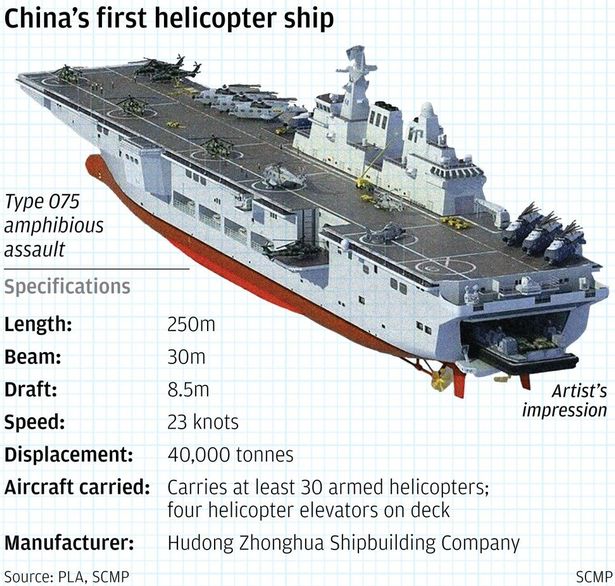
Chinese 075 amphibious assault ship. Click to enlarge
Moving beyond firepower, the greatest technological advantage Taiwan might gain from US assistance might be found in the realm of command and control, given that the Virginia-class submarines operate with a modern Large Aperture Bow sonar array bringing greater range, signal fidelity and sensitivity to submarine sonar detection, National Interest reported.
This, coupled with computer enabled, fly-by-wire navigational and sensor controls, could give the new Taiwanese submarines an edge when it comes to conducting clandestine reconnaissance missions.
Still not impressed? Wait, there’s more …
One would think that the People’s Liberation Army Navy (PLAAN) enjoys an overwhelming numeric advantage over the Taiwan Navy’s surface and underwater fleet.
But according to one expert, if we survey the scene of battle in the Shakespearean sense — in this case, the Taiwan Strait and its treacherous conditions — which just happen to favor the concealment of submarines, and, given China’s distinct inability to conduct ASW (anti-submarine warfare) underwater, on the surface, or in the air, even a small number of attack subs could stop a would-be Chinese invasion fleet in its tracks.
Bingo! That’s right, Taiwan’s eight new attack subs would have the advantage, and a Chinese invasion fleet would be highly vulnerable, Taiwan News reported.
China can talk tough on this front, all it wants, but many of its ships will join Davey Jones’ locker, should they attempt an invasion.
Mark Stokes, the executive director of the Project 2049 Institute in Virginia, was cited by Forbes magazine as saying that, “Their counter-coercive value should not be underestimated.”
The new submarines will have double hulls and will be powered by lithium-ion batteries. They will be armed with both Harpoon anti-ship missiles and Mark 48 torpedoes, Taiwan News reported.
Owen Cote, associate director of the MIT Security Studies and an expert on submarine warfare, was cited by the magazine as stating that, “The shallow, noisy waters of the Taiwan Strait greatly favor submarines over air and surface (anti-submarine warfare) forces.”
Cote asserted that despite the fact that PLAAN has 70 submarines and warships and aircraft equipped with sonar technology, “even a small flotilla of Taiwanese subs” could penetrate their defenses. He pointed out that only submarines in US and UK navies are capable of conducting anti-submarine warfare.
Furthermore, only NATO and Japanese navies have the capability to effectively hunt subs with their surface fleets and aircraft. For all these reasons, China’s numeric advantage is not as meaningful — so they say.
While military prognosticators have been wrong in the past, it would be foolish for Chinese military planners to under-estimate these new denizens of the deep.
Maybe they can’t stop an invasion force, but they could give it a nice big punch in the face — and that’s all they really have to do, because over-arching US forces would come in right behind them.
Taiwan is where China’s elite fled to after Mao’s revolution and that’s why it’s useful to America, to agitate against China, its great economic rival, the one greedy western businessmen made rich by sending factories over there to produce goods for western markets but paying Chinese wages.
For decades our leaders warned us about communism, but capitalism was the first to truly exploit it. Thatcher bought cheap Polish coal to smash UK miners when Poland was still behind the Iron Curtain, all while western businessmen were sending our manufacturing jobs and ultimately our prosperity over there, to take advantage of their low wages and decent infrastructure to become obscenely rich and damn everybody else. Now look at where Bill Gates and the uber-rich have taken us.
Though China is certainly America’s main economic rival it remains to be seen if China really did become capitalist, or whether it saw the chance for western businesses to finance communist supremacy. I don’t see why the Chinese Communist Party would see any need for all of China to dress and live plainly now they have a lot of money. And there’s no reason why the leadership cannot enjoy what the west still produces: German cars, French wines, Italian suits, British cigarettes and American, er…bubble gum.
Military hardware is in the inorganic world and does not determine anything. The British are good at building it but are supplanted in their own streets by stupid wogs.