James Corbett – The Corbett Report.com Dec 4, 2020
7 Comments
Carl Jones
on December 7, 2020 at 9:02 am
I am not watching fake alternative news, James Corbett. I scanned over the article & it’s full of faff.
“Prudent macroeconomic policies”. We have not had any prudent macroeconomic policies since the late 1990s. After the DESIGNED 2008 collapse, the term ‘macroeconomics’ wasn’t used for a decade. Before 2008, macroeconomics was a cornerstone foundation of the banking mantra.
The Central Reserve Banks all collaborated (certainly the big ones) to hold rates low, ridiculously low, and to expand the money supply…. no macroeconomics required, it was all bullpoo.
Since 2008 the banks and corporates get free money & the corporates get their stocks propped up by QE. It is like a sheeple getting a new credit card every month, with no bills to pay.
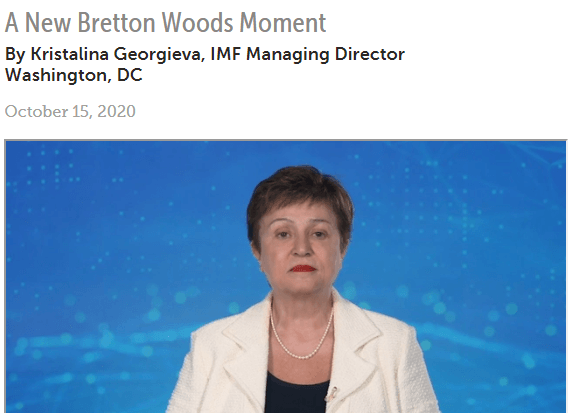
They talk of a new Bretton Woods style deal, but with who? If you haven’t noticed, living standards have been falling since the 70s. If you stripped out the debts, there wouldn’t be an economy. Take the massive US spending on all its wars. This was all debt-funded, so just imagine where the US economy would be today if this money (junkie fix) had not been spent mostly in the US?
Take the weaponised Hurricane Katrina. Bush raised around $10 billion in debt and then handed it all out to his best mates as relief contracts. The UK floods the country virtually every year in order to keep the High Street economy afloat.
Neo
on December 7, 2020 at 5:14 pm
If these Caucasian created nations were free of the Jews & bipedal apes, they would experience a tremendous cultural & spiritual revival. But the Jews brought their Trojan Horse Christianity into these nations, designed to dissolve gentile resistance/rejection of Jews entering & inhabiting their lands. This is why they had to eliminate/replace the ethnocentric pagan religions of the Celtic/Germanic tribes, with cosmopolitan Christianity, since the former obstructed their penetration, subversion & control of their societies…Figure it out, if you can.
tresmegistus
on December 7, 2020 at 7:00 pm
carl jones – have you considered one point? if the central banks kept interest rates to near zero for so long, then why not abolish interest rates altogether? and while we have this reset, why not have all private debt forgiven every 7 years and abolish tax on individual employment.? interest is a cost to business and usury to the individual. this would re-energise the economy
dwight watson
on December 8, 2020 at 12:57 am
Write a narrative |Life is too short t5oiwaste on a crap over 1 hour piece of bs
J Harry
on December 8, 2020 at 5:23 am
I like Hugh Douglas’ “Scottish” Social Credit economics. The government distributes money by issuing individual citizens a yearly dividend based on the economy’s productivity. The citizen would then buy whatever he or she needs with this money thus supporting industries that serve the public good as determined by its citizens. This balances the economy and solves the problem Douglas identified as the source of our economic problems: the shortfall caused by workers not making enough wages to buy the products they produce. It worked very well in Australia during WW2. The Aussies didn’t incur a national debt during that time. End the Fed.
Carl Jones
on December 8, 2020 at 10:27 am
tresmegistus: rates were low for banks and corporations. The banks got free money to lend to sheeple who pay interest, not very low interest, but the point is, due to weak & in most cases, nonexistent regulation, banks were lending to anyone who would take the money.
The wider problem is that in the now distant past, you would go to the bank for a loan to buy a car, they would look at your income (these days your credit score) & make a decision. If you wanted a loan for a business, they would look at your business plan, the state of the economy & make a decision. In both cases, the banks would lend at a rate of return… interest. These days, this might still happen, but usually, this only applies to medium-sized established businesses or you have a gold plated income or pension.
The banks carry no real risk, but they are taking risks because the rewards are so great.
All of what I have said above is based on the point that time has value. we could call this the interest paid on the debt. In the financial world & the big corporates, rates are very close to zero, zero, or even negative, so time now has no value.
In a functioning global economy, the elites had a need to make the sheeple wealthier or at least give the sheeple the impression that they had money in their pockets so they would spend it. Since the 1970s, the sheeple have lost way over 50% of their buying power, because wages have been underpaid for decades. This is why we have the culture of living life on debt & because the sheeple couldn’t pay the higher taxes on the wages they should be earning, regimes have also used debt to fund societal systems & this has led to an explosion in wealth for the elites.
Why have they done this? I think it is quite simple. It is much harder to control a wealthy population. Take Norway which has nearly €50 per hour average rate of pay… you can’t have idiots like Boris in power in Norway. Norway is so well run that running the country is more like an administrator’s job. While Norway isn’t perfect, they are quite conservative people, there is no space for crackpot ideologies like here in the UK and US.
@ J Harris. I’m with you on Clifford Hugh Douglas and his social dividend. It was known as “social credit” which unfortunately may be (mischievously) linked to to “Chinese” social credit, complete with the surveillance technology/1984 thinking, to accompany it. A further obstacle is that the Douglas social dividend/credit may be linked to Universal Basic Income, UBI, which acknowledges the need to distribute income without the requirement to reform the banking system. UBI also has strings attached implications.
Many alternative commentators such as Mark Windows and UK Column’s Austrian economist David Scott throw the baby out with the bathwater when they dismiss UBI without considering Douglas’ idea.
As you say Douglas saw the problem with the private banking system that did not issue credit in line with productivity. Oliver Heydorn wrote a good book “Social Credit Economics” of recent provenance; I wrote a book review for it on Amazon.
The failure to issue credit by the government to reflate the economy at the time of the Depression made the way for the Keynesian, private issuance of credit. Douglas was dismissed as an amateur when in fact the great thinkers of economics from Adam Smith, Henry George, C H Douglas, and of late Michael Hudson have not been compromised by an orthodox/mainstream/establishment lackey education.

I am not watching fake alternative news, James Corbett. I scanned over the article & it’s full of faff.
“Prudent macroeconomic policies”. We have not had any prudent macroeconomic policies since the late 1990s. After the DESIGNED 2008 collapse, the term ‘macroeconomics’ wasn’t used for a decade. Before 2008, macroeconomics was a cornerstone foundation of the banking mantra.
The Central Reserve Banks all collaborated (certainly the big ones) to hold rates low, ridiculously low, and to expand the money supply…. no macroeconomics required, it was all bullpoo.
Since 2008 the banks and corporates get free money & the corporates get their stocks propped up by QE. It is like a sheeple getting a new credit card every month, with no bills to pay.
They talk of a new Bretton Woods style deal, but with who? If you haven’t noticed, living standards have been falling since the 70s. If you stripped out the debts, there wouldn’t be an economy. Take the massive US spending on all its wars. This was all debt-funded, so just imagine where the US economy would be today if this money (junkie fix) had not been spent mostly in the US?
Take the weaponised Hurricane Katrina. Bush raised around $10 billion in debt and then handed it all out to his best mates as relief contracts. The UK floods the country virtually every year in order to keep the High Street economy afloat.
If these Caucasian created nations were free of the Jews & bipedal apes, they would experience a tremendous cultural & spiritual revival. But the Jews brought their Trojan Horse Christianity into these nations, designed to dissolve gentile resistance/rejection of Jews entering & inhabiting their lands. This is why they had to eliminate/replace the ethnocentric pagan religions of the Celtic/Germanic tribes, with cosmopolitan Christianity, since the former obstructed their penetration, subversion & control of their societies…Figure it out, if you can.
carl jones – have you considered one point? if the central banks kept interest rates to near zero for so long, then why not abolish interest rates altogether? and while we have this reset, why not have all private debt forgiven every 7 years and abolish tax on individual employment.? interest is a cost to business and usury to the individual. this would re-energise the economy
Write a narrative |Life is too short t5oiwaste on a crap over 1 hour piece of bs
I like Hugh Douglas’ “Scottish” Social Credit economics. The government distributes money by issuing individual citizens a yearly dividend based on the economy’s productivity. The citizen would then buy whatever he or she needs with this money thus supporting industries that serve the public good as determined by its citizens. This balances the economy and solves the problem Douglas identified as the source of our economic problems: the shortfall caused by workers not making enough wages to buy the products they produce. It worked very well in Australia during WW2. The Aussies didn’t incur a national debt during that time. End the Fed.
tresmegistus: rates were low for banks and corporations. The banks got free money to lend to sheeple who pay interest, not very low interest, but the point is, due to weak & in most cases, nonexistent regulation, banks were lending to anyone who would take the money.
The wider problem is that in the now distant past, you would go to the bank for a loan to buy a car, they would look at your income (these days your credit score) & make a decision. If you wanted a loan for a business, they would look at your business plan, the state of the economy & make a decision. In both cases, the banks would lend at a rate of return… interest. These days, this might still happen, but usually, this only applies to medium-sized established businesses or you have a gold plated income or pension.
The banks carry no real risk, but they are taking risks because the rewards are so great.
All of what I have said above is based on the point that time has value. we could call this the interest paid on the debt. In the financial world & the big corporates, rates are very close to zero, zero, or even negative, so time now has no value.
In a functioning global economy, the elites had a need to make the sheeple wealthier or at least give the sheeple the impression that they had money in their pockets so they would spend it. Since the 1970s, the sheeple have lost way over 50% of their buying power, because wages have been underpaid for decades. This is why we have the culture of living life on debt & because the sheeple couldn’t pay the higher taxes on the wages they should be earning, regimes have also used debt to fund societal systems & this has led to an explosion in wealth for the elites.
Why have they done this? I think it is quite simple. It is much harder to control a wealthy population. Take Norway which has nearly €50 per hour average rate of pay… you can’t have idiots like Boris in power in Norway. Norway is so well run that running the country is more like an administrator’s job. While Norway isn’t perfect, they are quite conservative people, there is no space for crackpot ideologies like here in the UK and US.
@ J Harris. I’m with you on Clifford Hugh Douglas and his social dividend. It was known as “social credit” which unfortunately may be (mischievously) linked to to “Chinese” social credit, complete with the surveillance technology/1984 thinking, to accompany it. A further obstacle is that the Douglas social dividend/credit may be linked to Universal Basic Income, UBI, which acknowledges the need to distribute income without the requirement to reform the banking system. UBI also has strings attached implications.
Many alternative commentators such as Mark Windows and UK Column’s Austrian economist David Scott throw the baby out with the bathwater when they dismiss UBI without considering Douglas’ idea.
As you say Douglas saw the problem with the private banking system that did not issue credit in line with productivity. Oliver Heydorn wrote a good book “Social Credit Economics” of recent provenance; I wrote a book review for it on Amazon.
The failure to issue credit by the government to reflate the economy at the time of the Depression made the way for the Keynesian, private issuance of credit. Douglas was dismissed as an amateur when in fact the great thinkers of economics from Adam Smith, Henry George, C H Douglas, and of late Michael Hudson have not been compromised by an orthodox/mainstream/establishment lackey education.