
Thomas Newdick – The Drive Nov 19, 2020
Click to enlarge
Iran’s Islamic Revolutionary Guards Corps has unveiled an unorthodox new multirole warship that it says is armed with anti-ship and surface-to-air missiles and is capable of carrying helicopters, drones, and fast attack boats. Described by local media sources as an “oceangoing warship capable of carrying aircraft,” the Shahid Roudaki is reportedly named after an Islamic Revolution Guards Corps Navy commander who was assassinated, continuing a recent convention of naming new weapons systems after “martyrs” of this kind.
Reportedly measuring 492 feet long, and with a displacement of 4,000 tons, the Shahid Roudaki is a former roll-on/roll-off ship that’s been adapted for military use. It joined the Islamic Revolutionary Guards Corps Navy (IRGCN) fleet today in a ceremony attended by IRGC Commander Major General Hossein Salami and several senior military officials.
According to Iran’s semi-official Tasnim News Agency, the IRGC plans to use the Shahid Roudaki as a “marine city,” able to carry out a wide range of missions including combat, reconnaissance, and logistics, “with the purpose of ensuring sustainable security in maritime routes and rescuing trade vessels and fishing boats of Iran and regional countries.”
The same report adds that the IRGC Navy has “already expressed readiness to dispatch vessels to international waters.” This suggests that the Shahid Roudaki is envisaged operating outside Iran’s territorial waters in the Persian Gulf and the Gulf of Oman and could instead potentially range as far as the Red Sea
Iranian expeditionary sea base. Perhaps forward deploy to Red Sea?
“The Islamic Revolution Guards Corps Navy on Thursday received an oceangoing warship capable of carrying helicopters, drones and attack boats.” pic.twitter.com/71MxdaxurY
— Ryan Chan 陳家翹 (@ryankakiuchan) November 19, 2020
New "multirole" vessel was adopted in service of the of IRGC Navy. Looks like there the idea is that it's the floating platform for various weapons, reconnaissance assets, etc., depending on the need. On photos there on deck – 3rd Khordad SAM, GhadirGhader ASM, Ababil-2 UAV etc pic.twitter.com/FMvbfCbZiN
— Yuri Lyamin (@imp_navigator) November 19, 2020
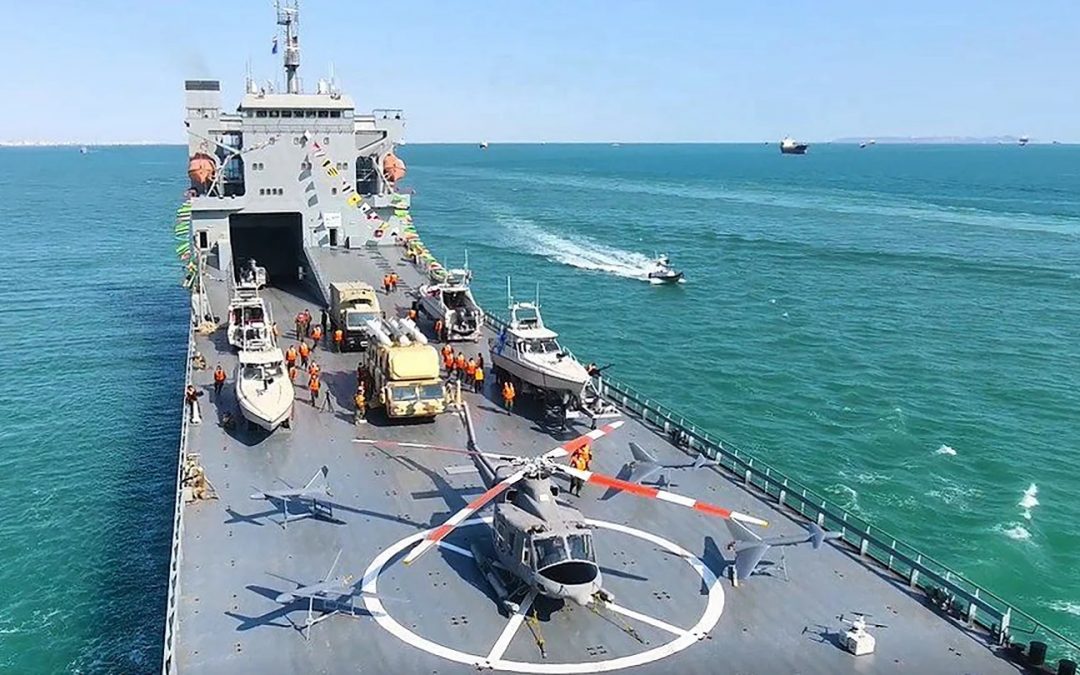
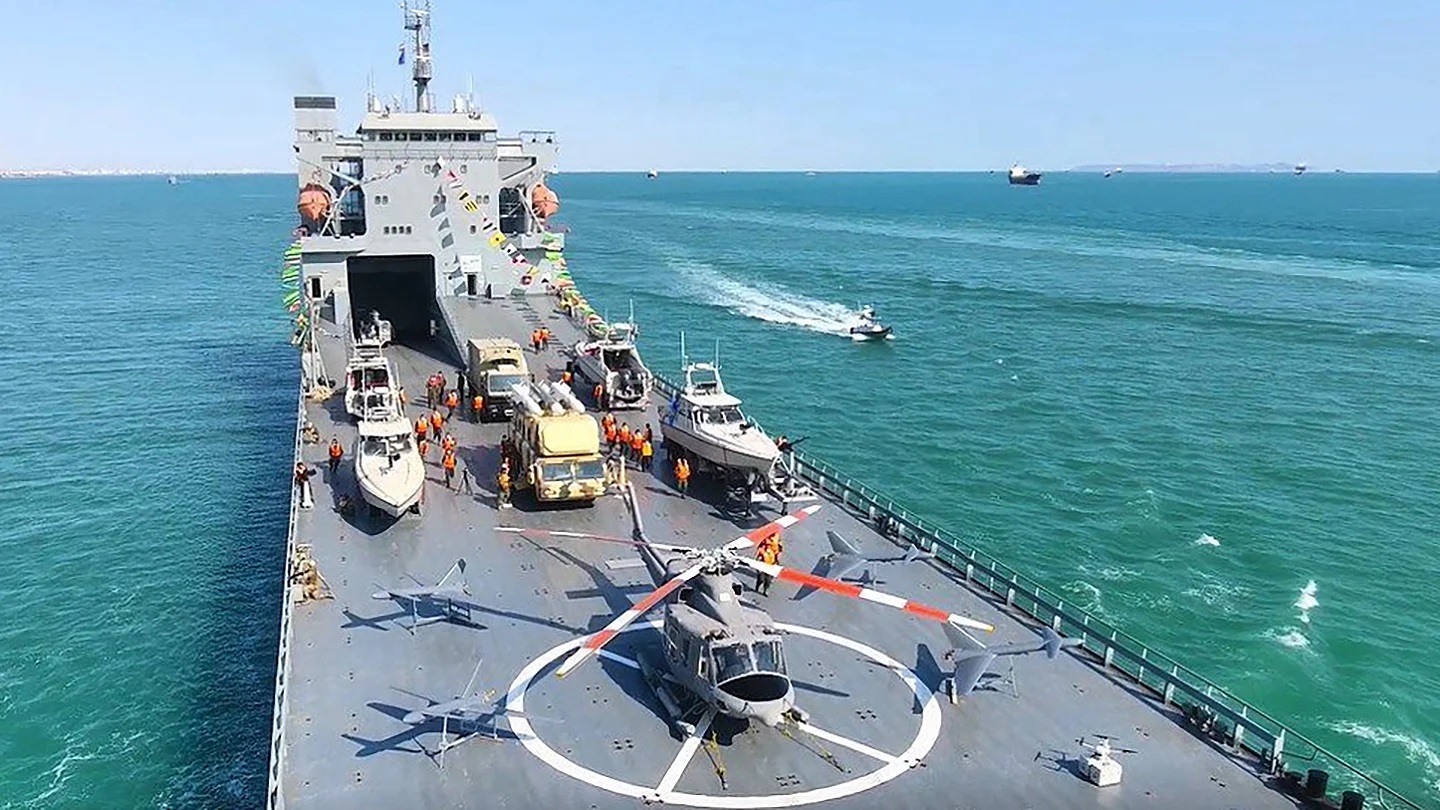
The various weapons and other systems that are seen on the deck in pictures from the ceremony at least visually reflects the warship’s purported mission spectrum, as a multipurpose vessel for long-range operations. From bow to stern, the weapons visible on deck comprise eight anti-ship cruise missiles in four twin container launchers, six Ababil-2 unmanned aerial vehicles (UAVs), a single Bell 412 helicopter, four speedboats, and a 3rd Khordad surface-to-air missile system on a road-mobile transport-erector-launcher plus what appears to be an associated command vehicle. Iranian media reports that the vessel is also equipped with a three-dimensional phased-array radar, plus “advanced communication systems for electronic warfare.”
While the type of anti-ship cruise missiles the ship is seen carrying has not been officially announced, there has been speculation on social media that these could be Qader or Qadir weapons, to which Iranian sources attribute a range of 124 miles and 186 miles respectively. These are reportedly derived from the Noor anti-ship missile, which is an Iranian copy of the Chinese C-802.
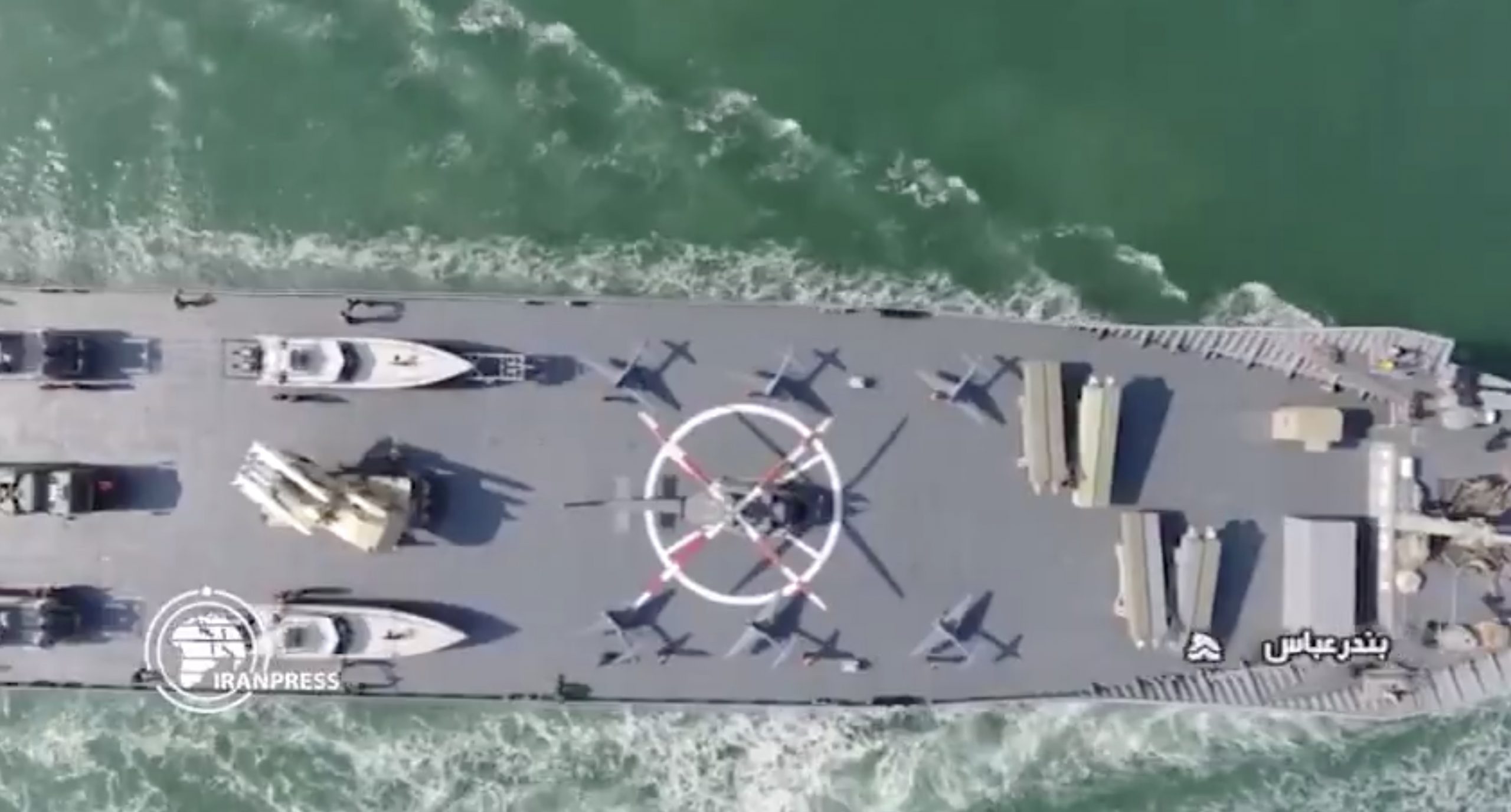
Four twin container launchers for anti ship missiles are located toward the bow. Click to enlarge
The Ababil-2 UAVs, which are launched from fixed stands on the ground, are ostensibly designed for surveillance missions, but can also carry explosive warheads and function as “suicide drones.” The Ababil series, and variants and derivatives thereof, has become something of a signature weapon in various conflicts that Iran has been involved with, in recent years, including the Yemeni civil war. Iran has other types of smaller unmanned aircraft, many of which can be used as suicide drones, that it could potentially launch from this ship.
Aside from these larger drones, images taken over the bow of the Shahid Roudaki reveal a pair of quadcopters, small-scale UAVs that could be used for surveillance in the vicinity of the warship, or potentially delivering lightweight weapons.
These drones pose very real threats, as evidenced by the unprecedented strikes on oil-related infrastructure in Saudi Arabia in 2019, which also involved several land-attack cruise missiles. The U.S. Navy also notably knocked down at least one Iranian unmanned aircraft after it came within “threatening range” of the amphibious assault ship USS Boxer in the Strait of Hormuz that same year.
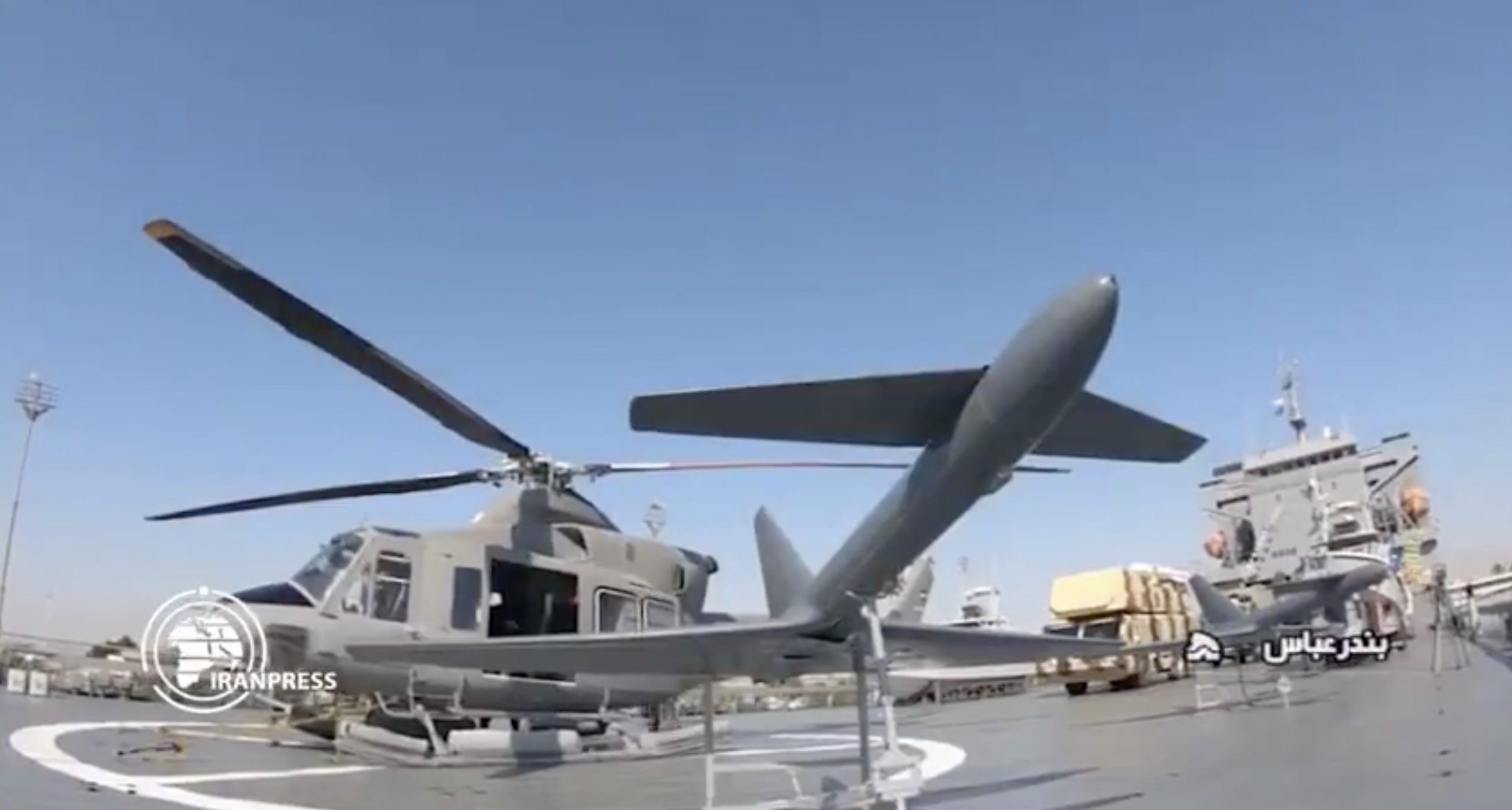
An Ababil2 UAV is displayed in front of a Bell 412 helicopter. Click to enlarge
The 3rd Khordad air defense system, the last of the weapons visible on Shahid Roudaki’s deck, is a variant of Iran’s Raad, or Thunder. This surface-to-air missile system is itself analogous to the Russian Buk (SA-11 Gadfly) and came to wider prominence after reportedly being the weapon used to shoot down a U.S. Navy RQ-4A Broad Area Maritime Surveillance-Demonstrator drone, or BAMS-D, flying over the Gulf of Oman, in June 2019.
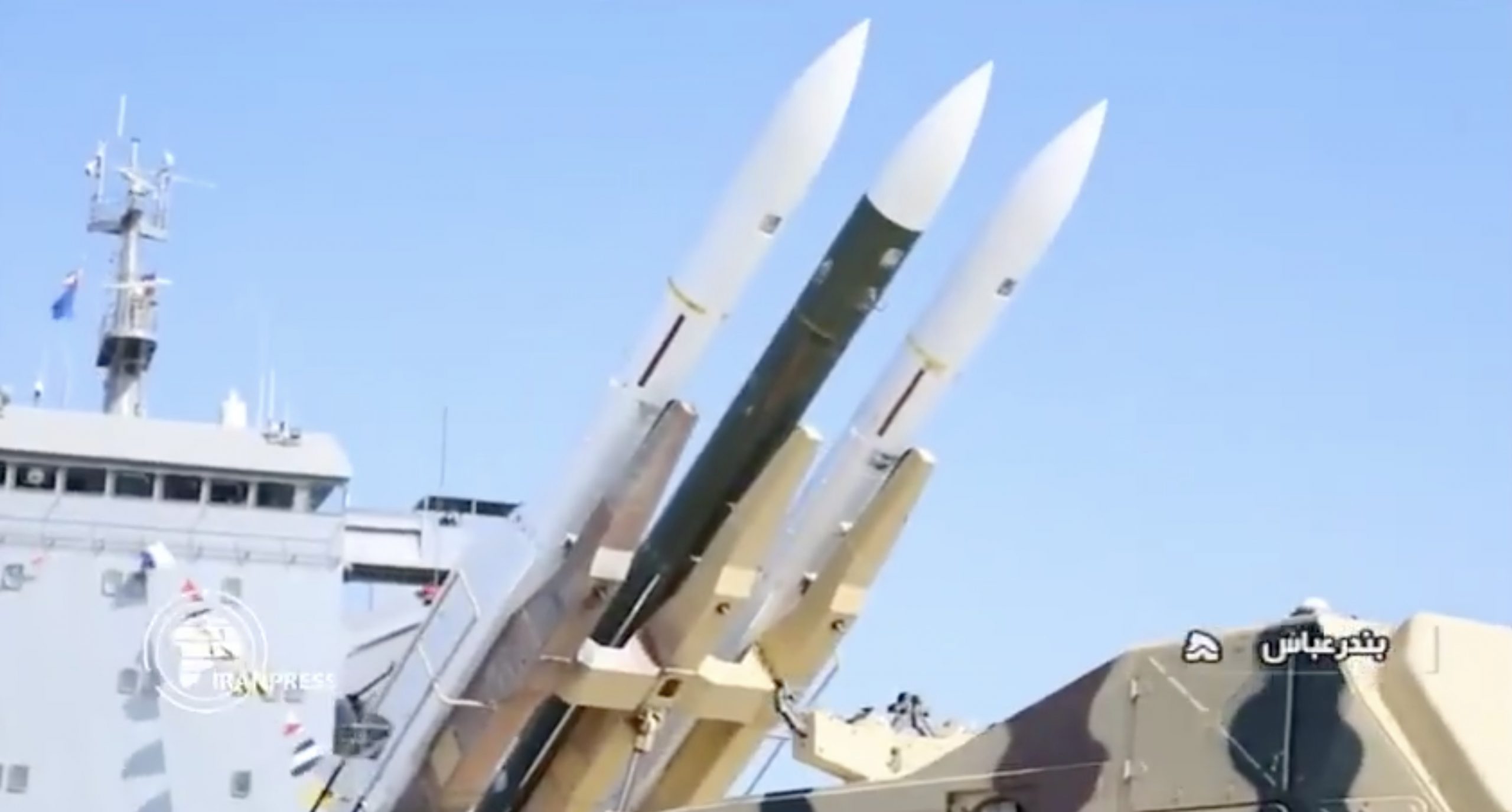
3rd Khordad surface to air missile on a road mobile transport launcher. Click to enlarge
The ship’s relatively large open deck could possibly accommodate other weapon systems, as well, including fixed or road-mobile cruise and ballistic missile launchers, or large caliber rocket artillery. Other kinds of mobile surface-to-air missile systems, as well as the radars associated with them, might also fit onboard.
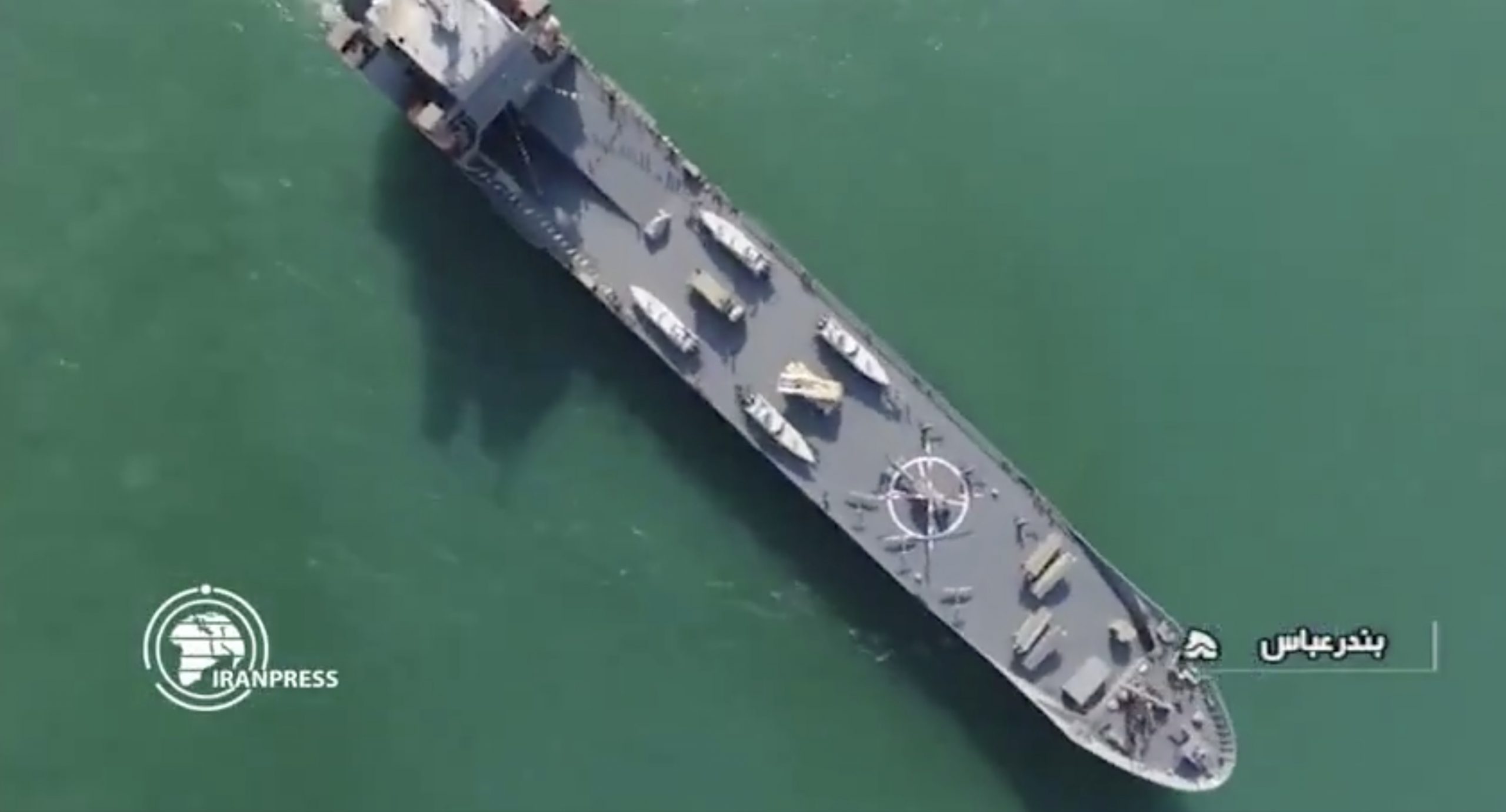
An aerial view of the Shahid Roudaki. Click to enlarge
At least in broad strokes, the Shahid Roudaki appears to be a much smaller version of the U.S. Navy’s Expeditionary Mobile Base concept. Those American ships are variants of the modified Alaska class oil tanker design, which you can read about here. Their role is to provide a persistent and capable maritime presence nearly anywhere on the high seas, and the IRGCN may hope to achieve something similar with its new warship, albeit on a much more modest and regional scale. This wouldn’t be surprising as the Iranians have gotten a very close look at one of these hulking vessels in action in the Persian Gulf, along with other U.S. sea base concepts that have called those waters home over the years.
In concept, the Shahid Roudaki also seems to have major parallels with the MV Ocean Trader, a highly modified Special Warfare Support vessel operated by the United States Military Sealift Command and which is able to operate helicopters, jet skis, drones, and various fast boats and Zodiac inflatables. It also uses the roll-on, roll-off cargo ship arrangement as its foundation. However, while there is little to give away the Ocean Trader’s military mission, the function of the IRGCN’s new warship is made abundantly clear by the assortment of weaponry arranged on deck during its unveiling, at least in the initial photos that have been released by the Iranian state media.
In a similar vein, it may also represent a further development of the concept explored by Iran with its covert operations ship MV Saviz, a modified cargo vessel that has reportedly been used for offshore surveillance, command, and liaison duties in the Red Sea in support of the Houthis in Yemen. You can read more about that ship in this previous War Zone piece.
There’s also a possibility that this new warship could serve as a “mother ship” for various kinds of discreet or asymmetric operations by the IRGC or other Iranian forces, such as the high-profile attacks launched against tankers in the Gulf of Oman in 2019. These included the use of limpet mines, presumably delivered by combat divers of the type that could be launched on raids from a vessel like the Shahid Roudaki.
More generally, there is a noticeable trend toward navies looking to introduce special operations “motherships”. The British Royal Navy, for example, is eyeing a vessel in this class that would be able to support a wider range of operations, including crisis response and disaster relief. The whole idea of leveraging roll-on, roll-off type ships and adapting them to become multi-mission naval platforms is clearly a growing trend, one that Iran has taken note of.
Overall, the utility of a floating platform able to accommodate different weapons and surveillance assets as required, depending on the mission, is clear, especially for Iran, whose surface combatants otherwise mainly comprise warships dating from pre-revolutionary times or smaller, indigenous vessels. The versatility of the Shahid Roudaki lies in its modular design, in which weapons and sensors, or other equipment, can be installed as required, potentially at short notice.
The value of an Iranian expeditionary sea base, forward-deployed to the Red Sea, could include supporting the Iranian-backed Houthi militia operating in Yemen. It could also serve as a platform for more directly challenging the country’s regional opponents, including Saudi Arabia.
It’s worth noting that the exact point of origin for the strikes on Saudi Arabia, which Iranian-backed Houthi rebels in Yemen claimed, remains unclear. The United States subsequently accused Iran of carrying them out directly.
A question mark remains, however, over how viable the Shahid Roudaki actually would be for any kind of long-endurance, high-seas operation. A cursory examination of the vessel doesn’t seem to reveal drone-launch equipment, missile reloads, helicopter maintenance/refueling facilities or hangarage, or even an obvious means of rapidly deploying and recovering the four speedboats.
Furthermore, as currently configured, the various weaponry is all simply placed on deck, seemingly not even lashed down. As such, it is exposed to the elements and potentially at risk from the effects of a deck pitching and rolling in rough seas. In an operational environment, much of this kit would instead have to be stowed in the hold below deck.
There’s also the very real problem of the survivability of this type of vessel in a conflict scenario. It’s unclear how resistant the design might be to hostile attacks and, at least in the configuration that Iran has displayed so far, it appears to have limited air and anti-ship defenses.
? الحاق ناو شهید رودکی به نیروی دریایی #سپاه
ناو اقیانوس پیمای شهید رودکی شناوری سنگین، چند منظوره و دوربرد است که قابلیت حمل و عملیاتی کردن انواع هواپیما، پهپاد و سامانه های موشکی، پدافندی و راداری را داردhttps://t.co/h09jcTWxMR pic.twitter.com/tO0J3q8tDq
— خبرگزاری تسنیم ?? (@Tasnimnews_Fa) November 19, 2020
This would hardly be the first time that Iran has made questionable boasts about the capabilities of its warships. Prime examples are the Sahand “stealth destroyer,” a missile corvette type vessel that has no stealthy features, and the Kharg, a fleet tanker with a helipad that has been repeatedly and credulously described as a “helicopter carrier.”
None of this is to say that the Shahid Roudaki might not still offer a useful platform for conducting the kinds of asymmetric and otherwise limited operations that Iran regularly engages in, directly or through proxies, in the Middle East, at least in littoral scenarios. At the same time, until the ship is actually employed on a real-world operation, or in a realistic exercise scenario, it’s hard to know to what degree it is a genuinely capable “oceangoing warship,” or whether it is more of a propaganda exercise intended to show off the IRGC’s missile and drone technologies and to provide an enhanced presence in the littorals near Iranian shores.
Who’s in whose back yard, that’s the aggressor. It’s laughable to hear the Yanks huff about Iran acting aggressively in the Persian Gulf when the waters of the Persian Gulf lap onto their shores. What Iran does there is defensive. If Iran was conducting provocative exercise in the Gulf of Mexico where the waters of that Gulf lap onto America’s shores, then yeah, that would be aggressive. But it’s all the other way round.
Good for Iran as the country certainly has a right to defend itself. Iran needs to keep cranking out armaments and naval vessels, as the insatiable haven of terrorists known as Israel and their idiotic suicidal lackey known as the Jewnited States will not stop their grossly illegal and shockingly immoral acts of aggression, with Iran being one of their top targets.
Iran is a country filled with lovely friendly people who haven’t invaded another another country in hundreds of years.
Please remind us. How many countries has the israeli controlled Us of A invaded since the second world war?
It’s shameful to be a brainwashed westerner with our Zionist controlled governments
https://www.thelondoneconomic.com/news/heres-a-list-of-all-the-countries-the-us-has-bombed-since-world-war-ii/03/01/
Iraq could not fight Iran, so the eight-year war was already an American (Jew) attack on Iran.
I guess this is sponsored content from the Nato, that parasite that needs an enemy? Looks to me like a ferry.
The importance of this multipurpose vessel should not be underestimated. Iran’s regular army (Artesh) already has standard corvettes, frigates, cruisers and subs; however this is an IRGC vessel. IRGC’s naval forces are mainly speedboats.
The difference between IRGC and Artesh is fundamental and doctrinal. The regular army is mainly equipped and functions in classic scenarios/battles/wars, IRGC on the other hand is unique and functions asymmetrically with the belief that in the cybernetics era in which the only important things are Energy and Information, the weapons that matter are Drones, Sure Strike Missiles, Electronic warfare, radars and satellites.
Unlike US mentality of “larger is better” and extravagance, IRGCs designs reflect efficiency, reliability and speed, compare poor Hoothis of Yemen backed by Iran with rich Saudis backed by US, their “crude” drones and missile have caused devastation on Saudi oil industry and the “luxury brand” of Patriot Air Defense System couldn’t do anything!
To an American, this vessel may appear like a “floating arms bazar”! Though those drones were put there for display purposes to show that the vessel is multipurpose, they can be stored inside cargo space.
I am still not sure of the ship’s capacity but it is possible to store more fast boats and/or ground units with that large foldable ramp in the backside of the ship or even larger drones under the deck on some variances. One can imagine a Roudaki version with a flight runaway for even larger drones.
Still the many Iranian oil tankers that have traveled half the globe to Venezuela and back multiple times, have defied US sanctions on both countries and Monroe Doctrine in US backyard multiple times, this shows that preemptively US is unable to attack Iran cargo ships and oil tankers even though they have no escort. If it did, Iran’s missile capability and ability to capture other ships will prove too costly for US and its allies to embark on such a move again.
my two rials