
Richard Spencer – The Times July 6, 2020
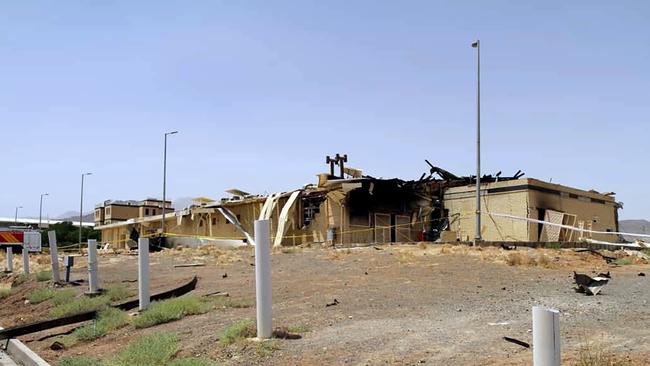
Warehouse after it was damaged at the Natanz nuclear facility. Click to enlarge
Suspicions that Iran is the victim of an international sabotage operation have intensified after a fire at a power station, the third incident in nine days.
The fire broke out on Saturday in the transformer of an electricity plant in the city of Ahvaz, in the west of the country. It was quickly brought under control, with no significant injuries.
That was also the case with an explosion at a missile factory at Khojir near Tehran last week and an explosion and fire at the country’s main uranium enrichment facility at Natanz early on Thursday.
In the past week there have also been 19 deaths in an oxygen tank explosion at a hospital in Tehran and a chlorine gas leak from a chemical plant near the Gulf coast.
Late on Sunday a spokesman for Iran’s atomic energy organisation said the blast at Natanz had caused significant damage.
“The incident could slow down the development and production of advanced centrifuges in the medium term,” Behrouz Kamalvandi said.
“Iran will replace the damaged building with a bigger one that has more advanced equipment.”
The incidents have prompted speculation in Iranian media and Israel, where the liberal Haaretz newspaper suggested that the Natanz blast was a “direct hit on Iran’s nuclear program”.
The explosion was accompanied by a warning sent to the BBC’s Persian language service before news of the blast became public.
A group of dissidents in the military, the Homeland Cheetahs, claimed responsibility.
The idea of internal sabotage would fit a claim by a Middle East intelligence official to The New York Times that an explosive device caused the damage.
Security analysts say that the Natanz warehouse was being developed as a unit for centrifuges, used to refine uranium to higher levels for civilian and military purposes. Iran has begun enriching to levels beyond those set by the 2015 nuclear deal since Donald Trump pulled the US out.
The Natanz explosion came almost 10 years after a cyberattack on the plant in which computer malware caused the centrifuges to break down.
The sophisticated operation has long been attributed to the CIA and its Israeli counterpart, Mossad.
The Ahvaz explosion hints at another culprit: Saudi Arabia. Ahvaz and the surrounding Khuzestan province are home to an ethnic Arab and Sunni Muslim minority and several terrorist attacks there have been carried out by the Arab Struggle Movement for the Liberation of Ahvaz.
The latest incident coincides with an announcement from the navy chief of Iran’s Revolutionary Guards on Sunday that Tehran had built underground “missile cities” along the Gulf coastline.
He warned of a “nightmare for Iran’s enemies”.
THE TIMES
I didn’t comment the first time this appeared on here. I think this is the SAS, they are more or less permanently based in Iran. I say the SAS because US special forces are pretty useless at this kind of thing and either require a chopper or at least a ride home. Clearly MI6 with its huge budget are recruiting, training, and funding local terrorists.
I have no doubt that CIAda & MI6 have mercenary terrorist armies in Iraq and Afghanistan, and maybe in other neighbouring states. Israel demands action & October could be the start of something big against Iran. I also expect a big or several big false-flag terror attacks this year.
I suspect Israeli interests at play, but imagine if it had been some plant in Israel and Iran was suspected. That would have been all across the western media as an act of war.
It wouldn’t surprise me if to keep Israel’s dirty fingers off the trigger US or UK agents did it. For me our special services lost a lot of their shine now they do what they do in our illegal wars which are just a covert extension of colonialism or empire. It taints them. They are by no means any longer the good guys. Sometimes they’re the really bad guys.
Israel, not Saudi Arabia or the US, has the main interest in such acts of sabotage. There are 47,000 Iranian-born Jews in Israel. Enough to be trained for such actions in Iran.
for every action there is a reaction
If Israel did it then Well done to them. Iran is a Terrorist country.
It is known and we have seen in the israeli Haaretz news that isrealis have been killing scientists intellectuals teachers etc in iraq syria lebanon iran and even in egypt
exactly as the communists did in hungary and poand in the lead up to W W 2
The SAS are currently committing acts of great terroris in syria which is protected by iran
These attacks are to provoke iran into retaliation, then israel can cry to america who will send in their brainwashed idiots to destroy the country s they usually do
They liberals in Iran play ping-pong with US and Zionists outside… so much of the news coming from inside or outside is questionable. In fact Zarif and Rohani have numerously twitted against national interest.
Nowadays if a small gas tank goes up in flames in Iran, Israeli officials rush to post a twit saying: “We can’t deny our involvement.”! They used to be involved in a lot of big things, nowadays though they want to involve themselves in even small things! The fact that Assad is still in power in Syria is the big thing! The fact that Michael D’Andrea is dead as part of Qassem Suleimanis’s revenge… and the fact that every Iran ally in the region is a winner and currently a strong force… these are the big things!
So to understand current ideological/political map and situation in Iran we should dig 40 years of the revolution:
Iran was the hub of world ideologies in the sense that almost every belief system in particular Liberalism and Communism had popular base in Iran when Khomeini’s Islamic revolution happened and he changed the world. The communists in Iran lost ideologically relatively quickly, they didn’t have any share of the cake after the revolution so they went berserk and rogue assassinating key Shiite figures of the revolution in bombings… they formed MKO (MEK), they also killed another 13K random targets on the streets of Tehran anyone with full beard or full hijab! Later they helped Saddam and did some atrocities in Iraq too and as you know they were removed from the US terrorist’s list… Bolton loves them! They failed to regenerate and now they are mostly formed of old people posting from fake accounts in social media! Their children living in European countries have dissociated themselves from their MEK parents. They are really no longer a threat even though they were the most militant internal opposition to Khomeini’s revolution. Khomeini predicted the fall of the Soviet Union and sent Gorbachev the famous letter warning him not to trust the western liberalism… the real threat however were the liberals who still hold executive branch in Iran even today under the turban of president Rohani and smiles of Zarif, they have just 1 more year in office! Liberals were a nasty disease and to take people’s hearts and minds away from their poisonous discourse we had to go through a lot of trouble and pain. With fall of western liberal market democracies in particular US, they are left with no patron. Today though liberals have no defense against the solid discourse and logic of core Shiite ideology of the Khomeini’s Islamic revolution and also due to their continued utter failure to deliver on their promises they have lost all popular support.
And finally we have the antithesis of the Khomeini’s revolution coming from the same city of Qom… indeed there are those Shiites who believed religion should not enter power/politics (secular Shiites) they were present at the same time of the revolution… in fact Forqan group was responsible in a bombing attack that left current Iran’s Supreme Leader disabled in the right hand. Amazing how they resorted to bombings just to say religion should be separate from politics! These “religious” figures allied with the liberals and now before president Rohani’s term they have planned their last try to cause an internal uprising. This time however most Iranians have been awakened and we can only wait and see what will be the results just as Zionist are watching, this is after all their last chance and the people who they have been relying on directly or indirectly have almost lost all their power inside Iran and hold no say in the future of Iran.
Amazingly, non-religious Iranian nationalists who are anti-Islam in general have come to terms with the Shiite establishment and believe in the current Supreme Leader not as a Shiite representative of the Imam of time but rather just as an awesome wise King who managed to strengthen Iran in every way and bring it to the Mediterranean sea again after thousands of years and they see the liberals as fifth column and lost. For them Shiite sect is a creation of their Persian ancestors to oppose the invasion of Muslims! And they have seen how we saved the entire region from the ISIS Zombie plague… so that rang a few other bells.
Many of the current officials will be held accountable at best for their mismanagement and at worse for working for the enemy directly or indirectly, few are known crypto Jews! They have no choice but to cause another unrest. Fortunately for us though despite sever economic pressure that they also artificially exacerbated on people the liberal camp has lost 90% popularity.
We are expecting some form of unrest in Iran before Rohani leaves and also another unrest in US at the time of elections.
my two pennies
GOD loves Israel, so let’s see what He has to say and what He will do about the next invasion of the land He gave to Abraham, Isaac, and Jacob forever.