
Ian Fantom – May 6, 2020
The Anglia Ruskin University in Cambridge, England, has been putting it about that research into COVID-19 ‘conspiracy theories’ suggests that they bear a danger to public health. They admit that their research is tentative and has not been peer reviewed, but this is not evident from the attention-grabbing headlines. The reported research is merely into correlations between belief in ‘conspiracy theories’ and individual compliance with mandated social-distancing measures.
The essence of their research boils down to showing that people who do not believe the need for social distancing or self-isolation are less likely to follow mandated social-distancing measures than those who do. This is intuitive and obvious, but their conclusions are obscured by woolly concepts such as ‘conspiracy theories’, which is neither defined, nor used consistently. The claimed health dangers are not derived from the work they report in their own paper, but are an extrapolation from previous papers and articles by psychologists who write about other ‘conspiracy theories’. They acknowledge in their paper “a degree of conjecture” in their thinking on that, but further analysis draws me to the conclusion that the claimed health dangers are unfounded and speculative.
They fail to take into account the fact that the need for such mandated social-distancing measures has been fiercely contested by various medical specialists in the fields of virology and epidemiology. Their speculation seems to assume that all ‘conspiracy theories’ are wrong, and that assertions put out by the government and the mainstream media are correct. Nor do they take into account any negative health effects arising from social isolation and the reduction in hospital services relating to other medical conditions, which have arisen from the alarm brought about not through ‘conspiracy theories’ but through the government’s statements and widespread reports throughout the mainstream media.
The paper referred to is: ‘Analytic Thinking, Rejection of Coronavirus (COVID-19) Conspiracy Theories, and Compliance with Mandated Social-Distancing: Direct and Indirect Relationships in a Nationally Representative Sample of Adults in the United Kingdom’. The authors are Viren Swami of the School of Psychology and Sport Science, Anglia Ruskin University, Cambridge, United Kingdom, and David Barron of the Centre for Psychological Medicine, Perdana University, Serdang, Malaysia. The paper acknowledges the funding as research grant PU-CPM-001 from Perdana University. I didn’t find the specific grant, but I did find that Viren Swami and David Barron are respectively Director and Deputy Director of the Centre for Psychological Medicine at Perdana University. I didn’t discover the original source of the funding.
Press Reports
Medical Xpress on 24 April published an article by Anglia Ruskin University headed ‘Rejecting conspiracy theories aids public health’. The article began by reporting, “New research has found that UK adults who reject COVID-19 conspiracy theories are more likely to comply with social distancing measures”, but two paragraphs later the article states: “The findings of the new study, led by Professor Viren Swami of Anglia Ruskin University (ARU), indicate there are health benefits to be gained from helping the public to reject COVID-19 conspiracy theories”. This is a big leap from the findings of the research, and is dependent on a belief in the government’s contested mandated measures.

Prof Viren Swami
They quote Professor Viren Swami, as saying: “Ensuring the largest possible number of people are complying with social distancing is essential to minimize the threat to life caused by the COVID-19 pandemic”. Coming from a university professor working in the health field – and Psychology in the UK is integrated into the National Health Service – and appearing in a medical journal, will have some weight as a professional opinion. For anyone who is aware that both authors are professors in a research team on Psychological Medicine, such a statement must be taken as a expert medical view. However, this view is contested by various leading specialists in the fields of virology and epidemiology. If Professor Swami considers himself to be a medical authority on that, the implication may be that he considers COVID-19 to be a psychological illness.
The quote continues:
Our results suggest that individuals who think more analytically—characterized by deliberative, demanding, and slow thinking styles—tend to be more compliant with social distancing rules. In addition, individuals who think more analytically are also more likely to reject conspiracy theories about the pandemic, which in turn is associated with greater compliance.
Finding ways to nudge citizens towards thinking analytically and questioning, and ultimately rejecting, conspiracy theories—and those who promote them—may be vital at this time.
Nudging citizens towards “thinking analytically”, as mentioned in the final paragraph, is exactly what I am attempting to do in the present analysis. However, whether people reject ‘conspiracy theories’ must be left to their own analytical thinking, and not be the objective. Furthermore, I would regard it as unprofessional to reject the people (“and those who promote them”) as distinct to their information or arguments. I would consider that to be encouraging ‘ad hominem’ attacks, which should have no place in science. I find much to be desired in the analytic thinking in that quote, and indeed in Swami and Barron’s paper.
The same article also appeared on the same day in the website of Cambridge Network, a membership organisation based in the “vibrant high technology cluster of Cambridge, UK”. Here they added at the bottom: “The conclusions of the study are tentative until after peer-review and the preliminary study is available via the Open Science Framework here.”.
A report had appeared the previous day on the ITV website, headed a little more correctly ‘Anglia Ruskin University finds that conspiracy believers are less likely to follow public health guidance’, but the first sentence states, “New research from Anglia Ruskin University has found that believing in conspiracy theories is a danger to public health”. On the same day the Mail Online published a report, which contained the text as an insert to a story on Twitter banning 5G ‘conspiracy theory’ tweets “designed to cause panic or encourage vandalism after nonsense claims that it causes coronavirus spread online”. The insert was headed ‘Fake news is helping to spread COVID-19, study suggests’.
Harpers Magazine published an article headed ‘Exploring the psychology of conspiracy theories – and why they heighten anxiety’ consisting of interviews with Professor Swamy and one of his previous co-authors, Professor Karen Douglas, who also specialises in the psychology of ‘conspiracy theories’. “A stunt to destabilise Iran? A Chinese plot to depopulate? Why we fall for fake news and how to debunk dangerous misinformation” runs the subtitle, thus equating ‘conspiracy theories’ with ‘misinformation’. This article doesn’t mention the Anglia Ruskin publication, though it appeared on the same day as the university’s articles in Medical Xpress and Cambridge Network, and it emphasises the same message: “Conspiracy theories are detrimental to your personal health, both mentally and physically” states Professor Douglas. However, there seems to be confusion here, too, on just what a ‘conspiracy theory’ is. Amongst those given are suggestions that Covid-19 can be caught from eating bat soup. They also state: “Followers of the pro-Trump QAnon conspiracy theory have even reportedly been promoting a substance dubbed ‘miracle mineral solution’. This ‘cure’ is falsely alleged to help treat everything from autism and cancer to Covid-19 – and contains bleach”. However sensible or ridiculous these ideas may be, it would be difficult to see how they could be described as ‘conspiracy theories’.
The European Commission’s Cordis website, too, carried a similar article, in six languages, headed in English: ‘TRENDING SCIENCE: Why COVID-19 conspiracy theories spread faster than the pandemic’. I find this a strange headline, considering that the governments’ version of events spread virtually instantaneously across the world. Are they really suggesting that ‘conspiracy theories’ are travelling faster than the truth? The article reproduces quotes from Professor Swami, though it doesn’t mention the Swami and Barron paper. One has to wonder at the timing. I also have to wonder at the paragraph:
Changing the mind of a conspiracy believer is practically hopeless: “No, near impossible, particularly if you’re a hardcore believer,” Prof. Swami continued. “They typically reject any evidence that doesn’t fit with their worldview and they only accept evidence that fits with pre-existing beliefs. They will reject anything and say mainly because I’m part of the conspiracy myself. They frame it in such a way that there is no possibility of having a debate. They get into this frame of mind, where they think people who are doing bad things are inherently evil and you don’t want to have a debate with someone who is evil, what you want to do is vanquish evil.
In my own studies of academics who specialise in denouncing ‘conspiracy theorists’ they consistently avoid arguing the facts, and accuse their adversories of doing just that. Instead, they attack the person – arguing ‘ad hominem’, as if everything was due to personality traits and nothing to do with the logical reasoning by which they had arrived at certain conclusions. The above paragraph is a string of regurgitated formulations, rather like George Orwell’s ‘worn-out metaphors’, which have “lost all evocative power and are merely used because they save people the trouble of inventing phrases for themselves”, many of which “are used without knowledge of their meaning”.
I also have to wonder why CORDIS would take such an interest in this at this precise moment. Under their ‘About Us’ tab they state: “The Community Research and Development Information Service (CORDIS) is the European Commission’s primary source of results from the projects funded by the EU’s framework programmes for research and innovation (FP1 to Horizon 2020)”.
I decided I would do an analytic study of the Swamy and Barron paper.
Review of Swamy and Barron (2020)
This is a 33 page report, with no Contents list, but the main headings are: Abstract; 1. Introduction; 2. Method; 3. Results; 4. Discussion. There is no Conclusions section, but the tentative conclusions are embodied in the Discussion, though the Discussion is mainly about work by other authors.
The body of the report – the part which describes their own work – is then just Method and Results, which is just 5 pages long. These two sections essentially state that they carried out a survey by questionnaire, asking participants to mark each item in list of statements (an ‘item pool’) on a 7-point scale, ranging from 1 (strongly disagree) to 7 (strongly agree). The first ‘item pool’ consisted of 18 statements about ‘conspiracy theories’ and the second ‘item pool’ related to the respondents’ own personalities. Then they produced some figures purportedly showing correlations. The results are presented as appendices in tabular form. A link to the raw data is given, but that link leads only to a blank page. I asked Viren Swami for access, but haven’t received a reply.
The body of the report relies heavily on reference to statistical methods developed by psychologists. There is no description of how the questions were selected and framed, or of any possibility of leading questions, leading to biasing in the responses. So apart from the psychostatistical models described, there is little or nothing of substance regarding psychology or medicine in the description of the experiment.
The first ‘item pool’ contains the term ‘conspiracy theory’ in every item. As every professor of psychology will be aware, ‘conspiracy theory’ is a term carrying negative connotations; it is a term of denigration, and so one should expect a certain biasing in the responses. Furthermore, each of these statements contains another negative concept, thus reinforcing the negativity, as can be seen in the underlined expressions in the list of statements, as reproduced here:
-> People who believe conspiracy theories about the epidemic are misguided.
-> Conspiracy theories about the epidemic only causing confusion and uncertainty.
-> The sharing of conspiracy theories at this time is irresponsible.
-> I do not believe any of the conspiracy theories of the epidemic that I have come across.
-> This is not the time to be engaging in conspiracy theories about the epidemic.
-> I think conspiracy theories about the epidemic have some truth to them.
-> Conspiracy theories about the epidemic usually do not make much sense.
-> I feel angry when I see people sharing conspiracy theories about the epidemic.
-> People who share conspiracy theories about the epidemic are untrustworthy.
-> The authorities should do more to clamp down on people who share conspiracy theories about the epidemic.
-> Conspiracy theories about the epidemic are a cause for concern.
-> People who share conspiracy theories about the epidemic are acting selfishly.
-> People or organisations who share conspiracy theories about the epidemic should be punished in some way.
-> I find it disgusting that some people believe conspiracy theories about the epidemic.
-> Conspiracy theories about the epidemic are endangering lives.
-> Conspiracy theories about the epidemic are making it difficult to stop the spread of the coronavirus.
-> Conspiracy theories about the epidemic are a cause of public disorder.
-> Some people are spreading conspiracy theories for political or financial gain.
It can also be seen from that list that the majority of the statements are not about ‘conspiracy theories’ as such, but about the people who hold them. Only numbers 6 and 7 are explicitly about the ‘conspiracy theories themselves’, whereas 11 and 17 are ambiguous, in that they could be referring to the spreading of ‘conspiracy theories’, and so implicating the people involved, or they could be referring to the truth of the ‘conspiracy theories’. In that sense number 6 would be interpreted as ‘Research findings about the epidemic are a cause for concern’ and ‘Research findings about the epidemic are a cause of public disorder’. I’m sure that interpretation would find widespread acceptance amongst those who have been questioning what they were being told by the mainstream media about the spread of CoronaVirus. In that sense I would have given 17 a low rating at the time, but a high rating if the statement had been put in the future tense, because I think that when the truth comes out there is every possibility of public disorder.
The second ‘item pool’ contains 42 items divided into four parts: analytic thinking, intuition, emotionality, and imagination. However, they use only the 12-item analytic thinking set in this research paper. They don’t explain why they threw the rest of the data away. This, in a scientific report, does need explaining, because the reason may have been cherry-picking of the data in order to obtain the desired results. They say that an overall score was computed as the mean of all 12 items, with higher scores reflecting a stronger analytic thinking style.
However, they don’t reproduce the 12 items, as they did for the first ‘item pool’, but they say it “assesses individual differences in the tendency to solve problems through understanding of logical principles and the evaluation of evidence”, giving one example of “I enjoy problems that require hard thinking”. Without access to that data, and in the absence of any analysis of that data, no assessment of this can take place. I have to wonder though what different personalities would strongly affirm the given item. My mind goes back to a landlady I had when I was an MSc Physics student in 1968. Her main objective each day seemed to be to complete the Daily Telegraph crossword. Her main point of self-identity seemed to be the fact that she went to Rodean School, Britain’s top private boarding school for girls, which in her mind put her above the hoi poloi. When I first arrived, before I had taken my coat off, she said, “I must show you this”. It was an Australian five-pound-note with her cousin’s signature on it. Her favourite saying when confronted with a scientific problem was, “I suppose it’s the osmotic pressure, you know”. She’d almost certainly have given that item a 7. I’m not sure what I’d have given it, because I’m motivated by curiosity rather than status. She thought I was good at tackling crossword clues when she asked me ones that she couldn’t do; I thought I was useless. She’d have been useless at Physics.
In a third ‘item pool’ they “asked participants to self-report their compliance to four activities adapted from the Cabinet Office’s (2020) list of mandated requirements for social-distancing, which were in place on April 9-10, 2020”. These were:
-> Only going outside for food, health reasons, or work (only if you cannot work from home).
-> Staying 2 metres (6 feet) away from other people when you have to go out.
-> Washing your hands regularly and as soon as you return home.
-> Not meeting other people, including family and friends, you do not share a home with.
Again, this was self-reporting. There was no consideration of what pressures the respondents were under. I comply with all four, but my main reason for complying with 1 and 4 is family pressures. My main reason for complying with 3 is that I tend to do that anyway, and my main reason for complying with 2 is out of courtesey to other people. I don’t believe that the main reason for the government’s restrictions on our freedom is medical.
They then produced figures for correlations between analytic thinking, rejection of COVID-19 conspiracy theories, and compliance with mandated requirements. The conclusions, as laid out at the beginning of the Discussion section, are:
In the present study, we hypothesised that greater analytic thinking would be directly associated with greater compliance with mandated requirements for social-distancing that were in place in the United Kingdom in early April 2020, as well as indirectly via the rejection of COVID-19 conspiracy theories. The results of our mediation analysis supported our hypotheses: in a nationally representative sample of adults in the United Kingdom, we found evidence of significant direct and indirect associations between analytic thinking and compliance.
So they found what they were looking for.
Wonderful ambiguity
However, they omit to say what they mean by ‘conspiracy theory’, which is crucial to drawing any proper conclusions from the report. More important than that is the question of what the participants in the survey understood by ‘conspiracy theory’, and whether or not they themselves had a clear idea of what they understood. Then there’s a further question of what people understand by ‘rejection of conspiracy theories’ and ‘belief in conspiracy theories’. The implication here is that there are two groups of people, one of which rejects all conspiracy theories, and one of which accepts all conspiracy theories. No-one as far as I am aware admits to ‘believing in conspiracy theories’, but from time to time I’ve been told by people “I don’t believe in conspiracy theories”. So the two propositions are not mutually complementary. What do people mean when they say “I don’t believe in conspiracy theories”? Do they mean “I don’t believe in conspiracies?”. If so, then why don’t they say that? Obviously, such a proposition would be absurd.
Although the authors do not give a definition of ‘conspiracy theory’, they do give two examples, when they state: “Conspiracy theories about COVID-19 – such as claims that it is caused by electromagnetic waves transmitted by 5G telephone masts or that governments are intentionally causing panic in order to introduce draconian population-control measures – have spread quickly in the past several months (Depoux et al., 2020; Kouzy et al., 2020), with about one in five respondents in the United States and United Kingdom believing in such theories.
I looked up the references. ‘Depoux et al., 2020’ is headed ‘The pandemic of social media panic travels faster than the COVID-19 outbreak’. It is about ‘misleading rumours and conspiracy theories about the origin’. They state, “A striking particularity of this crisis is the coincidence of virology and virality: not only did the virus itself spread very rapidly, but so did the information – and misinformation – about the outbreak, and thus the panic that it created among the public”. Clearly, they are associating ‘conspiracy theories’ with misinformation. “Misinformation causes confusion and spreads fear, thereby hampering the response to the outbreak”, they report the Director General of the World Health Organisation as saying. This is strange, considering that the world-wide fear and panic has undoubtedly been brought about by the mainstream media instantaneously reaching wide swathes of the public with government statements and statements from the WHO. So is that what is meant by ‘conspiracy theory’ in the Swamy and Barron paper?
The second paper they refer to doesn’t even mention ‘conspiracy theory’ but is entirely about ‘misinformation’. Indeed, it is headed ‘Coronavirus goes viral: Quantifying the COVID-19 misinformation epidemic on Twitter’. So why would Swamy and Barron cite that paper, unless they equated ‘conspiracy theory’ with ‘misinformation’. The implication, again, is that true information is supplied by the mainstream media, and misinformation is supplied by social media.
So I searched for any definition of ‘conspiracy theory’ previously published by either of the authors, and found a paper by Viren Swami headed ‘Social Psychological Origins of Conspiracy Theories: The Case of the Jewish Conspiracy Theory in Malaysia’. This threw in a further conundrum of whether ‘Jewish Conspiracy Theory’ is ‘conspiracy theory’ believed in by Jews, as one might expect from normal linguistic analyis, or ‘conspiracy theory’ about Jews, as one might be led to by the context. Again, the woolliness of the language I find worrying. In the first paragraph I found a definition, supported by a self-reference:
A related aspect of this literature concerns belief in conspiracy theories, defined as a subset of false narratives in which the ultimate cause of an event is believed to be due to a malevolent plot by multiple actors working together (Goldberg, 2001; Barkun, 2003; Bale, 2007; Swami and Furnham, 2012a). Although this definition of a conspiracy theory is not exhaustive, it does capture the crux of most such beliefs, including the suggestion that the Central Intelligence Agency (CIA) were responsible for the assassination of John F. Kennedy and that the September 11, 2001, terrorist attacks were allowed to happen by high-ranking officials in the United States government.
So here the author is stating that a ‘conspiracy theory’ is both a ‘subset of narratives’ and is false. So presumably if the JFK ‘conspiracy theory’ turns out either not to have been a ‘subset of narratives’, or false, then it would not be a ‘conspiracy theory’. But then they say that that definition is not exhaustive. That can only mean that it is not a definition, but just a description. That is no proper basis for a scientific paper.
I was led to that paper by an article in The Psychologist, the periodical of The British Psychological Society, headed ‘New Voices: Are conspiracy theories just harmless fun?’. Under a subheading ‘What is a conspiracy theory?’ they write: “Conspiracy theories can be defined in a variety of ways, and it appears each scholar refers to their own definition. …”. I find this surprising for a professional body representing scientists who regard ‘conspiracy theories’ as a core topic of their research. Given that situation, it is encumbent on an author to define the term before using it, rather than relying on a standard definition. This is normal scientific practice.
Further evidence of loose use of language lies later in the same paragraph, in which they give an example of ‘conspiracy theories’ as “theories suggesting the 9/11 attacks were planned”. Does anyone doubt that those attacks were planned? The article is preceded by a photo of Osama bin Laden (the thinner-faced one). Does that meant that they consider President Bush’s narrative as a ‘conspiracy theory’. Such cavalier use of language when dealing with academic papers concerning serious health issues should be of great concern.
The same paragraph continues: “Further, these events have also been shown to be accompanied by several contradictory conspiracy theories. …”. Should that surprise anyone? Any normal scientific process will involve mutually contradictory ideas. The implication here is that the expectation is that some people will believe a number of mutually contradictory ‘conspiracy theories’, and others will ‘not believe in conspiracy theories’. This seems to be the basic assumption in the Swami and Barron paper. Of course, this is baseless. Then the paragraph states: “It is also important to note that some conspiracy theories have been proven to be true”. So a ‘conspiracy theory’ can be true. I have to wonder at this confusion; I think of the British constitution, whose amazing flexibility relies heavily on its wonderful ambiguity.
Then another problem arises when the plural form, ‘conspiracy theories’ is used. Does anyone believe in more than one conspiracy in the case of COVID-19? People who believe in one conspiracy are unlikely to believe in another conspiracy for the same event. I recently wrote four articles for The Truthseeker related to CoronaVirus, in which I put together information which suggested that there may have been a leak, intentional or not, in Wuhan, possibly arising from the Pirbright laboratory in the area of Wuhan. I didn’t write about the possibility of 5G microwaves causing the outbreak, because I hadn’t investigated that area sufficiently to be persuaded of anything in that respect. A microwave engineer is likely to strongly reject such an idea from the knowledge that 5G involves three wavebands, only one of which is above 20GHz, which is the frequency range said to be damaging to the human immune system. That highest band will not penetrate walls, and so would be useless for domestic uses, such as mobile phones. It is therefore unlikely that that highest band has yet been widely implemented. Whatever the truth behind this is, it is likely that such a microwave engineer would respond in the questionnaire negatively with regard to ‘conspiracy theories’ in the case of COVID-19. Microwave engineers are analytical thinkers. Certainly my late brother was, and he wrote the book on Microwave and Radio Frequency Power Measurement. So by lumping all ‘conspiracy theories’ together Swami and Barron are confusing the issue, and undoubtedly biasing the result in favour of ‘rejecting conspiracy theories’ by analytical thinkers in their survey. In fact, whenever there are competing ‘conspiracy theories’ for a particular event, it is unlikely that more than one of them will be true, though mor than one may contain a partial truth.
So if in fact the point of Swami and Barron’s paper is to find out about attitudes to misinformation, then why don’t they call it that? That brings into question the issue of who is to be the arbiter of true information and misinformation. They seem to assume that mainstream information is true information, and that any misinformation is distributed through social media.
A more rational and straight-forward approach would clearly be to ask people whether they believe what they are being told by governments and the mainstream mass media on specific issues. I know that when I go out for a walk in my area of West Yorkshire and get into conversation on CoronaVirus, if I say “There’s something they’re not telling us”, they all say, “I know”, or words to that effect. A more useful approach to Swamy and Barron’s work would have been to find out what type of person tends to believe whatever they are told by official sources, and what type of person tends to question what they are told. This may depend on personality or training, or it may depend on the importance of losing one’s reputation, or of keeping one’s job. I was once at a seminar of journalists, in which one participant told us that in the BBC they were told not to check the facts of a story if it came from official sources. I suspect that something similar might apply to some university departments of psychology.
The very use of the term ‘conspiracy theory’ shows a wooliness in thinking, which undermines the idea of research into ‘Analytic Thinking’ as announced in the title of the work. I think every professor of psychology must be aware of George Orwell’s essay ‘Politics and the English Language’, because it is so central to the psychology of political thought and propaganda. In that essay, George Orwell wrote: “The inflated style itself is a kind of euphemism. A mass of Latin words falls upon the facts like soft snow, blurring the outline and covering up all the details. The great enemy of clear language is insincerity. When there is a gap between one’s real and one’s declared aims, one turns as it were instinctively to long words and exhausted idioms, like a cuttlefish spurting out ink. In our age there is no such thing as ‘keeping out of politics’. All issues are political issues, and politics itself is a mass of lies, evasions, folly, hatred, and schizophrenia. When the general atmosphere is bad, language must suffer”.
Health implications
There was nothing in this research to link belief in ‘conspiracy theories’ with health implications. In the quotes I give below I have underlined the active verbal elements, in order to show how speculative their narrative is. The abstract stated, “These results may have important implications for practical policy aimed at promoting greater compliance with mandated social-distancing.”. The Introduction dealt in some length with previous papers on a possible link between ‘conspiracy theories’ and health, beginning with “The coronavirus (COVID-19) pandemic presents a serious threat to physical and mental well-being worldwide”, but they follow this on with the direct health threat from the virus, with no suggestion that the health implications could be linked to ‘conspiracy theories’. Then they say, “While the effectiveness of these measures and their impact on mental well-being continues to be discussed …”, which adds nothing to knowledge of any health risks.
On the direct question of health implications of COVID-19 ‘conspiracy theories’ they state:
In turn, such beliefs may lead people to resort to potentially harmful remedies, to dismiss official guidance to prevent the spread of COVID-19, or to deliberately engage in risky behaviour that spreads the virus (Pennycook et al., 2020). For example, it is conceivable that individuals who believe that COVID-19 is caused not by a virus but rather by electromagnetic waves may take fewer precautions to comply with social-distancing and instead engage in action aimed at the perceived source of the threat (e.g., by setting fire to 5G telephone masts and thus endangering not just national infrastructure but also the lives of others; Waterson & Hern, 2020).
Both sentences in the above paragraph are speculative, the active verbal elements being respectively ‘may’ and ‘is conceivable’. The first reference they give matches two references in the references list. The first one is titled ‘Fighting COVID 19 misinformation on social media: Experimental evidence for a scalable accuracy nudge intervention’. The text in this reference mentions ‘conspiracy theories’ only once: “In the case of COVID-19, this misinformation comes in many forms – from conspiracy theories about the virus being created as a biological weapon in China to claims that coconut oil kills the virus”. This gives us two further examples of what are claimed as ‘conspiracy theories’. Since the idea of a biological weapon in China comes from the President of the USA, it is difficult to see why that is considered to be a ‘conspiracy theory’ when the idea that the attacks of 9-11 was carried out by 19 Semites funded by Osama bin Laden isn’t. The idea of coconut oil killing the virus being a ‘conspiracy theory’ baffles me. It seems that the terms ‘conspiracy theory’ and ‘misinformation’ are being used synonymously. I see no analysis in any of these psychology papers of the truth or otherwise of different ideas behind the origin of COVID-19. As regards health implications, that paper mentions only as the last sentence: “We hope that social media platforms will consider this approach in their efforts to combat the spread of health misinformation”. This paper has not been peer reviewed.
The second ‘Pennycook et al., 2020’ reference is actually dated 2019, not 2020 as stated in the references list, and is not about health aspects either.
The final reference in the quoted paragraph, ‘Waterson & Hern, 2020’, is a newspaper article about the vandalisation of 5G equipment in the belief that 5G microwaves are linked to the CoronaVirus epidemic. There is nothing in that report about ‘conspiracy theories’ in themselves bringing health risks. The cited text from Swamy and Barron’s paper therefore seems to me to be based on thin air.
They then state: “Indeed, the large body of research on the psychology of conspiracy theories prior to the COVID-19 pandemic (for reviews, see Douglas et al., 2017; Goreis & Voracek, 2019; Swami & Furnham, 2014) has highlighted the link between belief in conspiracy and a range of negative health behaviours and intentions (e.g., Oliver & Wood, 2014)”. All the subsequent mentions of health effects supposedly brought about by COVID-19 ‘conspiracy theories’ predate the appearance of COVID-19. Since the concept of ‘conspiracy theories’ has not only not been defined, but is woolly, I see no basis on which such a generalisation can be applied to any specific thought that is considered by Swamy and Barron to be a ‘conspiracy theory’. It’s like saying that medical advice damages your health, rather than saying that sometimes medical advice can be wrong and result in damage to a patient’s health.
I have to conclude that any derivation from this paper of any particular ‘conspiracy theory’ bringing about harm to the proponants’ health is not only speculative, but also vacuous.
Effects of lockdown on health
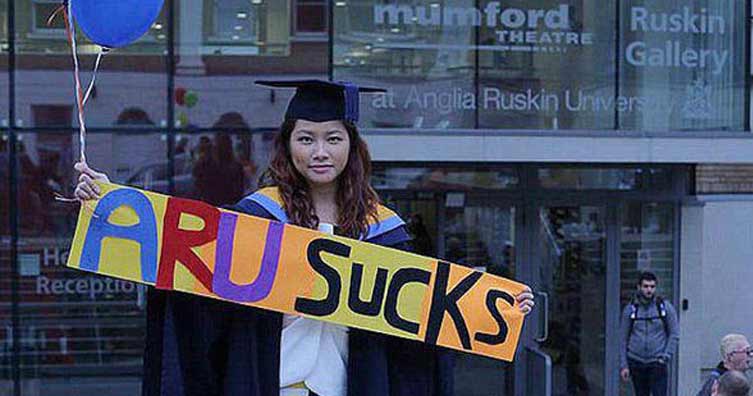
After feeling that she was let down by poor quality teaching, one graduate is taking things into her own hands and demanding a refund. She eventually won an out-of-court settlement. Click link for more on that.
According to Wikipedia ” A conspiracy theory is an explanation for an event or situation that invokes a conspiracy by sinister and powerful groups, often political in motivation, when other explanations are more probable.” There is also the theory that the term ‘conspiracy theorist’ was invented by the CIA to disparage truthers who had good reason to doubt the official version of Kennedy’s assassination, thinking it was probably an inside job. As the truth of that atrocity emerged with more and more evidence pointing to the involvement of the CIA and the US establishment, the Oswald explanation became more improbable and the court of public opinion has shifted to the evidence and disclosures of CIA and US & international establishment complicity as being more probable – thanks to the persistence of people whose noses smelled a rat right from the beginning. Because of this history with the term, those with the noses instead of being called “conspiracy theorists” should be described more as detectives or “probability analysts”.
One has to be a little suspicious whenever some establishment, corporate, or government-funded institution comes out strongly against free, independent, and public inquiry, fact compiling, analysis and synthesis based on any probable evidence, even suggesting sinister motives or sheer stupidity on the part of the people running things. Then when they call such efforts “conspiracy theory” while tacitly advocating internet censorship (which is exactly what Swami of ARU is up to), people ought to immediately know that the authorities are very worried that actual truth of the entire Covid fiasco will come out.
If for instance, some experts believed that social distancing was actually prolonging the life of the virus by preventing populations through generally light exposure to the virus to build up natural immunity in a faster and a safer way than by isolation, that knowledge or theory in any democratic and free nation should be as vital to the common good as any information backing the government theory and lockstep measures. It is by such controversy, conflict, and the free exchange of knowledge and ideas in the public square that a free society has a better chance of correcting media exaggerations and government wrongs, and to make real advancements. What Professor Swami is saying is that despite any theories or evidence challenging the official theories and “the lockstep” measures of our governments in its war on the so-called “killer virus”, they should not he heard and considered by the unwashed and ignorant public and especially on the internet or in the free press in any way. People ought not to be allowed to cast doubt on the wisdom of the government which ought to have an unfettered right to curtail social interaction and destroy countless businesses without question or public scrutiny as to the validity of any of government theories.
To know and not just to speculate what the next step in the “plan” actually is, all we have to do is check out the programs and scripts from the various government, vaccination drug industry, sponsored events and political statements over the past 10 years. The following is just a smattering:
– the 2010 Rockefeller Foundation “Scenarios for the Future of Technology and International Development”;
– the opening opening ceremony of the 2012 Olympics in London;
– the International Conference on Vaccines and Influenza – August 21-22, 2020 in Kuala
Lumpur, Malaysia;
– the October 2019 Coronavirus Pandemic Simulation at Event 201 in New York.
These are just a few examples, clearly telling us that the next step which our governments intend to impose on us in their “lockstep” is a mandatory (i.e. “forced”) flu vaccination program (Denmark style). However, none of us should be able to connect these dots, because that would be a “conspiracy theory” and some people may resist and not follow the wisdom of our corrupt, authoritarian governments who always know best.
On the theory that our governments are complicit in this matter of this plandemic, it is clear that none of them have the slightest concern about the fact that the Bill & Malinda Gates Foundation was the principal backer of Event 201 in October 2019, and had been lobbying for years not only the US government but other governments to pay for big pharma universal flu-vaccination programs. Trump has virtually agreed to such and Gates likely a key patent owner and with interests in vaccination producers like Moderna is not even investigated.
“With new grants, Gates Foundation takes an early step toward a universal flu vaccine”
By HELEN BRANSWELL @HelenBranswellAUGUST 29, 2019
https://www.statnews.com/2019/08/29/gates-foundation-grants-universal-flu-vaccine/
“Trump signs executive order to improve flu vaccines”
Filed Under: Influenza Vaccines; Pandemic Influenza; Business Preparedness, September 20, 2019
Lisa Schnirring | News Editor | CIDRAP News |
https://www.cidrap.umn.edu/news-perspective/2019/09/trump-signs-executive-order-improve-flu-vaccines
Trump: We’ve Asked Pharmaceutical Companies To ‘Accelerate’ Coronavirus Vaccine | MSNBC •Mar 2, 2020
https://www.youtube.com/watch?v=6ELRrAizW0o
“Trump is confident on coronavirus vaccine, says ‘by the end of the year’”
May 4, 2020
https://www.youtube.com/watch?v=R7m3IEMaNh4
Dear Ian
A great piece.
1. These professors are bought and paid for and doing the bidding of the control freaks.
2. None of the articles accusing others of being conspiracy theorists has any scientific and analytical credibility. Even the past editors of the Lancet and the NEJM had come out saying that at least 60% of the medical publications are misleading( inaccurate, poor methods, poor designs, fraud, small sample size, poor critical analysis by editorial boards, misusing statistics to get to their desired results, etc). How could a couple of psychologists decide on what is true or not without medical or scientific knowledge? It is one thing being forced to tow the line and it is another thing making up a paper to denegrade seekers of knowledge and truth.
3. I still believe Geroge Orwell’s phrases are still valuable and very important today as they were long time ago. There is no point creating new phrases to define the same matters just like there is no point reinventing the wheel. More phrases to define exactly the same things is neither efficient or effective and creates confusion. Less is more in this case. An unbiased analysis of facts is far more important than creating new phrases to define age-old stories.
4. I have read in various online articles that doctors have even been signing off death certificates of those that had not been tested as positive for COVID-19 as having presumably died of the virus just to over exaggerate the statistics and yet; it seems as if no one has been dying of any other diseases over the last few months. This is an example of a Miracle Happening in the Matrix; the number of people dying of all other diseases has exponentially declined ( not asymptotic though as the figures seem as though the non-covid fatality death rates are almost reaching zero deaths!) whilst there is a simultaneous exponential rise in deaths solely from covid-19. That can not be true or real.
5. Jon Rappaport writes excellent, precise and concise articles. The molecular genetic test used to identify the viral RNA is not that reliable. Dr Kerry Mulis, the inventor of PCR DNA amplification method, and the Nobel Laureate, had said that it should not have been used in diagnostics. The results are unreliable according to certain USA Health Departments which have stopped using the kits for that reason. Primers could be designed from any part of the sequence that is required to be amplified, primers could vary in length, primers could non-specifically bind various targets, labs are using different number of thermal cycles with different amounts of source DNA/RNA to amplify the source. Now, as a specialist Italian doctor I think mentioned on truthseeker, we are full of various pathogens but 99.99% do not get too ill or die from them. So what is the point of amplifying something billions of times just to prove that they have a particular strain of a virus? Having a “particular virus” does not mean a disease develops. Also, a positive PCR test does not necessarily mean we have that live virus present in our body or that a particular strain of a virus is present. Some have been tested negative with PCR and yet labs have repeated the test 30 times and may be ended up with one positive result. How could one call that patient to have the virus?
All viruses replicate so the primers and the PCR might not give positve result. But we all have a microbiome( bacteria, viruses, fungi, etc.) and the majority of us are fit and healthy because our microbiomes live within us symbiotically so what is the point of keep looking and amplifying things billions of times in a test tube which might be there but not harming us at all. Create a problem that does not exist? Storm in a teapot?
6. I do not agree that several theories could be wrong; sometimes many of those might all be valid and could explain variations in events. Biology is full of amplification cascades. Several apparently disparate molecules when added together could amplify each other’s effects hundreds or thousands of times.
7. The 5g network at 80 GHz creates resonance in outer valency electrons of oxygen which absorbs this frequncy maximally ( proven by experimenting and generating O2 absorption spectrum) resulting in those electrons not being available to form bonds with the Hemoglobin molecule within red blood cells resulting in hypoxemia and hypoxia. Patients’ lungs might still be compliant and not filled with significant inflammatory exudate and thus not suffering from Pulmonary Interstitial Oedema and yet have very low levels of oxygen in blood and tissues. A report came out recently in the BMJ that patients have been found to have very low oxygenation saturation levels and yet appear asymptomatic; i.e. show no dyspnoea ( feeling of difficulty breathing) and apparently no shortness of breath. What if 5G zaps the respiratory centre in Medulla Oblongata and takes it out; causing malfunction of oxygen-sensing neurons in the brain of sufferers who then can not feel the low oxygen levels any longer.
I know that it has been my “analytic thinking” that allowed me to conclude that the COVID-19 “pandemic” is all a fraud. One does not catch a virus to get sick. Being sick, or with flu, is the body’s way of getting rid of “disease”. Disease is just toxins in the body, which we all have to a degree.
It took me years to validate my conclusion. Trying too many modalities to mention to find relief from certain health issues and lots of research, helped me arrive at the truth.
If it wasn’t for my analytic thinking, I’d still be a sheeple!!
Excellent article. The COVID-19 narrative is fast falling apart, and the people behind it are now scrambling for a fall-back position. Their problem right now is that they are losing the info war, and even law enforcement can see that they are also the victims in this. In Canada, our Dear Leader Justin Castro – uh . . I mean Trudeau, has banned 151 so-called assault rifles on May 1st, without any Parliamentary debate. Perhaps he knows something? I just saw a newly minted T-shirt bearing the following: COVID-19: Keep the Fear Alive.
Ian ! It’s NOT ‘”Conspiracy Theories’ claim”?
But “‘Conspiracy FACTS’ claim”…