
Introduction – April 27, 2020
As parts of Europe consider slowly easing the Covid-19 lockdown there is reason for caution. As is detailed in the following article, previous pandemics have come in waves.
For example, the first wave of Spanish Flu killed approximately 3 to 5 million in 1918. Although the exact figures are still debatable, the following year a second wave killed millions more.
In other words we may not have seen the worst of coronavirus.
There is however another reason to be wary and you are unlikely to hear about it from the corporate media. Call me a conspiracy theorist but there’s good reason to suspect that coronavirus is being used to pave the way for a vaccination program.
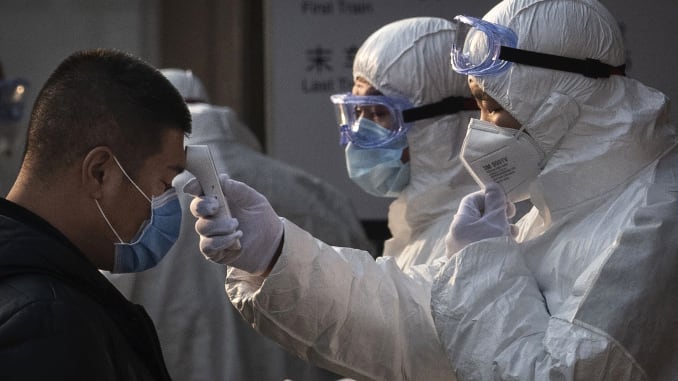
No matter that Covid-19 appears nowhere near as deadly as Spanish Flu, the corporate media is full of horror stories about the infection. While they portray the medical staff treating coronavirus as our heroes and saviours.
This is not to demean the medical staff’s efforts in any way but there’s an implicit message in much of the media coverage.
We’ve seen this before in the wall-to-wall media coverage about Saddam’s Weapons of Mass Destruction, which turned out to be nothing more than empty speculation. However, while those reports turned out to be entirely baseless they helped pave the for the 2003 Iraq invasion.
In brief it’s a problem-reaction and solution ploy. Wherein a problem is created, in the media’s coverage of Saddam’s non-existent WMD, and solution is offered in the form of the 2003 invasion of Iraq. Without the media having created the illusion of non-existent threat the Anglo-American invasion would probably never have happened
The media coverage of coronavirus is similar. To be sure Covid-19 is real enough, and deadly enough too, but like the coverage of Saddam’s WMD I suspect that there is a hidden agenda at work here. With the objective being to inflate the scale of the threat we face.
 Robert Redfield, director of the Centers for Disease Control and Prevention (CDC), and Bill Gates have both hinted at it. According to Robert Redfield we are likely to see several waves Covid-19 and the next wave will be even more deadly than the current one.
The second wave is expected to hit next year. That will be just in time, coincidently, for the large-scale roll out of Bill Gates coronavirus vaccine.
As a mentor remarked, “there is no such thing as coincidence”. So if you want to avoid the second wave of Covid-19 a solution will be on hand. Vaccination.
Those who are unwilling to be vaccinated will have only one option, however. They will either get vaccinated or they will be forced to remain in lock down, living under what is effectively house arrest.
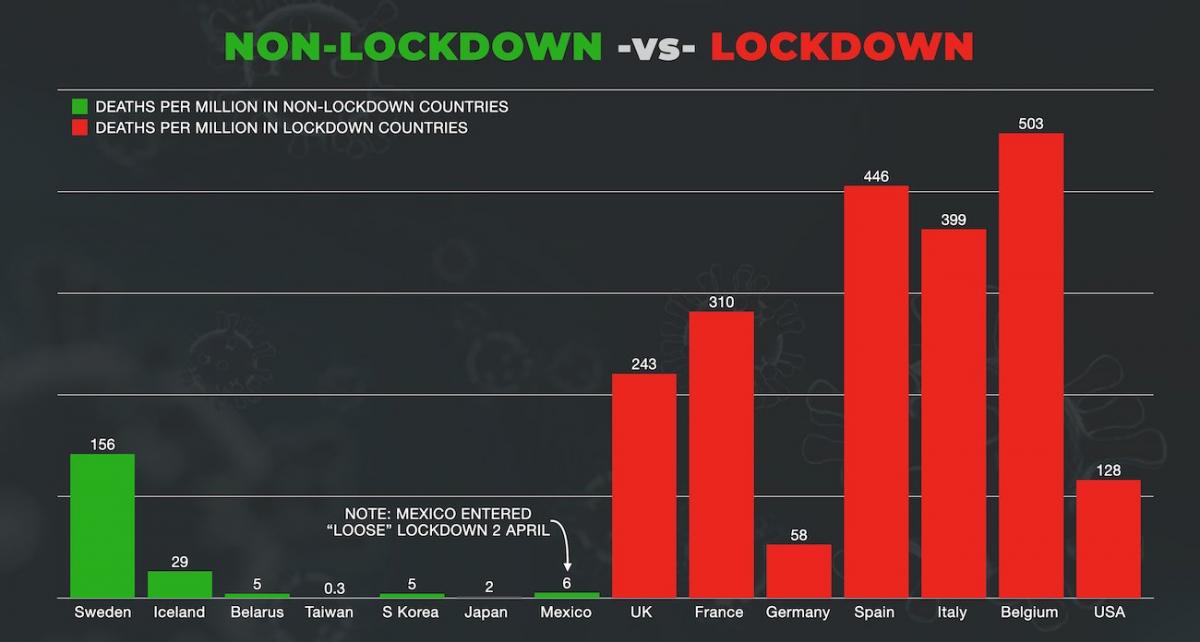
The current lockdowns may not be effective in containing Covid-19 — as the linked graphic illustrates – but they are a form of aversion therapy. So that by the time the next wave of infections arrives more will be ready to be vaccinated, if only to avoid lockdown. Ed.
Coronavirus: ‘Prepare for the second wave of COVID-19’
Darren McCaffrey – EuroNews April 27, 2020
The European country with the highest number of COVID-19-related deaths is beginning to lift its lockdown.
After seven, long and difficult weeks, Italy finally has a path forward. From next week, people will be allowed to visit their relatives in small groups.
Parks, factories and building sites will reopen.
Other countries, of course, are already in the process. From Denmark to Austria and the Czech Republic, Europeans are getting back to a sense of normality – even if it is a new kind of normal. But it’s happening in phases, one week at a time.
Many fear what the UK Prime Minister Boris Johnson talked about upon returning to work on Monday: a second wave. If the UK eases restrictions too quickly it would be “to throw away all the effort and sacrifice”. And he is right to be concerned. Throughout history, epidemics have battered us in waves.
The first recorded plague outbreak in Athens, in the 5th century BC, hit in 430BC, 429BC and 427BC to 426BC, bringing misery and death with it, year after year. The same was true of the Black Death in 14th century Europe and smallpox in the 18th century. And also, notably, the so-called Spanish Flu a century ago, which hit lots of Europe in the spring of 1918, before re-emerging later that same year and again in 1919.
Worryingly, it was that second wave in the autumn and winter of 1918 that proved more deadly in some places.
Most scientists in Europe think there will be a second wave of the novel coronavirus, most likely again in the latter half of this year. There is some evidence that the warmer summer could help dampen the spread of the virus, not least of all because people will spend more time outdoors. But if it does spike again later this year, combined with the seasonal winter flu, it could prove to be a very dangerous cocktail.
It’s why governments are easing lockdowns and suggesting that social distancing will have to be maintained for a long time yet. Most major events until the end of the summer have been cancelled or postponed, but in reality – as Oktoberfest and COP26 have proven – it is unlikely any major events will take place for the rest of the year.
There is still so much we don’t know, not least about immunity. But it is clear that even if you do build up sufficient immunity from infection, in most places we have not seen the rates of infection that would lead to overall or “herd immunity”. And, as I noted last week, we are also probably a long way off a vaccine.
So, even as those lockdowns ease, it does not mean a push to get through a crowded bar to enjoy your favourite drink, cheering on your team with your mates in a sold-out stadium or a dance with a random stranger in a summer festival field.
Fears over a second wave, a second spike in deaths, will mean getting used to a very different type of normal, the new normal, in 2020.
Darren McCaffrey is Euronews’ political editor.
This video also supports some of the thoughts mentioned in the Introduction, But has a slightly different slant to it. Interesting never the less.
https://www.richplanet.net/richp_genre.php?ref=282&part=1&gen=99
So Covid – 19 is real and deadly. Yet it is a scientific fact that no one has ever isolated a coronavirus, let alone Covid, using Koch’s postulates. The Chinese believe it’s a bioweapon, so does Iran and I bet many other countries think the same but remain silent.
Both the US and UK governments have tried to enforce medical staff vaccinations in the past. There was a massive rejection of this enforced medication. Will the sheeple accept a vaccine that has not been properly tested, contains bits of animals & humans? Then we have the case of legal immunity given to big pharma and their associates.
When wave two arrives, the NHS better has all the PPE under the Sun, because they’ll have mass walkouts. Any vaccine ready in 18 months, what will its efficacy be? If it’s very effective, then we’ll know it was made before Covid’s release, which should raise a few eyebrows. Let’s see if there’s a dramatic rise in properties on the market after lockdown. I mean, lots of people have died, so this could be the best indicator of real covid death and don’t forget, many patients will have permanent lung, heart and organ damage. The first official US Covid victim was a woman who’s heart valve exploded… a virus that so says attacks the lungs. The introduction looks like it was written by someone at the BBC.
I was walking along a path this morning and walked past a lady, probably in her 50s if not 60s, who was waiting in a bus shelter. She moved back very quickly into the corner of the shelter as I walked by and said something I did not clearly hear, but she definitely did say “I won’t warn you again. ” She obviously thought I was too close to her. . Her fear was VERY evident. . It is this sort of fear which will make people gladly line up for Gate’s vaccination (and probably a microchip).
Hi-ho, hi-ho, into our Smart-Prisons we will gladly go. !
The more one ponders the TS posting today “Olympic Opening Ceremony 2012 NHS” seeing such an “international” performance put on by globalist insiders, the more one should wonder about the cooperation of all the leading nations in this most obvious psyop. You shut down the economy to life support which is happening right now, with the masses increasingly dependent on the government, and you have the people literally eating out of your hand.
My hunch from first watching the video footage back in January or February from the Chinese media from Wuhan, was that it was a poorly-executed, government-orchestrated, clown-show of hype. Communist regimes have generally been rather awkward in their propaganda efforts. Then when the actual risk group or segment of the population from the virus became known, that very Chinese media footage with younger people keeling over on camera in the streets, crowds being pushed into buildings and doors locked from the outside, and absurd comments by people dressed in scrubs and wearing masks in an ER which looked like a war zone, then at least to my mind, the Chinese were acting out their role in the psyop, and that became the smoking gun going back to the first shot.
The TS posting of the 2012 Olympic opening ceremony brings the international cooperation aspect more into perspective. Right now in order to continue with the psyop show they have to prolong the lockdowns. Therefore, the second wave will be hyped as was predicted by many of us a few weeks ago, just as we predicted that because of the “clearly identified” risk segment from the initial studies being those with serious pre-morbid conditions or else the elderly at deaths door, that they would try to augment that weakness in their propaganda, and they immediately, on queque, did just that.
We saw last week the Brit spoksperson exhibiting the photo of the fictitious healthy 13-year-old victim, named Ishmael, which same photos were used in the psop network in numerous other nations by the media and the government hacks as a young previously victim in their nations, but of course having a different name.
Following postings on this and other sites, those at the top of the cabal, or whatever and whomever is calling the shots, they are presently in an operation to obtain more, or virtually complete, control of the masses, socially, physically, and financially. Our political leaders, and all of them, are merely puppets in the performance.
If the perpetrators and accomplices of this psyop can pull this off without being brought to justice then we have no justice and we truly are slaves. However, the same establishment or central organization which is likely behind the power grabs to further subjugate, manipulate and control the common people is no doubt in complete control of our justice systems. Hence, we are likely to see absolutely no redress in that direction.
Resistance to evil can take different forms. The first is exposure of what is really going on as well as the actual central perpetrators. My view is that if we are truly fighting the forces of darkness which appear to be running the world right now, then we have to go directly to God.
In my own faith my religious leadership has been completely co-opted or neutralized from seeing the truth or doing anything about it in this matter. The leaders seem to be in some kind of blind subservience to this new-world-order nonsense being crammed down our throats. They are unfortunately all followers, who are afraid and cannot for various reasons, even oppose the establishment regarding the many unjust wars in our midst, and which we perpetrate for material gain. They are silent regarding all of the government corruption in virtually every Western nation, likely because of their own corruption, by which they are being held in check.
I have a hard time praying for the victims of the virus as our religious leaders dutifully direct us, and quite franking have more sentiment for the many more who are dying from TB or other far more lethal diseases, and many of the elderly whom our governments seem to be more interested in assisting their deaths than their lives. In fact it makes me rather nauseated to think that our prelates are so easily duped or that the Church hierarchy may actually be part of the psyop.
Yet, none of failings of the prelates, or one’s religious leaders, should deter anyone from doing the right thing and using all of the tools given to them in their religion, such as prayer, to go directly to God, turning the problem over to Him, and perhaps through His heavenly servants, to start sorting things out, and to guide us into effective action. We also have to remember that in the West, all of the rights and freedoms of the common people are hard won. They have come both from converting people in power to a higher power or order of benefice, and very often through a great deal of struggle and sacrifice.
Fred B: “Let’s resist by sitting on our butts reading and idle talking online, praying and good vibrations.”
Hope you get your Darwin Award.
Fred B you are correct. This requires true spiritual warfare which most western churches are incapable of waging anymore. You’re right it has been that way by design because of infiltration at high levels by satanic interests, the same ones who are putting out these psy-ops like the Olympic ceremony. Jack:. Darwin was an elite eugenicist and his bogus theory was taught to everyone for the last 40+ years because it robs people of the truth, that we were divinely designed by God. For what it’s worth, the firmament is also real, but you will only see the truth if you are not a troll and you’re open to it!! The idea that we are hopeful monsters resulting from random mutation is ludicrous (not to mention mathematically impossible). However it is a powerful soul-crushing lie that alienates us from our Creator, makes us hate our fellow humans, and feel that life is meaningless (which is exactly why it’s promoted). If you look carefully at all of the symbolism that is promoted by this satanic elite global cult, it becomes obvious that this is a spiritual war not a material one.
* To be sure Covid-19 is real enough, and deadly enough too’
How can this author be so informed and so un-informed at the same time?
“prepare for the second wave of covid bullshit” more like. The media have successfully engineered a “mass psychosis” with an undoubtedly huge increase in suicides and those dieing due to suspended operations and treatments. Big Pharma will make massive profits from meds and vaccines from this politically initiated HOAX based on quack pseudo-science.
john seaton: because the author has a multitude of writing styles and levels. He used to write engaging copy. These days he has a ghost writer or worse.